

A project can have a compelling rationale and still lack a clear mandate. To understand what a project charter is and why it is important, start with its central role: it formally authorizes a project, defines its purpose and boundaries, and gives the project manager authority to coordinate organizational resources. It also records the people involved and the decisions that will guide the work.
That foundation matters because a promising idea alone is not enough to guide sound project decisions. A charter gives sponsors, managers, and stakeholders a shared reference for objectives, expected benefits, responsibilities, assumptions, and key risks. This helps clarify what success means before execution begins.
This article explains what a charter typically contains, how it differs from project scope and the management plan, and how its level of detail can reflect a project’s complexity. You’ll also see how a well-framed charter supports alignment, accountability, and disciplined decisions as circumstances change.
Key Takeaways
- Use the charter to establish a project’s mandate, intended outcomes, decision authority, and key responsibilities before execution begins.
- Keep the charter at a high level, then use the scope and management plan to define deliverables and the work needed to produce them.
- Record assumptions, risks, and success measures early so stakeholders can align expectations and assess decisions against a shared basis.
- Scale the charter’s detail to the project’s complexity, while securing sponsor and stakeholder agreement before work moves forward.
What is a project charter?
Understanding what a project charter is and why it is important starts with its function: it authorizes a project and sets its direction. It connects the business case to objectives, milestones, participants, and the decisions needed before execution.
Charter Definition and Purpose
A charter records why a project exists, what it aims to achieve, and how success will be assessed. It gives sponsors and stakeholders a common basis for authorizing work and guiding detailed planning.
Effective examples make intended results specific and observable. The Centers for Medicare & Medicaid Services (CMS) worksheet example sets a goal to reduce position-change-alarm use on a unit by 25% by a specified date. The U.S. Environmental Protection Agency example states that the team will produce deliverables for its community.
To understand what a project charter is and why it is important in practice, consider how a template organizes the business case, objectives, assumptions, constraints, risks, and success criteria. Sponsors and stakeholders can then assess whether the stated purpose merits authorization.
Authority, Roles, and Responsibilities
Authorization establishes the project manager’s authority to coordinate organizational resources for project activities. The sponsor provides the mandate and support, while the charter identifies the manager, team members, and stakeholders whose decisions or contributions shape delivery.
Clear role definitions show who approves decisions, who performs the work, and who receives updates. For example, a charter can name the sponsor as the escalation point and assign the project manager responsibility for coordinating milestones and reporting progress.
This clarity matters when competing priorities arise. Team members can act within an understood mandate, while stakeholders know where to raise concerns or approve changes. Agreeing on responsibilities before work begins helps prevent informal requests from becoming unauthorized commitments.
Scope Definition and Validation
The charter defines scope at a high level by stating intended outcomes, boundaries, and exclusions. It establishes what the project will address, leaving detailed requirements and task breakdowns to later planning.
Validation comes through discussion and agreement between the sponsor and key stakeholders. They consider whether proposed outcomes support the business case, whether assumptions are credible, and whether constraints are acknowledged. For example, a project to improve an operational process should specify the process area and intended result, rather than imply a wider redesign.
Once agreed, these boundaries provide a reference for evaluating requests and emerging milestones. If a proposed deliverable falls outside the stated purpose, stakeholders can assess its implications before expanding the work. The charter gives scope decisions an explicit basis instead of leaving them to differing expectations.
Project charter compared with project scope and the project management plan
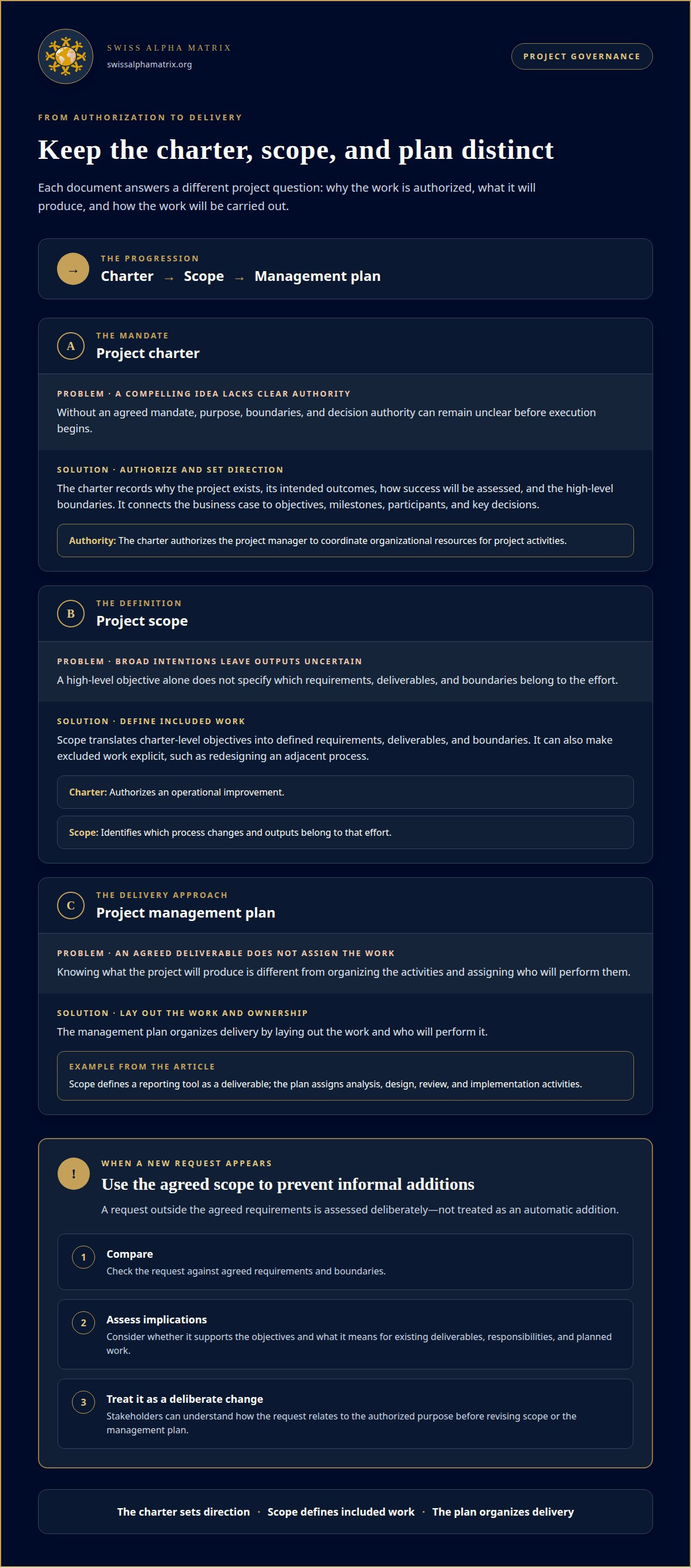
The charter, scope, and management plan serve different decision-making purposes. Understanding their boundaries helps stakeholders assess requests clearly and maintain alignment from authorization through delivery.
Objectives, Deliverables, and Boundaries
Project scope translates charter-level objectives into defined requirements, deliverables, and boundaries. If a charter authorizes an operational improvement, the scope identifies which process changes and outputs belong to the effort.
This distinction matters because project management decisions depend on agreed requirements, not broad intentions. Detailed scope can specify deliverable characteristics and excluded work, such as redesigning an adjacent process. Stakeholders can then assess whether proposed work supports approved objectives or changes expectations.
The charter remains the high-level mandate; scope gives a more detailed account of what the project will produce. A project management plan goes further, laying out the work and who will perform it. For example, scope may define a reporting tool as a deliverable, while the plan assigns analysis, design, review, and implementation activities.
Preventing Scope Creep
Defined scope helps prevent scope creep by making the project’s limits visible when new requests arise. A stakeholder proposing an additional report, process, or deliverable can compare it with the agreed requirements and boundaries.
If a request falls outside scope, the team can assess its implications before accepting it. That assessment considers whether the change supports the objectives and what it means for existing deliverables, responsibilities, and planned work. The request can then be treated as a deliberate change rather than an informal addition.
This discipline protects the project’s original expectations without treating every adjustment as inappropriate. A new requirement may be justified, but stakeholders should understand how it relates to the authorized purpose before revising scope or the management plan. Clear distinctions also help explain decisions: the charter sets direction, scope defines included work, and the plan organizes delivery.
Benefits of a comprehensive charter
A comprehensive charter connects project objectives to expected benefits, resources, risks, and measures of success. Without approved direction, team members may commit budget and effort before stakeholders agree on priorities or authority.
Objectives and Project Benefits
A charter states the outcomes a project seeks and the benefits they are intended to deliver. This connection helps key stakeholders judge whether the project plan supports organizational priorities.
For example, an objective to improve an operational process should identify the expected benefit and how progress will be assessed. Team members can then connect milestones to outcomes, rather than treating completed tasks as proof of value.
Recording assumptions, resource needs, and potential risks adds useful context to objectives. If a project depends on access to particular data, documenting that assumption helps stakeholders consider its effect on delivery and benefits.
Risks of Starting Without Approval
Starting without an approved charter leaves the project’s mandate, decision authority, and stakeholder expectations unresolved. Without a clear charter, team members may lack a shared understanding of responsibilities and intended outcomes.
That uncertainty can direct budget and effort toward work that lacks sponsorship or does not support organizational priorities. It can also complicate later decisions: without agreed success criteria, stakeholders may disagree about whether deliverables meet expectations or proposed changes belong in the project.
Approval provides a considered basis for proceeding. Before execution, the sponsor and key stakeholders can review the business case, expected benefits, resource requirements, and principal risks together. If the rationale or responsibilities remain unclear, they can resolve those issues before the project plan guides further commitments.
Throughout delivery, the charter remains a reference for accountability. Comparing reported progress with its objectives and success measures helps stakeholders identify concerns and consider whether assumptions still hold. A comprehensive charter therefore supports initial authorization and disciplined oversight without replacing the project plan or ongoing risk review.
Charters for projects of different sizes and delivery approaches
A project charter should match the scale and decision demands of the work. For a very simple project, the chartering phase may take a single afternoon; a cross-functional initiative needs broader stakeholder input to align expectations and authority.
The format can stay concise while its emphasis varies. A small internal process change may need a clear purpose, owner, outcome, and approval route. A complex programme may require more explicit assumptions, dependencies, risks, resources, and escalation paths. In either case, the charter gives the project team a reference suited to the decisions it must make.
Preparation is collaborative. A project sponsor or project manager typically prepares the charter, with the manager often drafting it using input from the sponsor and involved stakeholders. Together, they define the business need, intended outcomes, responsibilities, and key constraints. For an initiative using iterative delivery, the charter can set the overall objective and governance while detailed work is refined during execution.
Approval gives that shared direction formal standing. The project sponsor typically signs off, and key stakeholders should agree to the charter before work proceeds. The sponsor helps align the initiative with organizational goals and provides the authority and resources needed to proceed. Approval signals that the project has a mandate, not merely an informal request.
After approval, keep the charter available as a reference during execution. If major details such as scope, timeline, or budget change, review and update it so stakeholders retain a common basis for decisions. For complex initiatives requiring coordinated oversight, explore complex project management support.
Swiss Alpha Matrix: Complex Project Management
Swiss Alpha Matrix provides Complex Project Management for financial and investment programmes where coordinated oversight, clear accountability, and disciplined execution are central to delivery. This support is relevant when a project involves multiple stakeholders, interdependent workstreams, or decisions that require careful management of risk and resources.
Where a programme also requires independent examination of financial instruments or operational conditions, Audit-Grade Instrument Validation and On-Ground Verification Services address those needs. Operational Due Diligence helps assess operational considerations that inform project decisions. Together, these services help stakeholders build a clearer view of the work and its execution requirements.
If your project requires structured oversight or verification, contact Swiss Alpha Matrix to discuss the work.
Make the charter part of your decision discipline
Understanding what a project charter is and why it is important becomes more valuable when leaders treat it as an active governance instrument, not an initiation form filed away after approval. As decisions accumulate, use the charter’s mandate to frame discussions, distinguish strategic changes from operational adjustments, and connect accountability to the project’s intended purpose.
The next step is to consider whether your project has the oversight and verification its complexity requires. Swiss Alpha Matrix’s work in Complex Project Management, Audit-Grade Instrument Validation, and On-Ground Verification Services can support programmes where coordinated execution and dependable information matter to decision-makers.
Contact Swiss Alpha Matrix to discuss your project and consider how structured support can serve its objectives. A clear mandate, applied consistently, gives teams a considered basis for moving forward.
Frequently Asked Questions
What is a project charter in project management?
A project charter is the authorization document that establishes a project’s mandate and the project manager’s authority to coordinate organizational resources. In practical terms, it distinguishes approved work from an idea that has not received sponsorship. For example, a proposed system change becomes an authorized project when its sponsor approves the charter and assigns responsibility for moving it forward.
What information should a project charter include?
A useful charter identifies the business need, intended outcomes, high-level scope, sponsor, project manager, key stakeholders, required resources, assumptions, constraints, risks, and measures of success. It can also record a summary schedule and communication or decision pathways. For a technology initiative, naming the affected system and the teams involved helps clarify the proposal before detailed requirements are developed.
What is the purpose of a project charter?
Its purpose is to provide a formal basis for deciding whether a project should proceed and how it will be governed. The charter connects the business rationale to an accountable sponsor and manager, giving stakeholders a shared point of reference. If priorities compete, that documented mandate helps decision-makers assess whether a proposed action still serves the project’s approved purpose.
Why is a project charter important to project success?
A charter supports success by establishing an agreed basis for accountability before resources are committed. Without that foundation, a team may interpret a desired outcome differently from its sponsor, making progress difficult to assess. Clear success measures help stakeholders distinguish completed activity from achieved benefits, while documented assumptions make it easier to recognize when changing conditions could affect delivery.
Who creates and approves a project charter?
A project sponsor or project manager usually prepares the charter, with the manager often drafting it alongside the sponsor and other stakeholders. The sponsor typically approves it, while key stakeholders agree on its elements before work proceeds. In a cross-functional initiative, representatives responsible for affected operations can clarify dependencies and decision responsibilities before the sponsor authorizes the project.
When should a project charter be written and approved?
Write and approve the charter during initiation, before execution begins and before the team commits to substantial project work. Early agreement lets the sponsor settle the mandate and authority while plans remain open to adjustment. If major project details later change, such as scope, timeline, or budget, review the charter so it continues to reflect the project’s direction.