

What if the guarantee presented as protection has never been authenticated by the bank named on its first page? Understanding what is a bank guarantee and how to verify it means looking beyond its appearance to the bank’s undertaking, the conditions for making a demand, and independent evidence that the instrument is genuine.
A bank guarantee can provide meaningful assurance, but its practical value depends on precise terms and a workable claim process. Expiry dates, documentary requirements, governing rules, and the identity of the parties all affect what the beneficiary can do if the underlying obligation isn’t met. In a cross-border transaction, limited visibility into the issuer or the route by which the instrument was transmitted makes disciplined checks especially important.
This guide explains the parties and obligations involved, the provisions to review, and a practical sequence for verifying authenticity. It covers direct confirmation through independently sourced bank channels and authenticated inter-bank communication, as well as how to keep an evidence trail. It also explains when audit-grade instrument validation, on-ground verification, and broader due diligence can help decision-makers assess whether an instrument is genuine and whether its terms work for the transaction.
Key Takeaways
- To understand what is a bank guarantee and how to verify it, distinguish the bank’s undertaking from the applicant’s underlying commercial obligation.
- Assess whether the beneficiary, amount, expiry, demand wording, required documents, and presentation instructions make the guarantee workable in practice.
- Document inspection can identify inconsistencies, but independent issuer authentication provides evidence that appearance alone cannot establish.
- Use a controlled verification record to preserve the source document, authentication communications, reference details, and reviewer findings.
- Consider independent instrument validation and on-ground checks when cross-border complexity, issuer uncertainty, or transaction exposure calls for evidence beyond internal review.
What Is a Bank Guarantee, and What Does It Actually Promise?
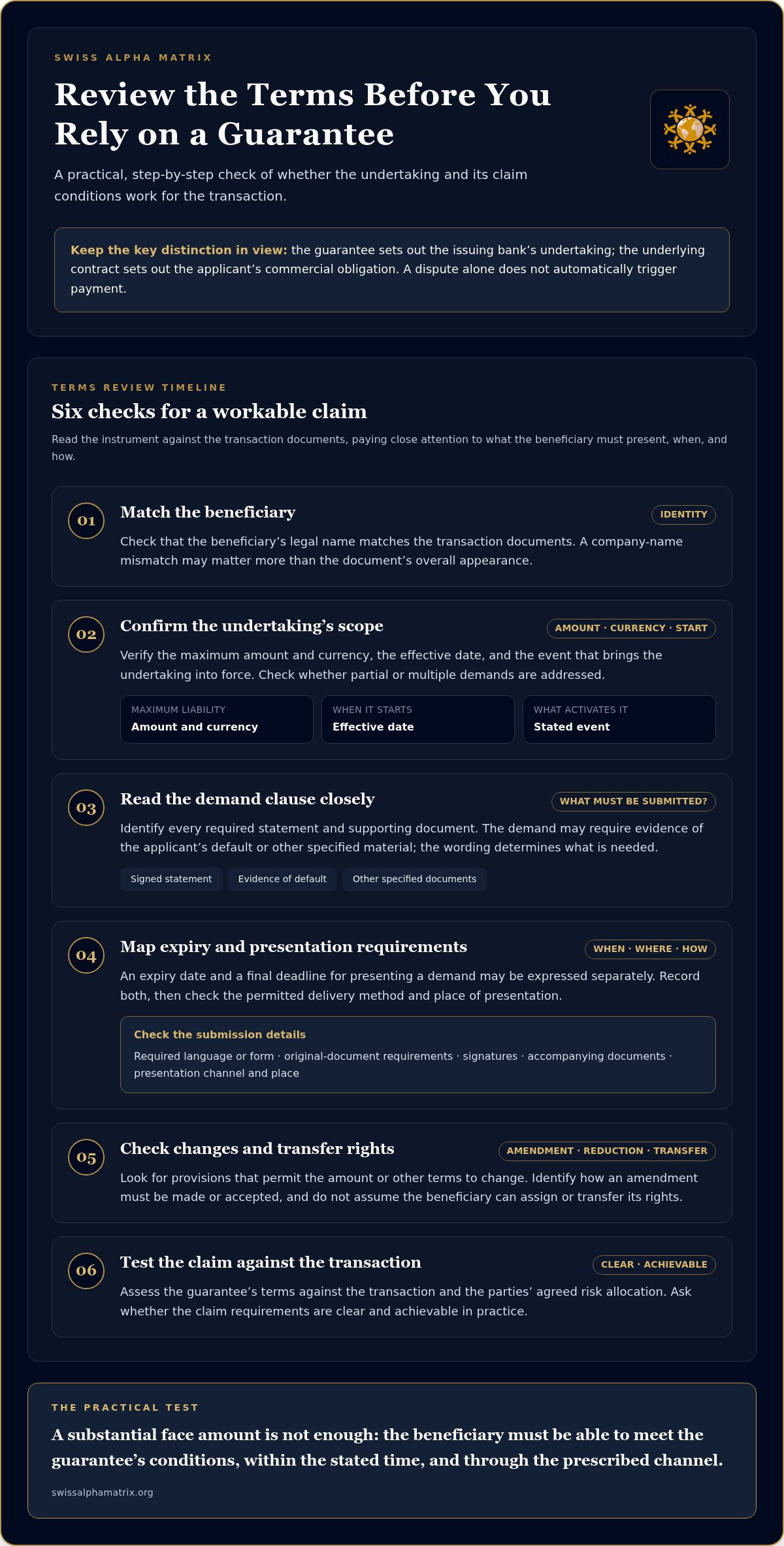
A bank guarantee is a bank’s undertaking to pay a beneficiary up to a specified amount if the applicant fails to meet an obligation and the beneficiary makes a demand that satisfies the guarantee’s requirements. It is separate from the underlying commercial contract: that contract sets out what the applicant owes, while the guarantee establishes a commitment by the issuing bank subject to its own terms. For anyone asking what is a bank guarantee and how to verify it, this distinction is fundamental. The document’s presence alone doesn’t establish when payment is due.
A disagreement between buyer and seller, contractor and employer, or borrower and lender doesn’t automatically trigger payment. The bank assesses the demand against the instrument’s conditions, which may specify particular statements, documents, deadlines, or presentation methods. A guarantee’s practical value depends on its wording and claim conditions. The Bank Guarantee on Wikipedia provides further background on the instrument’s use in trade and project finance.
How the parties and undertaking fit together
The applicant asks a bank to issue the guarantee, usually to support an obligation under a separate contract. The beneficiary receives the protection and may present a demand if the stated conditions are met. The issuing bank gives the undertaking. An advising bank may transmit or advise the instrument, but its role is not the same as that of the issuer responsible for the undertaking to pay.
- Applicant: The bank’s customer whose contractual performance or payment is supported.
- Beneficiary: The party named in the guarantee and entitled to present a compliant demand.
- Issuing bank: The bank responsible for the undertaking expressed in the instrument.
- Advising or counter-guarantee bank: An advising bank may relay the guarantee; in some structures, a counter-guarantee bank separately supports an undertaking issued by another bank.
Even if the applicant disputes the underlying claim, the issuing bank’s obligations are determined by the guarantee’s wording, governing law, and applicable rules, not simply by the parties’ account of the commercial dispute.
Demand guarantees, conditional guarantees, and related instruments
An on-demand guarantee generally requires the beneficiary to submit a demand that complies with the instrument, sometimes accompanied by a specified statement or documents. A conditional guarantee may require additional evidence or satisfaction of stated conditions before payment. Neither structure is universally preferable. Assess the terms against the transaction, the parties’ agreed risk allocation, and whether the claim requirements are clear and achievable.
A standby letter of credit can serve a similar security function, but it is a distinct instrument and may follow different rules or drafting conventions. The label alone doesn’t settle the analysis. The text, governing law, and any incorporated rules determine the instrument’s effect. For example, URDG 758 applies where the guarantee expressly incorporates those rules. Review both the undertaking and the steps required to make a valid demand.
Which Guarantee Terms Determine Whether It Can Be Used?
A guarantee’s face amount can appear substantial while its claim conditions make recovery difficult in practice. Start by matching the beneficiary’s legal name to the transaction documents. Then confirm the amount and currency, the effective date, and the event that brings the undertaking into force. A mismatch in a company name, or a guarantee that becomes effective only after a specified event, may matter more than the document’s overall appearance.
A guarantee’s claim conditions matter as much as its face amount: the beneficiary must be able to satisfy them correctly, within the stated time and through the prescribed channel. Read the demand clause closely. Does it require a signed statement, evidence of the applicant’s default, or other supporting documents? Must the demand be in a particular language or form, or submitted as an original? Each requirement can affect whether a claim meets the instrument’s terms.
- Amount and currency: Check the maximum liability and whether partial or multiple demands are addressed.
- Effective date and expiry: Confirm when the undertaking starts and when the right to present a demand ends.
- Amendment and reduction: Look for provisions that permit the amount or other terms to change, and identify how an amendment must be made or accepted.
- Transfer: Don’t assume the beneficiary can assign or transfer its rights. The instrument must address whether and how this is permitted.
Expiry, claim deadlines, and presentation requirements
An expiry date and a final deadline for presenting a demand may be expressed separately, so identify both rather than treating them as interchangeable. Record the permitted delivery method and place of presentation, along with any requirements for signatures, originals, or accompanying documents. If the instrument gives inconsistent dates, unclear time zones, or conflicting submission instructions, flag the ambiguity for transaction-specific legal review before relying on the guarantee.
Turn these clauses into a claim checklist: what must be prepared, who must sign, where it must be delivered, and by what date. A demand sent to the wrong address or after the applicable deadline may fail to meet the instrument’s requirements, regardless of the underlying dispute.
Applicable rules and governing law
Check whether the text expressly incorporates the Uniform Rules for Demand Guarantees (URDG 758) or identifies another set of rules, and note the stated governing law and jurisdiction. Read any reference to rules in context: confirm its wording, scope, and interaction with the instrument’s specific provisions. Neither a URDG 758 reference nor a governing-law clause authenticates the document or assures payment. Those questions require separate assessment.
For a disciplined review of what is a bank guarantee and how to verify it, record each material term and any unresolved discrepancy, then compare them with the transaction documents. Audit-grade instrument validation from Swiss Alpha Matrix adds structured, independent analysis to internal review, particularly when cross-border terms or claim mechanics require careful scrutiny.
How Do the Main Bank Guarantee Verification Methods Compare?
Verification is strongest when its methods are treated as complementary rather than interchangeable. Reviewing a document can expose inconsistencies. Issuer authentication can establish whether the bank recognizes the instrument. Transaction-level checks can test whether the guarantee fits the parties and commercial context. No single method, on its own, proves every element of authenticity, enforceability, or the applicant’s capacity to perform.
The distinction matters when considering what is a bank guarantee and how to verify it: evidence that a document looks credible is not the same as confirmation from the bank that supposedly issued it. Screenshots, forwarded emails, and standalone copies of message text can be altered, detached from their transmission context, or impossible to authenticate independently. Treat them as leads for further review, not conclusive proof.
| Method | Evidence sought | Limitation | Appropriate use |
|---|---|---|---|
| Document inspection | Consistency of names, dates, amounts, wording, signatures, references, and formatting within the supplied instrument. | Cannot establish that the issuer created or recognizes the document, or that the underlying transaction is genuine. | Initial screening and identifying discrepancies for follow-up. |
| Direct issuer authentication | Confirmation through an independently sourced official bank channel or authenticated bank-to-bank communication that the instrument and key details are recognized. | Confirms what the issuer verifies through that channel, not necessarily the applicant’s performance capacity or wider transaction legitimacy. | Establishing whether the named bank acknowledges the undertaking and its stated particulars. |
| Independent transaction-level verification | Coherence among the instrument, counterparties, transaction records, and supporting evidence. | Cannot replace issuer authentication or determine legal effect without analysis of the text and applicable rules. | Assessing whether the instrument has a credible role in the broader transaction. |
Authenticating the issuing bank and communication channel
Use contact information obtained independently from an official bank source, not solely the telephone number, email address, or website printed on the guarantee or supplied by the counterparty. Where appropriate, authentication should proceed through the beneficiary’s bank and an authenticated bank-to-bank channel. SWIFT MT 760 is commonly associated with guarantee issuance or advice, but a copied message reference or screenshot is not proof of an authenticated transmission. Confirm the applicable process with the banks involved and authoritative SWIFT guidance.
Checking the issuer, transaction, and supporting evidence
Validate the issuer’s identity and stated role against reliable records, then reconcile the guarantee’s parties, dates, amount, currency, and references with relevant transaction documents. Look for unexplained differences, inconsistent chronology, or an issuer that cannot be tied to the stated arrangement. These checks help assess coherence, but they are not proof of payment or a legal conclusion.
A genuine instrument and a sound transaction are separate findings. Independent, audit-grade instrument validation can document instrument-level evidence, while broader operational due diligence considers counterparties and transaction context. Keeping those conclusions distinct gives decision-makers a more precise basis for further review.
How to Verify a Bank Guarantee: A Step-by-Step Due-Diligence Process
A dependable review is a controlled sequence, not a visual inspection followed by an assumption. For anyone asking what is a bank guarantee and how to verify it, the objective is to establish where the instrument came from, what it says, whether the issuing bank recognizes it, and how its details fit the transaction. Each step should leave an evidence trail that another reviewer can follow.
The verification sequence from receipt to conclusion
Work through the checks in order, preserving the source material and recording the basis for each finding.
- Log receipt. Record when the guarantee arrived, who supplied it, the delivery channel, and the file format. Preserve the original attachment or document separately from working copies.
- Review the instrument. Identify the applicant, beneficiary, issuer, undertaking, amount, currency, effective date, expiry, demand conditions, presentation instructions, and any incorporated rules.
- Check internal consistency. Compare names, dates, signatures, references, and other identifying details across the document. Note alterations, missing pages, conflicting clauses, or unexplained formatting differences.
- Reconcile transaction records. Compare the instrument with relevant contracts, correspondence, and transaction records. Confirm that the parties, purpose, amount, and chronology align, and record any difference rather than silently resolving it.
- Authenticate independently. Use contact information sourced independently from the named bank or an authenticated bank-to-bank channel. Record the channel used, the bank’s response, relevant reference identifiers, and which particulars were confirmed.
- Document the conclusion. Separate confirmed facts from unresolved questions, identify the evidence supporting each finding, and record reviewer decisions, review dates, and any required escalation.
Pause the process if material details conflict, the person or channel responding cannot be linked reliably to the issuer, or the bank’s authority in the transaction is unclear. A polished document or reassuring intermediary explanation does not resolve those gaps. Escalate before committing capital or treating the guarantee as available security.
Evidence handling and escalation in cross-border transactions
Maintain a controlled file containing the source document, working copies, communications, timestamps, reference numbers, and review notes. Restrict access to people with a defined role, use secure information-sharing practices appropriate to confidential transaction material, and retain a clear record of versions so later changes can be identified. For cross-border matters, document the origin and time zone of communications where relevant, and distinguish a bank-confirmed fact from information relayed by another party.
Escalate unresolved inconsistencies for specialist financial and legal assessment, particularly where the instrument’s wording, governing law, or applicable rules affect its interpretation. Swiss Alpha Matrix provides independent validation to structure and document instrument-level findings as a supplement to internal review, alongside broader operational due diligence on the transaction and counterparties. No sequence of checks can guarantee payment or eliminate transaction risk; each reduces uncertainty within a defined scope.
For a documented, independent review of a consequential instrument, request audit-grade instrument validation tailored to the transaction’s evidence and risk profile.
When Does Independent Bank Guarantee Validation Add Value?
Independent review is most useful when a decision depends on evidence that internal document checks alone cannot establish. A high-value exposure, a cross-border transaction with limited visibility into the issuer, inconsistencies in the instrument, or a compressed decision timetable may justify a separate, structured assessment. Tight timelines are a reason to clarify scope and escalation routes early, not to treat incomplete checks as confirmation.
For decision-makers assessing what is a bank guarantee and how to verify it, specialist validation can provide an evidence-based view of the instrument and its relationship to the transaction. It is distinct from legal representation, which concerns legal advice or advocacy; from bank issuance, which is undertaken by the issuing bank; and from a promise that payment will occur. A review can identify verified facts, exceptions, and unresolved questions, but it can’t change the instrument’s terms or ensure a successful claim.
What an independent review can establish
Audit-grade instrument validation examines the document and available authentication evidence, then records what was checked, what could be established, and where uncertainty remains. In cross-border work, on-ground verification can complement document and issuer checks by testing relevant operational or transaction details. Operational due diligence places those findings in context, helping distinguish an instrument-level concern from a broader counterparty or transaction risk.
The review’s value lies in a clear evidentiary boundary. It may confirm that identified details match the evidence examined, while leaving questions of legal effect to the instrument’s text, governing law, and applicable rules. For further context on scope and methodology, consult this bank instrument validation services guide.
From verification findings to a controlled decision
Translate findings into an executive record that separates confirmed facts from exceptions and open issues. It should identify the evidence relied upon, the limits of the review, the material risks, and any further assessment needed before a decision. This creates a more disciplined basis for proceeding, seeking clarification through appropriate channels, or pausing while a material discrepancy remains unresolved.
Where concerns extend beyond the guarantee itself, broader analysis can consider counterparty capacity, operational dependencies, and the coherence of the cross-border transaction. A structured investment due diligence framework connects those wider factors to instrument-level findings without conflating them. The result is not certainty, but a more transparent account of what is known, what remains uncertain, and how those distinctions inform the decision.
For an independent assessment tailored to the instrument and transaction, Explore independent instrument validation.
Make the Next Decision with Greater Clarity
The question of what is a bank guarantee and how to verify it points to a broader discipline: make consequential commitments only after assessing the available evidence with care. Treat verification findings as part of the decision record so stakeholders can distinguish established facts from unresolved exposure and determine what further scrutiny is warranted before proceeding.
Swiss Alpha Matrix provides audit-grade instrument validation, executive-level risk assessment, and on-ground verification for complex cross-border transactions. Its leadership’s experience in senior roles at Tier-1 global banks informs a measured approach to evidence, discretion, and transaction risk. The purpose is not to promise an outcome, but to help decision-makers proceed with a clearer view of the instrument and its context.
Explore independent bank instrument validation and take a more considered next step with confidence.
Frequently Asked Questions
Is a bank guarantee the same as a letter of credit?
No. A bank guarantee and a letter of credit are distinct instruments, even though both can support commercial transactions. A documentary letter of credit is generally designed to pay a seller when specified documents meet its terms, while a guarantee commonly supports performance or payment obligations if the applicant fails to meet them. A standby letter of credit may serve a similar security function to a guarantee, so the instrument’s wording and applicable rules matter.
Can a bank guarantee be verified using a SWIFT message copy?
No. A copy, screenshot, or message reference on its own doesn’t establish that a bank authenticated or sent the communication. Verification should follow the relevant banks’ authorized procedures, with the receiving bank confirming what it can authenticate in its own systems. If a counterparty provides a message copy, treat it as a reference for follow-up, not as conclusive evidence of issuance or of the issuer’s current recognition of the instrument.
What happens if the beneficiary submits a demand after expiry?
A demand presented after the applicable deadline may be rejected as late, even if the applicant’s underlying obligation remains disputed or unpaid. The outcome depends on the guarantee’s precise expiry and presentation provisions, any applicable rules, and the relevant legal context. For example, a clause may specify a final date, location, or delivery channel. If expiry is approaching, the beneficiary should promptly obtain advice on the instrument and available steps rather than assume a late demand will be accepted.
Can a bank guarantee be cancelled or amended before it expires?
It depends on the instrument’s terms and applicable rules. Some guarantees address cancellation, reduction, extension, or amendment; others may not provide a unilateral route for changing the undertaking. Before relying on a proposed change, establish who must authorize it, how it must be communicated, and whether the beneficiary’s agreement is required under the applicable terms. A revised document or informal email should not be treated as an effective amendment without appropriate authentication.
Does a bank guarantee ensure that the beneficiary will receive payment?
No. It provides a bank undertaking subject to its conditions, not an unconditional assurance that every claim will be paid. A demand may fail to comply with documentary or presentation requirements, arrive outside the permitted period, or raise issues under the instrument’s governing law. The applicant’s default alone doesn’t settle whether the bank must pay. Review the guarantee’s claim mechanics and obtain transaction-specific legal advice where interpretation or enforceability is uncertain.
What information should a bank guarantee verification report include?
A useful report should identify the document reviewed, its source, the issuer and transaction parties, and the verification steps completed. It should distinguish facts confirmed through issuer channels from details checked only against supplied records, then record discrepancies, evidence references, dates, limitations, and unresolved issues. For example, note whether the bank confirmed the amount and expiry, rather than simply stating that the instrument was “verified.” Findings should support a decision, not imply certainty beyond the evidence.
Who should verify a bank guarantee in a cross-border transaction?
Verification should involve the beneficiary’s banking channel for issuer authentication, supported by internal finance, compliance, and legal expertise appropriate to the transaction. Where exposure, issuer access, or local operating conditions make internal checks insufficient, an independent specialist can assess the instrument and transaction evidence. For anyone asking what is a bank guarantee and how to verify it, the key is coordinated review: bank confirmation, document analysis, and transaction due diligence address different questions and should not be conflated.