

In high-stakes international finance, the assumption that a digital ledger or a notarized document represents absolute truth is perhaps the most expensive mistake an executive can make. The process of verifying assets in a foreign country requires more than a standard legal review; it demands an institutional-grade, on-ground presence to bridge the gap between reported data and physical reality. You likely understand that standard due diligence often falters in emerging markets where information asymmetry and the risk of fraudulent financial instruments remain persistent threats to capital preservation. It’s a reality that necessitates a move beyond superficial checks toward a more profound, multi-layered validation strategy.
This guide provides a sophisticated methodology for navigating these complexities, offering a transition from passive reliance to active, audit-grade intelligence for executive decision-making. We’ll explore a framework that integrates rigorous operational due diligence with localized verification to ensure your strategic decisions rest upon a foundation of absolute certainty. By the end of this analysis, you’ll possess the tactical insights needed to mitigate counterparty risk and protect your interests with the precision that institutional standards demand, ensuring your capital remains secure despite the volatile nature of global jurisdictions.
Key Takeaways
- Recognize why standard legal reviews often fail to address the nuances of jurisdictional arbitrage and the strategic imperative of establishing institutional-grade physical validity.
- Master a multi-layered methodology for verifying assets in a foreign country that prioritizes on-ground verification to resolve the inherent opacity of cross-border financial instruments.
- Differentiate between perfunctory regulatory compliance and the rigorous operational due diligence required to protect principal capital from sophisticated fraudulent schemes.
- Implement a structured framework for counterparty risk profiling and tiered authentication, ensuring that every strategic commitment is backed by audit-grade intelligence.
- Understand how the integration of Swiss financial precision and forensic discipline establishes a new benchmark for discretion and technical accuracy in global asset validation.
The Strategic Imperative of Verifying Assets in a Foreign Country
The process of verifying assets in a foreign country represents the foundational pillar of capital protection for institutional entities and high-net-worth individuals. It isn’t merely a perfunctory review of bank statements or corporate registries; it’s a forensic, institutional-grade investigation into the physical existence and financial validity of a stated interest. In environments where jurisdictional arbitrage allows bad actors to exploit the gaps between disparate legal systems, the risk of encountering fraudulent financial instruments remains profoundly high. Sophisticated counterparty risk often hides behind layers of shell companies or misinterpreted sovereign guarantees. This reality makes a passive approach to due diligence a significant liability for the modern executive.
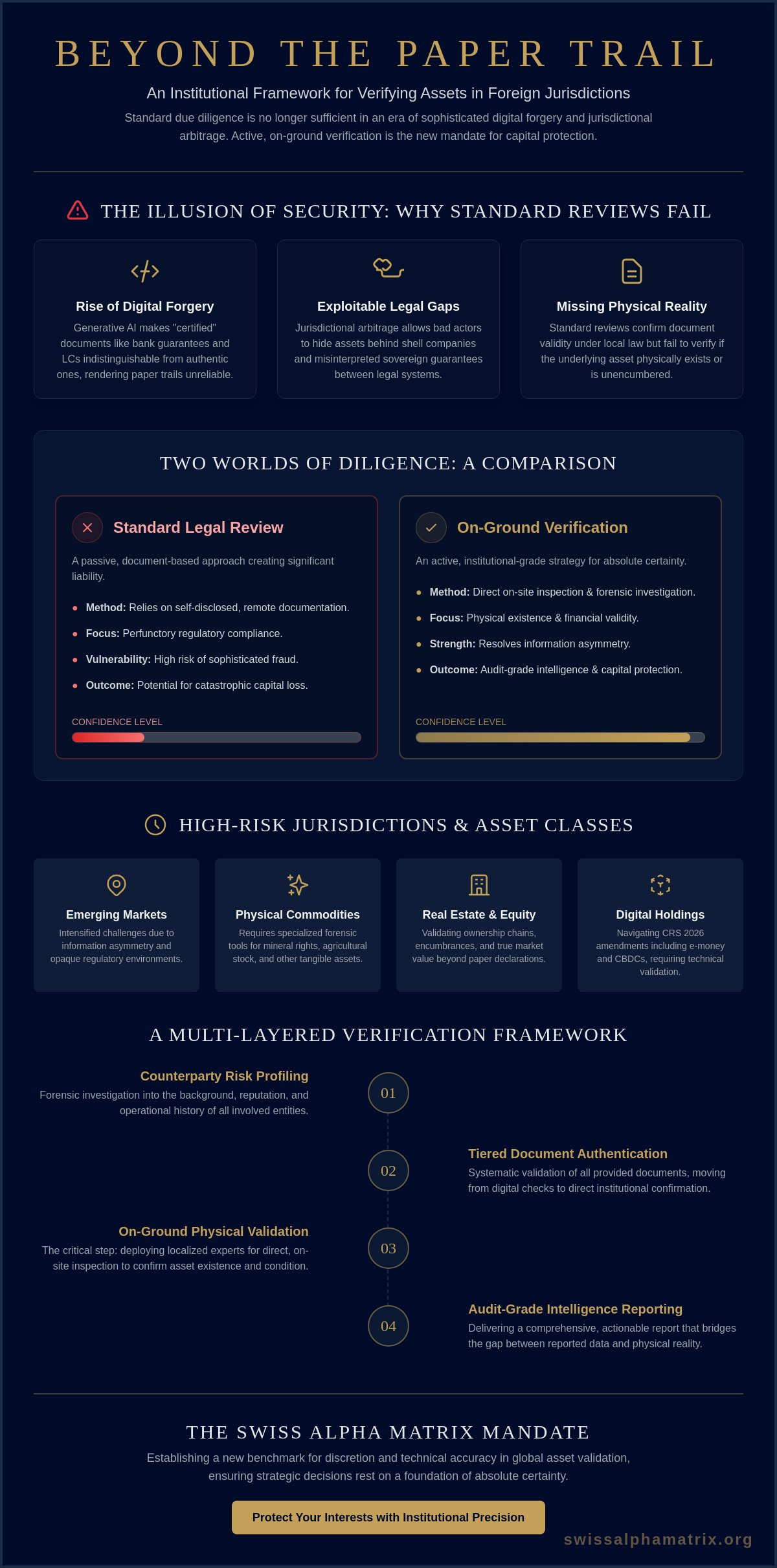
Standard legal reviews, while necessary for structural compliance, often fail to uncover deep-seated financial misrepresentation because they rely on the assumption that the provided documentation is authentic. These reviews confirm that a document looks correct under local law, but they rarely verify if the underlying asset is unencumbered or even exists in the physical world. This gap in protection necessitates a shift toward active, mandate-driven verification. By moving beyond the reliance on self-disclosed information, investors can secure audit-grade intelligence that serves as a bulwark against the complexities of international asset recovery. Recovery is often a lengthy and uncertain endeavor once capital has been deployed.
The Limitations of Digital and Document-Based Due Diligence
By 2026, the proliferation of generative AI and advanced digital manipulation has rendered traditional “certified” documents insufficient for validating high-value assets. Digital forgery has evolved to a point where bank guarantees and letters of credit can appear indistinguishable from legitimate institutional instruments to the untrained eye. Relying solely on a paper trail in a cross-border context creates a vulnerability that seasoned experts refuse to accept. Historical precedents show that even when documents are notarized, the lack of on-ground confirmation has led to catastrophic losses in sectors ranging from infrastructure to trade finance. Truth requires physical presence.
Identifying High-Risk Jurisdictions and Asset Classes
The challenges of verifying assets in a foreign country intensify when moving from established financial hubs to emerging markets. Validating physical commodities, such as mineral rights or agricultural stock, requires a different set of forensic tools than auditing private equity holdings or commercial real estate. Alongside these physical assets, digital holdings present unique hurdles. The 2026 amendments to the Common Reporting Standard (CRS) now include electronic money and Central Bank Digital Currencies, reflecting a global shift toward transparency in the digital economy. Integrating international financial regulations into this risk assessment ensures that every mandate remains compliant with the evolving standards of reporting. Precision is the only defense.
Beyond the Paper Trail: The On-Ground Verification Methodology
True security in cross-border capital deployment isn’t found in a digital ledger but through the deliberate application of physical presence. When verifying assets in a foreign country, the reliance on remote documentation creates a dangerous information asymmetry that can only be resolved through direct, on-site inspection. This approach merges the rigor of traditional financial discipline with the absolute necessity of physical validation, ensuring that the reported reality aligns perfectly with the tangible asset. By utilizing specialized on-ground verification services, an organization can effectively transform speculative claims into audit-grade reporting, providing the intellectual depth required for high-level decision-making. Throughout this process, maintaining a level of Swiss-level discretion is paramount, as deep-dive investigations must be conducted with a quiet authority that respects the privacy of the parties involved while yielding uncompromising accuracy.
Physical Inspection and Custodial Confirmation
Physical assets, whether they be industrial infrastructure, real estate, or raw commodities, require an independent, third-party ocular inspection to confirm their physical state, location, and accessibility. This process extends far beyond simply viewing the asset; it involves direct, professional engagement with local custodians, warehouse managers, and regulatory bodies to ensure the title remains unencumbered and legally sound. Within the broader FATF asset recovery framework, verifying the actual existence of an asset is a prerequisite for any meaningful risk mitigation strategy. It’s vital to distinguish between a “proof of existence” and a “valuation mandate,” as the former serves as the essential security floor upon which the latter’s financial projections are built.
Audit-Grade Instrument Validation
The validation of financial instruments, such as Standby Letters of Credit (SBLCs) and Bank Guarantees, represents a critical layer of modern capital protection that can’t be neglected. Effective bank instrument validation services involve a multi-step protocol that includes verifying the instrument’s authenticity directly at the issuing source. This often necessitates inter-bank communication via secure SWIFT protocols to confirm that the instrument is not only authentic but also active, funded, and unencumbered within the global financial system. When verifying assets in a foreign country, this level of forensic scrutiny prevents the acceptance of sophisticated digital forgeries that often bypass standard legal checks. For those seeking to fortify their investment strategies, implementing a rigorous risk management framework ensures that no detail is overlooked in the pursuit of strategic capital preservation.
Regulatory Compliance vs. Operational Due Diligence
Compliance is frequently conflated with security. While regulatory filings such as the FBAR or FATCA Form 8938 provide a legal paper trail, they don’t confirm the operational integrity or the unencumbered status of the counterparty’s holdings. Verifying assets in a foreign country requires looking beyond these filings to understand the actual mechanics of the asset’s management and the moral character of the entities involved. This is where an institutional-grade financial advisory methodology becomes indispensable. It shifts the focus from mere “box-ticking” to a comprehensive risk management framework that incorporates KYC and AML requirements as a baseline rather than a final destination. True capital protection isn’t found in the filing itself, but in the forensic analysis of the data that the filing represents.
Operational due diligence uncovers risks that standard regulatory filings often miss. A filing might show that an account exists, but it won’t reveal if that account’s assets are pledged as collateral for an undisclosed debt. By integrating rigorous risk management frameworks into the verification process, executives can move from a state of reactive compliance to one of proactive protection. This methodology ensures that every piece of intelligence is validated through multiple independent channels, creating a standard of service that is both broad in reach and meticulous in its attention to detail.
Navigating the Global Regulatory Landscape in 2026
As of January 1, 2026, the updated Common Reporting Standard (CRS) mandates the inclusion of electronic money and Central Bank Digital Currencies in automatic exchanges. This shift significantly increases the complexity of maintaining institutional privacy while adhering to global transparency mandates. Organizations like the International Centre for Asset Recovery (ICAR) emphasize that building jurisdictional capacity is essential for navigating the “gray areas” of beneficial ownership. True protection involves understanding how these modern regulations, including the latest May 2026 OFAC sanctions updates, interact with the specific jurisdictional nuances of the asset in question. Balancing these transparency requirements with the need for discretion is a hallmark of sophisticated wealth management.
The Role of Independent Project Oversight
Relying solely on local counsel often introduces subtle conflicts of interest that can compromise the integrity of a transaction. Local experts might possess regional ties or historical relationships with the counterparty that aren’t immediately apparent to an external investor. Establishing independent financial project management ensures that the verification process remains objective, forensic, and entirely aligned with the investor’s interests. This third-party oversight serves as a critical safeguard, ensuring that the rigorous process of verifying assets in a foreign country isn’t influenced by regional biases or undisclosed affiliations that could lead to significant capital loss. It’s about maintaining a steady, logical pace that leads to inevitable confidence in the decision-making process.
Implementing a Cross-Border Asset Verification Framework
The successful execution of a robust framework for verifying assets in a foreign country requires a disciplined, multi-stage approach that transcends basic administrative checks. This institutional process begins with Step 1: Jurisdictional and counterparty risk profiling, where we analyze the geopolitical and financial stability of the region alongside the established reputation of the entities involved. Step 2 involves a tiered document review and instrument authentication, ensuring that every financial vehicle is scrutinized for technical accuracy and historical consistency. Step 3 moves to the execution of on-ground verification and physical inspection, providing the tangible confirmation that digital records alone cannot provide. Step 4 requires the synthesis of this gathered intelligence into an audit-grade executive report, providing the clarity needed for final capital commitment. Finally, Step 5 establishes ongoing monitoring and milestone-based project management to ensure the asset’s status remains unencumbered throughout the lifecycle of the transaction.
This structured methodology provides a sense of inevitable logic, allowing executives to move from broad philosophical principles of risk down to specific strategic pillars with a calm, unwavering pace. By adhering to this sequence, the information asymmetry that often plagues cross-border deals is systematically eliminated. For those requiring a bespoke strategy to secure international interests, our complex project management ensures every phase of validation is executed with forensic precision and a standard of service that is both broad in reach and meticulous in its attention to detail.
Phase I: Initial Risk Assessment and Mandate Scoping
The success of any verification mandate depends on the precision of its initial scoping. During this phase, we define the specific objectives of the investigation, identifying the critical “deal-breakers” in the asset structure that would necessitate an immediate cessation of the transaction. By allocating senior-level expertise based on the specific asset class and regional nuances, we ensure that the investigation is tailored to the unique complexities of the jurisdiction. It’s during this assessment that we integrate the latest May 2026 OFAC sanctions updates and CRS reporting requirements to establish a baseline for regulatory compliance.
Phase II: Deep-Dive Investigation and Fieldwork
Once the scope is established, the framework moves into an active deep-dive investigation. This phase involves coordinating global teams for simultaneous on-ground and financial review, ensuring that no discrepancy between the physical asset and its financial representation goes unnoticed. By leveraging networks rooted in former Tier-1 banking expertise, we access institutional intelligence that isn’t available through public channels. Real-time reporting and stakeholder management during the investigation allow for a performance-oriented mindset, ensuring that decision-makers are kept informed of any emerging risks as they are discovered in the field. Truth in verifying assets in a foreign country isn’t found in a single source, but in the meticulous intersection of multiple, independent streams of data.
The Swiss Alpha Matrix Mandate: Precision in Asset Validation
The Swiss Alpha Matrix mandate is defined by an uncompromising refusal to settle for the superficial. By applying decades of Tier-1 banking expertise to the intricate task of verifying assets in a foreign country, we establish a standard of validation that aligns perfectly with the expectations of the world’s most discerning institutional entities. This isn’t merely an administrative function; it’s a profound fusion of traditional Swiss discretion and uncompromising forensic financial discipline. We provide executive-level intelligence that ensures precision in capital deployment, recognizing that in the high-stakes environment of cross-border transactions, a single oversight can compromise years of strategic accumulation. Our commitment to long-term capital preservation is reflected in a methodology that prioritizes meticulous verification over the haste of short-term speculation, ensuring that your interests remain in the hands of seasoned, unemotional experts.
Our Approach to Complex Project Management
Our methodology treats every mandate as a high-stakes financial project, requiring a level of complexity in management that standard due diligence providers simply cannot match. By implementing senior-level oversight at every critical juncture, we ensure absolute technical accuracy and a standard of service that is both broad in reach and meticulous in its attention to detail. This focus on complex project management allows us to identify and mitigate risks before they ever manifest as actualized losses. We position ourselves as a dedicated partner for those who value intellectual depth and a refusal to oversimplify complex dynamics, catering to an audience that prioritizes regional excellence and strategic stability over passive participation. It’s a standard that transforms uncertainty into a structured, logical path toward capital security.
Securing Your Global Interests
Sophisticated investors choose Swiss Alpha Matrix because they understand that genuine capital protection requires more than just perfunctory legal compliance. It requires the profound peace of mind that only comes from audit-grade instrument validation and on-ground verification. When you engage our firm, you’re securing a standard of intellectual superiority tempered by traditional values, ensuring that your global interests are shielded from the volatility of international jurisdictions. We invite you to contact Swiss Alpha Matrix to secure your cross-border mandates and ensure your interests are managed by experts who prioritize the permanence of your legacy. Truth in verifying assets in a foreign country is found in the intersection of logic and precision, a standard we uphold in every mandate we undertake to ensure your capital remains secure and your strategic goals are achieved with absolute certainty.
Securing the Future of Global Capital Deployment
The evolution of international finance necessitates a transition from the passive acceptance of digital records to the active, forensic validation of tangible interests. The true measure of security isn’t found within a regulatory filing but through the uncompromising rigor of on-ground verification and institutional-grade operational due diligence. By establishing a framework that prioritizes physical existence and unencumbered title, you ensure that strategic decisions rest upon a foundation of absolute certainty rather than speculative optimism. The process of verifying assets in a foreign country remains a sophisticated endeavor that demands the stewardship of seasoned experts who prioritize long-term principal preservation above all else.
Secure your global interests with Swiss Alpha Matrix’s expert advisory to leverage the insights of former Tier-1 global banking executives who provide audit-grade reporting standards with traditional Swiss-level discretion. With a global reach and a commitment to meticulous detail, you can deploy capital with the confidence that your interests are protected by a standard of regional excellence and intellectual depth. Your vision for strategic growth deserves a partner capable of navigating the most complex jurisdictional landscapes with unwavering precision and logical calm.
Frequently Asked Questions
What is the most common red flag when verifying assets in a foreign country?
The most prevalent red flag is a lack of transparency regarding the asset’s beneficial ownership structure, which often signals an attempt at jurisdictional arbitrage. When verifying assets in a foreign country, any discrepancy between a counterparty’s self-disclosed digital records and independent custodial reports suggests that the asset may be encumbered or misrepresented. These inconsistencies, even if seemingly minor, often indicate deeper operational risks that require a forensic investigation to resolve before capital is committed.
How does on-ground verification differ from standard due diligence?
Standard due diligence typically involves a perfunctory review of notarized documents and public registries, which can be easily manipulated in jurisdictions with low transparency. On-ground verification, by contrast, requires a physical presence to conduct site inspections and direct, professional engagement with local regulators and custodians. This forensic approach eliminates the information asymmetry inherent in remote reviews, providing a definitive confirmation of the asset’s existence and status that paper-based checks simply can’t provide.
Why is bank instrument validation necessary for international transactions?
Bank instrument validation is essential to protect against the rise of sophisticated digital forgeries that mimic legitimate Standby Letters of Credit (SBLCs) and Bank Guarantees. By validating these instruments directly at the issuing source through secure inter-bank protocols, investors ensure that the financial vehicle is active, funded, and unencumbered. This process mitigates the risk of entering a transaction based on a fraudulent instrument, which is a common vulnerability in high-value cross-border deals.
Can verifying assets in high-risk jurisdictions be done discreetly?
Discretion is a fundamental pillar of institutional-grade verification mandates, allowing for deep-dive investigations without alerting the broader market or the counterparty. Seasoned experts utilize a sense of quiet authority and traditional Swiss-level discretion to gather intelligence through private, high-level networks. This approach ensures that the investigation remains confidential, protecting the investor’s reputation while yielding the technical accuracy required for strategic capital preservation in volatile regions.
What role does Swiss Alpha Matrix play in cross-border project management?
Swiss Alpha Matrix acts as a master planner, providing complex project management that oversees every stage of the asset validation lifecycle. The firm coordinates global teams of experts to ensure that operational due diligence and risk management frameworks are executed with forensic precision. This senior-level oversight ensures that all strategic pillars are aligned, moving the process forward with a measured, logical pace that encourages confidence in the final executive decision-making process.
How long does a comprehensive international asset verification mandate typically take?
A comprehensive mandate generally requires four to eight weeks, depending on the complexity of the asset class and the specific jurisdictional challenges involved. While preliminary risk profiling can be completed more rapidly, the process of conducting on-ground inspections and multi-layered instrument validation requires a steady, unwavering pace to ensure audit-grade accuracy. This duration allows for the meticulous synthesis of intelligence into a final executive report that meets the highest institutional standards.
Is physical inspection required for financial instruments like SBLCs?
Financial instruments don’t require a physical “ocular” inspection of the paper itself, but they do require a forensic, source-level validation through secure inter-bank communication. When verifying assets in a foreign country that are purely financial, the focus shifts to verifying the instrument’s authenticity and funding status directly with the issuing bank via SWIFT protocols. This ensures the digital representation of the asset is backed by actual, unencumbered liquidity within the global financial system.
How do I ensure my capital is protected during the verification process?
The most effective way to protect capital is to adhere to a strict verification-first protocol, ensuring that no funds are released until an audit-grade report confirms the asset’s validity. By implementing a robust risk management framework, investors can manage the verification as a structured financial project with specific, milestone-based safeguards. This disciplined approach prevents premature capital exposure and ensures that every strategic commitment is backed by forensic intelligence and a standard of service that prioritizes long-term security.