

What if the primary vulnerability in your institution’s 2026 growth strategy isn’t market volatility, but the unverified digital signature of a cross-border partner you’ve never met in person? As global regulators, including the FCA with its March 2026 mandates and the NYDFS, intensify their scrutiny, the traditional reliance on “paper-only” due diligence has become an unacceptable liability. Mastering third-party risk management in finance now requires a transition from passive compliance to a proactive, institutional discipline that prioritizes the authenticity of foreign financial instruments over mere administrative checklists.
You likely recognize that the $4.91 million average cost of a third-party breach is a figure that fails to capture the deeper erosion of stakeholder trust and institutional prestige. This guide provides a sophisticated framework for executives to navigate these complexities through audit-grade validation and strategic oversight. We’ll examine the shift toward on-ground verification and the integration of operational resilience into your core risk architecture, ensuring your cross-border partnerships remain a source of strength rather than a point of failure.
Key Takeaways
- Understand why traditional compliance models fail in 2026 and how to transition toward a sophisticated model of global ecosystem oversight.
- Learn to architect a robust lifecycle for third-party risk management in finance that aligns institutional risk appetite with long-term strategic planning.
- Recognize the necessity of physical, on-ground verification and audit-grade validation to secure interests in high-stakes cross-border transactions.
- Establish clear governance structures that elevate third-party oversight to the board level, ensuring seamless integration with enterprise risk management.
- Discover the strategic value of independent advisory to provide the specialized bandwidth and expertise required for deep-dive operational due diligence.
The Evolution of Third-Party Risk Management in Finance
The historical paradigm of vendor oversight has undergone a profound transformation, moving beyond the simple management of localized service providers toward the governance of intricate, global financial ecosystems. In this context, Third-party risk management is no longer a peripheral administrative function; it’s a core strategic pillar for institutional stability. By 2026, the reliance on superficial, “check-the-box” compliance exercises has proven insufficient, as these methods often fail to detect the sophisticated fraud or operational vulnerabilities inherent in cross-border engagements. The stakes have evolved from simple service disruptions to existential threats involving capital protection, reputational integrity, and the maintenance of a defensible regulatory standing in an increasingly litigious environment.
Geopolitical instability has further elevated these vulnerabilities, turning previously stable corridors of commerce into zones of heightened scrutiny. When a financial institution engages with a third party today, it’s not merely inheriting a service; it’s absorbing the geopolitical, economic, and cyber risks associated with that entity’s entire operational footprint. This reality necessitates a shift in third-party risk management in finance, moving away from passive monitoring toward a model of active, strategic oversight that prioritizes the preservation of long-term value over short-term operational convenience.
Drivers of Risk in the Modern Financial Landscape
The acceleration of technological integration has introduced a dense web of fintech intermediaries that, while enhancing efficiency, often obscure the underlying risk profile of a transaction. This complexity is compounded by regulatory fragmentation across key financial hubs such as London, Geneva, and Hong Kong, where conflicting mandates can create blind spots for even the most diligent internal teams. We also see the rise of fourth-party and nth-party dependencies, where a failure in a vendor’s own supply chain can trigger a systemic collapse. These hidden layers of risk require a more sophisticated lens than traditional audits can provide, as they often involve non-linear dependencies that only seasoned experts can identify and mitigate.
Institutional vs. Retail TPRM Approaches
Institutional transactions demand a level of scrutiny that far exceeds the standard frameworks employed by community banks or retail entities. While retail-focused risk management may prioritize high-volume, standardized checks, institutional third-party risk management in finance must account for the unique, often bespoke nature of large-scale capital movements. These complex deals require a technical precision that goes beyond verifying a company’s registration. Protecting institutional interests in high-stakes environments often necessitates specialized bank instrument validation services to ensure that every asset, guarantee, and financial instrument is authentic, enforceable, and fully compliant with international standards of financial discipline.
Defining the Institutional Third-Party Risk Management Lifecycle
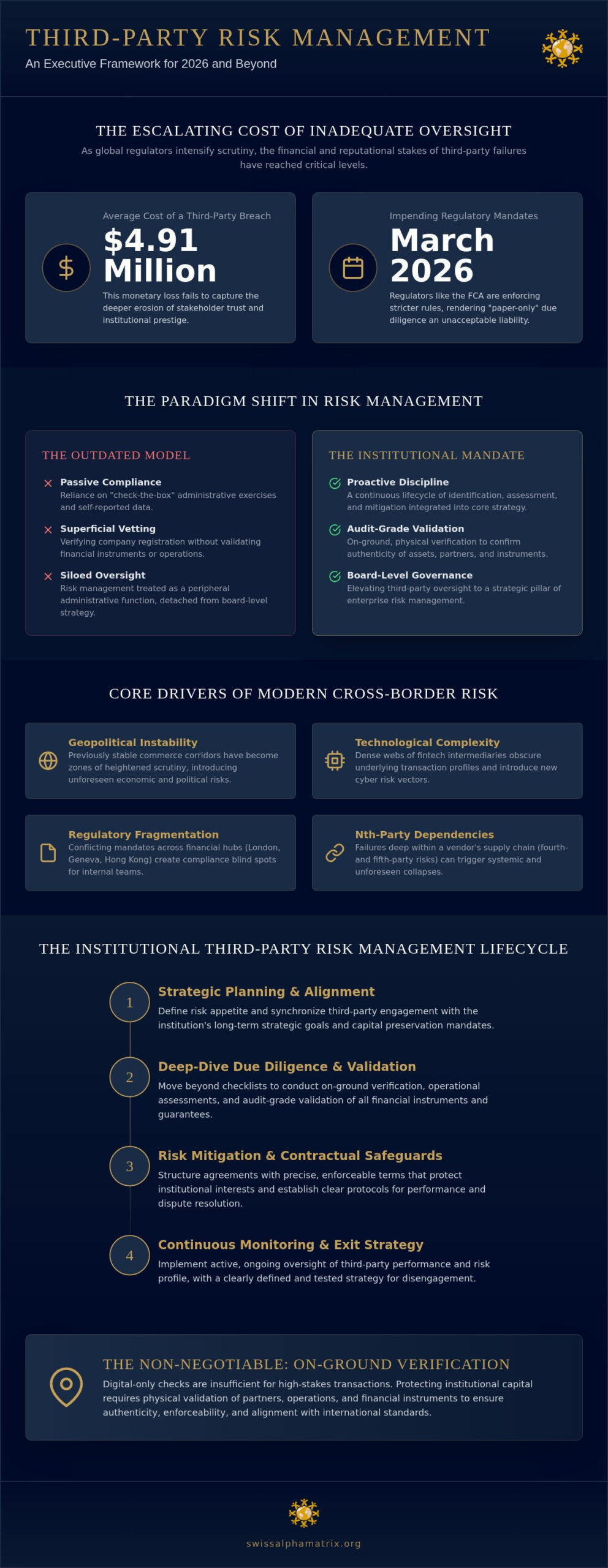
The institutional approach to third-party risk management in finance is defined not by a static point-in-time assessment, but by a continuous, iterative lifecycle of identification, assessment, and mitigation. This framework ensures that every external dependency is scrutinized through a lens of capital preservation and strategic alignment. Rather than a linear progression, the institutional lifecycle functions as a sophisticated feedback loop, beginning with the rigorous definition of risk appetite and extending through to the finality of an exit strategy. This methodology aligns with the international framework for third-party risk, which advocates for a holistic toolkit that moves beyond simple vendor management toward comprehensive ecosystem governance.
An effective institutional framework consists of four critical phases:
- Phase 1: Strategic Planning and Alignment. This initial stage involves synchronizing the third-party engagement with the institution’s overarching risk appetite, ensuring that the partnership doesn’t inadvertently exceed established risk tolerances.
- Phase 2: Rigorous Due Diligence. This phase requires a deep-dive investigation into the counterparty’s operational, financial, and legal standing, often necessitating on-ground intelligence to verify claims that digital documentation cannot substantiate.
- Phase 3: Ongoing Performance Validation. Monitoring must be dynamic, utilizing audit-grade reporting to ensure that the third party adheres to contractual obligations and regulatory standards throughout the duration of the engagement.
- Phase 4: Contingency and Exit Management. A dignified and secure exit strategy is essential, providing a clear roadmap for the cessation of services without compromising data integrity or operational continuity.
Pre-Contractual Due Diligence: Beyond the Paperwork
In the high-stakes environment of 2026, relying on a counterparty’s self-reported data is a fundamental failure of fiduciary duty. Institutional due diligence must verify the actual legal and operational existence of foreign entities, particularly in jurisdictions where corporate registries may lack transparency. This process involves a meticulous assessment of the track record and moral character of senior management, alongside an evaluation of the counterparty’s own internal risk frameworks. For those managing multi-jurisdictional interests, engaging specialized advisory and due diligence can bridge the gap between remote data and ground-level reality.
Ongoing Monitoring and Dynamic Risk Assessment
The regulatory landscape is no longer static, as evidenced by the revised guidance on model risk management issued by the OCC, Federal Reserve, and FDIC on April 17, 2026. This mandate emphasizes that the core principles of risk management apply even when utilizing third-party models. Effective third-party risk management in finance requires real-time surveillance of performance metrics, allowing for the immediate adjustment of risk posture in response to market volatility or emerging geopolitical shifts. Audit-grade documentation provides the necessary transparency for stakeholders, ensuring that executive oversight remains both informed and defensible.
The Criticality of On-Ground Verification and Instrument Validation
The prevailing reliance on remote, digital-first due diligence represents a significant vulnerability in modern third-party risk management in finance, particularly within the context of high-stakes cross-border transactions. While the FDIC Interagency Guidance on Third-Party Risk Management establishes that due diligence must be commensurate with the level of risk, institutional entities often find that standard administrative checks fail to penetrate the sophisticated veils of modern financial fraud. There is a fundamental fallacy in assuming that a digital document, regardless of its encrypted signatures, provides a true reflection of operational reality or asset existence. To ensure capital protection, executives must distinguish between ‘presented’ documentation, which is often a curated facade, and ‘verified’ assets that have been subjected to empirical, on-ground scrutiny.
Physical verification remains the only definitive method to prevent sophisticated fraud in jurisdictions where corporate transparency is inconsistent. This process moves beyond the passive acceptance of certificates of incumbency or bank statements, requiring instead a proactive investigation into the physical and legal foundations of a counterparty. By bridging the gap between digital data and the physical reality of the partner’s operations, an institution can move from a posture of hopeful compliance to one of informed, strategic confidence.
Audit-Grade Instrument Validation
Verifying complex financial instruments, such as standby letters of credit (SBLCs) or bank guarantees, requires a technical precision that internal compliance teams may lack. The process involves a meticulous review of SWIFT MT760 protocols, issuing bank authority, and the specific verbiage that governs the instrument’s enforceability. Identifying red flags, such as non-standard formatting or inconsistencies in the underlying collateralization, is essential for C-suite confidence. An independent review ensures that these instruments are not merely “paper-deep” but are robust, liquid, and fully aligned with the institution’s risk appetite.
Executing On-Ground Verification Services
The methodology of on-ground verification involves physical site visits and comprehensive operational audits that no remote desktop review can replicate. These services verify that a counterparty’s physical infrastructure, personnel, and daily operations actually exist as described in their proposals. This level of rigor ensures that cross-border investment due diligence is not only robust but also fully defensible in front of stakeholders and regulators. By deploying seasoned experts to the actual location of a partner’s operations, an institution secures a layer of intelligence that distinguishes a performance-oriented mindset from a passive participant in the global market.
Architecting a Framework for Cross-Border Third-Party Oversight
Constructing a resilient institutional framework for third-party risk management in finance requires a shift from viewing oversight as a siloed compliance obligation to recognizing it as a fundamental component of enterprise risk management (ERM). In the sophisticated environment of 2026, where capital flows are increasingly non-linear and cross-border dependencies are the norm, a robust architecture must provide the board with absolute clarity regarding the institution’s risk exposure. This process begins with a comprehensive inventory and categorization of all third-party relationships, identifying those “material” arrangements that, should they fail, would pose a systemic risk to the firm’s operational continuity or regulatory standing. By defining specific risk metrics and key performance indicators (KPIs) that are both measurable and defensible, leadership can move beyond anecdotal reports toward a data-driven understanding of their global ecosystem.
The final pillar of this architecture is the deployment of independent oversight to validate the accuracy of third-party reporting. Internal assessments, while necessary, often lack the specialized bandwidth or the objective distance required to detect subtle anomalies in foreign operations. Independent validation ensures that the documentation presented by a counterparty is not merely a curated administrative artifact, but a true reflection of their financial health and moral character. This structured approach creates a sense of inevitable logic and professional calm, providing stakeholders with the assurance that interests are being guarded by experts who prioritize long-term preservation over short-term speculation.
Governance and the Role of the Board
Regulators, including the New York Department of Financial Services (NYDFS) in their October 21, 2025 guidance, have made it explicitly clear that third-party risk management in finance is a board-level responsibility that cannot be outsourced. Boards must move beyond passive receipt of risk reports, instead taking an active role in defining the “Tone at the Top” and ensuring that the risk management culture permeates every level of the institution. Structuring board reporting for actionable intelligence requires a focus on high-level strategic pillars, allowing directors to exercise their fiduciary duties with a comprehensive understanding of how third-party dependencies impact the firm’s capital protection strategies.
Integrating Regulatory Compliance Advisory
Navigating the intricate overlap of AML, KYC, and complex sanctions regimes requires a framework that is both flexible and technically precise. To ensure that an institution’s oversight survives the scrutiny of global regulators, it’s essential to leverage international financial regulations as a baseline for all cross-border engagements. This integration is particularly critical given the UK Financial Conduct Authority (FCA) rules published in March 2026, which establish broader reporting requirements for material third-party arrangements. For executives seeking to fortify their institutional defenses against these evolving mandates, engaging a specialized regulatory compliance advisory provides the necessary expertise to align internal frameworks with global standards of excellence.
The Strategic Necessity of Independent Advisory in Risk Mitigation
Internal compliance departments often find themselves encumbered by the staggering operational volume of domestic reporting and routine monitoring, leaving insufficient bandwidth for the exhaustive, technical deep-dives required by cross-border third-party risk management in finance. While internal teams are vital for maintaining baseline standards, the intricate nature of multi-jurisdictional deals in 2026 demands a level of specialized scrutiny that standard institutional resources can’t always provide. There is an irreplaceable value in engaging the expertise of former Tier-1 bank executives who possess the technical depth to identify subtle risks, such as non-standard SWIFT MT760 protocols or jurisdictional anomalies, that remote software or junior analysts might overlook. This transition from a standard oversight function to a strategic partnership ensures that interests are in the hands of seasoned experts who prioritize long-term preservation over short-term operational speed.
Swiss Alpha Matrix embodies this elite standard of protection, merging the rigorous financial discipline of the Swiss banking tradition with the absolute discretion required for sensitive institutional engagements. By acting as an independent master planner, the advisory firm provides the necessary intellectual depth to navigate the complexities of global ecosystems. This approach ensures that every partner and every instrument is subjected to a standard of validation that is both broad in reach and meticulous in its attention to detail, creating a sense of professional calm that encourages confidence in the most complex decision-making processes.
Complex Project Management as a Risk Mitigation Tool
Ensuring the integrity of a multi-jurisdictional deal requires more than just initial due diligence; it demands a structured framework of ongoing project oversight. The role of a dedicated Project Management Office (PMO) is to maintain a single source of truth, preventing the dangerous fragmentation of data that often leads to operational failure in large-scale transactions. By integrating independent financial project management into the core risk architecture, institutions can protect their capital through every phase of the transaction lifecycle. This structured governance ensures that the deal remains aligned with the institution’s risk appetite while providing the audit-grade documentation required by modern stakeholders.
Conclusion: Securing the Future of Capital Deployment
The landscape of 2026 demands a departure from passive, remote-only verification strategies that have proven inadequate in the face of sophisticated global fraud. As we’ve explored, the evolution of third-party risk management in finance necessitates a sophisticated, on-ground approach that prioritizes audit-grade validation and board-level strategic governance. The long-term ROI of investing in these high-level standards is found not just in the prevention of catastrophic breaches, but in the enduring confidence of stakeholders and the preservation of institutional prestige. For executives and board members, the choice is clear: move beyond the administrative checklist and embrace a standard of service that reflects the traditional discretion and technical precision of high-end private wealth management. To fortify your institution’s cross-border interests, secure a partner dedicated to regional excellence and the absolute integrity of your financial ecosystem.
Fortifying Institutional Resilience in a Borderless Financial Ecosystem
As the global financial landscape continues to fragment under the weight of geopolitical shifts and technological complexity, traditional methods of oversight are no longer sufficient to protect institutional capital. We’ve established that a robust framework for third-party risk management in finance must transcend the limitations of digital documentation, prioritizing instead the empirical certainty of on-ground verification and the technical precision of audit-grade instrument validation. By elevating these responsibilities to the board level and integrating them into a comprehensive enterprise risk strategy, your institution can navigate cross-border complexities with a sense of informed calm and strategic confidence.
The transition from passive observation to active, expert-led mitigation is a prerequisite for long-term preservation in the modern era. Swiss Alpha Matrix, led by former senior executives from Tier-1 global banks, offers the specialized bandwidth and technical depth required to identify subtle vulnerabilities within complex international ecosystems. Our team provides the audit-grade reporting and precision-led advisory necessary to ensure that your cross-border partners and financial instruments meet the highest standards of integrity. We invite you to secure your interests with Swiss Alpha Matrix’s audit-grade validation services and establish a standard of due diligence that is both defensible and elite. The path toward a more resilient future for your institution begins with a commitment to excellence and the refusal to oversimplify the intricate dynamics of global risk.
Frequently Asked Questions
What is the primary goal of third-party risk management in finance?
The primary goal is the preservation of institutional capital and reputational integrity by ensuring that external dependencies don’t introduce unmitigated vulnerabilities into the firm’s operational ecosystem. It’s a strategic discipline that aligns third-party engagements with the organization’s broader risk appetite. By establishing a robust framework, executives ensure that cross-border partnerships enhance rather than compromise the firm’s long-term growth and regulatory standing.
How often should financial institutions conduct third-party risk assessments?
Assessments should occur continuously throughout the relationship lifecycle, rather than being treated as a static, point-in-time event. While annual reviews were once the standard, the volatility of the 2026 financial landscape necessitates real-time surveillance for material arrangements. Any significant change in the third party’s financial health, ownership structure, or geopolitical environment should trigger an immediate, deep-dive re-evaluation to maintain audit-grade oversight.
What is the difference between due diligence and third-party risk management?
Due diligence is the initial, investigative phase of the broader third-party risk management in finance lifecycle, focused on verifying the counterparty’s legal and operational standing before a contract is signed. In contrast, risk management is the comprehensive, ongoing governance framework that encompasses planning, monitoring, and exit strategies. While due diligence provides the foundation, risk management ensures the continuous alignment of the partnership with institutional standards over time.
Why is on-ground verification necessary if we have digital documentation?
Digital documentation, while convenient, often fails to detect sophisticated fraud or verify the physical existence of assets in jurisdictions with inconsistent transparency. On-ground verification provides an empirical layer of intelligence that digital signatures cannot replicate. By conducting physical site visits and operational audits, institutions bridge the gap between a curated administrative facade and the actual reality of a partner’s financial and moral character.
Can a financial institution outsource its responsibility for third-party risk?
No, a financial institution remains legally and ethically responsible for its risks, regardless of whether the associated services are outsourced to a third party. Regulators, including the NYDFS in their October 2025 guidance, have explicitly stated that the board and senior management cannot delegate their fiduciary duties. While you can outsource the execution of risk assessments, the ultimate accountability for the outcomes and regulatory compliance remains firmly with your leadership.
What are the most common red flags in third-party financial relationships?
Red flags often manifest as non-standard formatting in bank instrument documentation, such as SWIFT MT760 protocols, or inconsistencies in the underlying collateralization claims. Other warnings include sudden shifts in senior management, a lack of transparency regarding beneficial ownership, or operations in high-risk jurisdictions without commensurate compliance controls. Identifying these subtle anomalies requires the technical depth of seasoned experts who understand the intricate mechanics of institutional finance.
How do global regulators view third-party risk in 2026?
Regulators have shifted their focus from simple compliance to operational resilience, as evidenced by the FCA’s March 2026 rules which require annual registers of material arrangements. There’s an increased expectation for “cradle-to-grave” lifecycle management and visibility into fourth-party or nth-party dependencies. Regulatory bodies now view third-party risk management in finance as a critical component of systemic stability, demanding audit-grade documentation and proactive board-level oversight.
What role does the board of directors play in third-party oversight?
The board of directors is responsible for setting the “Tone at the Top” and ensuring that a culture of risk awareness permeates the entire institution. They must provide effective oversight by approving the third-party risk management framework and receiving regular, actionable intelligence on material dependencies. Their role is to exercise fiduciary duty by ensuring that third-party risks are managed in a way that protects the interests of all stakeholders and maintains institutional prestige.