

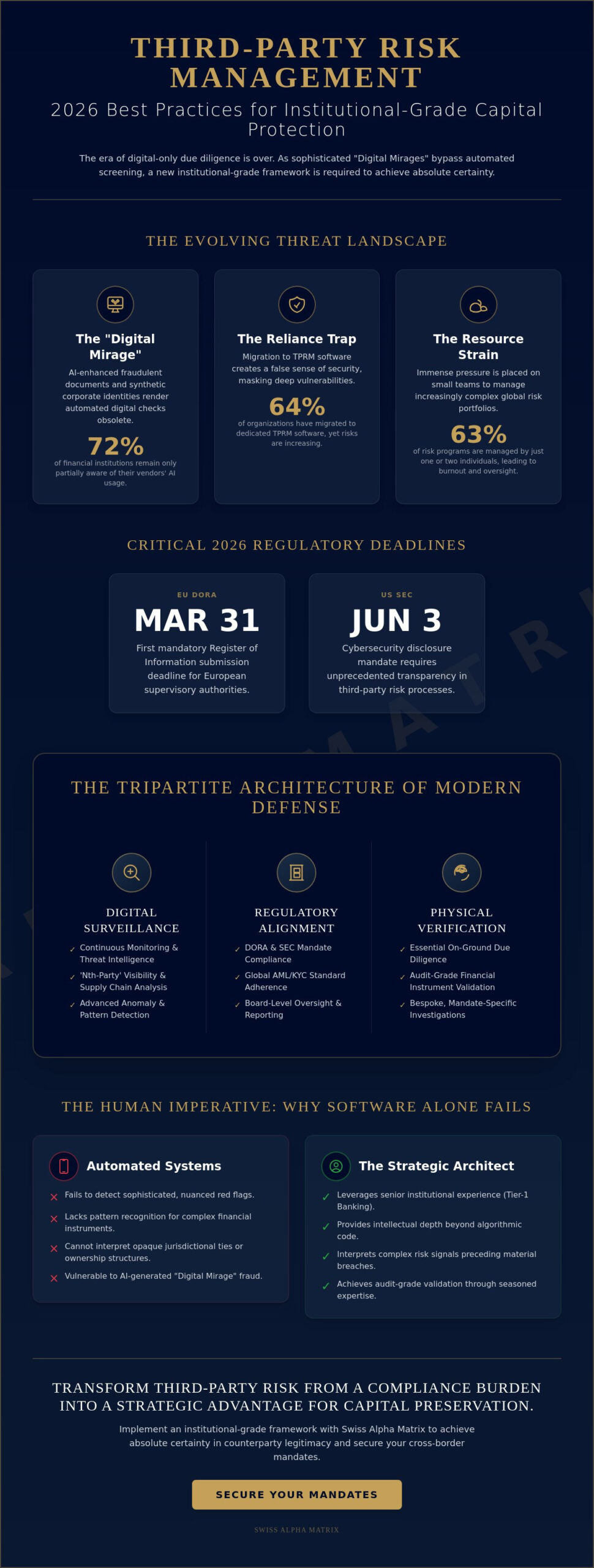
The era of digital-only due diligence has reached a definitive, precarious end, as sophisticated “Digital Mirages” now allow fraudulent entities to bypass even the most rigorous automated screening protocols. While 64% of organizations have migrated to dedicated TPRM software as of early 2026, this reliance on algorithmic validation often masks a profound vulnerability in capital protection. Implementing third-party risk management best practices 2026 requires more than a subscription to a data aggregator; it demands a return to the institutional rigor of on-ground verification and audit-grade instrument validation. You likely recognize that as global mandates become increasingly complex, the traditional reliance on static, point-in-time assessments is no longer a viable strategy for preserving long-term wealth or securing cross-border mandates.
We understand the immense pressure placed upon the 63% of risk programs currently managed by just one or two individuals, especially as the March 31, 2026, DORA reporting deadline approaches for European supervisory authorities. This article provides the sophisticated methodologies necessary to achieve absolute certainty in counterparty legitimacy and full compliance with the SEC’s June 3, 2026, cybersecurity disclosure mandates. We’ll examine the shift toward continuous monitoring, the necessity of “Nth-party” visibility, and the integration of bespoke on-ground due diligence into a modern, institutional-grade framework designed for the strategic architect of capital.
Key Takeaways
- Discover the tripartite architecture of modern risk defense, which synthesizes advanced digital surveillance with rigorous regulatory alignment and essential physical on-ground verification.
- Adopt a structured five-step implementation path, moving from precise mandate scoping to tiered due diligence, to ensure alignment with third-party risk management best practices 2026.
- Identify the critical limitations of automated systems and learn why a “Strategic Architect” with senior institutional experience is required to detect sophisticated anomalies in complex financial instruments.
- Establish an elite governance model that utilizes bespoke advisory and audit-grade validation to transform third-party risk from a compliance burden into a strategic advantage for capital preservation.
The Evolution of Third-Party Risk Management in 2026
The discipline of safeguarding institutional capital against external vulnerabilities has undergone a profound metamorphosis, evolving from a secondary administrative function into a primary strategic pillar for global investors. In 2026, the definition of risk has expanded beyond the siloed realms of cybersecurity or simple financial insolvency; it now encompasses a multi-dimensional convergence of cyber, financial, and physical security. This evolution is driven by the emergence of the “Digital Mirage,” where AI-enhanced fraudulent documentation and synthetic corporate identities have effectively rendered the automated digital checks of 2024 obsolete. Relying solely on software to validate a counterparty is no longer sufficient when 72% of financial institutions remain only partially aware of their vendors’ AI usage. Adopting third-party risk management best practices 2026 requires a shift from reactive monitoring toward proactive, mandate-specific due diligence that prioritizes absolute certainty over mere probability.
For those seeking a foundational Third-Party Risk Management Overview, the traditional framework focuses on the lifecycle of vendor relationships, yet this baseline fails to account for the sophisticated information asymmetry inherent in modern cross-border deals. Swiss Alpha Matrix approaches these challenges with the dignified discretion rooted in Swiss financial traditions, ensuring that sensitive counterparty relations are managed with a level of professional calm that secures both capital and reputation. We prioritize long-term wealth preservation over short-term market speculation, recognizing that a single oversight in a cross-border mandate can jeopardize decades of strategic growth.
Beyond GRC: The Need for Institutional-Grade Intelligence
Standard “check-the-box” compliance platforms frequently succumb to the complexities of global financial markets, as they lack the nuanced pattern recognition required to spot sophisticated red flags. Bespoke advisory mandates, led by seasoned former Tier-1 banking executives, provide a level of intellectual depth that automated platforms cannot replicate. These experts interpret complex risk signals, such as subtle shifts in ownership structures or opaque jurisdictional ties, which often precede a material breach. This human-in-the-loop requirement is the cornerstone of third-party risk management best practices 2026, ensuring that audit-grade validation is achieved through seasoned experience rather than just algorithmic code.
The 2026 Regulatory Landscape: DORA and Beyond
The regulatory environment has reached a critical inflection point, with the EU’s Digital Operational Resilience Act (DORA) requiring financial institutions to submit their first mandatory Register of Information by March 31, 2026. Simultaneously, the SEC’s June 3, 2026, deadline for cybersecurity disclosure forces public companies to detail their third-party risk processes and board-level oversight with unprecedented transparency. New AML and KYC standards for 2026 demand a deeper look into “Nth-party” supply chains to uncover hidden concentration risks that could trigger systemic failures. In this heightened environment, 2026 TPRM is the definitive convergence of regulatory compliance and the physical protection of institutional capital.
Three Pillars of Modern TPRM: Digital, Regulatory, and Physical
The architecture of a truly institutional-grade risk framework in 2026 rests upon three distinct yet interdependent pillars that, when synthesized, create a defense-in-depth strategy for capital preservation. While most market participants remain focused on the singular dimension of cybersecurity, third-party risk management best practices 2026 demand a more holistic integration of digital surveillance, regulatory mapping, and physical verification. This tripartite approach ensures that every facet of a counterparty’s operational and financial integrity is scrutinized, leaving no room for the information asymmetry that often plagues cross-border mandates. By moving beyond the limitations of standard vendor management, sophisticated investors can achieve a level of certainty that mirrors the traditional discretion and precision of Swiss private banking.
Digital Pillar: AI vs. AI in Risk Detection
As 64% of organizations have now adopted dedicated TPRM software, the digital battlefield has evolved into a sophisticated contest of machine learning models. It’s no longer sufficient to rely on annual assessments; instead, continuous monitoring is required to detect subtle anomalies in vendor behavior that might indicate a compromise or the emergence of a synthetic corporate identity. These digital systems must be calibrated to identify “shadow AI” and deepfake documentation, which have become primary tools for modern financial fraud. Integrating this high-frequency data into a broader financial risk framework allows the Strategic Architect to spot vulnerabilities long before they manifest as material breaches, though we must remember that 72% of institutions still struggle to fully comprehend their vendors’ AI governance structures.
Regulatory Alignment: Mapping Mandates to Global Standards
The regulatory pillar serves as the structural backbone of the framework, ensuring that all third-party engagements remain in strict accordance with evolving global mandates. This involves more than simple compliance; it requires a deep understanding of how acts like DORA and the SEC’s 2026 cybersecurity disclosure rules intersect with local jurisdictional requirements. Utilizing the OCC Risk Management Guidance as a foundational benchmark, we map these mandates against the specific risk parameters of each transaction. This meticulous alignment is essential for maintaining the audit-grade validation required to secure institutional capital and satisfy the rigorous expectations of national competent authorities during the 2026 reporting cycles.
The Physical Pillar: Why On-Ground Verification is Non-Negotiable
The most significant gap in contemporary risk management is the over-reliance on digital databases, which often fail to capture the ground-level realities of emerging markets. While satellite imagery and automated KYC tools provide a veneer of security, they cannot replace the absolute certainty provided by physical site visits and the direct validation of complex financial instruments. This is particularly critical when dealing with Standby Letters of Credit (SBLCs) or Letters of Credit (LCs), where the “Digital Mirage” is most prevalent. Our on-ground verification services are designed to bridge this gap, providing a level of operational due diligence that software alone cannot achieve. For those who prioritize long-term wealth preservation, establishing a bespoke risk management framework that includes physical asset legitimacy is the only way to ensure that capital is never deployed based on a digital fabrication.
Why Software Alone Fails: The “Human-in-the-Loop” Requirement
While the proliferation of GRC platforms has provided a veneer of administrative efficiency, the sheer complexity of the 2026 risk landscape, characterized by AI-enabled document forgery and opaque cross-border structures, often exceeds the pattern recognition capabilities of even the most advanced standard AI. Automation Bias, which we define as the dangerous tendency for risk officers to over-rely on positive dashboard indicators without manual verification, has emerged as a systemic vulnerability within large-scale institutional risk programs. Adopting third-party risk management best practices 2026 requires a Strategic Architect approach, where the seasoned intuition of former Tier-1 banking executives is utilized to identify those subtle discrepancies that algorithms, by their very nature, routinely overlook. As highlighted in McKinsey on TPRM Frameworks, an institutional framework must transcend simple data collection to achieve a truly multi-dimensional assessment of operational resilience. This human-centric oversight is particularly vital given that 63% of TPRM programs are currently operated by just one or two dedicated employees, a resource mismatch that inevitably leads to the “Digital Mirage” vulnerabilities discussed previously.
The Nuance of Bank Instrument Validation
Verifying Standby Letters of Credit (SBLCs) and other sophisticated financial instruments remains a discipline where digital-only systems consistently falter, primarily because they lack the forensic depth to analyze documents across jurisdictions with vastly differing standards. Audit-grade validation requires more than a database hit; it demands a meticulous, document-by-document analysis to ensure that every instrument is backed by legitimate, verifiable assets. Our bank instrument validation services address this gap by employing experts who can identify red flags, such as non-standard SWIFT formatting or inconsistencies in the issuing bank’s historical balance sheets, that software is not programmed to detect. It’s this level of professional calm and technical accuracy that distinguishes our methodology from the automated, surface-level checks favored by less specialized firms.
Executive-Level Intelligence vs. Dashboard Data
A profound distinction exists between the raw data output of a software dashboard and the high-level intelligence provided by a bespoke advisory mandate. While a platform might assign a vendor a favorable risk score based on static, self-reported questionnaires, it often misses the qualitative context of shifting geopolitical influences or internal management instability that could jeopardize a cross-border mandate. We favor an approach that prioritizes discretion and intellectual depth, ensuring that investigations into high-profile third-party entities are conducted with the quiet authority necessary to maintain institutional integrity. These bespoke mandates provide the nuanced perspective missing from standard GRC platforms, allowing the Strategic Architect to make decisions based on absolute certainty rather than statistical probability.
Implementing an Institutional-Grade TPRM Framework in 5 Steps
The construction of a resilient defense begins with the Strategic Architect’s blueprint, translating philosophical principles of capital protection into a measured, steady, and highly logical operational reality. Adopting third-party risk management best practices 2026 requires a departure from the frantic, reactive postures common in retail finance, moving instead toward a structured five-step methodology that mirrors the precision of Swiss financial traditions. This framework ensures that every cross-border mandate is scrutinized through a multi-layered lens, providing the intellectual depth necessary to secure wealth against the “Digital Mirage” and other sophisticated 2026 threats. Precision is the goal. By following this institutional progression, the Wise Guardian ensures that capital deployment is never an act of speculation but always an outcome of absolute certainty.
- Step 1: Mandate Scoping. We begin by defining the specific risk parameters for the transaction, ensuring that the due diligence process is bespoke to the unique jurisdictional and financial nuances of the deal.
- Step 2: Tiered Due Diligence. Given that 53% of organizations currently manage over 300 vendors, it’s essential to segment third parties by criticality and financial exposure to prioritize resources effectively.
- Step 3: Multi-Source Validation. This step synthesizes high-frequency digital scans with on-ground verification, bridging the gap between automated data and physical asset legitimacy.
- Step 4: Independent Project Oversight. Implementing a dedicated Project Management Office (PMO) provides the long-term counterparty management and objective scrutiny required to prevent internal confirmation bias.
- Step 5: Deliverable Review. Final capital deployment decisions are governed by a rigorous deliverable review matrix, ensuring that all audit-grade validations have been satisfied.
Establishing the “Tone at the Top”
Effective risk governance is not merely an administrative exercise; it’s a strategic imperative that must be anchored by Board-level reporting structures. We advocate for a clear definition of ownership using a sophisticated RACI analysis, which ensures that accountability for third-party vulnerabilities is transparently assigned among senior leadership. This institutional approach mitigates the risk of oversight gaps and ensures that independent oversight remains a constant tether to the firm’s core values of integrity and excellence. To secure your firm’s future, consider the implementation of a bespoke risk management framework that aligns with these global institutional standards.
Continuous vs. Periodic Review Cycles
The 2026 risk landscape has rendered the traditional annual audit obsolete, as the velocity of regulatory change and cyber threat evolution requires a more dynamic approach. Re-validation frequency must be determined by counterparty criticality, with high-exposure entities subject to real-time monitoring. Trigger-based assessments are essential; a single “news cycle” event or a shift in geopolitical stability must initiate an immediate re-investigation of the counterparty’s legitimacy. In this environment, 2026 mandates require real-time regulatory change management to maintain a standard of service that is both global in reach and local in its attention to detail.
Elevating Governance: The Strategic Guardian Approach
In the sophisticated environment of 2026, where regulatory enforcement is active and the “Digital Mirage” threatens the sanctity of institutional capital, governance must transcend the rudimentary functions of vendor oversight. Swiss Alpha Matrix positions itself as the Wise Guardian, providing a layer of elite protection that shields complex cross-border capital from the vulnerabilities of information asymmetry. By implementing third-party risk management best practices 2026, we ensure that every counterparty engagement is governed by a philosophy of quiet authority and technical precision. This approach doesn’t merely satisfy the reporting requirements of DORA or the SEC; it establishes a fortress of legitimacy around your firm’s most critical mandates, ensuring that capital preservation remains the primary objective in an increasingly volatile global market.
Our methodology provides a vital bridge between the specialized functions of legal counsel and the strategic goals of asset management, filling the void where standard due diligence often falters. While we don’t provide legal representation or direct asset management, our bespoke advisory services offer the audit-grade validation that both disciplines require to function with absolute certainty. This unique positioning allows us to interpret the intricate nature of global financial markets through the lens of seasoned experts who prioritize long-term stability. By integrating our operational due diligence into your broader governance framework, you gain access to a level of intellectual depth that transforms risk management from a compliance burden into a strategic asset for alpha generation.
The efficacy of our framework is rooted in the extensive experience of our team, comprised of former Tier-1 global banking executives who understand the nuance of institutional-grade risk mitigation. These professionals bring a sense of historical reliability and Swiss precision to every engagement, utilizing their expertise to spot the sophisticated red flags that automated systems, which 72% of institutions admit are insufficient for AI risk, consistently miss. We believe that true capital protection requires an unemotional, analytical approach that mirrors the traditional discretion of Swiss private banking, ensuring that your firm’s reputation and wealth are managed by architects of stability.
Bespoke Mandates for High-Stakes Transactions
Every investment program carries unique risks that require a hyper-personalized investigation strategy, rather than the generic assessments offered by retail-grade firms. We tailor our deep-dive investigations to the specific parameters of your mandate, integrating rigorous financial discipline with the discretion necessary for sensitive cross-border negotiations. Whether validating complex instruments or conducting on-ground verification in emerging markets, our commitment to excellence ensures that no detail is overlooked. We invite you to experience a standard of service that is global in reach and local in its attention to detail. To secure your capital with the precision it deserves, contact Swiss Alpha Matrix for an executive consultation and discover the definitive path to institutional-grade resilience.
Securing Institutional Capital in a Multi-Dimensional Risk Landscape
The sophisticated nature of the 2026 financial landscape demands a transition from administrative compliance to a framework of absolute certainty. We’ve explored how the synthesis of digital surveillance, regulatory mapping, and physical on-ground verification forms the only credible defense against the “Digital Mirage” of AI-enabled fraud. Implementing third-party risk management best practices 2026 isn’t merely a response to the March 31 DORA deadline or SEC mandates; it’s a strategic commitment to the long-term preservation of institutional wealth. By prioritizing audit-grade validation over automated probability, the Strategic Architect ensures that capital is deployed only after every counterparty’s legitimacy has been verified with Swiss precision.
Led by former Tier-1 Global Bank Executives, our firm provides the intellectual depth required to navigate these complexities from our offices in Geneva, London, and Hong Kong. We offer a standard of service that bridges the gap between legal counsel and asset management through bespoke mandates and audit-grade verification for complex financial instruments. It’s time to elevate your governance from a passive function to a proactive guardian of your firm’s integrity. Secure your cross-border mandates with Swiss Alpha Matrix. Your capital deserves the protection of seasoned experts who value stability over speculation.
Frequently Asked Questions
What are the most critical TPRM best practices for financial institutions in 2026?
Critical practices include the transition to continuous, real-time telemetry and the mandatory mapping of Nth-party dependencies across the entire supply chain. While 64% of institutions now utilize dedicated software, third-party risk management best practices 2026 prioritize the establishment of cross-functional risk committees that synthesize cyber, financial, and physical intelligence. This holistic approach ensures that no single point of failure within the vendor ecosystem remains unmonitored by the strategic architects of the firm’s capital.
How does the Digital Operational Resilience Act (DORA) change third-party oversight?
DORA fundamentally transforms oversight by requiring the first mandatory reporting cycle to be completed by March 31, 2026. It replaces the era of subjective, self-reported questionnaires with a requirement for demonstrable, audit-grade proof of operational resilience. Financial entities must now maintain a comprehensive Register of Information that encompasses all ICT third-party service providers, ensuring that systemic concentration risks are transparently managed at the board level to protect institutional wealth and stability.
Why is physical on-ground verification necessary if we have GRC software?
Physical verification is essential because digital databases are often populated with synthetic data that software is not programmed to challenge or verify. Given that 72% of financial institutions report only partial awareness of vendor AI usage, on-ground audits provide the only definitive proof of an entity’s operational existence. Site visits uncover ground-level realities, such as facility conditions and local jurisdictional pressures, that remain invisible to automated GRC platforms, thereby preventing the deployment of capital into fraudulent mirages.
How do you validate the legitimacy of cross-border financial instruments like SBLCs?
Validating cross-border instruments like Standby Letters of Credit (SBLCs) involves a multi-channel forensic approach that transcends standard SWIFT checks and automated document scans. We analyze document metadata, cross-reference issuance parameters with the bank’s verified balance sheets, and utilize local intelligence to confirm the authority of the signing officers. This meticulous process ensures that the instrument is backed by tangible assets rather than being a sophisticated digital fabrication, providing the stability required for high-stakes international mandates.
What is the difference between a standard audit and audit-grade instrument validation?
A standard audit focuses on the historical accuracy of financial statements, whereas audit-grade instrument validation provides a real-time, forensic assessment of a specific document’s legal and financial standing. This bespoke service investigates the underlying collateral and the specific issuance protocols of the bank to ensure absolute legitimacy. It offers the certainty required for capital protection in cross-border mandates, a level of detail that traditional accounting audits aren’t designed to provide to sophisticated institutional investors.
Can AI be used effectively for third-party risk management without human oversight?
AI is a powerful tool for processing high-frequency data, yet it cannot replace the qualitative intuition required to spot sophisticated red flags in the 2026 landscape. Automation bias remains a significant risk, as algorithms often miss the subtle management shifts or geopolitical nuances that precede a material breach. Effective third-party risk management best practices 2026 utilize AI for initial triage while relying on senior institutional experts for final intelligence interpretation to ensure capital remains in safe hands.
How does Swiss Alpha Matrix ensure discretion during sensitive investigations?
We maintain discretion by employing a Strategic Guardian approach that mirrors the traditional confidentiality and professional calm of Swiss private banking. All investigations are conducted through secure, compartmentalized channels, ensuring that sensitive counterparty inquiries do not trigger market speculation or reputational damage. This quiet authority allows us to gather deep-dive intelligence while preserving the hyper-personalization and privacy that our elite institutional clients expect and deserve during complex project management and operational due diligence mandates.
What is a deliverable review matrix in the context of TPRM?
A deliverable review matrix is a sophisticated governance tool used to evaluate third-party outputs against rigorous institutional benchmarks before any capital is deployed. It acts as a logical, audit-grade gatekeeper, ensuring that every project milestone meets the technical and regulatory standards defined in the initial mandate. This structured methodology prevents the deployment of funds based on incomplete or non-compliant documentation, securing the strategic growth of the firm while maintaining compliance with global institutional standards and best practices.