

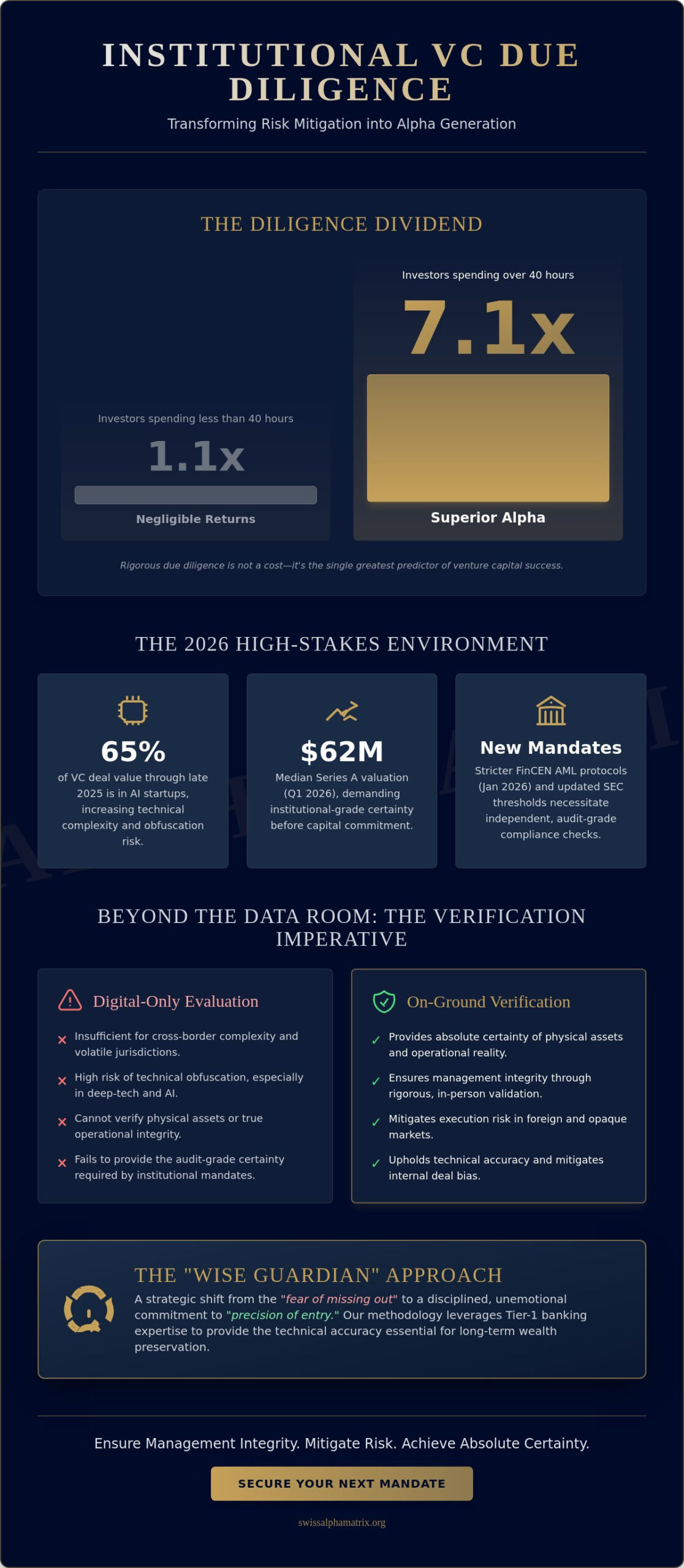
While the allure of high-growth sectors remains potent, particularly with AI startups accounting for 65% of venture capital deal value through late 2025, the stark reality is that investors dedicating over 40 hours to the venture capital due diligence process secure returns of 7.1x, compared to a negligible 1.1x for those who minimize their scrutiny. You likely recognize that in an era where median Series A valuations reached $62 million in Q1 2026, the traditional reliance on digital data rooms is no longer a sufficient safeguard against the opaque complexities of cross-border operations. It’s a fundamental truth that the preservation of wealth in volatile jurisdictions requires more than just administrative compliance; it demands a rigorous, audit-grade verification of every underlying asset and financial instrument within the deal structure.
We understand that the fear of execution risk and the lack of transparency in foreign markets can hinder even the most sophisticated deployment strategies. This guide provides the methodology to master an institutional-grade framework that transforms due diligence into a precise instrument for alpha generation. You’ll gain a comprehensive understanding of how to navigate the January 1, 2026 FinCEN AML protocols and the updated SEC registration thresholds for managers exceeding $150 million in assets. By implementing these bespoke on-ground verification techniques, you’ll ensure management integrity and achieve absolute certainty before any capital is committed to the mandate.
Key Takeaways
- Understand the transition from cursory checklists to a sophisticated, multi-disciplinary audit of viability and integrity, ensuring that capital deployment is guided by precision rather than the mere urgency of market entry.
- Master the institutional venture capital due diligence process by implementing five strategic pillars designed to validate technological moats and evaluate leadership through rigorous background verification.
- Discern the limitations of digital-only evaluation and the necessity of on-ground verification in global financial hubs to ensure the physical existence and management integrity of assets in cross-border mandates.
- Structure a high-performance diligence team that utilizes independent financial project management to mitigate internal deal bias and uphold the technical accuracy required for complex transactions.
- Adopt a “Wise Guardian” philosophy that leverages Tier-1 banking expertise to provide the unemotional rigor and strategic alpha essential for long-term wealth preservation in volatile venture markets.
Beyond the Checklist: Defining the Institutional Venture Capital Due Diligence Process
The modern venture capital due diligence process has matured far beyond the perfunctory examination of pitch decks and cap tables, evolving instead into a sophisticated instrument of institutional control. In the current 2026 climate, where the median seed pre-money valuation has surged to $18.4 million, an institutional-grade audit must function as a multi-disciplinary interrogation of a startup’s operational viability, management integrity, and technical scalability. This transition reflects a necessary strategic shift from the “speed-to-deal” obsession of previous market cycles toward a “precision-of-entry” mandate that prioritizes the preservation of the principal. At Swiss Alpha Matrix, we champion the “Wise Guardian” approach to capital deployment, ensuring that every investment is preceded by a technical validation that mirrors the traditional discretion and unwavering rigor of Swiss private banking.
To appreciate the depth required for such a mandate, one must reconsider the fundamental question: What is Due Diligence? in an institutional context. It’s not merely a checklist, but a comprehensive, technical appraisal of a business designed to establish the veracity of its assets and liabilities while evaluating its commercial potential under stress. Unlike generic vetting, which often seeks reasons to validate a trending AI startup’s narrative, the institutional-grade financial advisory methodologies we employ are engineered to identify the structural weaknesses that precipitate catastrophic capital loss. Our focus remains on technical accuracy and the validation of complex financial instruments, providing a level of certainty that surface-level checklists cannot achieve.
The Evolution of Risk in Global Venture Markets
Traditional Virtual Data Rooms (VDRs) are no longer sufficient to navigate the cross-border complexities of 2026. With the SEC’s April 2026 proposal to raise Form PF thresholds to $1 billion and new FinCEN AML requirements enacted as of January 1, 2026, regulatory compliance is now a central pillar of deal integrity. Independent oversight is mandatory to ensure that the data presented in a digital environment matches the physical reality of operations in foreign jurisdictions. As AI startups accounted for 65% of VC deal value through late 2025, the risk of technical obfuscation has increased, making on-ground verification an essential component of the modern mandate.
The Strategic Objective: Alpha Generation through Risk Mitigation
In this framework, alpha generation is achieved through the meticulous mitigation of risk rather than speculative hope. While competitors focus on identifying “power law” winners, our methodology emphasizes avoiding the “unforced errors” of poor vetting. Sophisticated investors treat the venture capital due diligence process as a competitive advantage. It’s a psychological shift from the fear of missing out to a disciplined, unemotional commitment to technical accuracy. Precision in entry ensures that once the deal is closed, the focus remains on strategic growth rather than remediating overlooked operational defects or regulatory gaps.
The Five Pillars of Audit-Grade Venture Diligence
To achieve the precision required for institutional capital deployment, the venture capital due diligence process must be viewed as an investigative mandate rather than an administrative formality. While retail-focused platforms often treat these pillars as simple data-entry tasks, our methodology demands a multi-dimensional audit of five core areas: management, market viability, financial integrity, regulatory compliance, and operational resilience. This structured approach ensures that every bespoke mandate benefits from the same technical accuracy one would expect in high-stakes Swiss private banking. Navigating the Diligence Process effectively in 2026 requires a departure from “box-ticking” in favor of deep-dive forensic analysis that protects the principal from unforeseen jurisdictional risks.
- Management and Governance: Evaluating leadership beyond the pitch deck through deep-dive background verification across multiple jurisdictions.
- Market and Product Viability: Independent validation of product-market fit and the technical durability of technological moats.
- Financial Integrity: Moving beyond the P&L to utilize bank instrument validation services and confirm cash-flow reality.
- Legal and Regulatory Compliance: Ensuring cross-border structures are robust and compliant with Jan 1, 2026 FinCEN AML protocols.
- Operational Resilience: Assessing the underlying infrastructure for scalability, cybersecurity, and management integrity.
Management Integrity and Governance Oversight
Founder-led startups frequently lack the governance structures necessary for institutional scale. We prioritize balancing visionary leadership with “institutional-ready” oversight, particularly in complex cross-border environments where executive track records must be verified across multiple legal jurisdictions to ensure long-term stability. By implementing a RACI matrix during the venture capital due diligence process, we establish clear management accountability and evaluate how leadership handles technical scrutiny during the deal phase. This level of oversight is essential for maintaining deal integrity and protecting against the execution risks prevalent in unfamiliar markets.
Financial Validation: Verifying the Invisible
In an era where AI startups command 65% of VC deal value through late 2025, validating the “invisible” components of a capital structure is paramount. This includes the rigorous verification of bank instruments, such as standby letters of credit (SBLCs), that may underpin a startup’s creditworthiness or liquidity. Audit-grade financial validation is defined as the independent, third-party verification of asset existence, liquidity, and the technical legitimacy of all underlying financial instruments. Our analysis extends beyond the surface-level P&L to evaluate unit economics through the lens of long-term capital preservation. If you require a more technical appraisal of your current deal flow, our risk management frameworks offer the necessary precision to secure your deployment.
Virtual Data Rooms vs. On-Ground Verification: A Comparison
While the convenience of Virtual Data Rooms (VDRs) has streamlined the initial stages of the venture capital due diligence process, relying solely on digital artifacts introduces a profound structural vulnerability into any investment mandate. Digital repositories are, by their nature, curated environments that present a sanitized version of a startup’s operational reality. In the complex landscape of 2026, where late 2024 saw global funding surge to $120 billion across 4,000 deals, the risk of “paper-only” assets has grown exponentially. Sophisticated capital deployment requires a transition from observing pixels to verifying physical substance. This is particularly critical in cross-border transactions where local jurisdictional nuances can obscure the true state of a company’s headquarters, inventory, or technological infrastructure.
Strategic alpha isn’t found in a PDF; it’s confirmed through the meticulous oversight of independent project management during on-site audits. Whether a deal originates in the tech hubs of London or the financial corridors of Hong Kong and Geneva, “boots on the ground” provide the only definitive safeguard against sophisticated digital obfuscation. This physical presence ensures that the assets claimed in the VDR actually exist and are under the legitimate control of the management team. Without this verification, an investor remains exposed to the execution risks inherent in unfamiliar jurisdictions where legal recourse can be both protracted and costly.
The Digital Illusion: Why VDRs are Only the Starting Point
Digital documents often fail to capture subtle red flags, such as stagnant operational energy, discrepancies in physical inventory, or the absence of key personnel at a claimed headquarters. A VDR cannot provide the sensory context required to judge the “integrity of the environment” in which a startup operates. Our framework for cross-border investment due diligence bridges this gap by mandating that digital claims must be reconciled with physical reality. This process involves verifying that the 65% of VC deal value currently flowing into AI startups is backed by genuine proprietary technology rather than white-labeled software or exaggerated capabilities.
Implementing On-Ground Verification Protocols
The execution of on-ground verification follows a measured, highly logical sequence designed to establish an immutable chain of custody for all gathered intelligence. It begins with a technical document review and culminates in unannounced site visits and deep-dive stakeholder interviews. This methodology prioritizes technical accuracy and management integrity over the frantic energy of retail deal-making. Utilizing Swiss discretion, we conduct these sensitive investigations to ensure that the privacy of our clients is maintained while achieving absolute certainty regarding the target asset. The objective is a technical validation that stands up to the most rigorous institutional scrutiny.
Executing the Mandate: How to Structure Your Diligence Team
The efficacy of the venture capital due diligence process is fundamentally determined by the intellectual architecture of the team tasked with its execution. While generalist venture associates often prioritize deal velocity and narrative alignment, an institutional mandate requires the involvement of specialist advisory firms that operate with the technical precision of a forensic auditor. This distinction is critical; the specialist’s role is not to facilitate the transaction, but to interrogate its structural integrity. By integrating seasoned experts across the legal, financial, and technical domains into a centralized reporting structure, investors can ensure that the final deliverable is an executive-level intelligence report that provides actionable clarity rather than an unvetted data dump of digital documents.
A sophisticated deployment strategy necessitates the use of independent financial project management to insulate the investigation from the internal biases that often plague investment committees. This independent layer acts as a strategic buffer, ensuring that the quest for alpha doesn’t compromise the rigorous standards of risk mitigation. If you are currently structuring a high-stakes mandate, our Operational Due Diligence services provide the institutional-grade oversight necessary to secure your capital against the complexities of global venture markets.
The Role of the Independent Lead Advisor
The lead advisor must remain structurally separate from the asset management function to maintain the unemotional objectivity required for capital preservation. Managing multi-jurisdictional teams across London, Hong Kong, and Switzerland requires a measured, steady rhythm of communication that synthesizes local insights into a global strategic perspective. This approach ensures that the investment committee receives a consistent flow of logical, technical intelligence, allowing them to act with the quiet authority characteristic of Swiss financial traditions. By maintaining this separation, the lead advisor serves as the Wise Guardian of the mandate, prioritizing long-term stability over short-term market speculation.
Reporting and Decision-Support Frameworks
In the high-stakes environment of 2026, where regulatory thresholds for SEC registration have shifted for managers exceeding $150 million in assets, reporting must move beyond simplistic “Pass/Fail” binary outcomes. Instead, the focus should be on complex risk-adjusted return analysis that accounts for the January 1, 2026 FinCEN AML protocols and other evolving international financial regulations. The deliverable review matrix serves as the final filter for capital deployment, synthesizing disparate technical, legal, and financial findings into a single, cohesive decision-support instrument. This framework ensures that every deployment decision is rooted in technical accuracy and a profound understanding of the asset’s management integrity.
The Swiss Alpha Matrix Approach to Venture Capital Due Diligence
The Swiss Alpha Matrix methodology represents a paradigm shift in the venture capital due diligence process, moving away from the speculative fervor of retail markets toward the technical rigor of institutional auditing. Our “Wise Guardian” philosophy dictates that capital deployment must be an unemotional act, rooted in the absolute verification of asset existence and management integrity. By leveraging the collective expertise of professionals from Tier-1 global banking institutions, we provide our clients with a standard of service that is global in reach yet local in its attention to detail, particularly in the critical financial centers of Geneva, London, and Hong Kong. This approach ensures that every mandate is executed with the same technical accuracy and strategic foresight that has defined Swiss financial traditions for generations.
Our commitment to excellence is reflected in our refusal to oversimplify the complex dynamics of the 2026 venture market, where AI startups now account for 65% of deal value through late 2025. We recognize that in an era of $62 million median Series A valuations, the margin for error has narrowed significantly. Consequently, our frameworks are designed to provide a steady, logical progression from initial risk assessment to final decision support, ensuring that our clients maintain a position of intellectual superiority in every transaction. Precision isn’t merely a goal; it’s the fundamental anchor of our performance-oriented mindset.
Bespoke Advisory for High-Stakes Capital
We specialize in crafting bespoke mandates for family offices and institutional funds whose investment programs require more than a generic checklist. In the high-stakes environment of 2026, where the federal lifetime estate and gift tax exemption has reached $15.00 million per person, the preservation of multi-generational wealth demands the highest level of discretion and technical validation. For instance, our independent oversight recently facilitated a complex cross-border acquisition where our on-ground verification protocols identified operational discrepancies that digital data rooms had failed to capture, successfully protecting the client’s principal from a high-risk entry point. We prioritize long-term wealth preservation over short-term speculation, ensuring that every deal aligns with the client’s broader strategic objectives.
Engaging Swiss Alpha Matrix
The transition from an initial inquiry to the execution of a mandate is a measured and highly logical process, designed to establish a foundation of technical clarity. Our engagement model begins with a comprehensive review of the project’s specific complexities, followed by the deployment of a specialist team tailored to the jurisdictional requirements of the deal. We maintain an unwavering commitment to intellectual depth, providing our partners with the certainty required to navigate the most intricate global markets. Secure your next cross-border venture with institutional-grade precision by engaging our team for a technical appraisal of your upcoming mandate.
Securing Strategic Alpha through Institutional Oversight
The evolution of the global investment landscape requires a fundamental shift in how we perceive the venture capital due diligence process. It’s no longer sufficient to rely on the sanitized narratives of digital data rooms; true alpha is secured only through the relentless validation of physical assets and the technical interrogation of complex financial instruments. By prioritizing management integrity and operational resilience, you can navigate the cross-border complexities of 2026 with a level of certainty that avoids the unforced errors of superficial vetting.
Swiss Alpha Matrix, managed by former senior executives from Tier-1 global banks, provides the specialized oversight necessary to bridge the gap between speculative investment and strategic wealth preservation. Our audit-grade instrument validation protocols and strategic presence in Geneva, London, and Hong Kong ensure that your bespoke mandates are executed with technical accuracy and Swiss excellence. We invite you to consult with our senior advisors on your next venture mandate to secure your deployment with the precision it deserves. Your capital is your legacy; we’re here to protect its future.
Frequently Asked Questions
What is the typical duration of a venture capital due diligence process?
The typical venture capital due diligence process requires 30 to 90 days of intensive technical interrogation to move from initial inquiry to final decision support. Investors who dedicate over 40 hours to this investigative phase achieve returns of 7.1x, whereas those who truncate the timeline often experience performance closer to 1.1x. This period allows for the rigorous verification of technological moats and management integrity across multiple jurisdictions.
How does venture capital due diligence differ from private equity due diligence?
Venture capital due diligence focuses on forward-looking technical viability and founder integrity, whereas private equity diligence emphasizes historical cash flow stability and EBITDA multiples. In 2026, the venture process must specifically interrogate the technical moats of AI startups, which represent 65% of current deal value. PE mandates typically prioritize operational efficiency and debt serviceability over the speculative growth profiles found in venture deals.
What are the most common red flags found during VC financial validation?
Common red flags in financial validation include unverified bank instruments, opaque cash-flow structures, and exaggerated unit economics that fail to account for long-term capital preservation. Discrepancies in standby letters of credit (SBLCs) or the absence of a clear chain of custody for funds often indicate structural weaknesses. Our audit-grade instrument validation services are designed to identify these technical inconsistencies before capital is deployed.
Can due diligence be performed entirely remotely in 2026?
Institutional-grade diligence cannot be performed entirely remotely in 2026 because digital data rooms are insufficient to verify the physical existence of assets or management integrity. While VDRs streamline document exchange, on-ground verification in hubs like Geneva, London, and Hong Kong remains the only definitive safeguard against “paper-only” operations. Physical site visits and stakeholder interviews provide the sensory context necessary for a technical validation of the mandate.
What is the role of a RACI matrix in the due diligence process?
The RACI matrix serves as a strategic architecture that defines who is Responsible, Accountable, Consulted, and Informed throughout the investigative mandate. By establishing clear lines of accountability, it ensures that management teams handle technical scrutiny with the necessary transparency. This framework prevents internal deal bias and maintains a steady, logical rhythm of communication between the diligence team and the investment committee.
How much does an institutional-grade due diligence mandate typically cost?
Due diligence costs in 2026 typically range from 0.2% to 4% of the total deal value, reflecting the technical complexity of the investigative mandate. For mid-sized transactions, this investment often falls between $50,000 and $200,000, while large-scale cross-border deals can exceed $500,000. These costs are a necessary allocation for risk-adjusted returns, providing the technical accuracy required to protect the principal in volatile markets.
What happens if a startup fails the due diligence process?
If a startup fails the venture capital due diligence process, the mandate typically concludes with a formal decline or a significant restructuring of the investment terms. This outcome, while disappointing to the target, represents a successful application of the “Wise Guardian” philosophy by avoiding unforced errors. The priority remains the preservation of long-term wealth, ensuring that capital is only deployed into environments characterized by absolute integrity and technical viability.
How does Swiss Alpha Matrix handle cross-border regulatory conflicts?
Swiss Alpha Matrix resolves cross-border regulatory conflicts through a sophisticated Regulatory Compliance Advisory framework that reconciles local jurisdictional requirements with international standards. We navigate the January 1, 2026 FinCEN AML protocols and SEC registration thresholds for managers exceeding $150 million in assets with technical precision. This ensures that every bespoke mandate remains compliant across the disparate legal landscapes of Switzerland, the United Kingdom, and Hong Kong.