

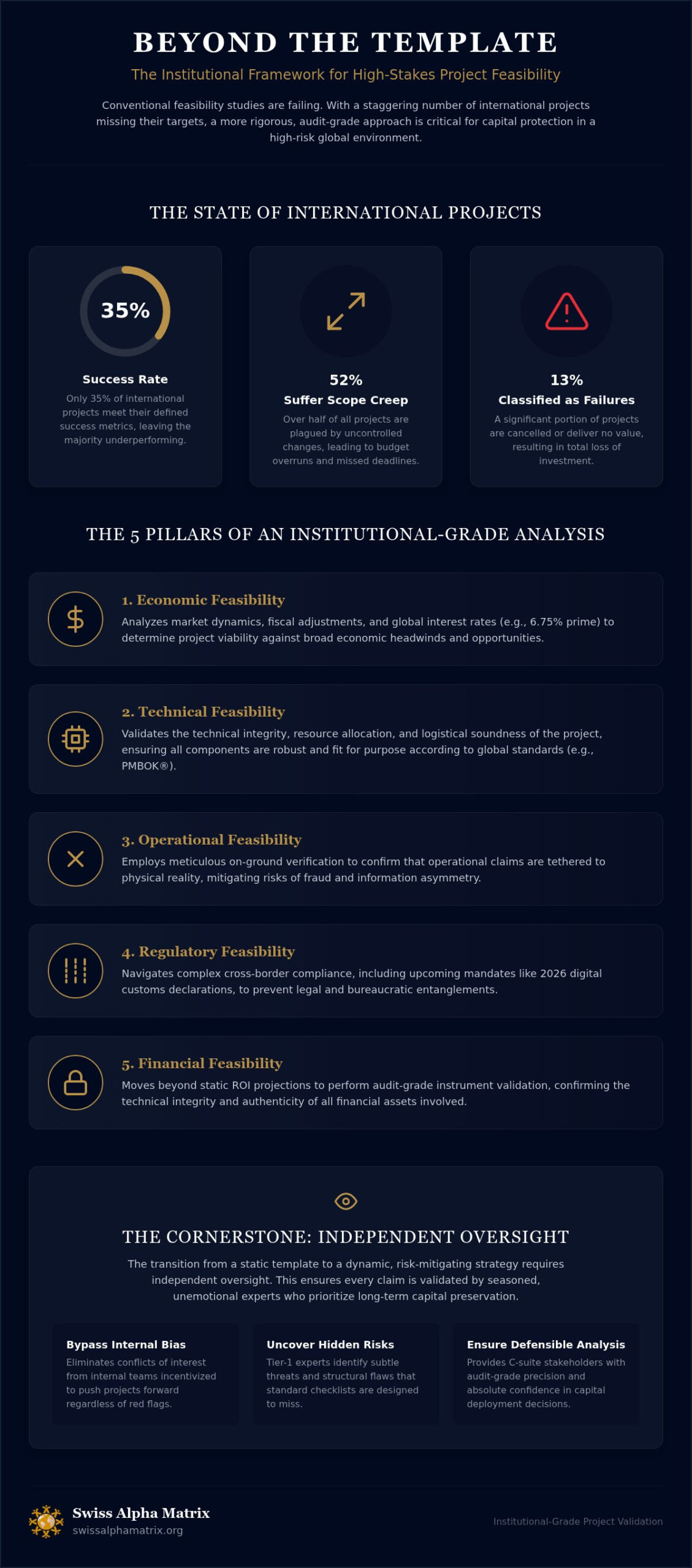
With only 35% of international projects currently meeting their defined success metrics, the distinction between a speculative venture and a sound institutional commitment often rests upon the technical rigor of the initial validation phase. For the sophisticated stakeholder, a generic project feasibility study template is insufficient to address the multi-layered complexities of cross-border transactions, where information asymmetry and the risk of financial instrument fraud remain persistent threats. You likely recognize that in an era of 6.75% prime rates and increasingly stringent 2026 digital customs declarations, the traditional boundaries of due diligence must be expanded to include on-ground verification and audit-grade instrument validation.
We understand that protecting capital in unfamiliar jurisdictions requires more than just a cursory overview; it demands a defensible framework that executive stakeholders can rely upon with absolute confidence. This article provides the institutional-grade architecture necessary to validate complex international projects, offering clear mitigation strategies for transactional risks while ensuring precision in capital protection. We’ll examine the strategic pillars of a high-stakes feasibility analysis, from navigating the nuances of the PMBOK® Guide – Eighth Edition to implementing the rigorous operational oversight required to survive an environment where 52% of projects suffer from scope creep.
Key Takeaways
- Recognize why a standard project feasibility study template often falls short of institutional requirements, necessitating a more robust framework to serve as a strategic gatekeeping mechanism for high-value capital.
- Explore the five pillars of institutional feasibility, encompassing Economic, Technical, Operational, Regulatory, and Financial dimensions, which form the basis of a defensible analysis for executive stakeholders.
- Understand the critical role of audit-grade instrument validation in confirming the technical integrity of financial assets before committing to complex ROI projections.
- Mitigate the risks of information asymmetry and regulatory non-compliance through specialized cross-border due diligence and meticulous on-ground verification.
- Transition from static feasibility assessments to active, independent project management to maintain rigorous oversight and ensure the long-term preservation of interests.
Beyond the Checklist: Why Conventional Project Feasibility Study Templates Underestimate Institutional Risk
A Feasibility study, when executed within the rigorous parameters of high-stakes international development, serves as the definitive gatekeeping mechanism for the deployment of institutional capital. It’s a strategic filter. It’s designed to separate viable opportunities from those burdened by insurmountable structural flaws. However, many organizations mistakenly rely on a generic project feasibility study template that prioritizes administrative compliance over genuine risk mitigation. While these templates might satisfy internal procedural requirements, they often fail to account for the multi-layered complexities of cross-border financial transactions, such as the 2026 mandates for digital customs declarations or the nuanced shifts in global prime interest rates, currently holding at 6.75%. For the C-suite, the objective isn’t merely to complete a document; it’s to achieve a level of audit-grade precision that protects the entity’s long-term interests against jurisdictional volatility and information asymmetry.
The Limitations of Standard PMBOK-Based Frameworks
Standard frameworks, often derived from the PMBOK® Guide, frequently focus on internal resource allocation and scheduling while inadvertently ignoring the external counterparty risks that define international deals. Precision matters here. In these complex environments, data often becomes siloed within specific departments, preventing a holistic view of the project’s true viability. Institutional investors require more than a basic business case for capital protection. They demand a rigorous analysis that transcends internal projections to validate the authenticity of the environment in which the project operates, especially when dealing with the 13% of projects that are classified as outright failures according to recent industry data.
The Shift Toward Independent Financial Oversight
The transition from a static assessment to a dynamic, risk-mitigating strategy requires a deliberate shift toward independent oversight. Bias is a risk. By incorporating the strategic architecture of independent financial project management, organizations can effectively bypass the inherent biases of internal project teams who may be incentivized to see a project proceed. Senior-level experts, often possessing Tier-1 global banking backgrounds, are uniquely positioned to identify the subtle red flags that a standard project feasibility study template might overlook. This independent perspective ensures that every operational claim is tethered to physical reality, providing the master planner with the clarity needed to ensure that interests remain in the hands of seasoned, unemotional experts who prioritize long-term preservation over short-term speculation.
The Institutional Framework: Core Components of a Comprehensive Feasibility Analysis
To validate high-value capital deployment effectively, one must look beyond the superficial layers often found in a standard project feasibility study template. An institutional-grade framework is constructed upon five foundational pillars: Economic, Technical, Operational, Regulatory, and Financial. These dimensions aren’t isolated data sets; rather, they form an interconnected ecosystem where a shift in one area inevitably resonates through the others. For example, a regulatory amendment in Hong Kong’s trade protocols or a fiscal adjustment in the London markets directly impacts the financial viability of a Swiss-backed infrastructure project. This methodology requires what we define as “Executive-Level Intelligence,” a standard where every data point is scrutinized by seasoned experts capable of identifying the subtle interplay between geopolitical stability and project milestones.
Economic and Market Viability
Economic viability involves significantly more than basic supply-demand curves. In an environment where prime rates are currently 6.75%, we must analyze geopolitical stability and currency risk with meticulous detail. Assessing the long-term sustainability of revenue drivers requires sophisticated predictive modeling that accounts for market volatility. It’s about ensuring that the project’s economic engine can withstand regional shocks without eroding principal capital. When projects move across borders, the project feasibility study template must account for jurisdictional variations, ensuring that the strategic assumptions hold true whether the capital is deployed in European or Asian markets.
Technical and Structural Feasibility
Technical feasibility assesses the physical and technological infrastructure required for flawless execution. It involves identifying potential bottlenecks, such as supply chain disruptions or inadequate on-ground technology, that could lead to significant capital erosion. Within the context of institutional-grade financial advisory methodologies, technical feasibility acts as the structural safeguard against operational failure. It ensures that every technical claim is verified against physical reality, preventing the 27% cost overruns typically seen in poorly managed ventures. To explore how these frameworks can be tailored to your specific mandate, you may wish to review our operational due diligence services.
Financial Feasibility and the Criticality of Instrument Validation
ROI calculations, while mathematically sound in isolation, are effectively meaningless if the underlying financial instruments supporting the project lack verified structural integrity. Within the architecture of an institutional-grade project feasibility study template, the transition from theoretical yield to tangible security is predicated upon rigorous Audit-Grade Instrument Validation. This process, a cornerstone of our mandate-specific engagements, ensures that every Standby Letter of Credit (SBLC), Bank Guarantee, or alternative financial instrument is not merely present but is fully authenticated through Tier-1 global banking protocols. Without this layer of verification, a project remains vulnerable to the 13% failure rate often seen in ventures where capital sources were assumed rather than audited.
Integrating bank instrument validation services into the feasibility phase acts as the bedrock of financial viability. It transforms a standard ROI projection into a defensible strategic asset that withstands the scrutiny of seasoned executive stakeholders. This level of verification is particularly vital in the current economic climate, where the 2026 prime interest rate of 6.75% demands absolute precision in capital allocation to maintain projected margins.
Verifying Capital Sources and Counterparty Credibility
Capital protection begins with a deep-dive investigation into the financial entities providing project funding. It’s not enough to review a balance sheet; one must identify the red flags in financial documentation that suggest instrument fraud or misrepresentation. We establish a protocol for independent financial instrument review that moves beyond surface-level aesthetics to verify the issuing bank’s capacity and the instrument’s specific conditions. This level of scrutiny is essential for cross-border deals where information asymmetry can lead to catastrophic capital erosion. Our methodology focuses on the long-term preservation of interests, ensuring that every counterparty is as credible as the instruments they provide.
Audit-Grade Reporting for Stakeholder Confidence
For a report to be considered “audit-grade” by institutional stakeholders, it must demonstrate a level of technical accuracy that survives the most rigorous executive scrutiny. This involves more than just listing data; it requires an unemotional analysis of complex financial dynamics and a clear articulation of risk-mitigation strategies. Precise financial intelligence reduces exposure in cross-border transactions by ensuring that every stakeholder has access to the same high-level, verified data. By maintaining this standard of reporting, we provide the quiet authority and technical depth that sophisticated audiences require when navigating the intricacies of global project finance, where the average cost overrun sits at 27% for those lacking such precision.
Operational and Regulatory Feasibility in Cross-Border Jurisdictions
The transition from a domestic project to a multi-jurisdictional venture introduces layers of operational complexity that a standard project feasibility study template often fails to address with sufficient technical depth. Success in cross-border environments is predicated upon a granular understanding of how regional variations impact project execution. Integrating a robust framework for cross-border investment due diligence into your template ensures that regional nuances are not merely acknowledged but are strategically mitigated. This involves a meticulous assessment of local partners and subcontractors, where the focus moves beyond their stated capacity to an empirical evaluation of their operational due diligence. We’ve observed that projects failing to verify the physical reality of their supply chains often encounter the 27% cost overruns typical of ventures managed with insufficient regional precision.
Navigating Global Regulatory Compliance
Regulatory feasibility is defined as the structural alignment of strategic project goals with the evolving complexities of international financial regulations, ensuring that every operational milestone remains compliant across disparate jurisdictions. This alignment is particularly critical when operating within the sophisticated financial hubs of Geneva, Hong Kong, or London, where AML and KYC requirements are increasingly stringent. In 2026, the implementation of mandatory digital declarations for customs has added a new layer of documentation risk that must be accounted for in the feasibility phase. Failure to harmonize project timelines with these mandate-specific regulations can lead to significant delays, eroding the capital protection measures established in the technical pillars of the study.
The Role of On-Ground Verification
Physical verification of assets and entities remains the only definitive method to prevent cross-border fraud and ensure that operational claims match physical reality. While a project feasibility study template provides the necessary structure, the intelligence populating that structure must be derived from direct, mandate-specific investigations. Our approach merges traditional financial discipline with on-site intelligence, identifying discrepancies that paper-based audits invariably miss. By deploying seasoned experts for on-ground verification, we minimize exposure to the information asymmetry that often plagues international deals. This level of scrutiny ensures that interests are protected by an unemotional analysis of facts rather than a reliance on unverified representations from foreign counterparties. To ensure your project is built on a foundation of verified reality, consider our on-ground verification services to secure your capital deployment.
Implementing Independent Oversight: From Template to Execution
The transition from a static project feasibility study template to the active execution phase represents a critical inflection point where theoretical validation meets operational reality. While the initial study identifies potential vulnerabilities, the subsequent implementation of independent oversight ensures that these risks are actively managed rather than merely documented. For complex, high-stakes programs, independent oversight is a non-negotiable requirement. It provides a necessary corrective to internal biases that often lead to the 27% cost overruns observed in less rigorously managed projects. Retainer-based strategic consulting offers a mechanism for ongoing risk mitigation, ensuring that interests remain in the hands of seasoned, unemotional experts who prioritize long-term preservation over short-term speculation.
Developing a Risk Management Framework
Translating feasibility findings into an actionable risk management architecture requires a sophisticated understanding of the project’s technical and financial pillars. This architecture establishes milestones and deliverables that prioritize capital preservation, ensuring that the project’s momentum doesn’t compromise its structural integrity. Senior experts, drawing upon Tier-1 global banking experience, maintain transactional integrity throughout the project lifecycle. They identify emerging red flags that automated systems invariably miss, providing a level of intellectual depth that software alone cannot replicate. This proactive approach ensures that the 52% of projects typically suffering from scope creep are instead kept within their defined strategic boundaries, preserving the original intent of the project feasibility study template.
Stakeholder Management and Precision Reporting
Effective stakeholder management in high-value transactions demands absolute technical accuracy and a commitment to precision reporting. High-net-worth individuals and institutional entities require a dedicated partner who provides executive-level intelligence tempered by strategic calm. We understand that in the realm of private wealth and complex capital projects, Swiss discretion is paramount. This discretion ensures project privacy while maintaining the rigorous oversight necessary to protect interests across diverse jurisdictions. Our commitment to regional excellence and hyper-personalization distinguishes our methodology, offering a standard of service that is both broad in reach and meticulous in its attention to detail. Every communication is designed to foster confidence, ensuring that stakeholders are informed by verified facts rather than speculative projections. Ultimately, Swiss Alpha Matrix provides the exclusivity and high-level access required to navigate the most demanding international mandates with unwavering technical precision.
Mastering the Transition to Verified Capital Protection
The complexity of high-stakes international mandates requires a departure from administrative checklists toward an institutional-grade risk management framework. A robust project feasibility study template serves as the foundation, yet its true value is realized only through audit-grade instrument validation and on-ground verification. It’s through this lens of technical precision and regional regulatory compliance that executive stakeholders can effectively navigate the information asymmetries inherent in cross-border deals.
Our methodology is defined by a standard of excellence rooted in the experience of former senior executives from Tier-1 global banks. We provide the decades of transactional and regulatory expertise necessary to transform static data into audit-grade reporting standards that withstand the most rigorous scrutiny. Secure Institutional-Grade Oversight for Your Next Mandate. Your project’s viability depends on the depth of its initial validation. We invite you to partner with a team dedicated to the meticulous preservation of your interests and the strategic growth of your global portfolio.
Frequently Asked Questions
What is the difference between a business case and a project feasibility study template?
A business case serves as a high-level strategic justification, focusing primarily on the alignment of a project with corporate objectives and expected ROI. In contrast, a project feasibility study template facilitates a much deeper technical and operational validation. It moves beyond the “why” to address the “how,” scrutinizing the structural integrity of the project’s foundational pillars. This rigorous analysis identifies insurmountable flaws before capital is committed, ensuring the project is technically and financially achievable.
Why is bank instrument validation necessary during the feasibility phase?
Bank instrument validation is a non-negotiable prerequisite for establishing financial feasibility in high-value transactions. It’s the only definitive method to confirm that Standby Letters of Credit (SBLCs) or other financial instruments are authenticated through Tier-1 banking protocols. Without this audit-grade validation, ROI projections remain mathematically sound but structurally hollow. This process identifies potential fraud early, protecting stakeholder capital from being tethered to mismanaged or non-existent financial assets during the initial deployment phase.
How does on-ground verification differ from traditional due diligence?
Traditional due diligence often relies on paper-based audits and remote data analysis, which can be manipulated in cross-border deals. On-ground verification involves physical, mandate-specific investigations into assets, facilities, and entities. This direct approach identifies discrepancies that remote reviews invariably miss. By merging financial discipline with physical site intelligence, we ensure that every operational claim matches reality, providing a level of security that remote administrative checklists simply cannot provide for complex international mandates.
Can a standard feasibility study template account for cross-border regulatory risks?
A generic project feasibility study template typically lacks the technical depth to address the intricate regulatory variations of markets like Geneva, Hong Kong, or London. These standard frameworks often ignore mandate-specific compliance requirements such as AML and KYC protocols or the 2026 mandates for digital customs declarations. Effective feasibility requires regional precision and an understanding of international financial regulations. Relying on a basic template without senior-level advisory often leaves a project vulnerable to significant jurisdictional bottlenecks.
What are the common red flags identified in high-stakes financial feasibility reports?
Common red flags include inconsistent documentation regarding financial instruments, unverified capital sources, and a lack of transparency in counterparty history. We also scrutinize ROI projections that lack structural backing or fail to account for current prime interest rates of 6.75%. In high-stakes reports, a primary indicator of risk is the absence of independent validation for operational claims. Identifying these anomalies early allows executive stakeholders to implement mitigation strategies before transactional risks escalate into catastrophic capital erosion.
How do institutional investors use audit-grade reports to protect capital?
Institutional investors utilize audit-grade reports as a defensible framework for executive decision-making. These reports provide a level of technical accuracy and unemotional analysis that justifies capital deployment to boards and stakeholders. By relying on verified facts rather than speculative projections, investors can precisely identify where risk-mitigation strategies are required. This precision reporting ensures that interests are managed by experts who prioritize long-term preservation, effectively reducing exposure to the 27% cost overruns seen in poorly validated ventures.
Why should an independent advisory firm conduct the feasibility analysis instead of the project sponsor?
Project sponsors often possess an inherent bias toward project approval, which can lead to the oversimplification of complex risks. An independent advisory firm provides objective oversight and a corrective to this internal perspective. Leveraging Tier-1 global banking expertise, independent advisors identify vulnerabilities that internal teams might overlook. This independent project management ensures that the feasibility analysis remains a rigorous gatekeeping mechanism, prioritizing transactional integrity and capital protection over the emotional pressure to proceed with a speculative venture.
What role does Swiss discretion play in complex project management?
Swiss discretion is characterized by a commitment to privacy, exclusivity, and a meticulous attention to detail. In complex project management, this approach ensures that sensitive transactional data remains protected while maintaining rigorous oversight. It provides a sense of professional calm and stability, allowing stakeholders to feel that their interests are in the hands of seasoned experts. This traditional discretion, combined with modern strategic precision, distinguishes a performance-oriented mindset from passive participation in the global financial markets.