

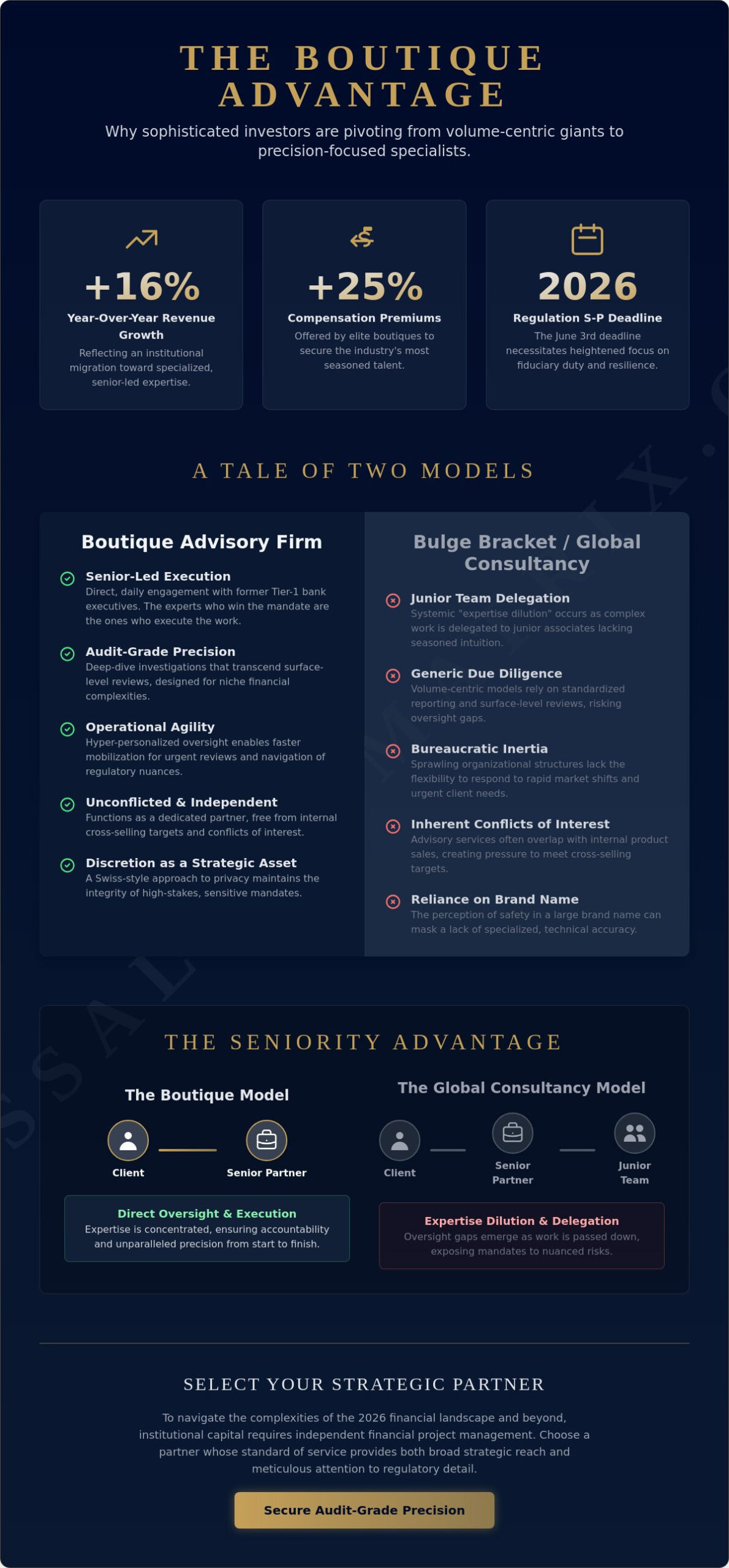
In an environment where elite boutique firms are currently outstripping bulge bracket banks by offering compensation premiums of up to 25% to secure the industry’s most seasoned talent, the traditional assumption that larger institutions provide superior security is being dismantled. You likely recognize that the sprawling bureaucracy of global consultancies often results in generic due diligence, leaving your most sensitive mandates exposed to technical nuances that larger teams frequently overlook. Understanding the boutique advisory firm benefits requires a shift in perspective; it’s a recognition that the 16% year-over-year revenue growth in the boutique sector reflects a broader institutional migration toward specialized, senior-led expertise.
This article explores why sophisticated institutional investors are pivoting toward boutique specialists to secure audit-grade precision in high-stakes global transactions, particularly as the June 3, 2026, compliance deadline for Regulation S-P amendments approaches. We’ll examine how direct access to former Tier-1 bank executives and the implementation of robust risk management frameworks provide the discreet, high-precision oversight necessary to navigate the SEC’s heightened focus on fiduciary duty and operational resilience. By prioritizing technical accuracy over transactional volume, these firms offer a standard of service that is both broad in strategic reach and meticulous in its attention to regulatory detail.
Key Takeaways
- Learn how the 2026 financial landscape necessitates a transition from big-box generalism to a specialized architecture designed for the most intricate niche financial complexities.
- Understand the methodology for eliminating expertise dilution by securing direct, daily engagement with former Tier-1 bank executives rather than delegating mandates to junior-level associates.
- Discover the specific boutique advisory firm benefits inherent in audit-grade deep-dive investigations that transcend the surface-level reviews typical of multi-national consultancies.
- Identify how operational agility and hyper-personalized oversight enable faster mobilization for urgent transactional reviews while effectively navigating evolving global regulatory nuances.
- Explore the essential criteria for selecting a strategic partner capable of providing the independent financial project management required to safeguard institutional capital.
The Evolution of High-Stakes Advisory: Beyond the Big-Box Paradigm
In the current financial epoch, the architectural distinction between a global consultancy and a specialized advisory entity has never been more pronounced. A boutique advisory firm isn’t merely a downscaled version of a “Big Four” institution; it’s a precision instrument engineered to address niche financial complexities that larger, volume-centric organizations often lack the structural flexibility to manage. As institutional investors navigate a 2026 landscape defined by a 16% year-over-year growth in boutique investment banking revenue, the pivot toward these specialist entities reflects a broader demand for audit-grade precision over generic due diligence.
While generalist firms prioritize scale and standardized reporting, the boutique model thrives on intellectual depth and a refusal to oversimplify the intricate dynamics of global capital. This shift is driven by a necessity for independent, unconflicted advisory. When global volatility increases, the inherent conflicts of interest in larger firms, where advisory services often overlap with internal product sales, become a significant liability. One of the primary boutique advisory firm benefits is the preservation of institutional-grade precision through a structure that prioritizes long-term strategic growth over short-term transaction volume.
The Shift Toward Specialist Mandates
Complex cross-border projects in 2026 require more than the perceived safety of a “brand name” consultancy. The rise of independent validation has become a non-negotiable requirement for capital protection, particularly as the SEC intensifies its focus on fiduciary duty and operational resilience. Boutique firms provide the operational agility required to respond to rapid market shifts, offering a level of technical accuracy that withstands intense regulatory scrutiny. This performance-oriented mindset distinguishes a boutique partner from passive participants in the global market.
Discretion as a Strategic Asset
Discretion remains the cornerstone of high-stakes international negotiations. A Swiss-style approach to privacy isn’t just about secrecy; it’s about maintaining the integrity of sensitive deals through a persona that’s elite yet accessible to a specific caliber of audience. Because boutique firms don’t sell competing financial products or manage direct assets, they function as dedicated partners rather than service providers. This unconflicted position ensures that every recommendation is rooted in the strategic preservation of the client’s interests, free from the pressure of internal cross-selling targets. When evaluating boutique advisory firm benefits, the value of a partner whose moral character and high-level standards align with traditional private wealth management cannot be overstated.
The Seniority Advantage: Eliminating Expertise Dilution
Large multi-national consultancies often operate on a structural paradox where the senior partners who secure a mandate are rarely the individuals executing the granular work. This “Junior Team” model creates a systemic dilution of expertise, as complex transactional analysis is delegated to associates who may possess academic proficiency but lack the seasoned intuition required for high-stakes oversight. In contrast, the most significant boutique advisory firm benefits stem from a model that mandates direct, daily engagement with former Tier-1 bank executives. This seniority ensures that every qualifying clause and technical nuance is evaluated by a practitioner who has spent decades navigating the intricacies of global capital markets.
The presence of senior-led oversight fundamentally reduces the risk of “oversight gaps” that frequently occur during standardized due diligence. Seasoned experts don’t merely follow a checklist; they utilize deep-seated pattern recognition to identify subtle fraud indicators and structural anomalies that junior analysts often overlook. Because elite boutique firms are currently paying 15 to 25% above bulge bracket banks to attract top-tier talent, they’ve effectively concentrated a level of institutional wisdom that is no longer accessible through traditional, volume-oriented firms. This concentration of talent allows for a level of intellectual depth that prioritizes long-term preservation over the rapid turnover of project cycles.
The Problem with Delegated Due Diligence
Delegating due diligence to junior staff introduces a “learning on the job” risk that is unacceptable when significant capital is at stake. In cross-border transactions, the cost of a single missed technical nuance can be catastrophic. Executive stakeholders generally prefer peer-to-peer communication, where they can discuss complex instrument validation with advisors who match their professional caliber. This direct line of communication ensures that project management remains logical, steady, and focused on audit-grade precision rather than bureaucratic reporting.
Boutique Pedigree: The Tier-1 Executive Benefit
An audit-grade report is only as reliable as the risk manager who signs off on it. By engaging advisors who have sat on both sides of the institutional table, organizations gain access to financial advisory methodologies that are rooted in historical reliability and regional precision. This pedigree ensures that the verification process is not just a surface review but a deep-dive investigation that can withstand the most intense regulatory scrutiny. To ensure your capital is protected by this level of seasoned expertise, you might consider how the meticulous attention to detail provided by a dedicated partner can stabilize your global mandates.
Precision in the Complex: Why Specialist Validation Surpasses Generalist Review
The technical rigor required for bank instrument validation services transcends the capabilities of a generalist consultancy, primarily because high-value mandates demand more than a superficial verification of documentation. While a large firm might offer a surface review that relies on automated data rooms and standardized checklists, a boutique specialist delivers an audit-grade deep-dive investigation. This methodology involves verifying the underlying liquidity and authenticity of the instrument through direct communication with issuing institutions and on-ground verification. One of the significant boutique advisory firm benefits is this ability to deploy seasoned experts who understand the subtle operational nuances that distinguish a legitimate financial instrument from a high-stakes fraudulent scheme.
In the 2026 regulatory environment, where the SEC has heightened its focus on operational resilience and fiduciary duty, the necessity for tailored risk frameworks is paramount. A boutique firm doesn’t apply a generic template to every transaction; instead, it constructs a bespoke oversight plan that accounts for the specific jurisdiction and the unique characteristics of the asset class. This hyper-personalization ensures that the validation process isn’t just a hurdle to be cleared, but a strategic safeguard for capital preservation. By prioritizing intellectual depth over transactional volume, these specialists provide the intellectual superiority required to manage the most intricate financial dynamics.
Validating the Invaluable: SBLCs and LCs
Standard due diligence checklists are frequently insufficient for high-value instruments like Standby Letters of Credit (SBLCs) and Documentary Letters of Credit (LCs). These instruments require a profound understanding of UCP 600 standards and the specific banking protocols of the issuing region. The boutique approach focuses on independent review to mitigate counterparty risk, ensuring that the liquidity promised is both accessible and unencumbered. This level of scrutiny is essential for institutional entities that cannot afford the reputational or financial fallout of a failed transaction, reinforcing the boutique advisory firm benefits of specialized, unconflicted oversight.
Cross-Border Due Diligence: A Tactical Approach
Navigating the friction between disparate international financial regulations requires executive-level intelligence rather than automated processing. Boutique firms bridge the gap between global standards and local operational realities by conducting on-ground verification services that automated data rooms cannot replicate. This tactical approach is particularly vital as the June 3, 2026, compliance deadline for Regulation S-P amendments approaches, requiring firms to demonstrate meticulous data protection and operational integrity. By utilizing this model, investors gain a partner capable of translating complex regional requirements into a logical, structured risk management framework that encourages confidence in the decision-making process.
Operational Agility and Discretion: Navigating Global Regulatory Nuance
Operational agility in a boutique context isn’t just about speed; it’s about the ability to mobilize senior resources without the friction of multi-layered approval committees. When a transactional review is urgent, the streamlined hierarchy of a specialist firm allows for immediate deployment of risk management frameworks. This efficiency is a core component of boutique advisory firm benefits, particularly when navigating the intricate web of international financial regulations in 2026. As the SEC intensifies its scrutiny of operational resilience, the capacity to provide hyper-personalized oversight becomes a significant strategic differentiator for institutional entities.
With the June 3, 2026, compliance deadline for Regulation S-P amendments approaching for smaller entities, the demand for advisors who possess technical dexterity has surged. Boutique specialists are uniquely positioned to manage sensitive stakeholder relationships by acting as a protective authority. They don’t just process data; they interpret regulatory nuances regarding AI and cybersecurity to ensure that every project phase remains in alignment with evolving standards of conduct. This logical, steady progression from principle to practice encourages a sense of professional calm that larger, more frantic organizations struggle to replicate. It’s a standard of service that’s both broad in strategic reach and meticulous in its attention to detail.
Tailored Frameworks vs. Standard Templates
“One-size-fits-all” due diligence often fails because it lacks the granularity required for complex project management in the current M&A environment. Boutique firms prioritize intellectual depth by creating bespoke risk assessment documentation that caters specifically to executive-level decision-making. This structural flexibility allows a team to pivot strategy immediately if new data emerges during an investigation, ensuring that the final audit-grade report reflects the absolute current reality of the mandate. Unlike the rigid protocols of bulge-bracket banks, these tailored frameworks accommodate the technical nuances of each specific instrument, providing boutique advisory firm benefits that generalist models simply can’t match.
Discreet Global Reach
Maintaining a low profile while conducting on-ground verification is essential for preserving deal integrity in high-stakes environments. Boutique firms leverage high-level global networks to secure “executive-level intelligence” without leaving the heavy footprint associated with major consultancies. This “Swiss-inspired” precision ensures that confidentiality is maintained throughout the engagement, positioning the firm as a dedicated partner rather than a mere service provider. This approach is particularly effective in cross-border mandates where regional excellence and precision are paramount. To secure this level of discreet, high-precision oversight for your next transaction, you can consult with our seasoned experts to establish a robust risk management framework.
Selecting Your Strategic Partner: The Swiss Alpha Matrix Standard
Identifying the appropriate partner for high-stakes financial mandates requires a departure from brand-name reliance toward a rigorous assessment of technical pedigree. While the broader market often equates size with security, the realized boutique advisory firm benefits manifest in the intellectual superiority and unconflicted guidance provided during high-stakes negotiations. In an era defined by heightened SEC scrutiny and evolving global volatility, the ultimate safeguard for institutional capital isn’t found in the scale of an organization, but in the independent financial project management that only a senior-led boutique can provide.
This selection process must be logical, steady, and focused on the long-term preservation of strategic interests. It’s about finding a master planner who can navigate the intricate nature of global capital with a sense of quiet authority and historical reliability. By prioritizing firms that offer hyper-personalization, institutional investors ensure their mandates are handled by seasoned experts who prioritize technical accuracy over transactional volume. This standard of service is essential for those who value nuance and thoroughness in an increasingly complex financial landscape.
The Pedigree Checklist for Executives
- Verify former Tier-1 experience: The professional background of the principals is the most reliable predictor of whether a report will achieve audit-grade precision.
- Assess the methodology: Determine if the firm utilizes institutional-grade risk management frameworks that are tailored to the specific instrument or jurisdiction rather than generic checklists.
- Evaluate the specialized focus: Ensure the firm possesses the technical depth required for the specific complexity of your deal, particularly in areas like bank instrument validation or on-ground verification.
The Swiss Alpha Matrix Commitment
At Swiss Alpha Matrix, our leadership team personally oversees every mandate from inception to completion, ensuring that no qualifying clause or technical nuance is overlooked. We integrate rigorous financial discipline with regional precision to provide a standard of service that reflects the traditional discretion of high-end private wealth management. This commitment ensures that your interests are in the hands of seasoned, unemotional experts who prioritize strategic growth and capital preservation. For those seeking to secure precision through senior-level expertise, we invite you to contact Swiss Alpha Matrix for a confidential consultation regarding your cross-border due diligence and project management requirements.
Securing Institutional Precision in an Evolving Market
The transition from generalist consulting toward specialized, senior-led oversight represents a fundamental shift in how institutional capital is protected. By prioritizing direct access to former Tier-1 global bank executives and implementing audit-grade instrument validation standards, organizations can effectively mitigate the risks associated with expertise dilution and bureaucratic delays. These boutique advisory firm benefits ensure that every high-stakes mandate receives the intellectual depth and meticulous attention to detail required to withstand intense regulatory scrutiny. It’s a strategic choice that favors long-term stability over the surface-level reviews typical of volume-oriented firms.
As global financial dynamics become increasingly intricate, the value of a partner who combines global reach with traditional Swiss discretion cannot be overstated. This methodology provides a logical, structured framework for capital preservation, moving beyond standardized templates to deliver hyper-personalized project oversight. It’s a standard of service that recognizes that precision isn’t just a metric, but a commitment to moral character and high-level standards. We invite you to contact Swiss Alpha Matrix for a confidential review of your complex financial mandates. Entrusting your strategic objectives to seasoned experts who prioritize long-term stability will provide the professional calm and certainty necessary for successful execution.
Frequently Asked Questions
What is the primary difference between a boutique advisory firm and a “Big 4” consultancy?
The primary distinction lies in the architectural execution of mandates, where boutique firms prioritize senior-led precision over the volume-centric models favored by “Big 4” consultancies. While larger institutions often delegate complex technical analysis to junior associates, boutique specialists ensure that former Tier-1 bank executives personally oversee every project phase. This structural difference ensures that the intellectual depth of the firm’s principals is directly applied to your most sensitive financial requirements.
Can a boutique firm handle the same level of technical complexity as a global institution?
Boutique firms frequently surpass global institutions in handling technical complexity because they specialize in niche, audit-grade instrument validation rather than generic advisory services. These entities are engineered specifically for high-stakes mandates that demand on-ground verification and meticulous risk management frameworks. By focusing on intellectual superiority and regional excellence, boutiques provide a standard of technical accuracy that withstands intense regulatory scrutiny in cross-border transactions.
Why is senior leadership involvement so critical in financial instrument validation?
Senior leadership involvement is essential because seasoned risk managers possess the pattern recognition required to identify subtle fraud indicators that automated systems and junior analysts typically overlook. In the context of boutique advisory firm benefits, this expertise ensures that every qualifying clause in a financial instrument is verified with absolute precision. This level of professional competence is non-negotiable when validating high-value assets like SBLCs or documentary letters of credit.
How do boutique firms ensure regulatory compliance across different international jurisdictions?
Boutique firms maintain regulatory dexterity by constructing bespoke risk management frameworks that account for the friction between disparate international financial regulations. Rather than applying a standard template, these specialists utilize on-ground verification services to bridge the gap between global standards and local operational realities. This approach is particularly critical for navigating the 2026 SEC focus on operational resilience and the June 3 compliance deadline for Regulation S-P.
What are the cost benefits of hiring a boutique firm for complex project management?
The cost benefits of engaging a boutique firm are realized through operational agility and the mitigation of “learning on the job” risks associated with junior-heavy teams. Senior-led specialists mobilize faster for urgent transactional reviews, reducing bureaucratic delays that can impede high-stakes negotiations. By ensuring audit-grade precision from the inception of a project, boutiques prevent the financial fallout of failed transactions and the high costs of regulatory non-compliance.
How does a boutique firm maintain discretion during high-stakes cross-border investigations?
Discretion is maintained through a “Swiss-inspired” approach that leverages high-level global networks without the heavy organizational footprint of a major consultancy. Boutique firms operate as dedicated partners, prioritizing privacy and exclusivity to ensure that sensitive stakeholder relationships remain protected throughout an investigation. This persona of quiet authority allows for high-impact on-ground verification while maintaining the absolute integrity of the transaction.
Is a boutique firm suitable for long-term retainer-based strategic consulting?
A boutique firm is exceptionally suited for long-term retainer-based consulting because its personality is rooted in historical reliability and the strategic preservation of interests. Unlike firms that prioritize short-term speculation, boutiques offer steady, high-precision project oversight that aligns with long-term growth objectives. This model provides executive stakeholders with consistent, unconflicted access to seasoned experts who understand the evolving boutique advisory firm benefits in a volatile global economy.