

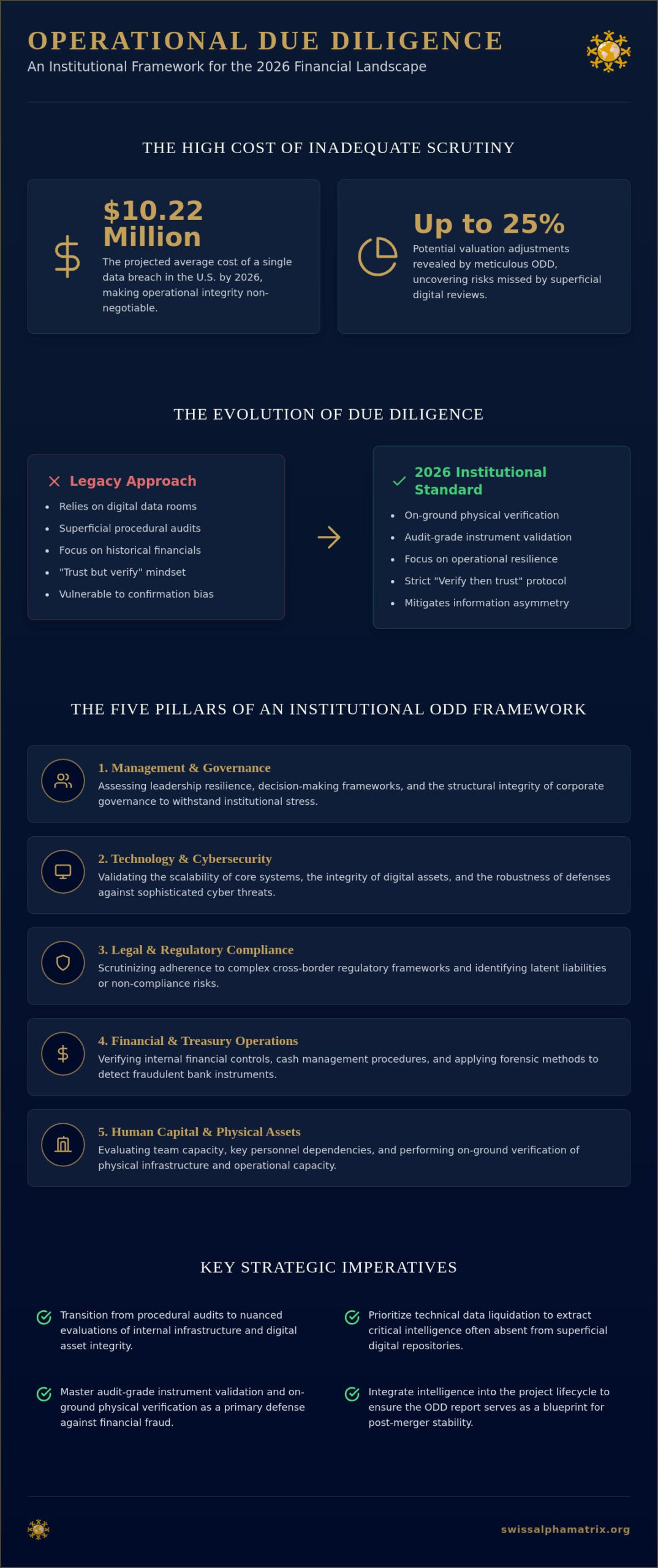
With the average cost of a data breach in the United States reaching an unprecedented $10.22 million in 2026, the margin for error in institutional capital deployment has effectively vanished. You likely recognize that a robust operational due diligence checklist is no longer a mere administrative formality, but a critical defense against the profound information asymmetries and misrepresented capacities often encountered in emerging markets. Relying on the superficial transparency of digital data rooms represents a risk that seasoned experts cannot afford to take, particularly when meticulous scrutiny often leads to valuation adjustments of up to 25%.
This article provides an audit-grade framework designed for the complexities of cross-border mandates and the requirements of Tier-1 financial environments. By following this protocol, you’ll gain the executive-level intelligence necessary to validate internal systems and detect fraudulent bank instruments with absolute precision. We’ll explore a roadmap for on-ground verification, the integration of 2026 regulatory standards, and the specific methodologies required to ensure long-term capital preservation through a lens of regional excellence and technical accuracy.
Key Takeaways
- Understand the necessary transition from traditional procedural audits to a nuanced evaluation of internal infrastructure and digital asset integrity, tailored to the specific geopolitical volatility of the 2026 financial landscape.
- Implement a rigorous operational due diligence checklist that prioritizes technical data liquidation, ensuring that the critical intelligence often absent from superficial digital repositories is meticulously extracted.
- Master the application of audit-grade instrument validation and on-ground physical verification as the primary defense against increasingly sophisticated cross-border financial fraud and misrepresented operational capacity.
- Evaluate the structural viability of target entities through a pillar-based framework, focusing on leadership’s resilience and the scalability of core technological systems under significant institutional stress.
- Integrate institutional-grade intelligence into the broader project management lifecycle to ensure that the due diligence report serves as a functional blueprint for post-merger stability and strategic growth.
Redefining Operational Due Diligence for the 2026 Financial Landscape
Operational due diligence (ODD) represents the rigorous, multi-faceted assessment of a target entity’s internal infrastructure, governance systems, and human capital. While historical approaches often treated this as a peripheral exercise to financial auditing, the 2026 landscape, characterized by heightened geopolitical shifts and the rapid digitization of financial instruments, demands a more profound interrogation of operational viability. To understand What is Operational Due Diligence in a modern context, one must view it as the primary mechanism for mitigating the information asymmetry inherent in global markets. The transition from a “trust but verify” mindset to a strictly institutional “verify then trust” protocol is no longer optional; it’s a fundamental requirement for capital protection.
Surface-level digital data rooms, while efficient for document distribution, frequently fail to provide the depth of intelligence required to protect cross-border capital. These repositories often lack the granular detail necessary to identify misrepresented operational capacity or the subtle indicators of fraudulent bank instruments that have become increasingly sophisticated. Consequently, a robust operational due diligence checklist must now account for geopolitical volatility and the integrity of digital assets as core components of risk management. Without this level of scrutiny, investors remain vulnerable to structural failures that no amount of financial engineering can rectify once the mandate has been executed.
The Evolution of the ODD Mandate
The traditional focus on EBITDA and historical financial performance is increasingly viewed as a lagging indicator of institutional longevity. In contrast, operational resilience provides a more accurate forecast of long-term value, particularly during periods of market stress where internal systems are tested to their limits. Engaging an independent advisory partner is essential to prevent the confirmation bias that often plagues high-stakes acquisitions, where internal deal teams may inadvertently overlook structural flaws in pursuit of transaction closure. In 2026, ODD is defined as a multi-layered strategic autopsy of operational viability that seeks to uncover the hidden frictions within a target’s execution model.
Institutional Standards vs. Generic Audits
Tier-1 global banks and sophisticated institutional investors require more than a generic audit; they demand audit-grade validation of all operational claims to ensure alignment with stringent regulatory frameworks. While automated due diligence tools have gained popularity for their computational velocity, they possess significant limitations in complex, cross-border environments where cultural nuances and local regulatory idiosyncrasies prevail. Establishing a protocol for cross-border investment due diligence serves as the cornerstone of capital preservation. This ensures that every component of the operational due diligence checklist is executed with regional precision and technical accuracy, moving beyond the digital ledger to confirm the physical and procedural reality of the target firm.
The Five Pillars of an Institutional ODD Framework
Constructing an institutional-grade operational due diligence checklist requires a departure from standard compliance toward a pillar-based strategic assessment. This framework ensures that every facet of the target’s operational engine is scrutinized for latent vulnerabilities that could jeopardize capital. It’s not simply about checking boxes; it’s about validating the structural integrity of the entire enterprise. A sophisticated protocol must be built upon five non-negotiable pillars that govern the long-term viability of any Tier-1 investment mandate.
- Management and Governance: We evaluate the leadership’s historical capacity to maintain operational poise under extreme institutional stress.
- Technological Infrastructure: With the average cost of a data breach reaching $10.22 million in 2026, we assess the scalability and security of core systems with surgical precision.
- Regulatory and Compliance Frameworks: Identifying hidden liabilities in foreign jurisdictions is paramount, particularly as the regulatory environment becomes increasingly fragmented.
- Supply Chain and Logistics: We validate resilience against global macro-economic shifts, ensuring that the target’s physical operations are not tethered to fragile nodes.
- Financial Cohesion: Operational data must align perfectly with the financial advisory methodologies employed during the initial deal structuring.
For entities navigating these multifaceted requirements, utilizing specialized risk management frameworks provides the necessary layer of institutional security.
Management and Human Capital Assessment
Leadership is the bedrock of operational stability. A sophisticated assessment must look beyond the C-suite to evaluate the depth of the middle-management layer, as these individuals are the actual stewards of operational continuity during volatile post-acquisition periods. We analyze “Key Man Risk” to ensure the organization isn’t overly dependent on a single architect. Furthermore, corporate culture is scrutinized through independent, off-book intelligence to predict post-merger integration success, ensuring that the human element of the operational due diligence checklist is as robust as the technical one.
Technological and Regulatory Integrity
The 2026 landscape introduces complex compliance hurdles that demand immediate attention. Our framework ensures alignment with international financial regulations, including the FCA’s May 2026 requirements for e-money safeguarding audits and California’s SB 253 emissions reporting deadlines on August 10, 2026. Beyond mere compliance, we audit the target’s cybersecurity posture and technical debt. Proprietary software stacks are evaluated for scalability, ensuring they can support projected growth without requiring a total architectural overhaul that could drain capital reserves.
Mitigating Cross-Border Risks: Instrument Validation and Physical Verification
In the current climate of sophisticated financial malfeasance, a misplaced reliance on digital documentation represents a profound strategic weakness. While many institutional participants assume that a populated data room equates to transparency, the reality of cross-border investment programs often reveals a disturbing prevalence of misrepresented operational capacity. To counter these risks, an effective operational due diligence checklist must move beyond the screen, integrating audit-grade instrument validation with on-ground verification. This methodology merges the precision of Swiss financial discipline with global intelligence, ensuring that capital is protected by more than just a digital ledger. It’s a necessary evolution for those managing mandates in environments where information asymmetry is the default state.
The rising threat of sophisticated fraud within cross-border programs demands a refusal to accept documents at face value. Fraudulent bank instruments are often crafted with enough technical accuracy to bypass basic compliance checks, yet they lack the underlying institutional backing required for execution. By prioritizing physical reality over digital representations, we eliminate the primary vector for transactional failure. This approach isn’t merely about risk avoidance; it’s about establishing a foundation of absolute certainty before any capital is deployed into foreign or emerging markets.
Validating Complex Financial Instruments
The verification of financial instruments, particularly those involving standby letters of credit (SBLC) or bank guarantees, requires a specialized protocol that transcends standard ledger reviews. Utilizing bank instrument validation services is the only definitive defense against the proliferation of fraudulent Swift MT760 and MT799 messages. We look for specific red flags, such as inconsistencies in issuing bank credentials or non-standard language that deviates from International Chamber of Commerce (ICC) standards. This rigorous process ensures that every instrument is validated directly with the issuing institution, maintaining strict regulatory compliance across key financial hubs including Geneva, London, and Hong Kong. It ensures the operational due diligence checklist covers the technical authenticity of the funding source itself.
The “Last Mile” of ODD: On-Ground Reality
True operational integrity is confirmed at the “last mile,” where physical assets and local stakeholders are scrutinized without the filtered lens of a target’s management team. On-ground verification remains the gold standard for validating the existence and actual condition of physical assets in remote or complex jurisdictions. By conducting site visits and interviewing local stakeholders in environments free from corporate influence, we uncover the discrepancies that digital data rooms are designed to obscure. Digital-only due diligence is a strategic vulnerability in 2026, as it provides a false sense of security while leaving investors exposed to the physical realities of operational failure. We don’t just review records; we confirm that the infrastructure described in the mandate exists in the exact capacity claimed.
The 2026 Operational Due Diligence Checklist: A Strategic Protocol
The execution of a Tier-1 mandate requires a structured progression that eliminates the ambiguity often found in traditional, document-heavy audits. A sophisticated operational due diligence checklist serves as a phased strategic roadmap, moving from broad philosophical alignment to the granular validation of physical and financial assets. This protocol is designed to dismantle information asymmetry by treating every disclosure as a hypothesis that must be rigorously tested. By following a structured five-phase approach, institutional investors can ensure that their capital is protected by a framework of inevitable logic rather than optimistic assumptions.
- Phase 1: Pre-Mandate Scoping: We begin by defining the investment thesis and risk tolerance, ensuring that the ODD parameters align with the specific strategic objectives of the board.
- Phase 2: Technical Data Liquidation: This phase involves extracting the “missing” data from digital data rooms, identifying discrepancies between reported metrics and underlying operational realities.
- Phase 3: Operational & Instrument Validation: Every capital-backing instrument, including SBLCs and bank guarantees, undergoes audit-grade authentication to confirm institutional legitimacy.
- Phase 4: Physical Inspection & Stakeholder Interviews: On-ground verification of assets and infrastructure is conducted to ensure that the physical reality matches the digital ledger.
- Phase 5: Synthesis & Executive Reporting: The final output is a definitive risk-mitigation roadmap, providing unbiased, executive-level intelligence for final capital deployment.
For institutions requiring the immediate deployment of these rigorous standards, our Operational Due Diligence services provide the technical depth necessary to secure complex mandates.
Pre-Deal and Data Room Protocols
Success in cross-border environments depends on the clarity of the team’s internal structure. We establish a comprehensive RACI matrix for the due diligence team, clearly defining who is Responsible, Accountable, Consulted, and Informed at every stage of the interrogation. This structure is essential for identifying “blind spots” in the target’s self-disclosed information, particularly regarding regulatory nuances. For instance, mandates involving UK-based entities must now account for the FCA’s May 2026 requirements for e-money safeguarding audits, while those in the US must navigate the CFPB’s Regulation B amendments effective July 21, 2026. Without this jurisdictional precision, even the most thorough operational due diligence checklist remains incomplete.
Validation and Physical Inspection Milestones
The transition from digital review to physical reality is where most generic audits fail. Our protocol for bank instrument authentication utilizes Swift protocol verification to ensure that every financial guarantee is issued by a verified Tier-1 institution. This technical rigor is matched by our on-ground asset inspection, which employs a 10-point checklist covering everything from equipment maintenance logs to environmental compliance records. Stakeholder interviews are conducted with middle management and local partners away from the influence of executive leadership, allowing us to extract the “unspoken” risks and cultural frictions that could jeopardize post-merger integration.
From Due Diligence to Execution: Integrating Intelligence into Project Management
The delivery of a final report often creates a false sense of finality among institutional participants. While generic advisors might view the synthesis of data as the conclusion of their mandate, the intelligence extracted through a sophisticated operational due diligence checklist must instead function as the foundational blueprint for post-merger integration and long-term asset stewardship. Bridging the gap between the investigative advisory phase and the subsequent complexities of independent financial project management is where theoretical risk mitigation transforms into tangible capital protection. Without this seamless transition, the most meticulous findings remain academic, leaving the enterprise vulnerable to the very execution risks the due diligence process sought to identify.
Ongoing regulatory oversight is particularly vital in cross-border programs where the legal landscape remains in a state of constant flux. Considering that the average time to identify and contain a data breach has reached 241 days in 2026, the operational milestones established after the deal closes must include continuous monitoring of cybersecurity posture and internal governance. We ensure that the findings from the initial interrogation are translated into actionable project phases, moving beyond the digital ledger to maintain a state of permanent audit-readiness. This disciplined approach ensures that the “verify then trust” protocol extends throughout the entire lifecycle of the investment.
Post-DD Project Oversight
The transition from investigative advisor to strategic project manager requires the conversion of the operational due diligence checklist results into a robust Risk Management Framework. This framework serves as the primary governing document for the integration phase, ensuring that every identified vulnerability, from “Key Man Risk” to technical debt, is systematically addressed. By maintaining audit-grade documentation throughout the project lifecycle, we provide the board with a continuous stream of unbiased intelligence. This level of oversight is essential for preventing the operational drift that often occurs when the initial deal team departs and the reality of day-to-day management begins.
The Swiss Alpha Matrix Approach to Capital Protection
Our methodology merges traditional Swiss financial discipline with executive-level project oversight to ensure that capital deployment decisions are made with surgical precision. We don’t merely identify risks; we architect the systems required to manage them, ensuring that every operational milestone is tethered to the original investment thesis. This partnership model prioritizes long-term preservation over short-term speculation, providing a standard of service that is both broad in reach and meticulous in its attention to detail. To ensure your interests are managed by seasoned, unemotional experts, consult with Swiss Alpha Matrix to secure your next mandate.
Securing Institutional Longevity through Rigorous Operational Interrogation
The transition from investigative due diligence to successful capital deployment requires a fundamental shift in perspective. An institutional operational due diligence checklist must serve as more than a collection of retrospective findings; it’s the strategic blueprint that governs the entire project lifecycle. By prioritizing physical reality over digital representations and ensuring that financial instruments are authenticated with audit-grade precision, you establish a standard of certainty that is essential for navigating the complexities of the 2026 financial environment. This disciplined methodology ensures that every mandate is executed with the technical depth required to protect long-term interests.
Protecting capital in high-stakes, cross-border environments demands a level of expertise that only seasoned practitioners can provide. Led by former senior executives from Tier-1 global banks, our firm offers the sophisticated audit-grade instrument validation and global on-ground verification capabilities required to secure institutional mandates. Consult with our former Tier-1 executives to secure your next mandate. We’re here to ensure that your strategic growth is built upon a foundation of absolute operational integrity and historical reliability.
Frequently Asked Questions
What is the difference between financial and operational due diligence?
Financial due diligence primarily examines historical fiscal performance and ledger accuracy, whereas operational due diligence interrogates the underlying infrastructure and human capital that generate those figures. While one validates the numbers, the other assesses the sustainability of the systems and processes required to maintain them under institutional stress. This distinction is critical for investors who recognize that revenue alone does not guarantee future operational resilience.
How long does a comprehensive operational due diligence process take in 2026?
A comprehensive interrogation typically spans four to eight weeks, though the exact duration is contingent upon the complexity of the cross-border mandate and the accessibility of on-ground assets. This measured pace allows for the rigorous technical data liquidation and physical verification phases necessary to ensure the operational due diligence checklist meets Tier-1 institutional standards. Such a timeline ensures that no strategic pillar is overlooked in the pursuit of transaction velocity.
Why is physical on-ground verification necessary for digital-heavy businesses?
Physical verification remains essential even for digital-heavy entities because it validates the human and geographic reality behind the software. It ensures that misrepresented operational capacity or “ghost” infrastructure is identified before capital is committed. Site visits allow for unfiltered interviews with local stakeholders, which often reveal structural vulnerabilities that digital data rooms are architected to obscure, providing a layer of certainty that digital ledgers cannot replicate.
Can operational due diligence detect fraudulent bank instruments?
Yes, a sophisticated protocol can detect fraudulent bank instruments by utilizing direct Swift protocol verification and issuing bank authentication. By scrutinizing MT760 or MT799 messages for non-standard language or institutional inconsistencies, experts can identify sophisticated forgeries that basic compliance checks might overlook. This ensures that all capital-backing instruments are legitimate and enforceable within the specific regulatory frameworks of hubs like London or Geneva.
What are the most common red flags in cross-border operational due diligence?
Common indicators of risk include significant “Key Man Risk” within the management layer, inconsistent operational data across digital repositories, and technical debt that threatens scalability. In cross-border mandates, red flags often manifest as vague regulatory disclosures or financial instruments issued by unverified institutions. Identifying these discrepancies early allows for valuation adjustments or the implementation of protective frameworks before the execution phase begins.
How do international financial regulations impact the ODD checklist?
Regulatory shifts, such as the FCA’s May 2026 safeguarding requirements and California’s SB 253 emissions reporting deadlines on August 10, 2026, necessitate frequent updates to the operational due diligence checklist. These mandates require institutions to validate third-party supplier integrity and non-financial misconduct standards, ensuring that compliance is maintained across all relevant jurisdictions. This ensures that the framework remains a precise instrument for identifying hidden liabilities in an evolving legal landscape.
Who should lead the operational due diligence team for a Tier-1 deal?
The team should ideally be led by former senior executives from Tier-1 global banks who possess the seasoned, unemotional judgment required for high-stakes mandates. These individuals bring the master-planner perspective necessary to coordinate complex project management and technical validation. Their background ensures that the investigative process remains unbiased and focused on long-term capital preservation rather than the short-term speculation often found in generic advisory firms.
What constitutes an audit-grade operational due diligence report?
An audit-grade report is a definitive risk-mitigation roadmap that provides unbiased, executive-level intelligence supported by verified data. It must include validated evidence of internal system integrity, authenticated financial instruments, and on-ground verification findings. This document serves as the strategic blueprint for capital deployment, offering the technical depth required to withstand the scrutiny of institutional boards and ensure that every operational claim is backed by physical reality.