

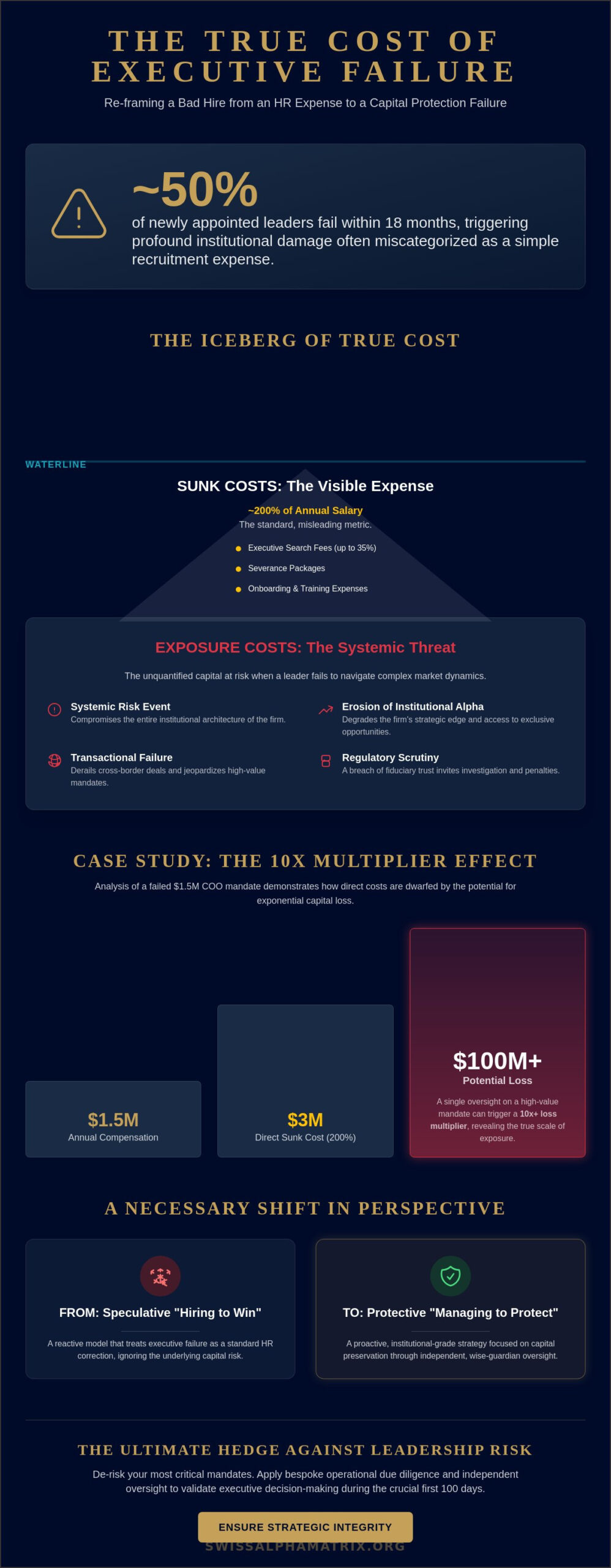
If nearly half of newly appointed leaders fail within eighteen months, why is the resulting institutional damage still treated as a mere recruitment expense rather than a profound capital protection failure? While standard metrics estimate the cost of a bad hire in an executive role at approximately 200% of their annual salary, it’s a figure that ignores the systemic risk and capital exposure that occur when a $1.5 million COO mandate fails to align with your firm’s cultural architecture. You understand that leadership transitions are delicate maneuvers where any deviation from excellence can derail cross-border transactions and erode the hard-won confidence of your institutional investors.
This article presents a sophisticated framework for C-suite stakeholders to quantify the specific capital exposure and project-driven risks that follow leadership instability. We’ll analyze the implications of the 8.2% rise in talent costs documented in the 2026 Report on the State of the US Legal Market, while providing bespoke strategies to mitigate the impact of executive failure on your long-term alpha generation. By validating the necessity of independent oversight, we offer a logical path to ensure your leadership transitions reflect the precision and permanence required to preserve your organization’s strategic integrity.
Key Takeaways
- Reframe executive failure as a systemic risk event that necessitates an institutional-grade approach to capital preservation rather than a standard HR correction.
- Discover why leadership instability in complex financial environments leads to the erosion of reputational capital and triggers the withdrawal of institutional funding.
- Evaluate the true cost of a bad hire in an executive role through a framework that measures the fragility of cross-border transactions and potential regulatory fallout.
- Apply bespoke operational due diligence protocols to validate executive decision-making during the critical first 100 days of a new strategic mandate.
- Shift your organizational focus from a speculative “hiring to win” model toward a “managing to protect” strategy supported by independent, wise-guardian oversight.
Quantifying Capital Exposure: The True Cost of Executive Failure
Standard HR metrics typically quantify the cost of a bad hire in an executive role at approximately 200% of their annual compensation, yet this figure, while mathematically accurate in terms of direct expenditures, fails to capture the systemic risk inherent in Tier-1 financial mandates. For a COO at a premier firm where total compensation may exceed $1.5 million, the immediate loss of $3 million is merely the surface of the damage. We must shift our perspective to view a failed leadership appointment not as a localized recruitment error, but as a profound systemic risk event that compromises the institutional architecture of the firm. It’s a breach in the protective barrier that separates your capital from the volatile currents of the global market.
The distinction between sunk costs and exposure costs is vital for any stakeholder concerned with long-term wealth preservation. Sunk costs, comprising executive search fees that often reach 35% of first-year compensation and the subsequent severance packages, are manageable accounting line items. Exposure costs, however, represent the unquantified capital at risk when a leader lacks the intellectual depth to navigate intricate market dynamics. In regulated financial environments, the fiduciary implications of such a failure are severe; they involve a breach of trust that can invite regulatory scrutiny and destabilize the firm’s strategic posture. When an executive fails, they don’t just leave a vacancy; they leave a legacy of unmanaged risk.
The Multiplier Effect in High-Stakes Finance
The financial impact of leadership failure follows a non-linear path, often resulting in a multiplier effect that dwarfs the executive’s base salary. Consider the complexities involved when an executive mismanages a bank instrument validation service; a single technical oversight in this arena can jeopardize a $100M+ mandate. One misstep in the oversight of complex project management or the validation of high-value assets can trigger a 10x loss relative to the individual’s annual earnings. Within this context, we define executive failure as a fundamental breakdown in the institutional risk management framework, where the protective layers of the organization are stripped away by a lack of technical precision.
Erosion of Institutional Alpha
Institutional alpha is the byproduct of a firm’s strategic edge, a quality that is painstakingly built and easily degraded by a misaligned leader. A leader who doesn’t embody the principles of Swiss-grade excellence will slowly erode the reputational capital that facilitates access to exclusive investment opportunities. The erosion of this reputational capital often represents the hidden, long-term cost of a bad hire in an executive role, as it limits the firm’s ability to secure bespoke mandates. When stakeholder trust begins to fracture, the bad hire evolves from a personnel issue into a direct threat to capital preservation. It’s the point where the quiet authority of the firm is replaced by the loud urgency of crisis management, signaling to the market that the firm’s strategic architect has failed in their primary duty.
Strategic and Operational Toll on Cross-Border Transactions
While a domestic transaction might absorb minor administrative friction, the intricate architecture of a cross-border mandate, particularly those bridging the regulatory divide between Geneva and Hong Kong, remains exceptionally sensitive to the caliber of its oversight. The cost of a bad hire in an executive role is often realized when the delicate chain of international deal-making fractures due to a lack of jurisdictional nuance or cultural misalignment. In high-stakes environments, where every movement is governed by international financial regulations, a single leadership misstep doesn’t merely delay a project; it can invalidate months of operational due diligence and compromise the firm’s standing with foreign counterparties. These “on-ground” mistakes in unfamiliar territories like London’s City or Hong Kong’s Central district carry a heavy premium, as they often necessitate costly remedial legal interventions to restore the transaction’s viability.
The institutional fragility of these deals means that a weak executive link effectively breaks the entire strategic chain. When leadership fails to provide the necessary intellectual depth to navigate multi-layered compliance requirements, the firm’s capital is exposed to unnecessary volatility. For those seeking to fortify their leadership pipelines, engaging with seasoned strategic architects ensures that each bespoke mandate is executed with the requisite Swiss precision, protecting your firm from the systemic risks inherent in global expansion.
Deal Integrity in Global Hubs
Consider the divergent outcomes of a mandate managed with Swiss-grade precision in Geneva versus a failed execution in Hong Kong. A six-month delay in a bespoke mandate, often the result of an executive’s inability to harmonize local operational realities with global strategic goals, can destroy millions in potential value. This failure underscores why mastering cross-border investment due diligence requires more than technical skill; it demands a sophisticated understanding of how leadership decisions ripple through international markets. The cost of a bad hire in an executive role is thus measured in the irreversible loss of time and the subsequent erosion of the firm’s competitive alpha.
Regulatory and Compliance Exposure
The financial penalties associated with AML or Form PF reporting errors, frequently caused by incompetent oversight during a transition, are rising alongside broader market pressures. According to the Thomson Reuters 2026 Report on the State of the US Legal Market, talent costs rose by 8.2% in 2025, which significantly increases the financial stakes of every compliance failure. A bad hire doesn’t just invite immediate fines; it fundamentally alters the firm’s risk profile with global regulators, leading to increased scrutiny that can persist for years. In 2026, the average regulatory fine for oversight failure in specialized financial sectors has reached levels that can threaten the very capital preservation goals the firm was established to protect.
The Intangible Cost: Reputational Capital and Stakeholder Trust
Reputational capital, though it lacks a fixed line on a balance sheet, remains the primary currency within the elite spheres of Swiss private banking and institutional finance. When a leadership transition falters, the resulting “discretion gap”, that period where institutional failure becomes apparent to external stakeholders, damages the subtle matrix of trust that takes decades to architect. This isn’t merely a personnel issue. It’s a direct catalyst for investor flight. The correlation between leadership instability and capital withdrawal is absolute, as sophisticated investors prioritize the preservation of capital through stable, seasoned stewardship. Beyond the visible financial outlays, the true cost of a bad hire in an executive role includes the catastrophic loss of institutional knowledge, a resource that’s often irreplaceable within the immediate fiscal year.
Sophisticated advisory contexts demand a level of privacy that a public executive failure inherently violates. While the market may forgive a temporary dip in risk-adjusted returns, it’s far less lenient regarding a perceived vacuum in strategic architecture. For law firm executives specifically, where the replacement cost can escalate to 400% of the annual salary, the financial burden is compounded by the erosion of the firm’s cultural integrity. Stakeholders don’t just see a vacancy; they see a breakdown in the firm’s ability to vet the very individuals tasked with protecting their interests.
Visible vs. Invisible Failure Costs
Understanding the hierarchy of these losses requires a clear distinction between “Visible” sunk costs and “Invisible” exposure costs. While recruitment fees and severance packages are easily audited, the invisible costs represent approximately 80% of the total institutional impact. These failures often degrade the integrity of institutional-grade financial advisory methodologies, leading to a long-term dilution of the firm’s strategic edge.
| Metric Category | Visible Sunk Costs | Invisible Exposure Costs (80%) |
|---|---|---|
| Recruitment & Logistics | 25-35% Search Fees | Strategic Misalignment |
| Compensation | Up to 200% Annual Salary | Loss of Institutional Knowledge |
| Stakeholder Relations | Severance & Legal Fees | Investor Flight & Capital Withdrawal |
Stakeholder Management Breakdown
A misaligned leader disrupts the established RACI matrix, creating a decision-making hierarchy that’s both sluggish and technically imprecise. This disruption is particularly costly when mending fractured relationships with Tier-1 global banks, where trust is the prerequisite for any bespoke mandate. Standard search firms often lack the technical depth to identify these nuances, leading to a mismatch that jeopardizes the firm’s long-term alpha. 85% of HR professionals report that a single bad hire negatively affects the morale and productivity of the entire team, yet in an institutional context, this “morale” hit translates directly into a loss of execution speed for complex, cross-border projects. The cost of a bad hire in an executive role is thus a multi-layered failure of the firm’s internal risk management framework.
De-Risking the Mandate: Frameworks for Capital Protection
Mitigation of systemic risk requires more than a standard onboarding checklist; it demands an audit-grade validation process that treats the first 100 days of a leadership transition as a period of heightened capital exposure. Given that 46% of newly hired executives fail within eighteen months, primarily due to cultural misalignment rather than a lack of technical acumen, the cost of a bad hire in an executive role can be significantly curtailed through rigorous Operational Due Diligence (ODD). This framework ensures that leadership-led projects are not merely accepted at face value but are subjected to the same level of scrutiny as a multi-asset diversification strategy. By implementing independent oversight, you create a fail-safe mechanism that protects the firm’s strategic edge even if the individual mandate falters.
Structuring bespoke mandates to survive a leadership transition involves decoupling the firm’s long-term objectives from the specific personality of the executive. This institutional-grade approach ensures that strategic growth remains steady, regardless of the individual at the helm. To ensure your leadership transitions are fortified against systemic failure, you should consult with our strategic architects to implement a bespoke risk management framework.
The RACI Model as a Risk Mitigation Tool
Defining clear accountability through a sophisticated RACI model prevents the C-suite from becoming a single point of failure. When you integrate independent financial project management into your organizational structure, you establish a buffer that absorbs the shocks of leadership instability. A Deliverable Review Matrix catches executive errors early by mandating a multi-layered verification process that decouples the executive’s authority from the technical validation of the project’s milestones. This ensures that the cost of a bad hire in an executive role doesn’t escalate into a total project collapse, as the institutional framework remains robust enough to identify and rectify deviations in real-time.
Audit-Grade Instrument Validation as a Fail-Safe
In high-stakes financial programmes, an executive should never be the final word on the verification of complex instruments. Integrating external advisory services ensures that every capital deployment decision is made with the technical precision that Swiss traditions demand. This approach significantly reduces the “Human Factor” risk, which is often the primary driver of catastrophic capital loss in regulated environments. By utilizing third-party validation, you ensure that the firm’s risk-adjusted returns aren’t compromised by a single leader’s lack of jurisdictional experience or technical oversight. It’s a logical extension of your fiduciary duty, providing a level of institutional security that standard search firms simply aren’t equipped to offer.
Independent Oversight: The Ultimate Hedge Against Leadership Risk
Transitioning from a philosophy of “hiring to win” toward a more resilient “managing to protect” mindset represents the final evolution in institutional risk management. While recruitment efforts focus on the potential for future performance, independent oversight prioritizes the preservation of existing capital through the continuous validation of leadership decisions. This “Wise Guardian” model ensures that cross-border project management isn’t left to the whims of a single individual, but is instead anchored by a collective institutional intelligence. When you consider that the cost of a bad hire in an executive role can reach up to five times the person’s salary, the logic of investing in a secondary layer of professional scrutiny becomes inescapable. It’s a strategic hedge that is significantly more cost-effective than the multi-million dollar fallout of a leadership failure in a complex financial environment.
The implementation of independent oversight provides a level of intellectual depth that transcends the capabilities of any individual hire. It ensures that bespoke mandates are executed with the technical precision and Swiss-grade discretion that institutional investors demand. By decoupling the execution of high-stakes financial programmes from the personal trajectory of a single executive, firms can maintain a steady, measured rhythm of growth even during periods of transition. This approach doesn’t just mitigate the immediate cost of a bad hire in an executive role; it fortifies the entire strategic architecture against the unpredictable human factor.
The Swiss Alpha Matrix Approach
We merge rigorous financial discipline with the traditional discretion of Swiss private banking to provide an institutional-grade oversight service. Our methodology offers executive-level intelligence that supports your board’s decision-making without the inherent risks of a permanent, unvalidated hire. Tier-1 global banks trust our independent verification processes because they prioritize long-term alpha generation over short-term market speculation. This level of oversight ensures that cross-border deals maintain their integrity, protecting your firm’s reputational capital from the “visible” and “invisible” failures discussed in previous sections.
Next Steps for the Board
To effectively de-risk your leadership pipeline, the board must move beyond traditional HR metrics and adopt a more logical, audit-grade approach to transition management. We recommend the following strategic actions:
- Conduct an immediate risk audit of all current leadership-led mandates to identify potential points of failure or strategic misalignment.
- Engage independent advisors to perform instrument validation and project oversight, ensuring that capital deployment decisions meet the highest technical standards.
- Establish a permanent Deliverable Review Matrix that catches executive errors before they impact the firm’s balance sheet or investor confidence.
Protecting your firm’s long-term strategic edge requires a partner who understands the intricate nature of global financial markets. You can secure your capital with Swiss Alpha Matrix’s bespoke advisory services to ensure your leadership transitions reflect the excellence and precision your stakeholders expect.
Securing the Strategic Integrity of Your Leadership Pipeline
We’ve established that the true cost of a bad hire in an executive role isn’t found in a recruiter’s invoice but within the systemic risks that compromise your firm’s capital preservation. By shifting the focus from simple recruitment to institutional-grade oversight, you ensure that cross-border mandates remain resilient in the face of leadership transitions. This logical progression from “hiring to win” toward “managing to protect” preserves your strategic edge and maintains the quiet authority your stakeholders expect. It’s a commitment to the permanence and precision that defines excellence in global finance.
Swiss Alpha Matrix, led by former Tier-1 senior bank executives with deep expertise in audit-grade instrument validation, provides the intellectual depth necessary to safeguard your bespoke mandates. With a strategic presence in Hong Kong, Geneva, and London, we act as the Wise Guardian for your global interests. It’s time to elevate your risk management framework beyond standard HR protocols. Request a Bespoke Risk Assessment from Swiss Alpha Matrix and ensure your organization’s excellence remains absolute.
Frequently Asked Questions
What is the average cost of a bad executive hire in the financial sector in 2026?
The financial impact of a failed leadership appointment can reach up to five times the individual’s annual salary when accounting for both direct outlays and systemic exposure. Current data from May 2026 indicates that the cost of a bad hire in an executive role often sits between 200% and 400% of their total compensation. For a COO at a top-tier firm, where salaries frequently exceed $1.5 million, the institutional loss can quickly surpass $6 million.
How can a bad executive hire impact a firm’s regulatory compliance?
A misaligned leader often introduces technical friction into AML protocols and Form PF reporting, which fundamentally alters the firm’s risk profile with global regulators. As talent costs rose by 8.2% in 2025, the financial penalties for oversight failures have become increasingly punitive. Incompetent leadership during a transition doesn’t just invite immediate fines; it compromises the institutional integrity required to navigate complex international financial regulations.
What are the early red flags of a failing executive in a cross-border mandate?
Early indicators of failure include a lack of jurisdictional nuance in hubs like Hong Kong or Geneva and a persistent inability to harmonize local operational realities with global strategic goals. If an executive fails to provide the intellectual depth required for bespoke mandates within their first 100 days, it often signals a breakdown in the firm’s cultural architecture. This misalignment typically manifests as a “discretion gap” that threatens the stability of investor trust.
Is it possible to mitigate the cost of a bad hire once they are in the role?
Mitigation is achievable through the implementation of independent oversight and a Deliverable Review Matrix to verify leadership-led projects in real-time. By decoupling strategic execution from a single point of failure, you can protect capital while preparing for the 35% search fee required for a replacement. This “Wise Guardian” approach ensures that the cost of a bad hire in an executive role doesn’t escalate into a total collapse of your cross-border transactions.
How does independent project oversight differ from traditional executive search?
Independent project oversight is a continuous risk management strategy focused on capital preservation, whereas executive search is a transactional service focused on placement. Oversight provides a secondary layer of audit-grade validation for every decision, ensuring that the firm’s strategic edge remains intact regardless of the individual at the helm. It prioritizes long-term alpha generation over the short-term speculative promise of a new candidate.
What role does Swiss discretion play in managing executive transitions?
Swiss discretion provides a dignified and formal framework that prevents the public erosion of reputational capital during periods of leadership instability. By handling transitions with traditional private banking precision, a firm can maintain the matrix of trust that prevents investor flight. This unemotional, seasoned approach to transition management ensures that the firm’s quiet authority remains unchallenged in the global marketplace.
How do I calculate the opportunity cost of a failed strategic initiative?
Calculation requires measuring the “invisible” costs, which represent 80% of the total institutional impact, including lost execution speed and degraded strategic edge. You must quantify the projected risk-adjusted returns that were forfeited during the period of leadership misalignment. A six-month delay in a bespoke mandate can destroy millions in potential value, making it a critical component of your systemic risk assessment.
Can audit-grade validation prevent the need for a ‘hero’ executive hire?
Audit-grade validation shifts the firm’s reliance from individual “hero” intuition toward a robust, institutional risk management framework. By integrating external advisory for instrument verification and project oversight, you ensure that capital deployment decisions are based on technical precision rather than unvalidated leadership claims. This logical structure protects the firm from the volatility inherent in high-stakes financial programmes.