

The acquisition of a private entity remains one of the most significant deployments of capital an institution can undertake, yet the traditional reliance on surface-level financial statements often obscures the true risk profile of the target. As we navigate the specific complexities of 2026, including the $133.9 million Hart-Scott-Rodino filing thresholds and stringent new California climate reporting mandates, a standard inquiry is no longer sufficient. The necessity of preserving capital demands a robust due diligence checklist for private company acquisition that prioritizes audit-grade instrument validation and on-ground verification over mere digital representations of value.
You likely recognize that the lack of transparency in operational data and the difficulty of verifying cross-border financial instruments can lead to catastrophic valuation errors. This guide provides an institutional-grade framework designed to master these complexities, ensuring precise valuation and absolute capital preservation. We will examine the critical pillars of modern acquisition, from analyzing the latest FCA transaction reporting changes to implementing rigorous risk management frameworks that identify hidden liabilities before they compromise your portfolio’s stability.
Key Takeaways
- Understand why private entity acquisitions demand a significantly higher standard of scrutiny than public markets to identify and mitigate latent liabilities.
- Utilize a structured due diligence checklist for private company acquisition to move beyond reported data toward institutional-grade validation of financial instruments and valuation.
- Learn why digital data rooms are insufficient for high-stakes deals and how on-ground verification ensures the physical and operational integrity of cross-border assets.
- Ensure full alignment with the 2026 regulatory landscape, including updated HSR thresholds and emerging climate-related financial risk reporting requirements.
- Discover the necessity of a centralized project management framework to unify financial, operational, and regulatory streams into a single, protective authority.
The Strategic Imperative of Comprehensive Due Diligence in Private Markets
In the sophisticated environment of high-stakes capital deployment, the fundamental question of What is Due Diligence? transcends mere procedural compliance. It represents a multi-layered verification of a target entity’s financial, operational, and legal integrity, serving as the definitive barrier between strategic growth and capital erosion. Unlike public markets, where continuous regulatory oversight provides a baseline of transparency, private acquisitions operate in a landscape of inherent opacity. This lack of public disclosure necessitates a more rigorous due diligence checklist for private company acquisition, one that moves beyond the desktop review to validate the very existence and quality of reported assets.
Seasoned investors recognize that standard legal and accounting reviews, while necessary, often lack the technical depth required to uncover hidden operational liabilities. An independent advisory, acting as a protective authority, provides the critical layer of complex project management needed to coordinate these disparate workstreams. This expert-led oversight ensures that the investigation isn’t just a collection of siloed reports, but a unified strategic pillar that informs precise valuation and risk mitigation.
The Evolving Landscape of Private M&A in 2026
Current global interest rate shifts, characterized by a SOFR rate of 3.62% as of mid-September 2026, have recalibrated private equity valuations and heightened the financial cost of any miscalculation. We’re seeing increased regulatory scrutiny on cross-border capital flows, particularly with the 2026 HSR threshold adjustments and new UK transaction reporting regimes that demand absolute precision. Successfully managing these variables requires a sophisticated approach to cross-border investment due diligence in a fragmented geopolitical environment. It’s no longer enough to rely on local counsel alone; a partner with institutional experience must harmonize disparate legal and regulatory streams to protect the investor’s interests.
Capital Preservation as the Primary Objective
The ultimate mandate of any acquisition is the preservation of capital through the elimination of information asymmetry. In private entity acquisitions, the seller often possesses a depth of insight that the buyer cannot match through standard data rooms. This imbalance creates invisible risks that can compromise long-term asset integrity if not addressed with technical precision. By prioritizing a comprehensive due diligence checklist for private company acquisition, investors can transition from the frantic energy of deal-closing to a measured, logic-driven deployment of capital. This methodology emphasizes operational due diligence and on-ground verification, ensuring that the valuation reflects the true state of the enterprise rather than an idealized financial model.
Financial Validation and Valuation Methodologies for Private Entities
The transition from accepting reported data to establishing validated intelligence represents the most critical phase of the due diligence checklist for private company acquisition. In private markets, financial disclosures lack the standardized rigor of public filings, often necessitating a forensic approach to uncover the underlying economic reality. While a Comprehensive M&A Due Diligence Checklist provides the necessary legal scaffolding, institutional-grade valuation requires a deeper technical inquiry into the quality of earnings and the authenticity of the target’s capital structure.
Detecting the divergence between creative accounting and genuine fiscal performance is paramount. Private entities may utilize aggressive revenue recognition or capitalize expenses that should be expensed to inflate EBITDA. A sophisticated review prioritizes cash flow over accounting profit, meticulously adjusting for non-recurring items and related-party transactions that can obscure the true operational health of the enterprise. This level of scrutiny ensures that the acquisition price reflects sustainable earnings rather than a transient peak in performance.
Core Valuation Frameworks: DCF vs. Comparable Company Analysis
Valuing a private entity in 2026 requires nuanced adjustments to traditional models. When employing a Discounted Cash Flow (DCF) analysis, the “private company discount” must be precisely calibrated to account for illiquidity and the often-concentrated customer base inherent in private firms. Similarly, Comparable Company Analysis demands a discerning eye; selecting peers in niche markets requires more than just industry alignment. One must account for technological disruption and the persistent inflationary pressures that have characterized the early part of this decade. Precedent transactions from even two years ago may no longer serve as reliable benchmarks without significant adjustment for the current SOFR environment and shifting capital costs.
The Role of Audit-Grade Instrument Validation
A significant risk vector in cross-border acquisitions involves the misrepresentation of credit facilities and off-balance-sheet instruments. Verifying the authenticity of standby letters of credit (SBLCs) and other bank instrument validation services is essential to confirm that the target’s liquidity is genuine. Fraud in cross-border documentation has become increasingly sophisticated, making digital data rooms insufficient for high-stakes transactions. Our methodology involves direct communication with issuing institutions to ensure that every financial instrument presented in the disclosure is both valid and unencumbered. For those seeking to secure their capital against such hidden liabilities, engaging a partner focused on audit-grade validation remains the only reliable safeguard.
Operational Integrity and On-Ground Verification: Mitigating Invisible Risks
While financial validation establishes the fiscal boundaries of a deal, the true resilience of an acquisition is often found within its physical and human infrastructure. In the high-stakes environment of 2026, relying solely on digital data rooms is a strategic vulnerability. These curated environments, while efficient for legal review, often obscure the visceral reality of a target’s operations. A truly robust due diligence checklist for private company acquisition must extend beyond the desktop, incorporating on-ground verification of plants, warehouses, and logistics hubs to ensure that the assets described in the ledger actually exist in the condition reported.
Operational due diligence also requires a sophisticated assessment of the target’s business model scalability and its capacity to withstand exogenous shocks. We look past current performance to evaluate how the entity handles stress, identifying “key person” risks where institutional knowledge is concentrated in a few individuals without adequate succession planning. Cultural integration barriers, often dismissed as “soft” issues by less experienced participants, can become significant friction points post-acquisition if they aren’t identified through direct, expert-led executive interviews and site observations.
The Swiss Alpha Matrix Approach to Physical Due Diligence
Our methodology prioritizes an independent verification of physical assets and inventory, especially in cross-border deals where local reporting standards may vary significantly. We assess supply chain resilience in volatile regions, looking for hidden dependencies that could be disrupted by shifting trade policies or regional instability. This “boots on the ground” philosophy serves as a necessary counterweight to the sanitised data presented by sellers, providing the investor with an unvarnished view of the target’s operational health and long-term viability. It’s this commitment to physical precision that distinguishes a secure deployment of capital from a speculative one.
Assessing Operational Risk Frameworks
Evaluating internal controls and governance structures is essential to ensure the target meets the standards expected by institutional investors and global regulators. It’s critical to analyze the target’s risk management frameworks against global benchmarks to identify any latent liabilities. Legal teams often overlook operational nuances, such as specific environmental compliance at a remote facility or the integrity of local labor agreements. By applying a due diligence checklist for private company acquisition that includes these technical layers, we provide the master planning necessary to protect capital and ensure a seamless transition from acquisition to integration.
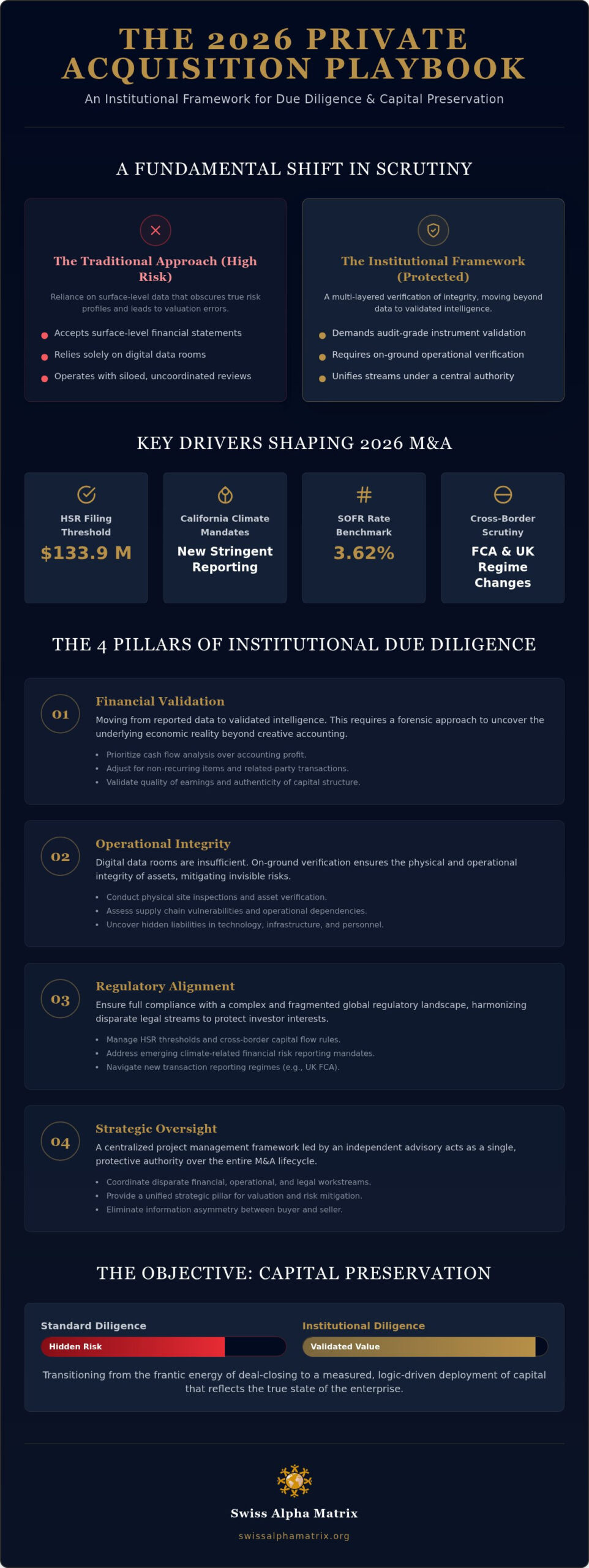
The 2026 Private Company Acquisition Due Diligence Checklist
To navigate the opaque nature of private markets with precision, one must employ a structured investigative framework that categorizes findings into distinct strategic pillars. A comprehensive due diligence checklist for private company acquisition organizes the inquiry into financial, legal, operational, and strategic streams, ensuring no latent liability remains unexamined. This multi-layered approach moves beyond the superficial to provide an institutional-grade assessment of the target’s true value and risk profile.
- Financial: Review of at least three years of audited financial statements, verification of tax compliance under the 21% federal corporate rate, and rigorous validation of all debt instruments and credit facilities.
- Legal: Exhaustive audit of intellectual property rights, pending or threatened litigation history, and employment contracts, with specific attention to 2026 amendments regarding AI discrimination and training cost repayments.
- Operational: Analysis of customer concentration risks, the resilience of IT infrastructure against cyber threats, and compliance with emerging ESG mandates such as California’s SB 253 and SB 261 emissions reporting.
- Strategic: Evaluation of market positioning and a realistic assessment of synergy realization potential within the broader portfolio.
Phase 1: Preliminary Review and Financial Instrument Audit
The process begins with a meticulous review of the Letter of Intent (LOI) and non-disclosure agreements to establish the legal boundaries of the investigation. Initial validation of bank instruments and proof of funds is paramount to confirm the target’s liquidity before deeper resources are committed. This phase is anchored by establishing a precise independent financial project management timeline, ensuring that all workstreams are coordinated by a central authority focused on capital preservation.
Phase 2: Deep-Dive Investigation and On-Ground Verification
Once the preliminary data is secured, the investigation transitions to physical site visits and operational audits. This phase is designed to cross-reference the digital data room’s contents with on-ground reality, verifying the existence and condition of physical assets. Interviews with key stakeholders and middle management are conducted to identify “key person” risks and assess the cultural alignment of the target organization. This level of unvarnished insight is essential for mitigating the invisible risks that paper-only reviews consistently miss.
Phase 3: Final Risk Assessment and Valuation Adjustment
The final phase involves compiling an audit-grade report for executive stakeholders, highlighting any discovered liabilities or untapped synergies. The purchase price is then adjusted based on these findings to ensure the valuation remains precise and defensible. A final regulatory compliance check is performed against the latest international financial regulations, including updated AML/KYC protocols for 2026. For institutions requiring absolute certainty, our specialized audit-grade instrument validation services provide the final layer of protection against transactional fraud.
Strategic Oversight: Integrating Advisory Expertise into the M&A Lifecycle
The execution of a high-stakes acquisition is an exercise in synchronization, requiring a master planner to harmonize the disparate workstreams of legal, financial, and operational experts. While the technical components of a due diligence checklist for private company acquisition provide the necessary data, the synthesis of this intelligence into a cohesive decision-making framework is what separates a successful deployment of capital from a speculative failure. This strategic oversight ensures that the transition from investigative scrutiny to post-acquisition project management is seamless, preserving the value identified during the audit phase and protecting the interests of the acquirer.
Closing a transaction with the precision of a Tier-1 global financial institution requires an unemotional commitment to institutional discipline. It’s during the final negotiations that the protective authority of an independent advisor becomes most apparent, ensuring that every discovered liability is accounted for in the final purchase agreement. By maintaining a measured, logical pace, the master planner prevents the frantic energy of deal-closing from compromising the long-term integrity of the asset. This dignified approach mirrors the traditional discretion of private wealth management, prioritizing stability and strategic growth over short-term speculation.
Independent Project Management in Complex Deals
In the context of multi-jurisdictional acquisitions, the role of a Project Management Office (PMO) is indispensable for ensuring milestone-based deal execution. Managing stakeholders across different regulatory bodies requires a sophisticated understanding of international financial standards and a steady hand to navigate local nuances. This centralized oversight ensures that capital deployment decisions are made with absolute precision, grounding every strategic move in verified intelligence rather than assumptions. By coordinating these complex project management streams, the advisor ensures that the momentum of the deal remains steady without sacrificing the technical accuracy required for a successful close.
The Swiss Alpha Matrix Promise of Exclusivity
We offer a boutique service tailored to a specific calibre of global investor who values privacy, discretion, and technical depth. By leveraging decades of experience from former Tier-1 banking executives, we provide a standard of service that is both broad in reach and meticulous in its attention to detail. This standard of excellence is rooted in historical reliability and regional precision, positioning us as a dedicated partner throughout the entire M&A lifecycle. For those seeking to master the complexities of private market acquisitions with an institutional-grade framework, contacting Swiss Alpha Matrix for a confidential mandate discussion represents the first step toward securing a legacy of strategic growth.
Securing Strategic Growth in an Evolving Private Market
Navigating the complexities of private company acquisitions in 2026 requires a transition from passive data review to active, audit-grade verification. By implementing a rigorous due diligence checklist for private company acquisition, institutions can bridge the gap between reported financials and true economic value. This framework ensures that capital preservation remains the primary objective, particularly when verifying cross-border instruments and conducting on-ground operational audits. The integration of these disparate workstreams into a unified strategic pillar is essential for mitigating the invisible risks that often compromise high-stakes transactions.
Success in this fragmented landscape is defined by the quality of one’s investigative framework and the precision of the master planner overseeing the M&A lifecycle. Swiss Alpha Matrix provides this specialized oversight, delivering audit-grade reports for executive stakeholders with the global reach and Swiss precision required for high-stakes transactions. Our firm is led by former Tier-1 global bank executives who prioritize long-term stability over speculative gains. It’s this commitment to technical accuracy that protects your portfolio against latent liabilities and ensures a seamless transition to post-acquisition management.
Secure your capital with institutional-grade due diligence. Contact Swiss Alpha Matrix today.
With the right advisory partner, your next acquisition can move beyond simple growth toward lasting institutional excellence.
Frequently Asked Questions
What is the most critical component of a private company due diligence checklist?
The most critical component of a due diligence checklist for private company acquisition is the transition from accepting reported data to executing audit-grade validation of all financial instruments and physical assets. While legal documentation provides the necessary structure, it’s the independent verification of the target’s capital and operational integrity that protects the acquirer. This process ensures that every reported asset actually exists and is unencumbered by hidden liabilities that standard digital reviews often fail to detect.
How do you value a private company when market data is limited?
Valuing a private entity requires a multi-layered approach using Discounted Cash Flow (DCF) models adjusted for the “private company discount” and illiquidity. We also utilize Comparable Company Analysis, though peers must be selected with extreme precision to account for niche market dynamics. In 2026, it’s essential to adjust historical precedent transactions for current inflation and the 3.62% SOFR rate to ensure the valuation reflects contemporary capital costs rather than outdated market assumptions.
Why is on-ground verification necessary if I have a virtual data room?
Digital data rooms are inherently curated by the seller and often omit the visceral reality of a target’s physical operations. On-ground verification is necessary to confirm the existence and condition of inventory, plants, and equipment reported in the ledger. By deploying “boots on the ground,” an advisor can identify operational bottlenecks, “key person” risks, and maintenance deficits that are invisible in a PDF. This physical scrutiny is the only reliable antidote to sophisticated cross-border transactional fraud.
How long does a comprehensive private company due diligence process typically take?
The duration of a comprehensive investigation typically spans between 60 and 120 days, depending on the complexity of the target’s corporate structure and geographical footprint. This timeline allows for the coordination of financial audits, physical site visits, and regulatory compliance reviews. A rushed process compromises the technical accuracy of the due diligence checklist for private company acquisition, increasing the likelihood of post-acquisition friction. A measured, logical pace ensures every strategic pillar is thoroughly examined before capital deployment.
What are the common red flags during the financial instrument validation phase?
Common red flags include inconsistencies in bank signatures, unverified Standby Letters of Credit (SBLCs), and a seller’s refusal to allow direct communication with issuing financial institutions. We often encounter sophisticated documentation that appears legitimate but lacks audit-grade validation from the source. Detecting these discrepancies early prevents the deployment of capital into fraudulent or insolvent structures. Our former Tier-1 bank executives utilize rigorous validation frameworks to ensure that every financial instrument is authentic and legally enforceable.
How does operational due diligence differ from financial due diligence?
Financial due diligence focuses on historical fiscal performance and earnings quality, while operational due diligence assesses the “engine” that generates those numbers. This includes evaluating supply chain resilience, IT infrastructure integrity, and the scalability of the target’s business model. Operational reviews also identify cultural integration barriers and human capital risks, such as high employee turnover or inadequate succession planning. Understanding these dynamics is essential for ensuring that the target can sustain its performance under new ownership.
Can independent advisory replace the need for traditional legal counsel in M&A?
Independent advisory serves as a protective authority that coordinates the entire M&A lifecycle, but it doesn’t replace the need for traditional legal counsel. Legal teams focus on the execution of contracts and statutory compliance, whereas specialized advisors manage the technical validation of financial instruments and physical operations. These roles are complementary; the advisor acts as a master planner, ensuring that the legal and financial workstreams are unified into a single, cohesive strategy for capital preservation and growth.
What regulatory changes in 2026 impact cross-border private acquisitions?
Significant changes in 2026 include the adjusted Hart-Scott-Rodino threshold of $133.9 million for reporting acquisitions and the implementation of California’s SB 253 and SB 261 for climate-related risk reporting. Additionally, the UK’s FCA has introduced Policy Statement 26/15, which streamlines transaction reporting requirements. Navigating these cross-border complexities requires a sophisticated understanding of international financial regulations to ensure that every acquisition remains compliant across multiple jurisdictions while protecting the investor’s interests.