

Is the current oversight mechanism within your high-stakes mandates merely a static ledger of possibilities, or does it function as a dynamic instrument capable of defending against the subtle erosion of institutional capital? For many seasoned executives, the realization that traditional tracking methods are insufficient often arrives only after a cross-border counterparty failure or a significant regulatory misalignment. You understand that fragmented risk reporting isn’t just an administrative hurdle; it’s a direct threat to the fiduciary responsibility of capital preservation. This article details how a sophisticated risk register in financial projects serves as the primary architecture for maintaining technical precision and ensuring regulatory compliance in an increasingly complex global landscape.
By implementing an institutional framework, you’ll establish a robust foundation for capital protection and generate audit-grade documentation that satisfies the most discerning stakeholders. We’ll explore the transition from passive monitoring to a proactive, independent methodology that identifies instrument-specific vulnerabilities with the meticulous detail that modern finance demands. This approach moves beyond simple checklists, offering a strategic pillar for those who prioritize long-term stability and regional precision over short-term speculation.
Key Takeaways
- Understand how a sophisticated risk register in financial projects functions as a dynamic instrument for capital preservation, moving beyond the limitations of standard project management frameworks.
- Identify critical vulnerabilities within complex transactional structures, including counterparty credit risks and technical validation gaps in instruments like SBLCs and LCs.
- Learn the methodology for implementing independent, audit-grade oversight to ensure that risk mitigation strategies meet the rigorous requirements of global regulatory standards.
- Discover how precise risk identification facilitates more efficient capital deployment by reducing the friction associated with fragmented reporting and unforeseen operational failures.
- Explore the value of integrating Tier-1 institutional discipline with regional precision to maintain fiduciary excellence in the most demanding cross-border financial mandates.
Beyond the Spreadsheet: The Strategic Role of the Risk Register in 2026
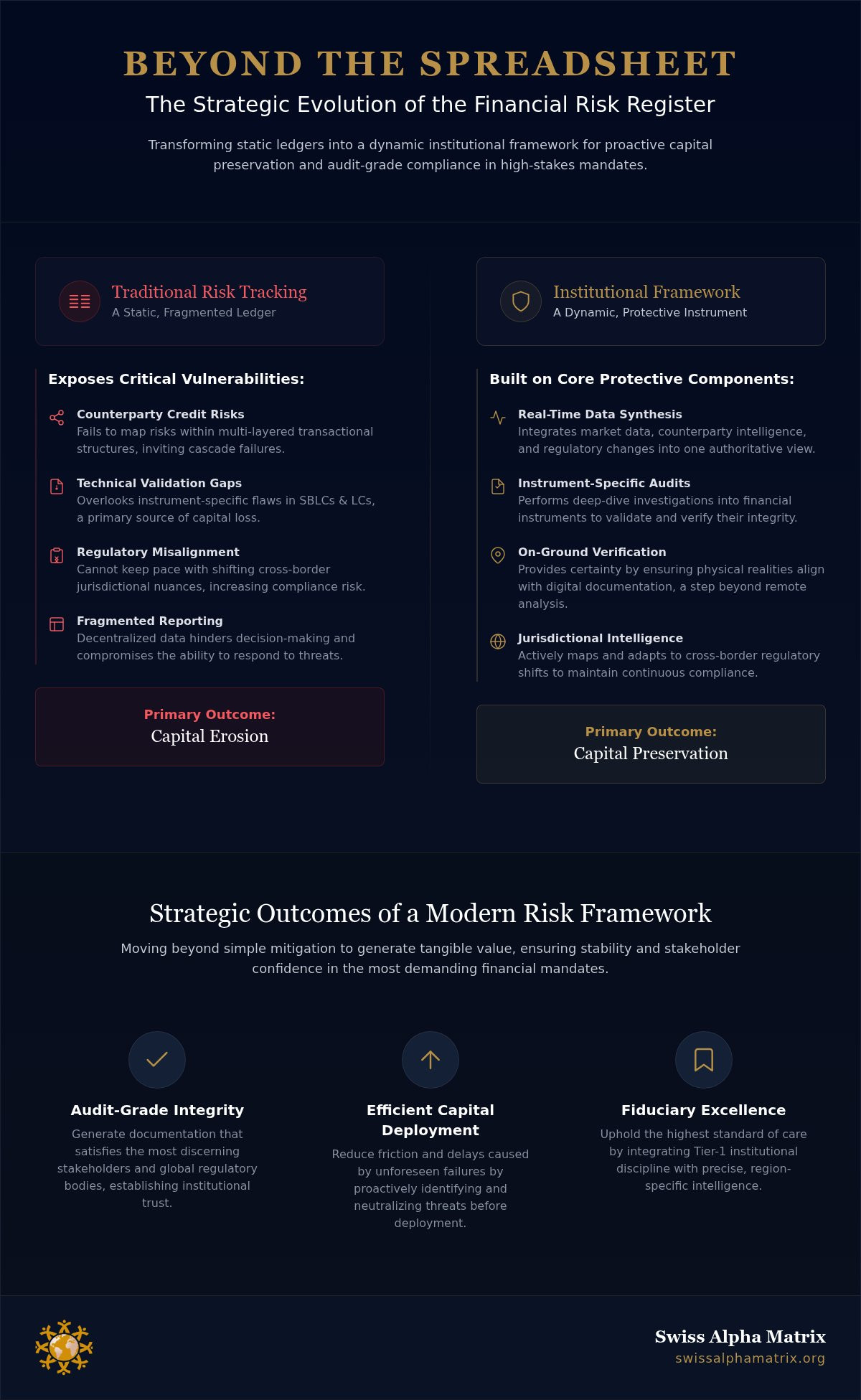
The evolution of financial oversight has transformed the traditional risk register in financial projects from a static, administrative list into a dynamic strategic asset. In the current fiscal environment, a risk register in financial projects functions as an institutional-grade instrument that synthesizes real-time market data, counterparty intelligence, and regulatory requirements into a single, authoritative repository for capital preservation. While traditional project management frameworks offer a foundational understanding of threat identification, they frequently lack the technical granularity required to manage the layered complexities inherent in cross-border capital deployments. Sophisticated mandates demand a transition from mere tracking to a proactive philosophy of capital protection. This shift ensures that every identified vulnerability is matched with a validated, technical response rather than a generic mitigation plan.
The Cost of Inadequate Risk Documentation
Fragmented risk reporting is often the primary catalyst for capital erosion in high-stakes mandates. When documentation is decentralized or lacks technical depth, unforeseen operational failures can quickly escalate into systemic project collapses. Senior executives shouldn’t view the register as a secondary compliance burden; it’s a protective authority that provides the necessary visibility to navigate volatile markets. Without a centralized, real-time view of vulnerabilities, the ability to respond to shifting counterparty risks is severely compromised. Precision is non-negotiable. A lack of clarity in risk documentation doesn’t just hinder decision-making, it actively invites the very capital erosion that seasoned experts are hired to prevent.
Regulatory Alignment and Audit-Grade Integrity
Modern international financial regulations require a level of transparency that standard spreadsheets simply cannot provide. Achieving audit-grade integrity means ensuring that every entry in the risk register meets the rigorous standards of Tier-1 financial institutions and global regulatory bodies. This alignment is deeply rooted in operational due diligence, where the focus remains on the validation of instruments and the verification of on-ground realities. By maintaining a high-level standard of documentation, firms establish a sense of trust with stakeholders, demonstrating that their interests are managed by experts who prioritize long-term stability. This meticulous attention to detail transforms the register into a tool for strategic growth, allowing for smoother capital deployment through the clear identification and neutralization of instrument-specific vulnerabilities.
Institutional-Grade Components of a Financial Project Risk Register
An institutional-grade risk register in financial projects must transcend the generic categories found in standard project management manuals. It requires a granular focus on counterparty credit risk (CCR) within multi-layered transactional structures, where the failure of a single entity can trigger a cascade of capital erosion. For the 2026 landscape, mapping jurisdictional shifts and cross-border regulatory nuances is essential to maintain compliance across diverse legal environments. A robust framework also necessitates the inclusion of on-ground verification data as a distinct risk category. This ensures that physical realities align with digital documentation, providing a level of certainty that remote analysis cannot replicate. By integrating these specific data points, the register moves from a passive list to an active shield for high-stakes mandates.
Instrument-specific vulnerabilities, particularly validation gaps in Standby Letters of Credit (SBLC) or Letters of Credit (LC), represent a significant portion of unforeseen operational failures. These aren’t merely administrative errors; they’re structural weaknesses that can lead to total loss of capital if not meticulously documented. Effective oversight requires a deep-dive investigation into the issuing and confirming banks’ operational histories and current liquidity profiles. By treating instrument validation as a primary risk pillar, seasoned experts can identify discrepancies before they manifest as financial losses. This level of technical scrutiny is what distinguishes a sophisticated mandate from a speculative venture.
Counterparty and Operational Risk Categories
Defining parameters for deep-dive investigations into financial entities involves more than a cursory credit check. It requires tracking operational risks through the lens of institutional-grade financial advisory methodologies to ensure absolute technical accuracy. By categorizing risks associated with complex financial instrument validation separately, managers can isolate technical failures from broader market volatility. This compartmentalization allows for a focused application of protective measures, ensuring transaction integrity remains intact despite external pressures. It’s this structured approach that prevents the fragmentation of risk reporting across cross-border deals.
Quantitative vs. Qualitative Impact Analysis
Purely numerical risk scoring often fails to capture the nuanced dynamics of multi-layered transactions. While a quantitative score might indicate a low probability, the qualitative impact of a specific jurisdictional shift could be catastrophic. Applying Swiss-style precision to qualitative risk descriptions involves detailed, qualifying clauses that describe the exact nature of a threat. Prioritizing risks based on their potential for total capital loss, rather than simple frequency, ensures the most critical vulnerabilities receive rigorous attention. Through this lens, the risk register in financial projects becomes a living document of defensive strategy. This logical progression from broad assessment to specific strategic pillars reflects the Swiss Alpha Matrix methodology of prioritizing long-term preservation and strategic growth.
Developing a Framework for High-Stakes Risk Mitigation
Sophisticated capital protection, within the context of high-stakes mandates, necessitates a deliberate departure from the reductionist “avoid or transfer” models that are frequently disseminated in entry-level project management literature. A robust risk register in financial projects must, therefore, be seamlessly integrated into a more comprehensive cross-border investment due diligence framework, ensuring that every defensive action is anchored in the same institutional-grade standards that govern Tier-1 global banking operations. This systemic integration facilitates a transition from the mere identification of vulnerabilities to the deployment of validated, technical responses that are designed to preserve capital integrity across disparate jurisdictions. Such a framework ensures that interests are held by seasoned, unemotional experts who prioritize long-term preservation over speculative agility.
The role of independent oversight in this process cannot be overstated, as it serves as the final layer of validation for the effectiveness of any proposed mitigation strategy. It’s not enough to simply list a potential threat; the framework must demonstrate a logical and technical path toward neutralization that satisfies the rigorous standards of international audit bodies. This approach moves beyond generic administrative tracking, positioning the risk register as a strategic pillar of financial discipline. By maintaining this steady and measured pace, the framework creates a sense of professional calm, encouraging stakeholder confidence through the inevitable logic of its methodology.
Independent Project Oversight as a Mitigation Pillar
Internal project teams, despite their technical proficiency, often encounter an inherent risk blindness that stems from their proximity to the mandate’s execution, which can lead to the oversimplification of intricate dynamics. The primary value of independent financial project management is found in its capacity to provide a dignified and objective validation of the risk register’s efficacy. By implementing a RACI matrix that prioritizes executive accountability, the framework ensures that the burden of capital protection is not fragmented but is instead concentrated in a structured hierarchy of professional competence. This elite level of oversight provides a master plan that anticipates failures before they manifest as capital erosion.
Dynamic Maintenance and Real-Time Reporting
Given the volatile nature of global markets, the traditional reliance on monthly review cycles has become an antiquated practice that fails to protect against rapid-onset liquidity crises. Continuous monitoring, which must be reinforced by on-ground verification to ensure absolute technical accuracy, is the only method for maintaining the relevance of a risk register in financial projects. This proactive maintenance transforms the risk repository into a living instrument of strategic intelligence, capable of generating the high-level reports that sophisticated stakeholders require for transparency. By tethering modern reporting strategies to concepts of regional excellence, the framework provides a steady and logical flow of information that encourages confidence in the most complex decision-making processes.
Addressing the Executive Objection: Precision Over Administrative Complexity
A meticulously calibrated risk register in financial projects serves not merely as a defensive shield but as a sophisticated catalyst for strategic capital deployment. For many senior decision-makers, the primary objection to institutional-grade risk documentation is the perceived administrative burden, yet this view overlooks the profound reduction in friction that technical certainty provides. When vulnerabilities are identified with absolute precision, the speed of capital allocation increases because the unknowns that typically paralyze high-stakes mandates are neutralized. This transformation reframes the register from a bureaucratic ledger into a tool for strategic growth, providing the psychological certainty required to navigate the review of complex financial instruments with confidence. By anticipating structural failures through rigorous planning, a robust register minimizes the need for costly emergency interventions, ensuring that the project remains a steady pursuit of long-term preservation.
The Sophistication of Swiss Precision
In the context of cross-border deals, “good enough” documentation is frequently the precursor to financial fraud and institutional embarrassment. Technical accuracy is the bedrock upon which stakeholder trust is built, requiring a level of detail that mirrors the traditional discretion of high-end private wealth management. Leveraging the expertise of former Tier-1 global bank executives allows for a definition of precision that exceeds standard industry benchmarks. This elite level of scrutiny ensures that every entry in the risk register is backed by audit-grade validation, distinguishing a performance-oriented mindset from passive participation. It is this intellectual depth and refusal to oversimplify complex dynamics that protects the moral character and reputation of the entity involved.
Streamlining Oversight for Global Mandates
Managing the risk cycles of global mandates requires a logical framework that accounts for the nuances of different time zones and shifting jurisdictional requirements. A centralized risk register in financial projects maintains deal integrity even amidst the noise of M&A news cycles, providing a single source of truth for all involved parties. By utilizing independent advisory services, the cognitive load on senior executives is significantly reduced, allowing them to focus on high-level strategic pillars rather than granular administrative tracking. This measured and steady approach to oversight ensures that interests are managed by seasoned experts who prioritize technical discipline. To ensure your mandates are protected by this level of institutional rigor, consider the advantages of independent financial project management to validate your capital protection strategies.
Swiss Alpha Matrix: Elevating Risk Management to a Protective Authority
Swiss Alpha Matrix operates at the intersection of traditional financial discipline and modern regional precision, positioning itself as a protective authority for high-net-worth individuals and institutional entities. Our methodology for maintaining a risk register in financial projects isn’t a passive exercise; it’s a rigorous application of Tier-1 institutional standards led by seasoned experts who’ve previously managed global portfolios at the highest levels. By utilizing our bank instrument validation services, clients gain access to a level of technical granularity that’s often absent in standard advisory models. We provide audit-grade reports that don’t just list vulnerabilities but offer a validated path toward capital preservation, ensuring that every deployment decision is backed by unemotional, expert analysis. This commitment to technical accuracy ensures that your interests are in the hands of master planners who prioritize long-term stability over short-term speculation.
Boutique Advisory for Complex Transactions
A dedicated partner brings a sense of permanence and moral character that generic service providers simply can’t replicate in complex transactional structures. Our focus remains exclusively on high-value, mandate-specific engagements where the integration of on-ground verification with executive-level intelligence is paramount. This hyper-personalized approach ensures that your risk register in financial projects reflects the actual technical realities of the deal rather than just theoretical projections. It’s this commitment to regional excellence and meticulous attention to detail that distinguishes a performance-oriented methodology from the passive oversight typical of larger, less specialized firms. By maintaining a boutique scale, we ensure that every mandate receives the intellectual depth and technical precision it deserves.
Securing the Future of Your Capital
Securing the future of your capital requires a refusal to oversimplify the intricate dynamics of cross-border finance. An institutional-grade risk framework is the only reliable instrument for navigating the regulatory and operational complexities of 2026 with absolute certainty. Engaging Swiss Alpha Matrix for independent project oversight means placing your interests in the hands of master planners who prioritize long-term stability and strategic growth through logical, measured methodologies. We conclude every mandate with an implicit promise of exclusivity and high-level access, maintaining the Swiss discretion that’s become our signature. It’s a standard of service that’s broad in reach but meticulous in its execution, providing the professional calm necessary for fiduciary excellence in a volatile global landscape.
Navigating the Future of Institutional Oversight
The evolution of global mandates requires a transition from passive tracking to the implementation of a robust risk register in financial projects that serves as a living repository of capital vulnerabilities. By prioritizing technical precision and independent verification, sophisticated stakeholders ensure their interests remain protected against the subtle erosion of unforeseen operational failures. This framework isn’t merely a defensive posture; it’s a strategic pillar that facilitates smoother capital deployment through the absolute neutralization of instrument-specific gaps. It’s the difference between reactive crisis management and the steady, logical preservation of institutional wealth.
Led by former Tier-1 global bank executives with decades of transactional and regulatory expertise, our firm specializes in complex financial instrument validation to maintain the highest standards of fiduciary excellence. We invite you to secure your capital with institutional-grade risk oversight by Swiss Alpha Matrix. By embracing this level of meticulous detail and Swiss discretion, you establish a sense of professional calm and inevitable logic in your decision-making process. Your commitment to these standards ensures that your mandates are managed with the intellectual depth and traditional values required for long-term strategic growth.
Frequently Asked Questions
What is the primary difference between a risk register and an issue log in finance?
The primary distinction lies in the temporal orientation of the documentation. A risk register in financial projects identifies potential vulnerabilities that haven’t yet manifested, allowing for proactive mitigation and capital protection strategies. Conversely, an issue log records events that have already occurred and require immediate resolution. Maintaining this separation is essential for audit-grade integrity, as it ensures that speculative threats are managed with the same technical precision as realized operational failures.
How often should a risk register be updated during a cross-border merger?
In the volatile environment of a cross-border merger, a risk register should be updated continuously to reflect shifting jurisdictional requirements and counterparty liquidity profiles. While monthly reviews might suffice for stable operations, the intricate nature of M&A news cycles demands a more measured and steady rhythm of reporting. Daily updates are often necessary during the final stages of a mandate to ensure that every instrument-specific vulnerability is neutralized before capital is deployed.
Who is ultimately responsible for the ownership of risks in a financial project?
Ultimate responsibility for risk ownership resides with the executive leadership or the designated project sponsor. While technical experts identify and categorize instrument-specific vulnerabilities, the fiduciary duty of capital preservation can’t be delegated. Establishing a clear RACI matrix ensures that every entry in the risk register in financial projects is assigned to a specific individual who possesses the authority to execute mitigation strategies. This structured hierarchy prevents the fragmentation of accountability in complex mandates.
Can a risk register help in preventing cross-border financial fraud?
A robust risk register is a primary instrument for preventing cross-border financial fraud by identifying validation gaps in bank instruments early. By documenting counterparty red flags and requiring on-ground verification, the framework exposes structural weaknesses that fraudulent entities often exploit. This proactive methodology transforms the register from a simple administrative tool into a protective authority, ensuring that every transaction is backed by the technical accuracy required for long-term stability.
What are the essential risk categories for validating bank instruments?
Essential categories include issuing bank liquidity profiles, jurisdictional legal frameworks, and the technical specifications of instruments like SBLCs or LCs. One must also account for counterparty credit risk and the verification of the physical existence of the underlying assets. By categorizing these instrument-specific vulnerabilities with Swiss-style precision, seasoned experts can identify discrepancies that might otherwise lead to total capital loss. This level of technical scrutiny is a hallmark of institutional-grade financial discipline.
How does independent project oversight improve the accuracy of a risk register?
Independent project oversight improves accuracy by removing the inherent bias and risk blindness often found in internal teams. Former Tier-1 executives bring a level of intellectual superiority and historical reliability that ensures the risk register meets the highest institutional standards. This objective validation process provides a master plan for capital protection, ensuring that every mitigation strategy is logically sound and technically accurate. It’s a standard of service that encourages confidence among sophisticated stakeholders.
Is a risk register required for regulatory compliance under Basel III?
While Basel III doesn’t explicitly mandate a document titled “risk register,” its requirements for managing counterparty credit risk and operational resilience necessitate such a framework. Institutional entities must demonstrate a logical and technical approach to risk identification to meet global regulatory standards. Utilizing a sophisticated risk register in financial projects ensures that the documentation is of audit-grade quality, facilitating compliance with the rigorous transparency demands of international banking regulations and high-level fiduciary standards.
How can on-ground verification be integrated into a digital risk register?
On-ground verification is integrated by including physical site reports and face-to-face counterparty validation as primary data points within the digital repository. This methodology ensures that the digital record isn’t just a reflection of paper documentation but is tethered to regional realities. By linking specific verification evidence to entries in the risk register, managers achieve a level of technical precision that remote analysis can’t match. It’s a meticulous approach that distinguishes performance-oriented oversight from passive administration.