

The true measure of institutional excellence in cross-border finance is not found in the initial capital injection, but in the structural integrity of the invisible scaffolding that supports it through regulatory turbulence. In an era where the validity of financial instruments is often obscured by layers of global complexity, you likely understand that the absence of a robust financial project governance framework is an invitation to unmitigated counterparty risk and institutional exposure. It’s a reality that demands a shift from passive compliance to the active, strategic orchestration of capital preservation, ensuring that every movement of capital is backed by a foundation of absolute technical precision.
This article provides the institutional perspective required to construct an audit-grade governance structure that ensures precision in every deployment decision. We’ll examine the specific methodologies for rigorous instrument validation and the implementation of operational due diligence that transforms governance from an administrative burden into a strategic anchor. By establishing a framework rooted in regional precision and seasoned expertise, you’ll gain the clarity necessary to minimize regulatory friction and secure the long-term stability of your most complex international initiatives.
Key Takeaways
- Understand why traditional project management fails in high-stakes environments and how a robust financial project governance framework secures capital through technical rigor.
- Explore the four architectural pillars of institutional oversight, ensuring that every cross-border deployment is governed by senior-led accountability and regulatory alignment.
- Distinguish between mere administrative oversight and the technical financial discipline necessary to mitigate counterparty risk in complex, multi-stakeholder projects.
- Gain a structured methodology for capital deployment that prioritizes on-ground verification and jurisdictional due diligence to navigate the complexities of 2026 compliance.
- Recognize the strategic importance of independent, audit-grade instrument validation in preserving capital and maintaining institutional credibility during international mandates.
What is a Financial Project Governance Framework in an Institutional Context?
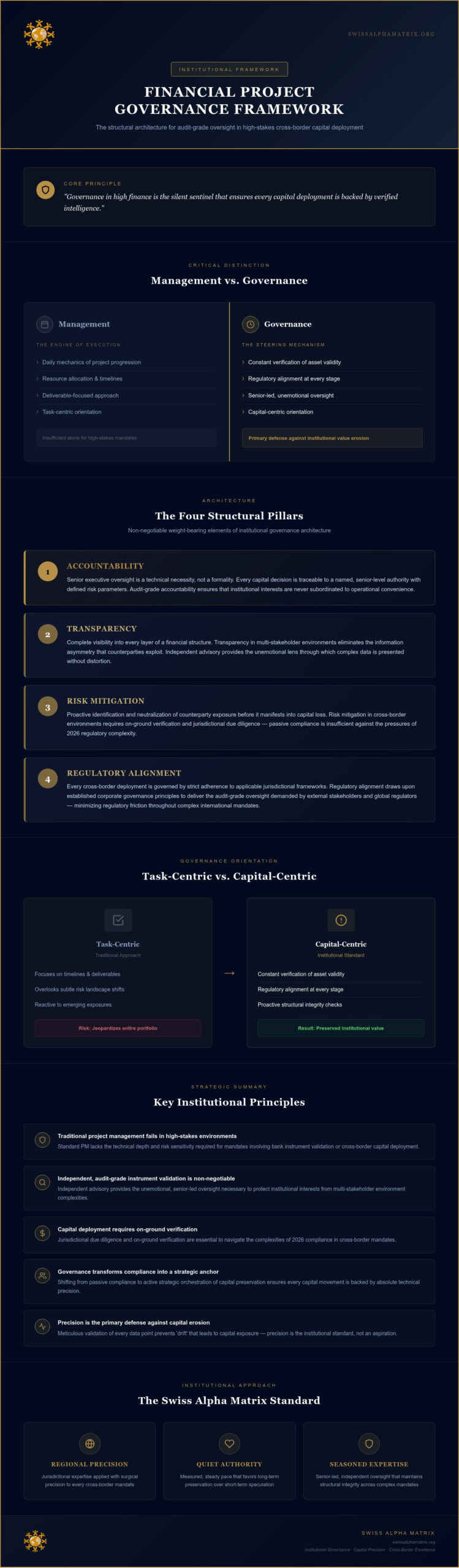
An institutional financial project governance framework is far more than a collection of administrative checklists or reporting templates. It’s a structured system of rules, practices, and processes meticulously designed to direct and control high-stakes financial initiatives with surgical precision. While standard project management might suffice for internal operational tasks, it lacks the technical depth and risk sensitivity required for mandates involving bank instrument validation or cross-border capital deployment. In these elite environments, governance isn’t a secondary support function; it’s the primary mechanism for ensuring the structural integrity of the entire investment thesis.
The core of this methodology lies in the shift from task-centric management to capital-centric governance. Task-centric approaches focus on timelines and deliverables, often overlooking the subtle shifts in the risk landscape that can jeopardize an entire portfolio. Capital-centric governance, however, prioritizes the constant verification of asset validity and regulatory alignment above all else. Independent advisory serves as the vital mechanism that maintains the integrity of this framework, providing the unemotional, senior-led oversight necessary to protect institutional interests from the inherent complexities of multi-stakeholder environments.
The Distinction Between Management and Governance
It’s vital to recognize that management and governance serve distinct, albeit complementary, roles. Management is the engine of execution, focusing on the daily mechanics of project progression and resource allocation. Governance, conversely, is the steering mechanism that ensures the project remains strictly within the defined risk appetite of the institution. It draws upon established corporate governance principles to provide the audit-grade oversight that external stakeholders and global regulators demand. This oversight is particularly critical when dealing with complex financial structures where the margin for error is non-existent. For those seeking to deepen their understanding of these dynamics, exploring the strategic architecture of independent financial project management reveals how these layers of control function in practice to safeguard capital.
Why Discretion and Precision are Non-Negotiable
The Swiss Alpha Matrix approach to governance is defined by a sense of quiet authority and regional precision. In high-stakes finance, loud urgency is often a mask for inadequate preparation; we prioritize a measured, steady pace that favors long-term preservation over short-term speculation. True governance relies on the meticulous validation of every data point to prevent the ‘drift’ that leads to capital exposure. Precision isn’t just a goal; it’s the primary defense against the erosion of institutional value. ‘Governance in high finance is the silent sentinel that ensures every capital deployment is backed by verified intelligence.’ By maintaining this standard, institutions can navigate regulatory friction with the confidence that their interests are protected by seasoned experts.
The Structural Pillars of an Institutional Governance Architecture
Constructing a resilient architecture for high-stakes capital projects requires more than just high-level intent. It demands the integration of four non-negotiable pillars: Accountability, Transparency, Risk Mitigation, and Regulatory Alignment. Each pillar serves as a weight-bearing element in a financial project governance framework designed to withstand the pressures of cross-border capital movement. Senior executive oversight isn’t a formality here; it’s a technical necessity. These pillars form the basis for institutional-grade financial advisory methodologies, ensuring that every strategic decision is rooted in seasoned expertise rather than speculative optimism.
Accountability and the RACI Matrix in Finance
In complex deals, the traditional RACI matrix must be refined to reflect institutional stakes. The ‘Accountable’ party isn’t merely a project manager. They must possess deep institutional banking experience to interpret the nuances of transactional flow and potential counterparty friction. This ensures that technical insights from the ground level reach the C-suite without dilution. When responsibility is fragmented, risk increases. A precise flow of information ensures that those with the ultimate authority are informed by verified intelligence, making complex project management a disciplined exercise in capital protection.
Risk Mitigation through Audit-Grade Validation
Risk mitigation within this framework hinges on audit-grade validation. This standard defines a level of technical scrutiny that can withstand the most rigorous regulatory audits and institutional reviews. It involves a multi-layered approach to instrument validation, where on-ground verification is a critical sub-component. For instance, validating standby letters of credit (SBLCs) requires independent third-party reviews that look beyond the document to the underlying institutional capacity. This level of rigor aligns with evolving expectations for SEC governance and risk disclosure requirements, providing a robust shield against regulatory scrutiny. By embedding these validation cycles into the broader governance timeline, institutions can identify and neutralize exposure before it manifests as capital loss.
Administrative Oversight vs. Financial Discipline: Resolving the Credibility Gap
A frequent misconception among institutional stakeholders is the belief that governance constitutes a purely administrative exercise, a suite of paperwork that slows momentum without adding tangible value. This perspective fails to distinguish between generic administrative oversight and the technical financial discipline required to secure high-value mandates. While administration tracks milestones, financial discipline interrogates the underlying validity of the capital itself. Within a sophisticated financial project governance framework, this discipline acts as a safeguard against “fraud-by-omission,” where critical technical inconsistencies in cross-border deals are overlooked due to a lack of senior-led scrutiny. True governance is an investment in the structural safety of capital, prioritizing long-term preservation over the superficial efficiency of a checklist.
The Pitfalls of Generic Project Management Software
Generic project management platforms like Jira or Trello offer visibility into tasks, yet they are fundamentally incapable of replacing the seasoned judgment of former Tier-1 bank executives. These tools often encourage green-light reporting, a phenomenon where a project appears on schedule even while the underlying bank instruments suffer from terminal instability. The credibility gap in governance arises when the technical complexity of a transaction exceeds the intellectual depth of the oversight body, leaving the institution vulnerable to systemic failures that no software can detect. Precision in governance requires a human-led, technical interrogation of every performance metric within the financial project governance framework to ensure absolute accuracy.
Ensuring Regulatory Alignment in 2026
As we approach 2026, the complexity of international financial regulations continues to escalate, demanding a governance architecture that is both agile and technically rigorous. Compliance is no longer a static requirement; it’s a dynamic process that must account for evolving AML protocols and the heightened transparency mandates of Form PF. Governance frameworks must produce regulatory-grade documentation at every milestone, ensuring that every deployment decision is defensible under the most stringent external audits. This level of meticulous detail distinguishes a performance-oriented mindset from passive participants, positioning the framework as a pillar of institutional reliability in an increasingly transparent global market.
Implementing the Framework for Cross-Border Capital Deployment
The transition from theoretical pillars to operational reality requires a phased approach that honors the intricate nature of international finance. A robust financial project governance framework is deployed through a sequence of technical milestones, beginning with Phase 1: Jurisdictional and Operational Due Diligence. This initial scrutiny is followed by Phase 2: Stakeholder Alignment and Mandate Definition, which ensures all parties operate under a unified risk appetite. Phase 3 centers on Instrument Validation and Counterparty Verification, providing the technical foundation for Phase 4: Ongoing Monitoring and Milestone-Based Reporting. This structured progression ensures that capital isn’t merely moved, but is actively protected throughout its lifecycle.
Navigating Jurisdictional Complexity
Moving capital between global financial hubs, such as London, Geneva, and Hong Kong, introduces distinct regulatory frictions that a generic framework is ill-equipped to address. The implementation must adapt to the regional nuances of each jurisdiction, utilizing cross-border investment due diligence to bridge the gap between “on-paper” claims and the “on-ground” reality. In many instances, what appears as a valid instrument in one locale may fail to meet the audit-grade standards required in another, necessitating a governance structure that prioritizes regional precision. By deploying seasoned experts to verify the physical and legal existence of assets, institutions can avoid the pitfalls of relying on unverified digital representations.
Milestone-Based Reporting for Executive Stakeholders
Reporting within a high-stakes financial project governance framework must transcend the simplistic tracking of task completion percentages. Executive stakeholders require sophisticated reports that prioritize risk indicators and technical anomalies, which could signal underlying instrument instability or counterparty friction. Every release of capital must be preceded by the production of audit-grade documentation, providing a clear, defensible record of the decision-making process. When technical red flags emerge, the framework provides the structured protocols necessary to pause and interrogate the anomaly without prematurely derailing the broader transaction. This measured approach ensures that capital deployment decisions are driven by verified intelligence rather than administrative momentum.
To ensure your next cross-border initiative is supported by these rigorous standards, you may benefit from our specialized operational due diligence services, which provide the independent oversight necessary for complex mandates.
Swiss Alpha Matrix: Orchestrating Governance with Precision and Discretion
Swiss Alpha Matrix operates as a boutique entity dedicated to the orchestration of complex financial mandates with a level of precision that mirrors the traditional discretion of high-end private wealth management. Led by former senior executives from Tier-1 global banks, our firm provides the independent oversight necessary for high-stakes deals where the margin for error is non-existent. By integrating a rigorous financial project governance framework into every engagement, we ensure that capital preservation remains the central pillar of the strategic architecture, regardless of jurisdictional complexity. This commitment to regional excellence and technical accuracy allows us to act as a master planner for institutional entities that value nuance and thoroughness over administrative simplicity.
Beyond the Paperwork: The Value of Senior Intelligence
The intelligence provided by our advisors transcends the standard reporting found in generic project management methodologies, offering instead a level of executive-level intelligence that stems from decades of transactional and regulatory expertise. Understanding the intricate nature of the industry is essential for navigating the multi-stakeholder environments typical of cross-border finance, where passive participation often leads to unmitigated risk. Our bank instrument validation services represent the ultimate tool within our broader governance framework, providing the audit-grade verification required to secure capital against counterparty instability. At Swiss Alpha Matrix, we do not just manage projects; we safeguard the strategic integrity of your capital.
Securing Your Next Mandate
Engaging Swiss Alpha Matrix for project-based advisory or a dedicated retainer mandate begins with a measured, logical assessment of your specific risk profile and jurisdictional requirements. We’ll facilitate the transition from operational uncertainty to a governed, audit-grade environment through a series of strategic pillars designed to ensure that every deployment decision is backed by verified intelligence. It’s a process that reflects our dedication to a standard of service that is both broad in reach and meticulous in its attention to detail, aligning your project with the evolving regulatory requirements of 2026. If you require a partner who prioritizes long-term preservation and technical accuracy, we invite you to engage our team for specialized capital risk mitigation and complex project oversight.
Securing Institutional Integrity in a Complex Financial Future
The transition toward a more transparent and regulated global market in 2026 necessitates a shift from passive oversight to a technically rigorous financial project governance framework. We’ve explored how the distinction between mere administrative checklists and true financial discipline represents the difference between institutional exposure and capital preservation. By prioritizing senior-led instrument validation and on-ground jurisdictional verification, organizations can navigate cross-border complexities with absolute precision. It’s a standard that demands the judgment of seasoned experts who understand the subtle mechanics of global transactional flow.
Swiss Alpha Matrix provides this level of elite oversight, led by former Tier-1 banking executives who deliver audit-grade reports for your most complex transactions. Our global reach is tempered by Swiss-standard discretion; we ensure your interests are protected by a partner dedicated to long-term stability. To ensure your next mandate is governed by these uncompromising standards, we invite you to secure your capital with the precision of Swiss Alpha Matrix. Establishing a foundation of trust and technical excellence remains the most strategic decision you can make for the future of your capital.
Frequently Asked Questions
What is the difference between project management and project governance?
Project management centers on the mechanics of execution, focusing on resource allocation and the delivery of specific milestones. Project governance, however, provides the strategic oversight that ensures these activities remain aligned with the institution’s risk appetite. While management tracks the completion of tasks, governance interrogates the validity of the project’s strategic intent. It acts as the steering mechanism that protects institutional interests from operational drift during complex financial mandates.
Why is a specialized framework necessary for financial instrument validation?
Standard project management methodologies often lack the technical depth required to verify the authenticity of complex assets like standby letters of credit. A specialized financial project governance framework is necessary to provide the rigorous, audit-grade scrutiny that identifies technical inconsistencies. This framework moves beyond administrative checklists, employing former Tier-1 banking executives to conduct a deep-dive interrogation of the issuing entity’s capacity and the instrument’s structural integrity.
How does a governance framework improve regulatory compliance in cross-border deals?
A robust framework establishes a standardized, regulatory-grade documentation trail that satisfies the stringent requirements of international bodies. It ensures that every cross-border deployment is backed by verified intelligence, which is critical for meeting 2026 AML and transparency mandates. By aligning jurisdictional due diligence with global compliance standards, the framework reduces regulatory friction and provides a defensible record of institutional diligence in diverse and complex legal environments.
What are the key components of an audit-grade governance report?
Audit-grade governance reports must transcend simple progress summaries to offer executive-level intelligence. Key components include technical verification of instrument validity, detailed on-ground due diligence findings, and a comprehensive assessment of counterparty risk. These reports prioritize technical anomalies and risk indicators over superficial task completion percentages. The objective is to provide a clear, defensible record of the decision-making process that can withstand the most rigorous external regulatory audits.
Can a governance framework prevent financial fraud in international investments?
Fraud prevention is achieved through the elimination of administrative blind spots and the implementation of senior-led technical scrutiny. The framework identifies “fraud-by-omission” by interrogating counterparty claims that generic software often overlooks. By mandating on-ground verification and independent third-party reviews, the governance structure ensures that every capital movement is supported by verified data. This proactive approach neutralizes institutional exposure before technical inconsistencies can manifest as significant capital loss.
How does Swiss Alpha Matrix integrate with existing internal PMO teams?
Our team functions as an independent layer of technical oversight that complements existing internal PMO structures. While internal teams focus on operational efficiency and daily task management, Swiss Alpha Matrix provides the specialized financial discipline and instrument validation. This integration ensures that the project’s administrative momentum is always balanced by senior-led risk mitigation. It allows internal stakeholders to maintain control while benefiting from the seasoned judgment of former Tier-1 bank executives.
What is the role of a RACI matrix in high-stakes financial project governance?
The RACI matrix serves as the architectural blueprint for accountability, ensuring that technical responsibilities are clearly defined among all stakeholders. In high-stakes environments, the party designated as “Accountable” must possess deep institutional banking experience to interpret the nuances of transactional flow. This precision prevents the fragmentation of authority that leads to capital drift. It ensures that technical insights from the ground level reach the C-suite without being diluted by administrative layers.
How often should a financial project governance framework be audited for effectiveness?
Effectiveness should be formally assessed at every major capital release or project milestone to ensure the financial project governance framework remains aligned with the project’s risk profile. For multi-year mandates, a quarterly technical audit is recommended to account for evolving regulatory requirements and shifting market dynamics. This measured, steady approach to refinement ensures the framework maintains its precision and authority, providing continuous protection for the institution’s strategic interests.