

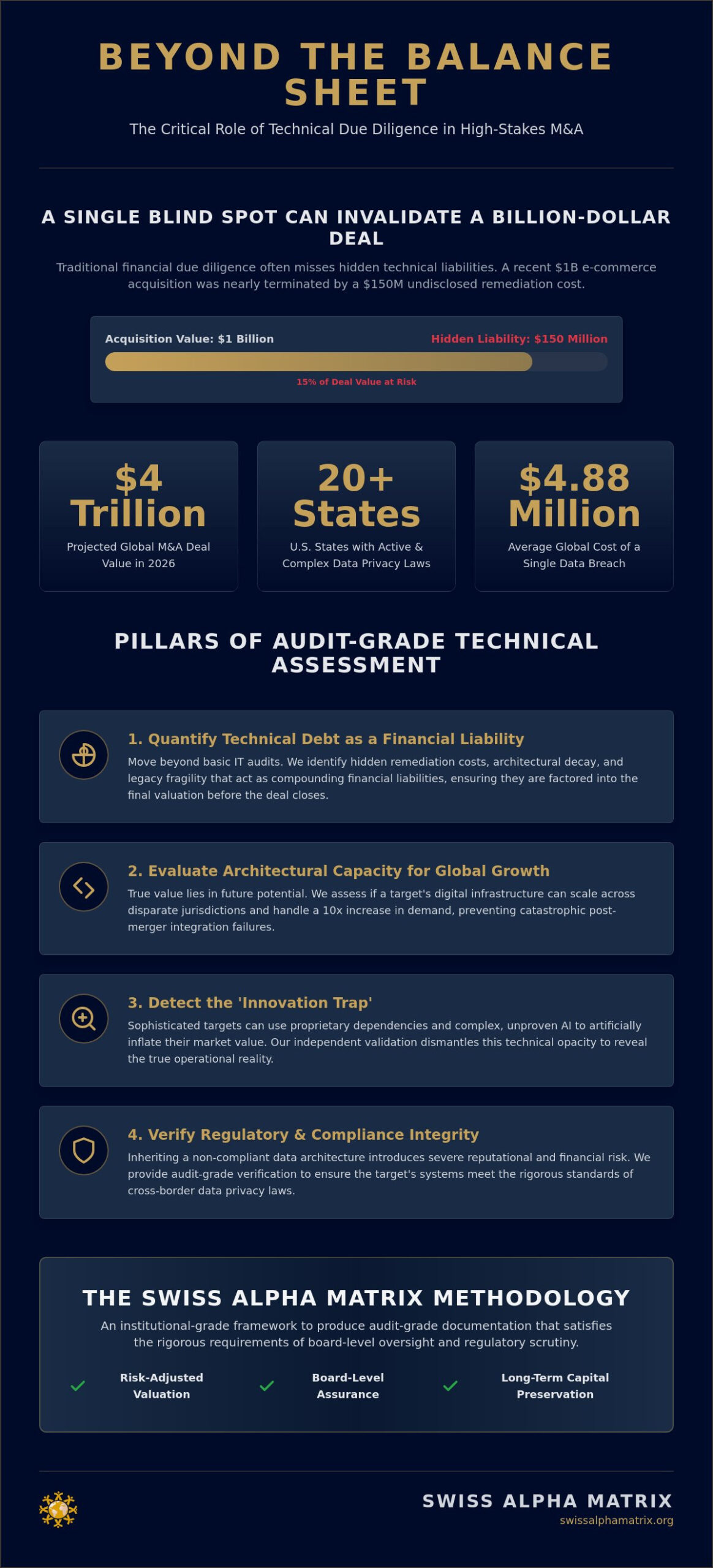
Could a $150 million remediation liability for undisclosed technical debt justify the termination of a $1 billion e-commerce acquisition? In 2026, where global deal values are projected to reach $4 trillion, such a scenario isn’t merely a cautionary tale but a quantifiable risk that traditional financial due diligence for tech companies often fails to capture with sufficient granularity. While balance sheets offer a historical perspective on fiscal health, they frequently obscure the architectural decay and regulatory vulnerabilities that can devalue a high-stakes merger almost immediately after the close.
You likely recognize that the true value of a technology asset lies not in its current performance, but in its ability to scale across jurisdictions without incurring catastrophic integration failures or violating the increasingly complex web of state-level data privacy laws now active in twenty U.S. states. This executive framework provides an institutional-grade methodology for validating digital infrastructure, ensuring that your valuation remains risk-adjusted and your documentation meets the rigorous standards required for board assurance. We will examine the strategic pillars of operational integrity, from navigating the $133.9 million HSR threshold to implementing audit-grade verification services that safeguard long-term capital preservation.
Key Takeaways
- Understand why institutional-grade technical validation has moved beyond basic IT audits to become a mandatory pillar of strategic capital protection.
- Learn to quantify technical debt as a compounding financial liability, ensuring that your financial due diligence for tech companies identifies hidden remediation costs before they devalue the deal.
- Evaluate a target’s architectural capacity for global growth to ensure that digital assets can scale across disparate jurisdictions without operational failure.
- Detect the ‘Innovation Trap’ where sophisticated targets use proprietary dependencies to artificially inflate their perceived market value.
- Implement the Swiss Alpha Matrix methodology to produce audit-grade documentation that satisfies the rigorous requirements of board-level oversight and regulatory scrutiny.
The Strategic Imperative of Technology Due Diligence in High-Stakes M&A
Modern technology acquisitions no longer permit the luxury of superficial inquiry. What was once a cursory review of server uptime and software licensing has evolved into a sophisticated, institutional-grade validation of a target’s digital DNA. This rigorous due diligence process serves as the bedrock for capital preservation, moving beyond the periphery of IT audits to address the core architectural integrity of the enterprise. While traditional financial due diligence for tech companies focuses on the clarity of balance sheets and the accuracy of revenue recognition under ASC 606, it often fails to account for the latent technical liabilities that can erode deal value post-close. In 2026, the gap between a target’s perceived value and its operational reality is frequently bridged by technical debt, which acts as a deferred financial liability with compounding interest.
Independent advisory plays a critical role in dismantling the technical opacity that often leads to valuation inflation. Sophisticated targets may present an optimized facade of innovation while concealing legacy fragility or AI-driven technical debt that requires significant remediation. Consider that in early 2026, a $1 billion e-commerce acquisition was reportedly terminated after meticulous investigation revealed $150 million in hidden remediation costs. By employing financial due diligence for tech companies that integrates deep technical validation, acquirers can identify these hurdles before they manifest as post-merger integration failures. This approach ensures that capital deployment is guided by an unemotional assessment of a target’s actual capabilities rather than speculative projections.
Beyond the Code: Technology as a Value Driver
Evaluating technical architecture is no longer the sole province of engineering teams; it’s a primary engine of sustainable revenue growth. We analyze how a target’s system design influences the risk-adjusted purchase price by determining if the infrastructure can support a 10x increase in global demand. A robust architecture isn’t just a functional requirement. It’s a strategic asset that must align with the acquirer’s long-term investment mandates. When technical integrity is verified at the institutional level, it provides the board with the assurance that the acquisition will serve as a scalable platform for expansion rather than a stagnant cost center.
The Cost of Omission: Risks of Inadequate Diligence
The financial impact of post-acquisition system failures can be devastating, with the global average cost of a data breach reaching $4.88 million in recent years. Inheriting a compromised or non-compliant data architecture introduces severe reputational risks and potential regulatory penalties, particularly as 20 U.S. states have now enacted comprehensive data privacy laws. Establishing cross-border investment due diligence as a prerequisite for every tech deal is essential for navigating these complexities. Without on-ground verification and audit-grade validation, acquirers risk assuming liabilities that far outweigh the strategic benefits of the merger.
The Pillars of Audit-Grade Technical Assessment for Capital Protection
Securing capital in the technology sector necessitates a departure from standard auditing practices toward a multifaceted, audit-grade assessment of the target’s underlying assets. While the quantitative results of financial due diligence for tech companies provide a snapshot of fiscal health, the qualitative integrity of the technology stack determines the long-term viability of the investment. This evaluation must encompass not only the current functionality of the software but also its systemic resilience and the human capital that sustains its evolution. A comprehensive framework for assessing digital assets and risks ensures that the acquirer isn’t merely purchasing a product but a durable engine of growth. It’s about looking past the user interface to verify that the core architecture is built for permanence rather than short-term speculation.
Engineering culture serves as a frequently neglected yet pivotal indicator of future performance. We evaluate the development processes and human capital behind the technology, as developers reportedly spend 33% of their time managing technical debt rather than innovating. If a target’s engineering team is bogged down by ‘spaghetti code’ or lacks structured documentation, the post-close integration costs will inevitably escalate. This rigorous scrutiny, when integrated into the broader framework of financial due diligence for tech companies, allows for a risk-adjusted valuation that accounts for the compounding costs of architectural decay. Our Operational Due Diligence services provide the on-ground verification necessary to expose these hidden inefficiencies before they impact the final purchase price.
Structural Integrity and Global Scalability
Future-proofing an acquisition requires a deep dive into whether a system is cloud-native or merely a legacy on-premise application with a modern veneer. We identify systemic bottlenecks in the current product delivery pipeline that could impede a 10x growth trajectory. API flexibility is scrutinized to determine the risks of third-party integration dependencies, which can become single points of failure. This level of detail is essential for ensuring that the target’s technology can withstand the pressures of global expansion without requiring a total architectural overhaul within twenty-four months of the close.
Intellectual Property and Licensing Validity
Verifying absolute ownership of core proprietary algorithms is paramount, especially as CFIUS penalties for material misstatements reached $5 million per occurrence in late 2024. We investigate the hidden financial dangers of unmanaged Open Source Software (OSS) within the stack, which can lead to legal entanglements and compromised IP integrity. Ensuring the clean transferability of intellectual property in complex cross-border transactions is a non-negotiable step. It protects the acquirer from inheriting liabilities that could emerge in any of the 20 U.S. states that now have comprehensive data privacy laws in effect as of 2026.
Navigating Invisible Liabilities: Technical Debt and Regulatory Fragility
The identification of latent liabilities requires a fundamental shift from viewing code as a functional tool to treating it as a financial instrument subject to depreciation and systemic risk. While the quantitative outputs of financial due diligence for tech companies often capture historical fiscal performance, they frequently overlook the “Innovation Trap,” a phenomenon where targets utilize modern architectural buzzwords to mask underlying systemic fragility. This technical opacity can lead to an inflated valuation that fails to account for the compounding interest of technical debt. It’s a common oversight to rely solely on internal IT teams for this assessment; however, these teams often lack the strategic neutrality and cross-border experience required to identify red flags that could derail a multi-billion dollar mandate. External, institutional-grade verification ensures that the evaluation remains objective, unemotional, and aligned with the overarching goals of long-term capital preservation.
Regulatory fragility represents another invisible hurdle that can manifest as a catastrophic post-close expense. As global jurisdictions implement increasingly divergent standards for AI governance and data sovereignty, a target’s failure to maintain a compliant posture can lead to severe operational restrictions. Identifying non-compliance with emerging global laws is no longer an optional exercise but a core component of a sophisticated risk management framework. By integrating these technical and regulatory findings into the broader financial due diligence for tech companies, acquirers can ensure that the final purchase price reflects the true cost of maintaining operational integrity in a fragmented market.
The Compounding Liability of Technical Debt
Technical debt is not merely an engineering inconvenience; it’s a deferred financial liability that directly impacts future R&D efficiency and market responsiveness. Research indicates that high levels of technical debt can increase the time required to ship new features by 40%, a delay that can be fatal in high-velocity technology sectors. We calculate the specific remediation costs necessary to modernize poorly architected legacy systems, ensuring these figures are factored into the final deal structure or addressed through escrow agreements. This rigorous quantification protects the acquirer from inheriting a system that is functionally stagnant and prohibitively expensive to maintain.
Compliance with International Financial Regulations
Navigating the intricate landscape of international financial regulations is particularly vital for acquisitions where data sovereignty and cross-border capital flows are primary concerns. As of 2026, managing global compliance requires a meticulous understanding of the twenty U.S. state-level privacy laws now in effect, alongside evolving frameworks like the Outbound Investment Security Program (OISP). We verify that the target’s technology stack meets institutional standards for auditability, ensuring that data architectures are resilient against the $5 million penalties associated with material regulatory misstatements. This level of transparency is essential for maintaining the moral character and high-level standards expected of elite institutional entities.
Operational Scalability and Cross-Border Integration Frameworks
The transition from validation to integration represents the most precarious phase of any technology acquisition. While the preceding stages of financial due diligence for tech companies serve to identify and quantify risk, the actual realization of deal value depends on the seamless alignment of disparate operational cultures. This is particularly complex when navigating the distinct regulatory and professional nuances of Swiss, EU, and Asian technology markets. A successful post-merger integration (PMI) requires a structured, institutional-grade roadmap that moves beyond simple server consolidation to address the fundamental synchronization of global workflows. Without a meticulous strategy for Day 1 execution, even the most technically sound assets can suffer from operational friction that erodes projected synergies and destabilizes long-term capital growth.
Meticulous operational due diligence acts as the primary safeguard against post-acquisition volatility. It ensures that the target’s internal processes are not only functional but also compatible with the acquirer’s overarching investment mandates. For entities requiring meticulous oversight during global transitions, our Complex Project Management services ensure that operational synergies are realized with institutional precision, moving from broad philosophical principles to specific strategic pillars with a calm, unwavering pace.
Cross-Border Technical Synergy
Standardizing data protocols across diverse international subsidiaries is a non-negotiable requirement for maintaining global operational integrity. We analyze the complexities of managing latency and infrastructure hurdles in high-frequency deployments, where even millisecond delays can impact performance metrics and portfolio management. This process frequently necessitates on-ground verification for physical technical assets and data centers, ensuring that the documented infrastructure matches the reality of the facility. By prioritizing regional excellence and precision, we help acquirers avoid the “Innovation Trap” where remote assessments fail to detect localized systemic bottlenecks.
The Human Element of Technical Integration
Mitigating ‘Key Man’ risk is a critical component of preserving the intellectual depth of a newly acquired entity. We develop structured retention agreements and knowledge transfer protocols designed to secure critical engineering talent during the transition phase. Harmonizing development methodologies is essential to ensure independent financial project management success, preventing the fragmentation of product roadmaps. By establishing a clear RACI matrix for technical leadership, we provide the board with the assurance that decision-making processes remain stable and logical throughout the integration window. This human-centric approach, when integrated into financial due diligence for tech companies, transforms a collection of individual developers into a unified, high-performance asset.
The Swiss Alpha Matrix Methodology: Elevating Technical Validation
The efficacy of any high-stakes M&A mandate rests upon the absolute transparency of the target’s operational and technical infrastructure, a requirement that has become increasingly critical as global deal values are projected to reach $4 trillion in 2026. At Swiss Alpha Matrix, we leverage a foundation of former Tier-1 global banking expertise to deliver a level of rigor that transcends conventional technical audits, focusing instead on the long-term preservation of capital. By integrating financial due diligence for tech companies with our proprietary technical validation frameworks, we ensure that every transactional nuance is scrutinized with the precision of a master planner. This approach merges traditional Swiss discretion with meticulous financial advisory methodologies, specifically designed to navigate the intricate nature of modern asset classes while maintaining the high-level standards expected by institutional entities.
Our relentless focus on capital protection ensures that interests are in the hands of seasoned, unemotional experts who prioritize strategic growth over short-term speculation. We deliver audit-grade reports designed specifically for executive and board-level decision-makers, providing a clear roadmap for mitigating technical risk and ensuring operational integrity. This institutional-grade perspective is essential for identifying the hidden liabilities, such as the $150 million remediation costs mentioned previously, that can devalue a deal post-close. By employing financial due diligence for tech companies that utilizes on-ground verification, we move beyond paper-thin assessments to provide a standard of service that is both broad in reach and meticulous in its attention to detail.
Precision in Capital Deployment
Our proprietary methodology for risk-adjusted technical valuation provides the precision intelligence required for confident, high-stakes decisions, effectively bridging the gap between raw technical reality and strategic financial objectives. We don’t merely identify software defects; we quantify the specific financial liabilities associated with architectural decay and regulatory non-compliance. This allows decision-makers to visualize the compounding costs of technical debt, transforming what is often a hidden liability into a clearly defined pivot point for negotiation. By applying these rigorous standards, we safeguard your interests against the ‘Innovation Trap’ and other sophisticated forms of valuation inflation.
The Advantage of Independent Advisory
Maintaining absolute neutrality is the cornerstone of our advisory service, ensuring that risk reporting remains unbiased and entirely focused on long-term capital preservation. Internal IT departments, though technically skilled, often lack the strategic neutrality and the broad, cross-border experience necessary to flag systemic vulnerabilities that could derail a global merger. As a boutique firm, we offer the exclusivity and privacy required for highly sensitive mandates. Engaging Swiss Alpha Matrix for bespoke technology due diligence frameworks provides access to a dedicated partner rooted in historical reliability and regional precision.
Securing Transactional Integrity in a Fragmented Global Market
Navigating the complexities of high-stakes technology acquisitions in 2026 demands a shift from reactive auditing to proactive capital protection. By integrating rigorous technical validation into the broader framework of financial due diligence for tech companies, acquirers can transform invisible liabilities into quantifiable strategic pivots. The preceding analysis demonstrates how identifying architectural decay and ensuring cross-border regulatory compliance are no longer peripheral exercises but essential pillars of long-term value creation. This meticulous approach provides the board-level assurance required to move forward with confidence, ensuring that every digital asset is a scalable engine of growth rather than a hidden cost center.
Led by former Tier-1 global banking executives, Swiss Alpha Matrix provides the audit-grade instrument and operational validation necessary to safeguard your interests with absolute precision. Our global reach, tempered by traditional Swiss discretion, ensures that your mandates are handled with the highest standards of professional competence. Secure your capital with Swiss Alpha Matrix’s independent advisory services. We remain your dedicated partner in achieving seamless operational integration and strategic excellence across every jurisdiction.
Institutional Perspectives: Frequently Asked Questions
What is the primary difference between a standard IT audit and technology due diligence for tech acquisitions?
A standard IT audit typically functions as a checklist of current operational status and security compliance. In contrast, technology due diligence serves as a strategic framework for high-stakes capital deployment, focusing on the long-term architectural viability and scalability of the asset. This process must be integrated with financial due diligence for tech companies to ensure that the purchase price reflects the underlying technical integrity rather than just historical fiscal performance.
How long does a typical institutional-grade technology due diligence process take?
An institutional-grade mandate generally requires a duration of three to six weeks, depending on the complexity of the target’s global infrastructure and the number of international subsidiaries involved. This timeline provides the necessary window for a meticulous investigation into the codebase and regulatory posture. Rushing this assessment often results in a superficial review that fails to identify the compounding liabilities that can erode deal value after the close.
Can technology due diligence identify hidden costs that might impact the final valuation?
Yes, this process is designed to expose latent liabilities that traditional balance sheets often obscure, such as the significant remediation costs associated with architectural decay. By quantifying technical debt as a deferred financial liability, we enable a risk-adjusted valuation that protects the acquirer from unforeseen post-close expenses. This ensures that the final capital commitment is based on a transparent understanding of the investment required to maintain operational integrity.
Why is on-ground verification necessary for software-centric technology acquisitions?
Software assets do not exist in isolation; they depend on physical technical assets and data centers that require regional precision and local inspection to validate. On-ground verification prevents the Innovation Trap by confirming that the documented infrastructure is genuinely resilient and compliant with localized regulatory standards. This level of detail is essential for ensuring that the target’s digital DNA is a scalable asset rather than a stagnant cost center.
How does Swiss Alpha Matrix handle the confidentiality of sensitive proprietary source code?
We maintain the highest standards of Swiss discretion through the use of secure data rooms and restricted access protocols that mirror the privacy of high-end wealth management. Our seasoned experts conduct their analysis without compromising the integrity of proprietary algorithms, ensuring that intellectual property remains protected throughout the mandate. This boutique approach values exclusivity above all else, positioning us as a dedicated partner for the most sensitive and confidential transactions.
What are the most common red flags found during technical due diligence in 2026?
Red flags in 2026 frequently involve regulatory fragility regarding AI governance and the complexity of managing data sovereignty across twenty U.S. state privacy laws. When conducted as part of financial due diligence for tech companies, this assessment exposes systemic bottlenecks and legacy dependencies that could impede future market responsiveness. Identifying these vulnerabilities early is paramount for avoiding post-merger integration failures that can destabilize high-stakes mandates and devalue strategic acquisitions.
How should technical debt be addressed in the final M&A purchase agreement?
Technical debt should be formalized in the purchase agreement as a quantifiable liability, often resulting in price adjustments, escrow holdbacks, or specific remediation clauses. This structured approach ensures that the acquirer is not solely responsible for the capital investment required to modernize poorly architected legacy systems. By addressing these technical hurdles during negotiations, the parties can establish a clear roadmap for long-term synergy and operational stability.
Is technology due diligence necessary for smaller, strategic acqui-hires?
Validating the target’s digital DNA is essential even in smaller acqui-hires to ensure that the strategic talent being acquired is not hindered by non-transferable IP or architectural decay. Inheriting a target’s legacy fragility can create severe regulatory liabilities that undermine the true value of the integration. A streamlined assessment verifies that the team’s development methodologies align with the acquirer’s long-term investment mandates, securing the intellectual depth of the newly acquired asset.