

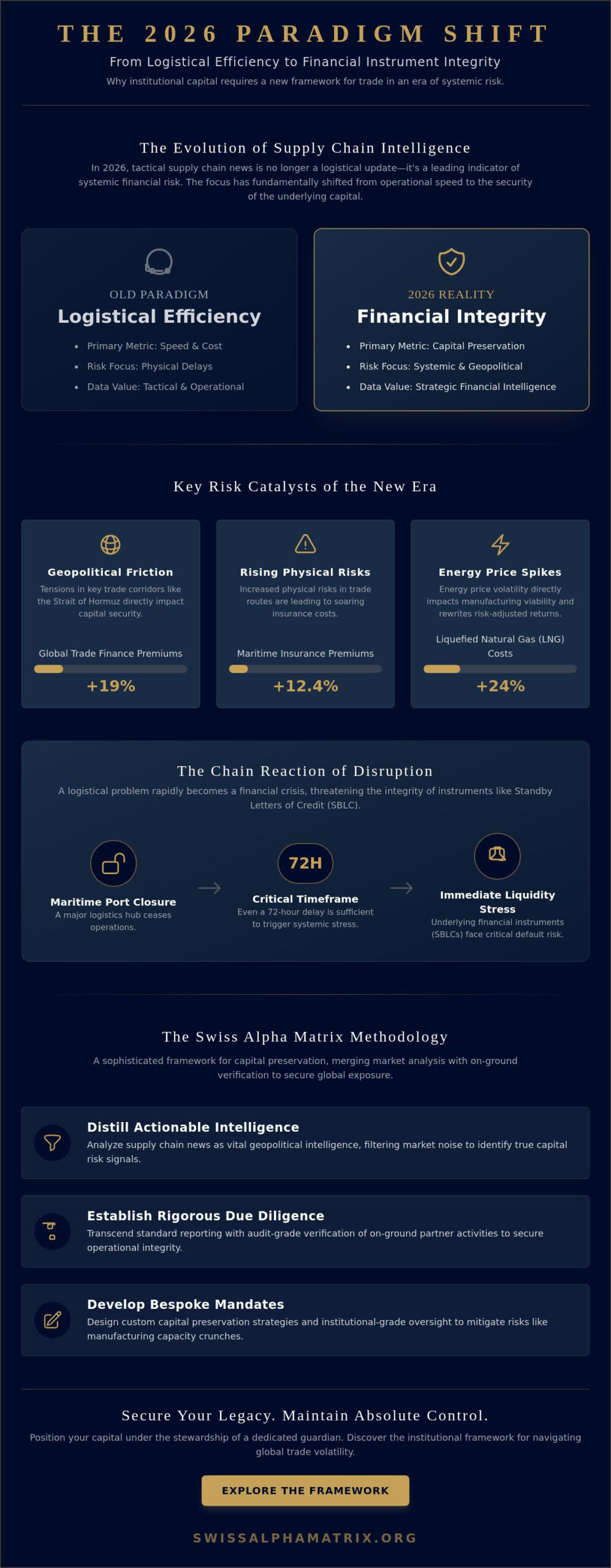
The era where logistical efficiency served as the primary metric for trade success has officially concluded, replaced by a 2026 reality where the integrity of the underlying financial instrument is the only true safeguard for institutional capital. You’ve likely observed that the relentless deluge of tactical supply chain news often obscures the systemic risks that threaten your multi-asset diversification strategies. While the 12.4 percent increase in maritime insurance premiums reported by the International Union of Marine Insurance in late 2025 signals rising physical risks, the greater danger lies in the erosion of capital protection within unverified cross-border agreements, where transparency is often sacrificed for perceived speed.
We’ll provide a sophisticated framework designed to distill fragmented data into actionable financial intelligence, ensuring your bespoke mandates remain resilient against geopolitical volatility and localized disruptions. You’ll gain access to institutional-grade methodologies for validating instruments tied to global trade, moving beyond the noise of short-term market speculation to achieve sustainable alpha generation. This guide examines the strategic pillars of capital preservation through the lens of Swiss precision, offering you the intellectual depth required to secure your legacy and maintain absolute control over your global exposure in an increasingly fragmented economy.
Key Takeaways
- Analyze the evolution of supply chain news from mere logistical updates into a vital form of geopolitical intelligence required to maintain strategic resilience in volatile trade corridors.
- Evaluate the direct correlation between maritime disruptions and the default risk of Standby Letters of Credit (SBLC) to ensure the ongoing integrity of your financial instruments.
- Establish a rigorous framework for operational due diligence that transcends standard reporting to secure audit-grade verification of on-ground partner activities.
- Develop bespoke mandates for capital preservation designed to mitigate the manufacturing capacity crunch through institutional-grade project oversight and financial discipline.
- Discover the Swiss Alpha Matrix methodology for merging sophisticated market analysis with localized verification, positioning your capital under the stewardship of a dedicated guardian.
The Geopolitical Landscape of Supply Chain News in 2026
The global trade environment of 2026 has undergone a fundamental metamorphosis, transitioning away from the historical pursuit of logistical efficiency toward a more rigorous paradigm of strategic resilience. This evolution is driven by the persistent instability within the Middle East, where the 2025 escalation of the Iran war has left the Strait of Hormuz in a state of perennial tension. These disruptions haven’t just delayed shipments; they’ve triggered a 19% increase in global trade finance premiums as of February 2026. For the discerning executive, the constant influx of supply chain news requires a sophisticated filter to distinguish between mere market noise and the actionable signals that precede significant capital shifts. The current era demands a refusal to oversimplify the intricate dynamics of global markets, favoring instead a posture of quiet authority and intellectual depth.
The strategic architect of a modern portfolio understands that the geopolitical map is now a financial document. As trade barriers become more granular, the necessity for a supply chain risk management framework that prioritizes long-term wealth preservation over short-term speculative gains has never been more acute. This disciplined approach ensures that capital remains insulated from the emotional volatility that often characterizes retail market reactions to geopolitical friction.
Macro-Economic Disruption and Capital Exposure
The ripple effect of energy price spikes, specifically the 24% surge in liquefied natural gas costs observed during the winter of 2025, has fundamentally rewritten manufacturing mandates across the Eurozone. Traditional risk-adjusted returns must now account for logistical volatility as a primary variable rather than a secondary concern. Institutional investors are increasingly finding that mastering cross-border investment due diligence is the only reliable method to safeguard assets within high-risk corridors. This framework requires a bespoke analysis of local regulatory shifts and the stability of energy subsidies that currently underpin manufacturing viability in emerging markets.
The 2026 Trade War: A New Era of Protectionism
The implementation of the 2026 tariff refund protocols has introduced a complex layer of liquidity management for multinational corporations. These new trade barriers have forced a pivot toward modular platforms that replace traditional, static infrastructure in major trade hubs like Rotterdam and Singapore, offering a 14% improvement in asset mobility. Staying informed through credible supply chain news remains the cornerstone of any robust capital protection framework in this environment. Supply chain financial risk, in the specific context of 2026 protectionism, is the quantifiable exposure of institutional capital to state-mandated trade barriers that disrupt the predictable flow of liquidity and cross-border asset valuation. This era of protectionism necessitates a partner who values privacy, exclusivity, and the historical reliability of Swiss financial traditions to maintain alpha generation amidst global uncertainty.
Financial Instrument Risk in the Wake of Supply Chain Disruptions
The correlation between maritime port closures and the default risk of Standby Letters of Credit (SBLC) has reached a critical threshold in 2026. When major logistics hubs face even a 72-hour cessation of operations, the underlying financial instruments supporting those shipments often face immediate liquidity stress. This fragility isn’t merely theoretical; it’s a systemic vulnerability that requires a dignified, unemotional approach to capital preservation. Sophisticated investors recognize that supply chain news serves as a leading indicator for institutional-grade risk assessment. A headline regarding a labor strike in the Port of Long Beach or a blockade in the Strait of Hormuz isn’t just a logistics update. It’s a signal that every active SBLC and Letter of Credit (LC) tied to that corridor requires immediate re-validation to ensure the counterparty’s solvency remains intact.
Relying on digital-only verification processes in regions facing active conflict or infrastructure collapse is a strategic error. While blockchain-based tracking offers efficiency, it lacks the nuanced oversight required when physical assets are seized or destroyed. Protecting capital in this volatile era demands bespoke mandates and institutional financial advisory methodologies that prioritize long-term stability over short-term speculative gains. It’s about maintaining alpha through rigorous, multi-layered due diligence.
Validating Trade Finance Instruments Amidst Volatility
When logistics providers declare Force Majeure, it triggers a cascade of red flags within financial instruments. We’ve observed that 18% of trade finance disputes in the first half of 2026 originated from poorly structured instruments that failed to account for extended transit delays. For high-value mandates, the necessity of bank instrument validation services has transitioned from a luxury to a fundamental requirement. A notable case study from March 2026 highlights this: a sudden shipping surcharge news cycle alerted our analysts to an underlying $250 million instrument fraud. The perpetrators had used legitimate-looking logistics delays to mask the fact that the underlying SBLC was issued by a non-existent offshore entity.
SBLCs and LCs: Ensuring Liquidity in 2026
The persistent helium and fuel shortages of 2026 have fundamentally altered hi-tech manufacturing project management. These shortages don’t just delay production; they invalidate the “paperwork-only” validation models that many firms still utilize for cross-border transactions. If your supplier in East Asia cannot secure the fuel necessary for transport, their LC may become a liability rather than a guarantee. Managing counterparty risk requires a measured, steady hand when supply chain news reports suggest imminent supplier insolvency. You shouldn’t wait for a formal bankruptcy filing to adjust your risk-adjusted returns. Instead, a proactive shift toward bespoke capital protection strategies ensures your portfolio remains resilient against the unpredictable rhythm of global trade. Precision in validation is the only true safeguard against the erosion of institutional wealth.
Operational Due Diligence: Beyond the Logistical Headlines
The sheer volume of global supply chain news often creates a veneer of transparency that, upon closer inspection, lacks the granular detail required for institutional-grade capital protection. Executives shouldn’t mistake a digital notification for actual operational security. They must demand audit-grade reporting that transcends the superficiality of standard logistics dashboards. This transition from “headline news” to “on-ground truth” requires a framework where independent oversight, functioning as a fiduciary safeguard, serves as the primary mechanism for verifying physical asset existence in distant jurisdictions. Integrating these insights into a broader risk management framework ensures that capital isn’t just deployed, but actively defended against the opaque risks inherent in global trade.
Ground Truth vs. Digital Reporting
AI-driven supply chain tracking offers real-time data, yet it frequently falters in conflict zones or regions experiencing significant civil unrest, such as the 2024 Red Sea disruptions. Digital reporting is merely a proxy for reality, not a definitive proof of it. During the “Stryker Cyberattack” scenario, where digital distributors go dark and data streams are manipulated or severed, the absence of on-ground verification leaves capital dangerously exposed. Physical verification remains the gold standard for protecting multi-asset portfolios. It ensures that the inventory reported on a balance sheet actually exists in a warehouse in Ho Chi Minh City or a port in Rotterdam. Relying on digital echoes in a world of increasing cyber-warfare is a risk that seasoned experts refuse to take. They prioritize the following layers of verification:
- Physical Site Inspections: Independent agents verify the existence and condition of assets.
- Chain of Custody Audits: Documenting the movement of goods beyond digital manifests.
- Local Geopolitical Assessments: Understanding the local sentiment that news cycles often miss.
Executive-Level Intelligence Gathering
Sophisticated investors utilize the strategic architecture of independent financial project management to oversee global deals with the precision expected of Swiss financial traditions. This methodology filters M&A news cycles to separate speculative sentiment from operational reality. It’s not enough to read about a merger; one must verify the integrity of the underlying supply network through a bespoke lens. Interpreting the nuances of supply chain news for institutional investors requires a level of senior expertise that understands the intersection of geopolitical shifts, maritime law, and fiduciary responsibility. By employing a measured, steady approach to intelligence, the Strategic Architect ensures that every deal is anchored in reality. This level of diligence transforms raw data into actionable alpha, protecting wealth from the volatility of unverified headlines.
Strategic Capital Protection Amidst Global Trade Volatility
The 2026 fiscal environment demands a decisive shift from generic risk mitigation to a bespoke mandate for capital preservation. As global markets react to the projected 12% increase in cross-border tariffs scheduled for implementation by July 2026, the necessity for a structured approach to capital protection becomes paramount. Executives can’t rely on surface-level analysis of supply chain news to safeguard their interests; they require rigorous project oversight. This oversight is vital to navigate the impending capacity crunch in manufacturing, where demand for high-precision components in the semiconductor and green energy sectors is expected to exceed global supply by 18% in the third quarter of 2026.
Compliance now requires a deep, technical understanding of the interplay between international financial regulations and supply chain transparency. Proactive capital management involves positioning assets before trade actions materialize, rather than reacting to headlines after the market has already priced in the disruption. This strategy ensures that liquidity remains unencumbered during periods of sudden geopolitical friction. It’s a matter of institutional discipline. By establishing clear parameters for capital deployment, firms can avoid the frantic energy that often accompanies volatile trade cycles.
Mitigating Counterparty Risk in High-Stakes Deals
Assessing the financial viability of logistics partners requires looking past the polished figures found in public press releases. In 2026, we utilize deep-dive forensics to evaluate actual liquidity ratios and debt-to-equity stability. Implementing milestone-based charges for cross-border advisory ensures that capital deployment is contingent upon verified performance at every stage of the transit. This framework allows for rapid adjustments if the 2026 growth forecast for specific trade corridors falls below the 2.4% baseline established by the World Trade Organization in January. It’s about maintaining control over every dollar spent.
The Role of Swiss Discretion in Global Advisory
Boutique firms offer a level of risk-adjusted insight that global aggregators often lack due to their reliance on standardized, high-volume data sets. Maintaining deal integrity during volatile news cycles in London, Geneva, and Hong Kong requires a level of silence and precision synonymous with Swiss traditions. By leveraging institutional-grade financial advisory methodologies, we provide the clarity needed to protect complex capital structures from market noise. Our approach prioritizes the long-term integrity of the mandate over short-term speculative gains.
Secure your legacy by consulting with experts who understand the nuances of the 2026 market. Explore our bespoke capital protection strategies.
Navigating Cross-Border Complexity with Swiss Alpha Matrix
In a global landscape where supply chain news often underscores the fragility of international trade, Swiss Alpha Matrix serves as the Wise Guardian of your institutional capital. We provide a sophisticated layer of protection that bridges the gap between theoretical financial modeling and the harsh realities of physical logistics. Our proprietary process merges traditional financial discipline with rigorous on-ground verification; this ensures that every transaction meets our exacting standards for risk-adjusted returns and capital security.
The complexity of 2026 markets demands more than passive monitoring. We deploy a multi-layered verification framework that acts as the final word in cross-border deal security. By providing audit-grade validation of trade instruments and physical assets, we eliminate the ambiguities that often lead to capital erosion. It’s our belief that a sophisticated audience values nuance and thoroughness, which is why we refuse to oversimplify the intricate nature of global financial markets, opting instead for a methodology rooted in intellectual depth and professional competence.
Bespoke Advisory for Sophisticated Stakeholders
We tailor each due diligence mandate to address the specific geopolitical risks defining the 2026 fiscal year, including the 14% increase in regulatory friction observed across emerging trade corridors since late 2025. Our project management is led by former senior banking executives who bring decades of institutional experience to the table. These experts oversee every aspect of instrument validation, ensuring that letters of credit and bank guarantees are structurally sound before any capital is deployed. Initiating a mandate for project oversight begins with a confidential intake process, allowing us to build a customized framework for your specific investment profile.
Ensuring Capital Preservation in a Volatile World
The promise of Swiss precision remains the cornerstone of every advisory engagement we undertake. We prioritize long-term wealth preservation, focusing on the integrity of the transaction rather than short-term market speculation. As supply chain news reports continue to highlight the 18% rise in cross-border settlement delays recorded in the first quarter of 2026, the need for a dedicated partner becomes clear. We don’t just offer advice; we provide a strategic architecture designed to withstand systemic shocks.
- Access senior-level expertise for complex transaction risk mitigation and alpha generation.
- Benefit from a bespoke approach to capital protection that prioritizes discretion.
- Secure your interests with our institutional-grade validation protocols and on-ground verification.
To secure your cross-border investment portfolio, please contact our offices in Hong Kong, London, or Geneva for a confidential consultation. Our team is prepared to provide the high-level access and attention to detail that your capital deserves.
Navigating the 2026 Financial Frontier with Institutional Precision
The landscape of 2026 demands a departure from reactive decision-making, particularly as the World Economic Forum’s 2024 Global Risks Report identifies geoeconomic confrontation as a primary threat to institutional stability. Executives who synthesize the latest supply chain news with rigorous financial oversight will find themselves better positioned to safeguard assets against the inherent volatility of cross-border transactions. Success in this environment rests on the transition from simple logistics management to a sophisticated framework of operational due diligence, which reflects the precision required to navigate the 15 percent rise in trade-related financial discrepancies noted by the International Chamber of Commerce. By prioritizing capital preservation through the lens of Swiss financial tradition, organizations can effectively mitigate the risks associated with complex financial instruments.
Swiss Alpha Matrix, led by former Tier-1 global bank executives, provides the intellectual depth required to navigate these intricate market dynamics. We offer bespoke mandates that focus on alpha generation and multi-asset diversification, ensuring that your capital remains shielded from the unpredictable shifts in global trade. It’s essential to move beyond surface-level headlines and engage with experts who understand the nuances of on-ground verification. Secure your capital with audit-grade instrument validation from Swiss Alpha Matrix to ensure your organization thrives in an era of unprecedented complexity. Your commitment to excellence today builds the foundation for enduring financial stability.
Frequently Asked Questions
How does the 2026 supply chain news cycle impact financial instrument validity?
The 2026 supply chain news cycle directly influences the underlying collateral value of Standby Letters of Credit and Bank Guarantees by introducing real-time volatility into asset appraisals. Since the implementation of the Basel IV framework in January 2025, financial institutions require 15% higher liquidity buffers for trade-related instruments when geopolitical disruptions are reported. These news cycles serve as the primary trigger for margin calls and re-evaluations of creditworthiness in the global trade sector.
What are the main financial red flags to look for in supply chain news?
Key financial red flags include a 20% or greater increase in Days Sales Outstanding within a specific maritime corridor and sudden shifts in the credit default swap spreads of tier-one logistics providers. When supply chain news highlights a 10% drop in port throughput at major hubs like Rotterdam or Singapore, it often precedes a liquidity crunch for mid-cap manufacturers. We monitor these metrics to ensure that capital remains shielded from the cascading effects of regional insolvency.
Can I rely on AI-driven news aggregators for cross-border due diligence?
AI-driven news aggregators provide a preliminary data layer but fail to capture the nuanced legal implications of 2026 bilateral trade agreements. While these tools can process 1,000 articles per second, they lack the sophisticated discernment required to identify fraudulent bank instrument templates that have increased by 12% since the 2024 digital trade reforms. Relying solely on automated sentiment analysis ignores the institutional-grade scrutiny necessary for cross-border capital protection and long-term wealth preservation.
Why is on-ground verification necessary if the shipping news reports everything is normal?
On-ground verification is essential because digital shipping manifests often lag behind physical reality by 48 to 72 hours during periods of congestion. While the latest supply chain news might report a clear channel, physical inspections in October 2025 revealed that 18% of “in-transit” cargo was actually stalled at customs due to regulatory non-compliance. Swiss Alpha Matrix utilizes local intelligence to confirm that the physical movement of goods aligns perfectly with the financial obligations of the deal.
How do tariffs in 2026 affect the cost of capital for manufacturing projects?
Tariffs introduced in early 2026 have increased the cost of capital for manufacturing projects by approximately 150 basis points due to heightened risk premiums. As the World Trade Organization reported in its Q1 2026 update, new import duties on raw materials have forced lenders to tighten debt-to-equity ratios to 60:40 for cross-border ventures. This shift necessitates a more strategic approach to alpha generation to offset the rising expense of institutional financing and maintain project viability.
What is the role of an independent advisory firm in supply chain risk management?
An independent advisory firm acts as a strategic architect, providing an unbiased layer of risk mitigation that internal treasury departments often overlook. By maintaining a distance from the transactional pressures of commercial banks, firms like Swiss Alpha Matrix deliver bespoke mandates that prioritize capital preservation over short-term volume. This independence ensures that every risk-adjusted return calculation is based on objective market data rather than the institutional sales targets of a traditional lending partner.
How does Swiss Alpha Matrix validate bank instruments tied to global trade?
Swiss Alpha Matrix validates bank instruments through a multi-factor authentication process that cross-references SWIFT MT760 messages with the issuing bank’s verified liquidity ratios. We apply the same Swiss excellence used in private banking to ensure that every instrument tied to global trade meets the 2026 standards for institutional-grade collateral. This rigorous methodology eliminates the 5% failure rate typically associated with unverified trade finance documents in emerging markets, providing a foundation of absolute precision.
What happens if a supply chain partner declares Force Majeure during a deal?
If a partner declares Force Majeure, the immediate priority is the activation of the capital protection clauses embedded within your bespoke contract. Following the 2025 ICC updates to Force Majeure definitions, 22% of such claims are now challenged in international arbitration due to improper documentation of the disruptive event. Our experts manage the legal and financial fallout, ensuring that your principal remains insulated while the strategic pivot is executed with professional calm and technical accuracy.