

A contract can establish the relationship; a statement of work (SOW) makes the project executable. To answer what a statement of work (SOW) is, it is the document that sets out a project’s objectives, scope, deliverables, responsibilities, schedule, payment terms, and acceptance procedures. Its value lies not simply in listing tasks, but in connecting roles, outputs, and timing to a shared basis for execution.
It’s easy to treat a statement of work (SOW), a scope of work, and a master agreement as interchangeable because each may describe aspects of the work. Their functions differ, though, and that distinction matters when setting expectations and assessing changes.
This article explains what an SOW defines, how it relates to those other documents, and how roles, deliverables, and schedules fit together. It also covers common drafting oversights, from vague acceptance criteria to unstated assumptions, so you can see what makes an SOW a practical guide to completing the work.
Key Takeaways
- Distinguish the project-level SOW from the narrower scope of work and the broader master agreement to understand what each document governs.
- Connect responsibilities, deliverables, deadlines, and acceptance criteria so project expectations can be assessed against clear outcomes.
- Surface assumptions, exclusions, dependencies, payment terms, and change procedures before they become sources of disagreement.
- Choose an SOW structure that reflects the work: focus on measurable outcomes, defined deliverables, or the time and resources required.
Common SOW drafting mistakes
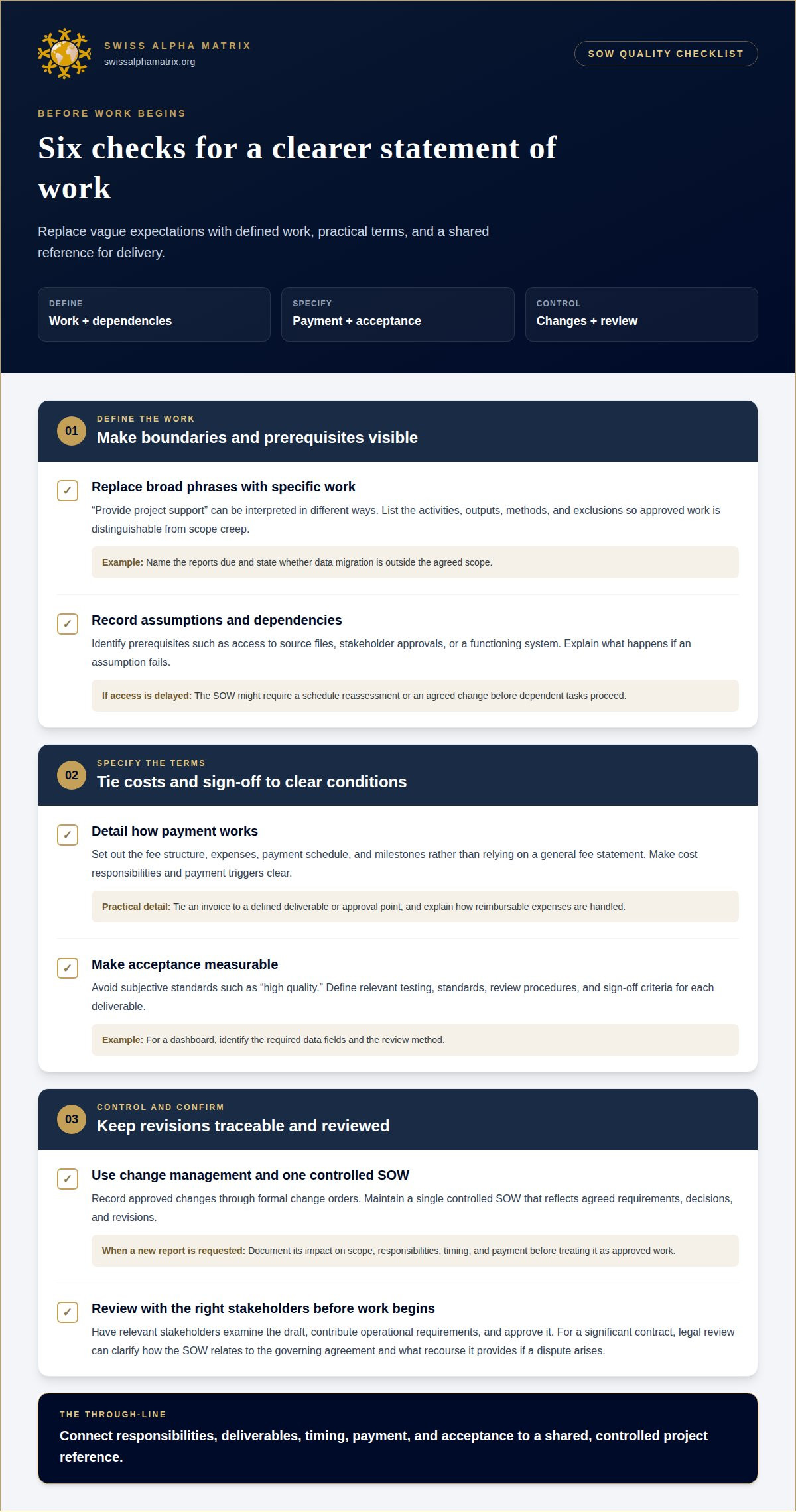
A broad phrase such as “provide project support” leaves the work open to interpretation. Define the activities, outputs, methods, and exclusions instead. For example, list the reports due and state whether data migration is outside the agreed scope. Clear boundaries help distinguish an approved request from scope creep.
Unstated assumptions can undermine an otherwise precise plan. Record prerequisites and dependencies, such as access to source files, stakeholder approvals, or a functioning system. Then explain what happens if an assumption fails. If a client delays access, the SOW might require a schedule reassessment or an agreed change before dependent tasks proceed.
Payment terms also need practical detail. Specify the fee structure, expenses, payment schedule, and milestones instead of relying on a general fee statement. For example, tie an invoice to a defined deliverable or approval point. Explain how reimbursable expenses are handled so both parties can see cost responsibilities and payment triggers.
Another common weakness is acceptance language based on subjective terms such as “high quality.” Set criteria for each deliverable, including relevant testing, standards, review procedures, and sign-off. For a dashboard, criteria could identify required data fields and the review method. Pair acceptance terms with a change-management process that records approved changes through formal change orders.
Competing versions create avoidable confusion. Maintain one controlled SOW that reflects agreed requirements, decisions, and revisions. When a stakeholder requests a new report, document its impact on scope, responsibilities, timing, and payment before treating it as approved work. This preserves a reliable reference during execution.
Finally, do not skip review. Relevant stakeholders should examine the draft, contribute operational requirements, and approve it before work begins. For a significant contract, legal review can clarify how the SOW relates to the governing agreement and what recourse it provides if a dispute arises. A carefully reviewed document supports clearer decisions when delivery diverges from expectations.
Differences between a statement of work, scope of work, and master agreement
These documents answer different questions. A scope of work identifies the work itself: tasks, activities, and deliverables. A statement of work places that scope within a project framework, connecting it to objectives, responsibilities, schedule, and acceptance. A master agreement establishes broader terms for an ongoing relationship, while an SOW can describe a particular engagement under those terms.
Are SOW requirements different for government contracts in the United States? They can be, because the solicitation and resulting contract may set requirements that the SOW must reflect. Do not assume a commercial template fits a public procurement unchanged.
Consider a consulting engagement. The scope might specify analysis of operational processes and delivery of a findings report. The SOW could add the project objective, responsible parties, review dates, and how the report will be accepted. If the parties already have a master agreement, it may set shared terms, while the SOW records the engagement’s specific commitments.
The distinction matters when a document changes. If a request adds a deliverable, the scope describes the added work. The SOW should show how the change affects related responsibilities, milestones, or acceptance. The master agreement remains the reference for broader relationship terms unless the parties amend it. Keeping each document’s role clear helps prevent a project revision from being mistaken for a change to every standing term.
Terminology isn’t always consistent across organizations. Some use “scope of work” for a standalone document; others place the scope inside a broader SOW. Read the document’s contents and relationship to the signed agreement rather than relying on its title alone. Identify which document governs project-specific work and how approved changes are recorded.
For cross-border initiatives, clear project governance helps connect contractual documents to delivery. Explore project governance considerations when assessing complex programmes.
Project size, roles, deliverables, schedule, and service expectations
The client and service provider typically develop the SOW together, then relevant stakeholders review and approve it before work begins. Name each decision-maker, contributor, and approver so responsibilities remain clear during delivery. For example, a project sponsor may approve a final report, while a technical lead supplies the data needed to prepare it.
Project size should shape the level of detail. A warehouse expansion covering 12,000 square feet requires coordinated workstreams, site requirements, and handoffs. The SOW can identify workforce needs, staffing levels, and required qualifications. For a smaller assignment, a concise list of tasks and accountable roles may provide sufficient control without adding unnecessary administrative detail.
Define each deliverable as an item submitted for review, then state how acceptance will be assessed. A website project might require a functioning site that loads in under 2 seconds, with testing procedures and sign-off criteria attached. If training is included, specify the deliverable, such as 2 hours of content-management-system training, rather than describing it simply as “support.”
Build the schedule around tasks, dependencies, reviews, and revisions. A website-development example sets a 3-month launch target; intermediate milestones clarify whether design approval or development completion is driving progress. Include time for stakeholder feedback and potential setbacks. A deadline without review periods can make the overall plan appear achievable while leaving no time to resolve defects.
Service expectations should describe the required outputs and operating rhythm without prescribing unnecessary detail. State who provides progress reports, how communications happen, and when reviews take place. If work involves a specific location, identify where activities happen. Reference relevant industry standards when applicable, and explain how the provider demonstrates compliance. This ties delivery quality to observable evidence rather than subjective expectations such as “responsive service” or “professional results.”
What are the different types of SOWs?
An SOW’s format should reflect what the client needs to control: outcomes, effort, or inputs. Three common models organize that decision differently. Each shifts the emphasis, so align its requirements with how delivery will be assessed.
A performance-based SOW defines the expected results rather than prescribing how the provider performs the work. For example, a data-analysis engagement could specify a completed report that meets stated accuracy and acceptance criteria. The provider retains discretion over the method, while the client evaluates performance against agreed outcomes. This structure suits work where results can be clearly described and consistently measured.
A level-of-work SOW focuses on time and resources, not a fixed set of deliverables. Consulting projects and ongoing support often use this model. The document can identify the roles involved, the support required, and the expected work capacity. For example, an advisory engagement may define access to specialist analysis as the central service rather than promise a specific report. Clarify how effort will be tracked and requests prioritized.
A time-and-materials SOW bases the arrangement on hours worked and materials used. It can suit assignments where the precise work becomes clearer as the project progresses. Define how time is recorded, which materials count, and how work is reviewed. Without those controls, the parties may interpret the same activity differently. The SOW should also explain how emerging tasks relate to the original scope and approval process.
These models aren’t interchangeable labels. A performance-based structure emphasizes measurable outcomes, a level-of-work structure emphasizes capacity, and a time-and-materials structure tracks inputs. Choose based on what can be reliably defined at the outset. Complex initiatives may combine elements, but the document should make each payment basis, responsibility, and acceptance method explicit.
For support aligning project requirements with delivery oversight, discuss complex project requirements.
Swiss Alpha Matrix: Audit-Grade Instrument Validation
Swiss Alpha Matrix provides Instrument Validation to support stakeholders assessing financial instruments within complex investment programmes. It is relevant when an SOW defines validation activities and stakeholders also need independent scrutiny of instrument documentation and related project risks. Clear deliverables and review criteria connect the engagement’s scope with the evidence stakeholders need for their assessment.
For programmes involving activity across locations, Swiss Alpha Matrix’s On-Ground Verification Services can add an operational perspective. Complex Project Management and Operational Due Diligence address broader execution and operational considerations, helping stakeholders relate defined responsibilities to delivery realities. These services complement an SOW; they do not replace the agreement or its approval process.
To discuss how these capabilities may fit your programme, contact Swiss Alpha Matrix.
Put the SOW to Work
Knowing what a statement of work (SOW) can and cannot control is a useful starting point. The next step is to connect its commitments to the decisions that govern delivery. Before work begins, consider whether the project’s oversight, evidence requirements, and execution risks are addressed alongside its written scope. This is particularly valuable in complex investment programmes, where operational realities and instrument validation may require attention beyond document drafting.
Swiss Alpha Matrix supports stakeholders who need independent scrutiny and structured execution input for complex programmes. Its Audit-Grade Instrument Validation, On-Ground Verification Services, and Complex Project Management can be relevant where project requirements intersect with verification or delivery oversight.
To explore how this support may relate to your programme, contact Swiss Alpha Matrix. A considered next step can help bring greater clarity to the work ahead.
Frequently Asked Questions
What is a Statement of Work (SOW)?
To understand what a statement of work (SOW) is, treat it as the project’s operating record: it translates an agreed engagement into instructions people can use during delivery. For example, a data-review SOW can identify which records are in scope and the format of the final analysis. This practical reference helps teams connect the engagement’s purpose to day-to-day decisions.
What are some risks of a SOW?
An SOW can create delivery and commercial friction if its language leaves important decisions open. A phrase such as “complete the analysis” may prompt different interpretations of data sources, depth, or presentation. Unrecorded approvals can also create uncertainty about which version controls. Consistently recording project decisions, document revisions, and agreed interpretations helps reduce these risks.
What does a SOW do?
An SOW gives project participants a shared reference for coordinating work and resolving practical questions during delivery. If a team needs to decide whether a requested analysis belongs in the engagement, it can compare the request with the documented commitments. That comparison supports a clear discussion about whether to proceed, defer the request, or formally revise the project arrangement.
What should be included in an SOW?
An SOW should include enough project-specific context for participants to understand the engagement without relying on informal conversations. For a data review, identify the source materials, intended audience, required output format, review route, and any constraints affecting access or use. Explain how project records and decisions will be maintained. Tailor the detail to the work, since an operational review may need different context from a consulting assignment.
What are the key components of a statement of work?
The key components work together as a coherent control framework: the objective explains the intended result, work packages clarify planned activities, and governance provisions establish how decisions and progress are managed. For example, a reporting engagement can link each report to a responsible contributor and a review route. This relationship matters more than a collection of headings that seem complete but lack operational connections.
What is the difference between an SOW, a contract, and a project scope statement?
A contract establishes the parties’ broader agreed terms, while an SOW describes a particular engagement and its delivery arrangements. A project scope statement is commonly used to frame project boundaries and intended work for planning purposes. The labels can vary across organizations, so examine how each document is used, what it governs, and whether it forms part of a wider agreement.