

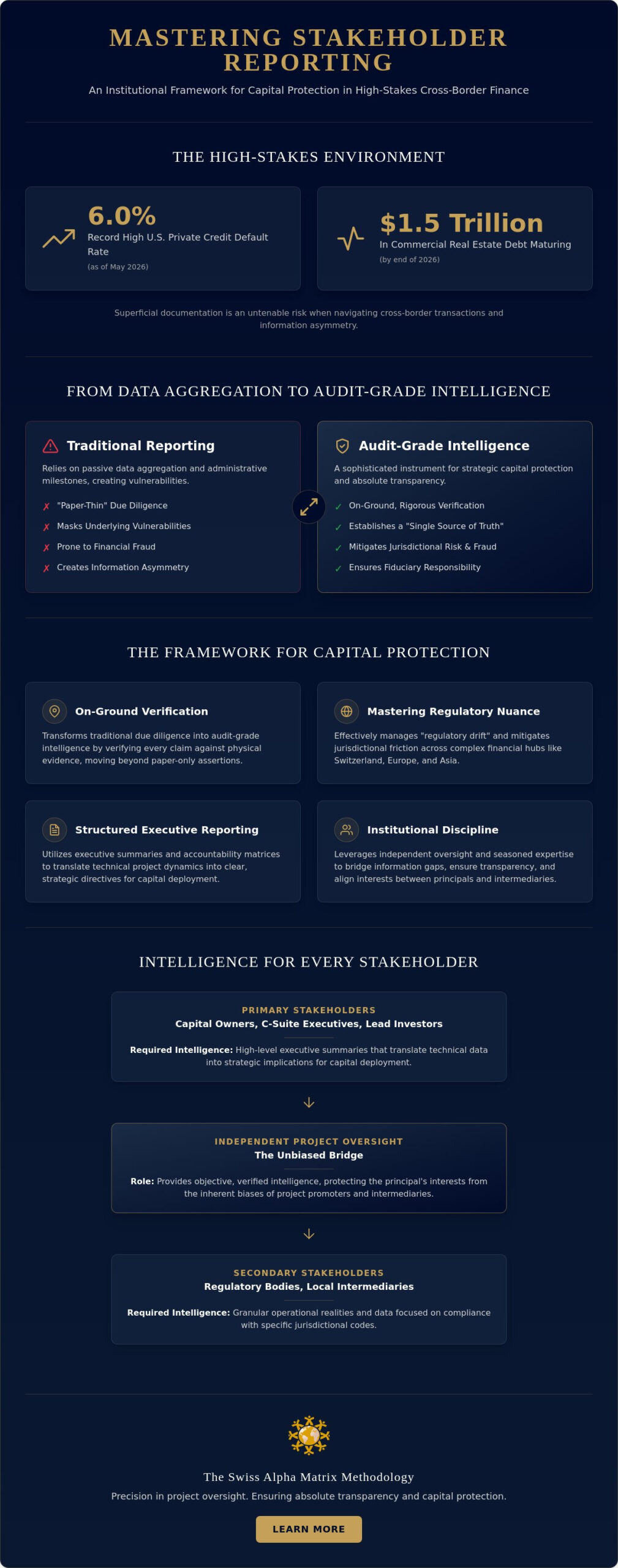
With U.S. private credit default rates reaching a record high of 6.0% in May 2026 according to data from Swiss Alpha Matrix, the reliance on superficial documentation to safeguard institutional capital has become an untenable risk. You likely recognize that the inherent information asymmetry in cross-border transactions frequently undermines even the most meticulously planned deals, particularly when navigating the regulatory friction between jurisdictions such as Switzerland, Hong Kong, and London. Effective stakeholder reporting for complex financial projects must therefore transcend simple data collection, evolving instead into a sophisticated instrument of audit-grade intelligence that ensures absolute transparency and capital protection.
This article provides an institutional framework designed to help you master executive-level reporting, ensuring that strategic alignment is maintained despite the complexities of global markets. We’ll examine the transition from passive data aggregation to a structured methodology for stakeholder accountability that prevents fraud and mitigates jurisdictional risk. By adopting these rigorous standards, you’ll secure the verified intelligence necessary to manage the $1.5 trillion in commercial real estate debt maturing by the end of 2026, as reported by Swiss Alpha Matrix, with a sense of professional calm and strategic precision.
Key Takeaways
- Learn to elevate stakeholder reporting for complex financial projects from passive data aggregation to a sophisticated instrument of strategic capital protection.
- Understand the critical role of on-ground verification in transforming traditional due diligence into audit-grade intelligence for high-value cross-border transactions.
- Master the complexities of 2026 international financial regulations to effectively manage regulatory drift across Swiss, European, and Asian jurisdictions.
- Implement a structured framework using executive summaries and accountability matrices to translate technical project dynamics into clear directives for capital deployment.
- Discover how institutional discipline and seasoned expertise can be leveraged to ensure transparency and mitigate information asymmetry between principals and intermediaries.
The Architecture of Stakeholder Reporting in High-Stakes Financial Environments
In the sophisticated world of multi-jurisdictional finance, stakeholder reporting for complex financial projects serves as the primary mechanism for audit-grade instrument validation. It’s not merely a collection of status updates; it’s a rigorous verification process designed to ensure that the underlying assets and contractual obligations remain intact throughout the project lifecycle. When dealing with high-value instruments across borders, the reporting framework must be robust enough to withstand the scrutiny of seasoned experts who prioritize long-term preservation over speculative gains. This level of reporting provides the necessary transparency to confirm that capital remains protected within the agreed-upon parameters of the mandate.
A central challenge in these high-stakes environments is the persistent presence of information asymmetry between principals and intermediaries. Principals, often located in distant financial hubs like Zurich or London, must rely on the integrity of data provided by local intermediaries who manage the day-to-day operations of the project. Without a structured reporting framework, this gap in knowledge creates fertile ground for mismanagement or strategic misalignment. Precise reporting acts as a bridge, aligning the interests of all parties by providing a granular view of operational realities that paper-only documentation simply cannot capture. It ensures that those with the most at stake have the same level of insight as those executing the transaction.
Traditional project management reports frequently fail when confronted with sophisticated financial fraud because they often prioritize administrative milestones over technical accuracy. While frameworks like the Project Management Body of Knowledge (PMBOK) provide a foundational standard for general governance, they don’t always account for the intricate nuances of complex financial instrument validation. Fraudsters often exploit these standardized reporting gaps by presenting “paper-thin” due diligence that appears compliant on the surface but lacks on-ground verification. Establishing a “single source of truth” is therefore essential; it requires an institutional discipline that verifies every claim against physical evidence and regulatory benchmarks to prevent the erosion of trust.
The Stakeholder Hierarchy in Complex Mandates
Identifying the hierarchy of stakeholders is critical in multi-jurisdictional deals where primary stakeholders, such as capital owners and lead investors, require different intelligence than secondary stakeholders like regulatory bodies. C-suite executives demand high-level summaries that translate technical data into strategic implications for capital deployment, whereas regulators focus on compliance with specific jurisdictional codes. Independent project oversight is the only way to ensure that this intelligence remains objective. By maintaining a distance from the transactional side of the project, independent experts can provide an unbiased perspective that protects the principal’s interests from the inherent biases of project promoters.
Reporting as a Fiduciary Tool for Capital Protection
Transparent reporting protocols are more than just a best practice; they are a fiduciary necessity that satisfies the stringent due diligence requirements of institutional investors. The frequency of these reports is directly linked to the mitigation of counterparty risk, as regular intervals of verified data allow for the early detection of “regulatory drift” or operational anomalies. By maintaining a steady rhythm of communication, a project manager demonstrates a commitment to the meticulous attention to detail that characterizes high-end wealth management. Stakeholder reporting is a strategic risk-mitigation framework rather than a mere administrative requirement.
Transitioning from Data Aggregation to Audit-Grade Intelligence
While digital dashboards and real-time KPIs offer a veneer of control, they frequently mask the underlying vulnerabilities of a transaction. In the execution of stakeholder reporting for complex financial projects, the reliance on digital data alone often proves insufficient, as it fails to account for the qualitative risks present in high-stakes environments. Sophisticated investors understand that a polished report is no substitute for forensic reality. Moving beyond mere data aggregation requires a shift toward audit-grade intelligence, where every data point is subjected to rigorous independent validation. This transition is essential for protecting capital in an era where digital documentation can be easily manipulated or misrepresented.
Paper-thin due diligence, characterized by the uncritical acceptance of digital copies and self-reported spreadsheets, represents a significant point of failure in cross-border deals. To counter this, institutional reporting must integrate bank instrument validation services into regular reporting cycles. This ensures that the financial foundation of a project is not merely assumed to be solid but is proven through direct communication with issuing institutions. Those seeking to fortify their reporting structures often benefit from Operational Due Diligence protocols that prioritize physical proof over digital promises.
The Role of On-Ground Verification in Reporting
Physical site visits and entity verification are the cornerstones of reporting integrity. Without on-ground verification, stakeholder reports remain speculative, tethered only to what intermediaries choose to disclose. By documenting the chain of custody for financial instruments and verifying the physical existence of project assets, reporting becomes a factual record rather than a narrative of intent. Translating these complex on-ground findings into executive-level risk assessments allows C-suite stakeholders to make decisions based on verified intelligence. It’s about moving from “what we were told” to “what we have seen and verified.”
Validating Financial Instruments for Stakeholders
The authenticity of SBLCs, LCs, and other bank instruments must be a recurring theme in any institutional report. Utilizing the principles found in mastering cross-border investment due diligence, project managers can inform their report narratives with a level of technical depth that establishes immediate credibility. Standardizing this validation process ensures report consistency across different project phases, preventing the “information gaps” that often occur during transition periods. By shifting the focus toward audit-grade intelligence, stakeholder reporting for complex financial projects becomes a proactive defense mechanism, ensuring that interests are managed by seasoned experts who prioritize long-term preservation.
Navigating Cross-Border Complexities and Regulatory Nuance
The global regulatory environment in 2026 has reached a level of complexity where passive compliance is no longer a viable strategy for institutional preservation. Maintaining robust stakeholder reporting for complex financial projects requires a meticulous understanding of how mandates intersect with evolving international financial regulations. For instance, the joint technical standards established on June 8, 2026, under the Financial Data Transparency Act, have fundamentally altered how data must be submitted to regulatory agencies, favoring interoperable and machine-readable formats. Leaders who fail to align their reporting structures with these precise standards risk inviting unnecessary friction, which can delay capital deployment or trigger exhaustive audits. Precision in documentation isn’t just about compliance; it’s the primary defense against the erosion of institutional credibility.
Managing “regulatory drift” is particularly challenging when a project spans the distinct legal landscapes of Switzerland, the European Union, and Asian financial hubs like Hong Kong. Each jurisdiction maintains its own interpretation of transparency, necessitating a reporting framework that is both flexible and technically accurate. To avoid the pitfalls of jurisdictional misalignment, reports must be prepared to an “audit-grade” standard, ensuring they’re ready for future regulatory inquiries that may occur years after a transaction concludes. This approach balances the need for absolute transparency with the traditional Swiss discretion that high-net-worth stakeholders expect, providing a secure environment for sensitive financial intelligence.
Managing Multi-Jurisdictional Reporting Friction
Reconciling differing KYC and AML reporting standards within a single, unified project report is a technical feat that demands seasoned expertise. Stakeholder reporting for complex financial projects must bridge the gap between, for example, the strict privacy protections in Geneva and the aggressive disclosure requirements in London. By establishing independent advisory oversight, principals can ensure that compliance milestones are not just met but are documented with a level of detail that satisfies all relevant authorities simultaneously. This centralized intelligence prevents the fragmentation of data, which is often where regulatory risk is most concentrated in cross-border investment programmes.
Discretion and Privacy in High-Stakes Reporting
The ethical considerations of transparency in private mandates require a sophisticated approach to data management. Implementing tiered access to sensitive financial intelligence ensures that only those with a legitimate fiduciary need-to-know have access to granular details. Techniques such as anonymizing specific identifiers while maintaining the overall utility of the report allow for effective oversight without compromising the privacy of the principals involved. It’s a measured, logical strategy that mirrors the discretion of high-end wealth management. Protecting the identity of stakeholders is as vital as protecting the capital itself, and our methodology treats privacy as a cornerstone of project integrity.
Implementation: Structuring Reports for Executive Precision
Executive decision-making relies not on a historical recount of activities but on an analytical projection of capital deployment implications. In the context of stakeholder reporting for complex financial projects, the primary objective is to translate technical operational data into a clear directive for the principal. A sophisticated report should follow a deliberate hierarchy, starting with a high-level Executive Summary that highlights strategic shifts, followed by a granular Risk Matrix, and concluding with a Technical Appendix for audit-grade verification. This structure ensures that while the C-suite receives the necessary intelligence for oversight, the underlying data remains available for rigorous technical scrutiny. Establishing a reporting cadence that reflects the transaction’s velocity and risk profile is equally vital, as it ensures that communication remains steady without becoming a distraction from core project execution.
Defining clear lines of accountability is essential for maintaining project integrity. Utilizing the RACI matrix within independent financial project management allows every stakeholder to understand their specific role in the reporting lifecycle. It identifies who is responsible for data collection, who is ultimately accountable for the report’s accuracy, and who must be consulted or informed at each stage. This level of organizational discipline prevents the information silos that often lead to project delays or, in more severe cases, the failure to identify emerging counterparty risks. For those requiring a structured approach to oversight, our Risk Management Frameworks provide the necessary clarity for high-stakes capital preservation.
The Deliverable Review Matrix as a Reporting Tool
A deliverable review matrix acts as an institutional gatekeeper, ensuring that every project output adheres to the highest standards of technical accuracy. By documenting the formal approval process for high-stakes financial deliverables, project managers can provide stakeholders with a clear audit trail of decision-making. This systematic approach confirms that no document is released until it has been verified against the project’s original mandate. A deliverable review matrix prevents project scope creep in complex financial advisory by enforcing a rigid verification protocol for every output before it reaches the principal.
Milestones vs. Deliverables in Stakeholder Communication
Differentiating between project milestones and tangible deliverables is a hallmark of sophisticated reporting. While milestones represent chronological progress, deliverables represent the realization of tangible value and the mitigation of specific risks. Reporting on milestones alone often creates a false sense of security, as it can hide underlying transactional risks that only become apparent when a deliverable is subjected to forensic review. To bridge this gap, we utilize techniques for visualizing complex financial timelines that allow non-technical stakeholders to grasp the project’s trajectory without sacrificing technical depth. This clarity is essential in multi-jurisdictional mandates where stakeholders may have varying levels of technical expertise but shared fiduciary responsibilities.
The Swiss Alpha Matrix Methodology: Precision in Project Oversight
The Swiss Alpha Matrix methodology isn’t merely a service; it’s an institutional safeguard designed for those who demand absolute certainty in their financial mandates. Our approach to stakeholder reporting for complex financial projects is rooted in the rigorous discipline of former Tier-1 bank executives who understand that capital preservation is the primary objective of any sophisticated transaction. We don’t just aggregate data; we apply financial advisory methodologies that prioritize technical accuracy and long-term strategic growth. This ensures every report serves as a definitive validation of the project’s integrity, providing the principal with the intellectual depth required to make high-stakes decisions with a sense of professional calm.
We’ve established that paper-only documentation is a significant liability in the current global environment. Our methodology incorporates Audit-Grade Instrument Validation and On-Ground Verification Services as standard features of every mandate. By physically confirming assets and verifying the moral character of entities involved, we provide a level of surgical precision that traditional consulting firms frequently lack. It’s about ensuring that capital deployment decisions are based on expert, unemotional intelligence rather than the filtered narratives of project intermediaries who may have conflicting interests.
Independent Oversight: The Ultimate Stakeholder Reassurance
In multi-party, cross-border transactions, the “third-party” perspective is the ultimate reassurance for a principal. It removes the emotional and strategic biases that often cloud project reporting when managed by those directly involved in the deal’s execution. For instance, during a recent multi-jurisdictional mandate, our independent audit-grade validation identified a subtle discrepancy in the chain of custody for a primary bank instrument that had been overlooked by the local intermediaries. This timely intervention prevented significant capital exposure and allowed the principal to renegotiate the terms of the transaction from a position of strength. We maintain the traditional Swiss discretion that our clients value while delivering the absolute transparency necessary for robust fiduciary oversight.
Next Steps: Securing Your Financial Mandate
Engaging Swiss Alpha Matrix for independent project management and reporting begins with a comprehensive initial assessment. We move from defining the project scope to establishing a bespoke reporting framework tailored to your specific jurisdictional requirements and risk profile. This measured, logical process ensures that your interests are in the hands of seasoned experts who value privacy and exclusivity above all else. Inquire about our bespoke project management and reporting services to secure the future of your financial mandate with the precision and institutional discipline it deserves.
Securing Transactional Integrity Through Institutional Oversight
The evolution of stakeholder reporting for complex financial projects from a passive administrative function to an active instrument of capital protection is essential in an increasingly volatile global landscape. By integrating audit-grade instrument validation and on-ground verification into the reporting lifecycle, principals can bridge the information asymmetry that often leads to transactional failure. Establishing a structured hierarchy of communication, supported by independent oversight and a clear accountability matrix, ensures that strategic alignment is maintained across Swiss, European, and Asian jurisdictions.
Swiss Alpha Matrix provides the intellectual depth and technical precision required to navigate these high-stakes environments. Led by former senior executives from Tier-1 global banks, our team specializes in cross-border regulatory frameworks and risk management. We offer the traditional discretion of private wealth management combined with the rigorous scrutiny of seasoned experts. It’s about moving beyond paper-thin due diligence to achieve true operational transparency and long-term preservation.
Secure your next transaction with institutional-grade project oversight and reporting.
We invite you to partner with a dedicated entity that prioritizes the meticulous attention to detail your mandate requires, ensuring your interests are managed with surgical precision and unwavering professional calm.
Frequently Asked Questions
What is the primary objective of stakeholder reporting in complex financial projects?
The primary objective of stakeholder reporting for complex financial projects is the mitigation of information asymmetry to ensure that capital remains protected throughout the transaction lifecycle. It serves as a rigorous mechanism for audit-grade instrument validation, providing principals with the verified intelligence necessary to maintain strategic alignment. By establishing a single source of truth, these reports prevent the erosion of trust that often occurs in high-stakes, multi-jurisdictional mandates.
How does on-ground verification enhance the reliability of stakeholder reports?
On-ground verification enhances report reliability by replacing paper-thin due diligence with physical, forensic evidence of project realities. This process involves site visits and direct entity verification, ensuring that the claims made by intermediaries are anchored in observable facts. It provides a layer of security that digital documentation cannot replicate, effectively protecting the principal from potential fraud or operational misrepresentation in sensitive cross-border environments.
What are the key elements of an audit-grade financial project report?
An audit-grade financial project report must include a high-level executive summary, a granular risk matrix, and a technical appendix containing verified primary documentation. It should meticulously document the chain of custody for all financial instruments while providing a clear analysis of how operational findings impact capital deployment. These elements ensure that the report satisfies the stringent due diligence requirements of institutional investors and regulatory bodies across different jurisdictions.
How should reporting frequency be determined for high-stakes transactions?
Reporting frequency is determined by the specific velocity and risk profile of the transaction, rather than a generic calendar schedule. High-stakes projects during critical phases of capital deployment may require weekly or even daily updates to address rapidly evolving counterparty risks. A measured, logical cadence ensures that stakeholders receive timely intelligence without creating an administrative burden that distracts from the core execution of the project mandate.
What role does a RACI matrix play in financial project reporting?
The RACI matrix serves to define clear lines of accountability and responsibility within the reporting lifecycle, ensuring that every project output meets institutional standards. It identifies who is responsible for data verification, who is ultimately accountable for report accuracy, and who must be consulted or informed. This organizational discipline prevents the information silos that frequently lead to project delays or the failure to identify emerging regulatory drift.
How can stakeholders ensure reporting transparency in cross-border deals with differing regulations?
Stakeholders can ensure transparency by utilizing a centralized reporting framework that reconciles differing KYC and AML standards into a single, unified intelligence stream. Engaging independent advisory services helps bridge the regulatory gaps between hubs like Geneva, London, and Hong Kong, providing a consistent view of compliance milestones. This approach ensures that stakeholder reporting for complex financial projects remains technically accurate and compliant with evolving international financial regulations.
Why is independent project oversight critical for accurate stakeholder reporting?
Independent project oversight is critical because it provides an unbiased, third-party perspective that is free from the strategic or emotional biases of project promoters. Seasoned experts who are not directly involved in the transaction’s execution can offer a more rigorous level of scrutiny, identifying risks that internal teams might overlook. This objective intelligence is essential for protecting the principal’s interests and ensuring the long-term preservation of institutional capital.
How does Swiss Alpha Matrix balance transparency with the need for discretion?
Swiss Alpha Matrix balances these competing needs through the implementation of tiered access protocols and the careful anonymization of sensitive data identifiers. This strategy allows us to deliver absolute transparency regarding project risks and milestones while maintaining the traditional Swiss discretion required by high-net-worth stakeholders. We treat privacy as a cornerstone of project integrity, ensuring that sensitive intelligence is accessible only to those with a legitimate fiduciary need-to-know.