

In the sophisticated sphere of global capital allocation, the most pervasive threat to long-term preservation isn’t found in market volatility, but rather in the deceptive elegance of a perfectly executed, yet fundamentally fraudulent, regulatory filing. You recognize that while Mexico reached a historic peak of $40.871 billion in foreign direct investment in 2025, the inherent opacity of local jurisdictions often masks a profound misalignment between international standards and regional enforcement. Achieving certainty requires more than a cursory review of digital records; it demands a rigorous approach to regulatory due diligence in emerging markets that prioritizes institutional discipline over administrative convenience.
By reading this analysis, you’ll gain the strategic clarity necessary to synthesize high-level compliance frameworks with the granular reality of on-ground verification, ensuring your interests remain insulated from the systemic risks of corruption. We’ll explore a methodology for audit-grade validation that addresses recent shifts, such as the February 2026 expansion of the FATF “grey list” to include Kuwait and Papua New Guinea. This measured exploration moves from broad principles of risk management to the specific strategic pillars required for absolute capital protection in an increasingly complex global environment.
Key Takeaways
- Transition from passive administrative compliance to an institutional-grade risk mitigation framework that verifies the precise legal standing of entities and their statutory instruments.
- Master the complexities of regulatory due diligence in emerging markets by learning to reconcile superficial “paper reality” with verifiable operational truth on the ground.
- Establish a structured, risk-adjusted approach to market entry through comprehensive jurisdictional mapping and the forensic identification of Ultimate Beneficial Owners.
- Utilize on-ground verification services to detect subtle red flags in corporate registries and local filings that often evade standard international audit procedures.
- Understand the strategic advantage of integrating Swiss-inspired discretion with technical investigative rigor to ensure long-term capital protection across disparate jurisdictions.
The Evolving Landscape of Regulatory Due Diligence in Emerging Markets
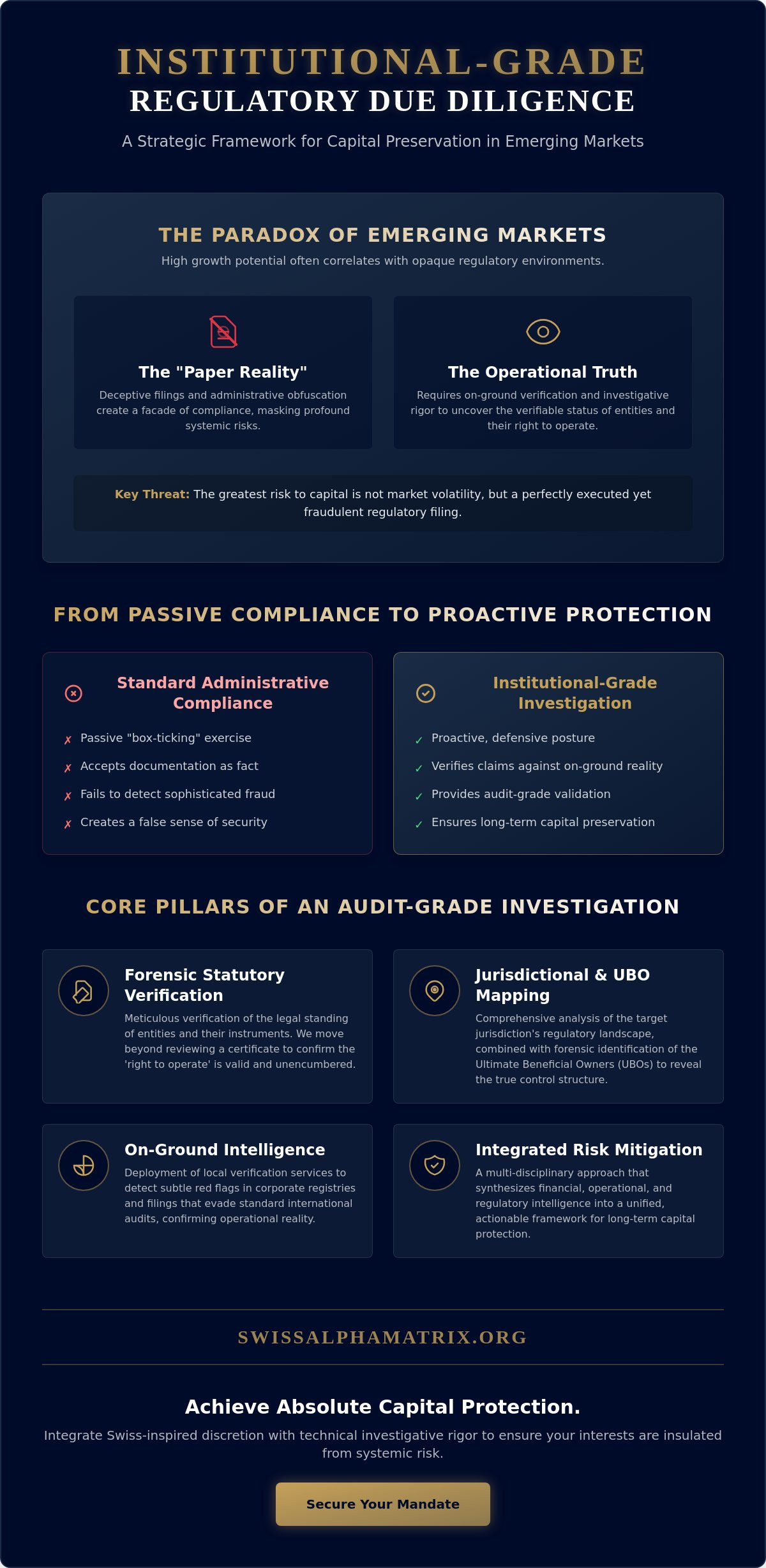
The pursuit of alpha in frontier economies necessitates a departure from the superficial administrative checks that characterize standard compliance. In these jurisdictions, due diligence is not merely a procedural hurdle but a fundamental exercise in capital preservation. True regulatory due diligence in emerging markets involves an exhaustive synthesis of statutory verification and on-ground intelligence, designed to bridge the gap between official documentation and operative reality. This institutional-grade approach replaces the broad-brush assessments of traditional consulting with the technical precision typical of high-end private wealth management. It’s a shift from passive box-ticking to a proactive, defensive posture that treats every regulatory filing as a claim to be verified rather than a fact to be accepted.
Standard Western frameworks often falter because they assume a level of institutional transparency that rarely exists in high-growth markets. While a legal registry in a developed economy might be considered a definitive source of truth, registries in emerging markets can be compromised by administrative lag or intentional obfuscation. Seasoned experts, particularly those with a background in Tier-1 global banking, recognize that identifying hidden regulatory pitfalls requires a mindset calibrated for regional idiosyncrasies. It’s about looking past the seemingly legitimate paperwork to find the structural weaknesses that could lead to expropriation or regulatory seizure. This level of scrutiny ensures that interests remain in the hands of experts who prioritize long-term preservation over short-term speculative gains.
The Paradox of Regulation and Growth
Investors are frequently drawn to jurisdictions where the lack of established competition signals high growth potential, yet these same regions often harbor the most opaque regulatory environments. The shifting nature of geopolitical alliances directly influences local enforcement patterns, as seen in the 2026 adjustments to the FATF “grey list” which now includes Papua New Guinea and Kuwait. This volatility underscores the necessity for a framework that views regulation not as a static set of rules, but as a dynamic political instrument. The regulatory paradox in emerging markets is defined as the inverse correlation between market opportunity and the transparency of the institutional structures governing it.
Beyond the Legal Checklist: A Multi-Disciplinary Approach
Effective risk mitigation requires the integration of financial, operational, and regulatory perspectives into a unified mandate. Mastery of cross-border investment due diligence in 2026 demands more than just legal scrutiny; it requires understanding the “silent” regulations that govern informal power structures. These unwritten rules often dictate the success of a project more than the formal statutes found in a government gazette. By identifying these nuances, a dedicated partner can provide the audit-grade validation necessary to ensure that a counterparty’s “right to operate” is both valid and unencumbered by undisclosed local obligations. This multi-disciplinary approach transforms regulatory due diligence in emerging markets from a cost center into a strategic advantage.
Core Pillars of an Institutional-Grade Regulatory Investigation
The integrity of any cross-border transaction rests upon the structural soundness of its regulatory pillars. Statutory compliance serves as the first line of defense, requiring a meticulous verification of the legal standing of both the entities involved and the instruments they utilize. It’s not enough to review a certificate of incorporation; one must confirm that the “right to operate” remains valid, unencumbered by undisclosed liens or administrative suspensions that often plague high-growth jurisdictions. This level of regulatory due diligence in emerging markets demands a forensic approach to licensing and permitting, ensuring that every operational prerequisite is satisfied under both local law and international benchmarks. Rigorous Anti-Money Laundering (AML) and Know Your Counterparty (KYC) deep dives are essential to reconcile regional practices with the stringent requirements of the Foreign Corrupt Practices Act (FCPA) and the UK Bribery Act. These investigations move beyond standard database searches, employing on-ground verification to uncover the nuances of local corporate registries that digital aggregators frequently overlook. The intersection of local statutes and international mandates creates a complex legal environment where only the most disciplined approach can identify the subtle indicators of regulatory non-compliance. For those seeking this level of precision, engaging a specialized regulatory compliance advisory ensures that every instrument is scrutinized with the same rigor applied to Tier-1 institutional portfolios.
Audit-Grade Instrument Validation
Securing capital in volatile environments requires the technical validation of financial commitments. Sophisticated investors rely on bank instrument validation services to authenticate SBLCs, LCs, and other complex structures. This isn’t a mere document review; it’s a process of direct institutional communication that bypasses intermediaries to confirm the authenticity of the underlying assets and the authority of the signatories involved.
Political Exposure and Sanctions Screening
Identifying Politically Exposed Persons (PEPs) is critical within opaque ownership structures where beneficial owners are hidden behind layers of shell companies. Real-time sanctions monitoring has become indispensable as global alliances shift. With Papua New Guinea and Kuwait added to the FATF grey list in February 2026, adherence to international financial regulations is the only way to ensure strategic preservation and continued access to global markets.
Reconciling Documentary Evidence with Operational Reality
In the context of high-stakes cross-border transactions, the most significant risk often lies in the seductive clarity of a well-prepared document package. This “Paper Reality” frequently serves as a veneer for fundamental fraud, where local regulatory filings and corporate registries appear legitimate but are disconnected from the actual operational state of the entity. Relying solely on local legal counsel can be a strategic error, as their scope is typically limited to verifying that documents exist within official channels rather than confirming their underlying truth. To achieve a standard of regulatory due diligence in emerging markets that withstands institutional scrutiny, one must move beyond the administrative surface to identify red flags that only an independent, multi-disciplinary advisory can detect. This involves scrutinizing the consistency of filings over time and identifying discrepancies that suggest political interference or administrative manipulation, ensuring that capital is protected by more than just a signature on a page.
The Limitations of Desktop Regulatory Reviews
While digital transformation has reached many emerging jurisdictions, the databases that house regulatory information often remain incomplete, intentionally delayed, or subject to manipulation by local actors with vested interests. A clean desktop report is often the starting point, not the conclusion, of diligence, as it merely confirms what the local authorities have been instructed to record. Investors who rely exclusively on these reports fall victim to a dangerous confirmation bias, accepting the official narrative without questioning the provenance of the data. Effective regulatory due diligence in emerging markets requires recognizing that a lack of negative information in a digital registry is not synonymous with the absence of risk, particularly in jurisdictions where transparency is not an institutional priority.
The Swiss Alpha Matrix Methodology for Physical Verification
Bridging the gap between a document and its operational reality requires the deployment of on-ground verification services to conduct discreet site visits and local stakeholder interviews. This methodology moves beyond the ledger to verify the physical existence and actual operational capacity of regulated entities, ensuring that the infrastructure described in a prospectus truly exists. By reconciling bank records directly with physical instrument custody, we eliminate the risk of intermediated fraud that often occurs in the last mile of a transaction. This rigorous application of operational due diligence provides the audit-grade validation necessary for capital preservation, reflecting a standard of regional precision that distinguishes a sophisticated master planner from a passive market participant.
Implementing a Risk-Adjusted Framework for Market Entry
Transitioning from a theoretical understanding of risk to a functional market entry strategy requires a departure from abstract checklists in favor of a structured, operationalized methodology. This process transforms regulatory due diligence in emerging markets from a reactive compliance exercise into a proactive defensive strategy, ensuring that capital is deployed only when every institutional prerequisite has been satisfied. By treating regulatory hurdles as a series of technical milestones, a master planner can maintain deal integrity even in jurisdictions where transparency is not the default setting. This rigorous framework moves beyond simple legal reviews, incorporating a multi-layered approach that reconciles administrative data with on-ground reality and financial instrument authenticity.
The following five-step sequence provides the architectural foundation for an institutional-grade investigation:
- Step 1: Preliminary Regulatory Mapping and Jurisdictional Risk Assessment. A forensic assessment of the local regulatory landscape, accounting for recent shifts such as the April 2026 expansion of data protection mandates across 45 African nations.
- Step 2: Counterparty Deep-Dive and Ultimate Beneficial Owner (UBO) Identification. Piercing complex corporate structures to identify the natural persons in control, ensuring compliance with global AML standards.
- Step 3: On-Ground Operational and Regulatory Reconciliation. Deploying local experts to verify that physical assets and operational capacities match the claims made in regulatory filings.
- Step 4: Independent Financial Instrument Validation and Audit-Grade Reporting. Subjecting SBLCs, LCs, and other credit enhancements to direct institutional verification to eliminate the risk of document fraud.
- Step 5: Ongoing Regulatory Oversight and Milestone-Based Project Management. Maintaining a continuous defensive posture through the lifecycle of the transaction, ensuring that regulatory status does not degrade after the initial entry.
The Role of Independent Project Management
Ensuring that these diligence milestones are met without compromising technical accuracy requires a centralized authority that stands apart from the transaction’s primary stakeholders. This is where independent financial project management becomes indispensable, as it provides the necessary oversight to manage a complex R.A.C.I. matrix across multiple time zones and legal systems. By maintaining an unemotional focus on deal integrity, this function ensures that every step of the regulatory due diligence in emerging markets process is documented to an audit-grade standard, providing a clear trail of validation for institutional stakeholders.
Mitigating Counterparty and Jurisdictional Risk
Developing custom risk management frameworks allows for the hyper-personalization of safety protocols based on the specific idiosyncrasies of the target market. Sophisticated entities utilize escrow arrangements and milestone-based capital deployment to ensure that funds are only released upon the verification of regulatory compliance. Leveraging established financial advisory methodologies enables the structuring of safe exit strategies, protecting interests from the moment of entry. To begin securing your cross-border mandates with this level of precision, consider engaging a specialized risk management framework designed for the complexities of modern emerging markets.
Swiss Precision in Global Mandates: The Swiss Alpha Matrix Advantage
The efficacy of regulatory due diligence in emerging markets is fundamentally tethered to the pedigree of the investigators conducting the mandate. At Swiss Alpha Matrix, we leverage decades of Tier-1 global banking experience to provide a level of technical precision that standard corporate consultancies, often hampered by high-volume throughput, cannot replicate. Our methodology integrates the traditional discretion of Swiss private wealth management with institutional-grade investigative rigor, delivering executive-level intelligence that transcends the limitations of standard legal reporting. This approach ensures that capital preservation remains the primary objective, achieved through a meticulous oversight process that treats every project as a unique strategic architecture rather than a recurring administrative task. It’s about providing a standard of service that is both broad in its reach and meticulous in its attention to detail.
Boutique Service, Institutional Reach
Sophisticated investors often find that the broad reach of global consulting firms is frequently diluted by a lack of hyper-personalized attention. We provide a dedicated partnership that prioritizes long-term stability and regional excellence over transaction volume. By maintaining a single, trusted Swiss point of contact, our clients gain access to a global network of on-ground verification specialists without the fragmentation typically associated with cross-border mandates. This boutique model allows for the intellectual depth required to manage complex project management tasks while ensuring that technical accuracy is never sacrificed for speed. We don’t just verify documents; we authenticate the entire operational environment surrounding them.
Securing Your Next Cross-Border Transaction
Transforming regulatory uncertainty into actionable strategic intelligence requires a synthesis of institutional discipline and on-ground truth. The final deliverable of our process is an audit-grade report that provides executive-level validation, allowing for confident decision-making in jurisdictions where shifting local laws might otherwise cause hesitation. Our commitment to capital protection is unwavering, rooted in a persona that is elite yet accessible to those who value nuance and thoroughness. To secure your interests with the precision of a master planner, engage Swiss Alpha Matrix for your next emerging market mandate and experience a standard of regulatory due diligence in emerging markets defined by historical reliability and regional precision.
Architecting Resilience in High-Growth Jurisdictions
The transition from speculative capital allocation to an institutional-grade defensive posture requires a profound synthesis of technical rigor, regional precision, and historical reliability. By prioritizing the reconciliation of documentary evidence with the granular reality of on-ground verification, sophisticated entities can successfully move beyond the superficial administrative security offered by local registries. This disciplined approach to regulatory due diligence in emerging markets, when executed through a risk-adjusted framework, transforms systemic opacity into a manageable strategic variable that’s rooted in the traditional discretion of high-end wealth management. It ensures that capital preservation remains the primary objective, insulated from the inconsistencies between local laws and international standards.
Our methodology, which is led by former Tier-1 global bank executives with decades of cross-border transactional experience, ensures that every mandate is governed by audit-grade instrument validation standards and meticulous project oversight. It’s about providing the intellectual depth and technical accuracy required to maintain deal integrity across disparate legal systems. To elevate your operational standards and secure your next transaction with absolute certainty, we invite you to consult with our senior advisors on your emerging market regulatory requirements. This partnership offers the elite access and professional calm necessary for enduring strategic growth in the world’s most complex environments.
Frequently Asked Questions
What is the difference between legal due diligence and regulatory due diligence in emerging markets?
Legal due diligence focuses on the validity of contracts and title ownership, while regulatory due diligence evaluates an entity’s standing within a jurisdiction’s administrative and statutory framework. This process ensures the “right to operate” remains unencumbered by local administrative suspensions or shifting political mandates. It’s a defensive strategy that moves beyond basic ownership to verify that all operational prerequisites are satisfied under both local law and international benchmarks.
How does Swiss Alpha Matrix verify the authenticity of bank instruments in opaque jurisdictions?
We utilize a process of direct institutional communication that bypasses intermediaries to confirm the provenance of the asset and the authority of its signatories. This audit-grade validation ensures that instruments like SBLCs or LCs are authenticated through technical protocols rather than a simple document review. By employing former Tier-1 banking executives, we apply the same rigor found in high-end private wealth management to every private mandate.
Why should institutional investors prioritize on-ground verification over desktop research?
Desktop research in high-growth jurisdictions often relies on digital databases that are subject to administrative lag or intentional manipulation. Physical on-ground verification is the only reliable method to reconcile a clean report with actual operational capacity. Site visits and stakeholder interviews allow us to detect subtle red flags that digital aggregators frequently overlook, ensuring that capital is protected by more than just a signature on a page.
Can regulatory due diligence prevent fraud in cross-border investment programs?
Rigorous regulatory due diligence in emerging markets acts as a primary defensive layer against fraud by identifying discrepancies between official filings and physical reality. By uncovering hidden political exposures or fraudulent documentation before capital is deployed, it prevents the misallocation of funds into compromised structures. This proactive posture treats every regulatory filing as a claim to be verified rather than a fact to be accepted.
What are the common red flags in emerging market regulatory filings?
Common red flags include inconsistent historical filing dates, beneficial ownership structures that terminate in high-secrecy jurisdictions, and a lack of correlation between an entity’s reported assets and its local regulatory permissions. These indicators often suggest a “paper reality” designed to mask operational deficiencies or political interference. Identifying these nuances requires a mindset calibrated for regional idiosyncrasies and a refusal to oversimplify complex institutional dynamics.
How does independent project management improve the outcomes of cross-border due diligence?
Independent project management provides a centralized authority that maintains an unemotional focus on deal integrity and technical accuracy. It manages the complex R.A.C.I. matrix across multiple legal systems, ensuring that every milestone is validated to an audit-grade standard without the bias of primary transaction stakeholders. This oversight ensures that due diligence milestones are met without compromising the thoroughness required for long-term capital preservation.
How long does a comprehensive regulatory due diligence process typically take?
The duration of a comprehensive investigation is dictated by the complexity of the jurisdiction and the transparency of the target entity. While a preliminary assessment can be swift, achieving a standard of validation suitable for institutional mandates requires a measured, steady pace that prioritizes technical accuracy over administrative speed. We focus on delivering executive-level intelligence that provides a clear trail of validation for all involved parties.
Is regulatory due diligence in emerging markets required for AML/KYC compliance in 2026?
Adherence to regulatory due diligence in emerging markets is essential for robust AML/KYC compliance in 2026, particularly given the increased monitoring of jurisdictions like Papua New Guinea and Kuwait. New data protection mandates and AI governance laws across Africa have significantly expanded the statutory obligations for entities operating across borders. Maintaining a continuous defensive posture ensures that your regulatory status doesn’t degrade after the initial market entry.