

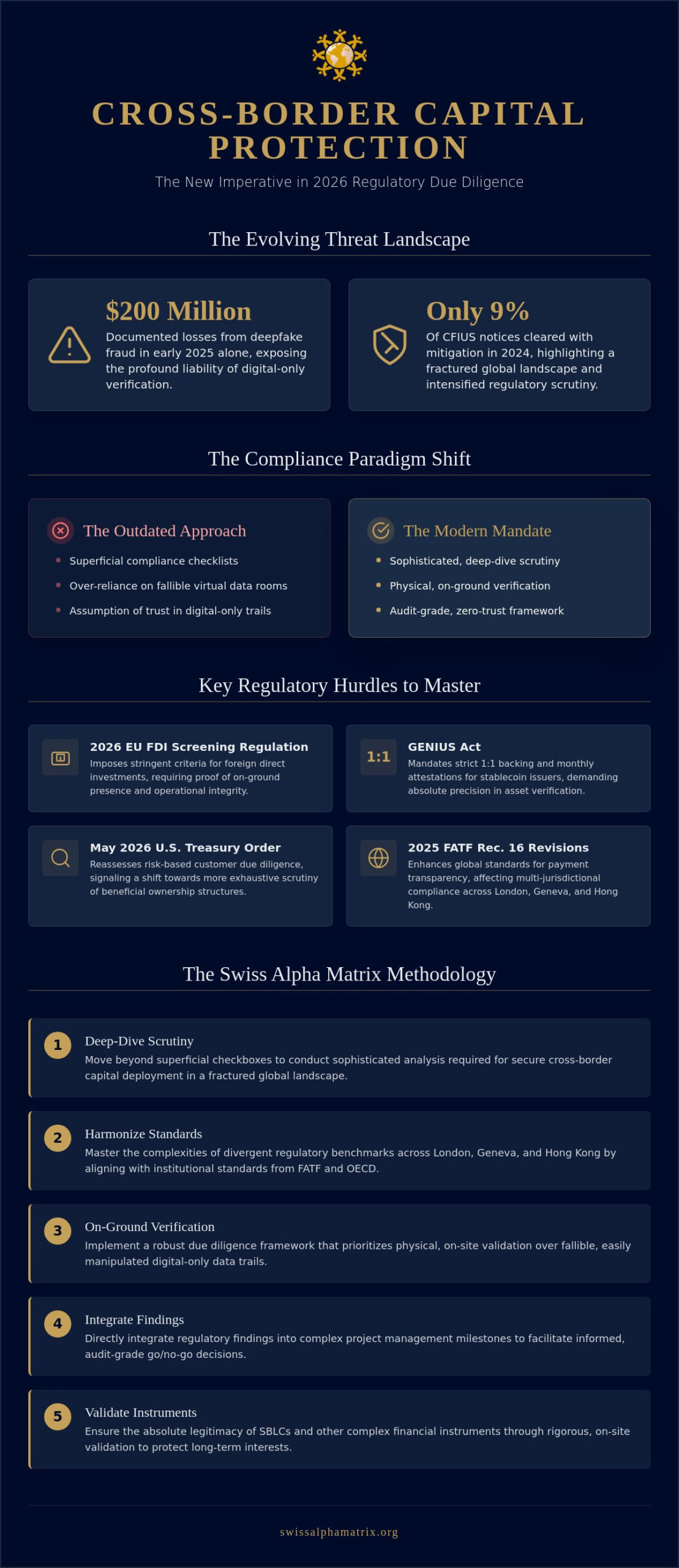
In an era where documented losses from deepfake fraud reached $200 million in early 2025 alone, the assumption that digital-only verification suffices for institutional security is no longer a calculated risk; it’s a profound strategic liability. You’ve likely observed that the global landscape is becoming increasingly fractured, evidenced by the fact that only 9% of CFIUS notices were cleared with mitigation in 2024. Conducting thorough regulatory due diligence for cross-border transactions has evolved from a standard procedural requirement into a high-stakes exercise in capital preservation, requiring a level of scrutiny that transcends traditional checklists. We recognize the inherent skepticism toward automated compliance tools, particularly as the U.S. Treasury reassesses risk-based customer due diligence under the May 2026 Executive Order.
This article provides the framework to master the complexities of multi-jurisdictional compliance and capital protection through a sophisticated, audit-grade approach to regulatory scrutiny. We’ll examine the specific operational nuances of the 2026 EU FDI Screening Regulation and the stringent 1:1 backing requirements mandated by the GENIUS Act for stablecoin issuers. By moving beyond the inherent limitations of virtual data rooms, you’ll gain a robust framework for on-ground verification and a clear understanding of cross-border regulatory nuances. Our analysis provides the steady, logical methodology required to ensure the legitimacy of financial instruments while maintaining the quiet authority your institutional interests demand.
Key Takeaways
- Distinguish between superficial compliance checkboxes and the sophisticated, deep-dive scrutiny required for secure cross-border capital deployment in an increasingly fractured global landscape.
- Master the complexities of navigating divergent regulatory benchmarks across London, Geneva, and Hong Kong by aligning with FATF and OECD institutional standards.
- Implement a robust framework for regulatory due diligence for cross-border transactions that prioritizes physical, on-ground verification over fallible, digital-only data trails.
- Integrate regulatory findings directly into complex project management milestones to facilitate informed, audit-grade go/no-go decisions that protect long-term interests.
- Leverage the Swiss Alpha Matrix methodology to ensure the absolute legitimacy of SBLCs and other complex financial instruments through rigorous, on-site validation.
Defining Regulatory Due Diligence for Cross-Border Transactions in 2026
Regulatory due diligence for cross-border transactions is far more than a binary checklist of legal requirements; it’s a meticulously constructed institutional risk mitigation strategy designed to safeguard capital against the volatile shifts of international law. While standard compliance often settles for verifying that a transaction doesn’t overtly violate existing statutes, a sophisticated approach involves a deep-dive scrutiny of the counterparty’s structural integrity and the provenance of the assets involved. In 2026, this process requires a nuanced understanding of how global transparency standards, particularly those influenced by the 2025 FATF Recommendation 16 revisions, interact with local jurisdictional quirks. Stakeholders within Tier-1 institutions, including chief risk officers, senior legal counsel, and specialized validation experts, are now tasked with ensuring that every financial instrument is not only legal but also robust enough to withstand the scrutiny of future audits. The process of Defining Due Diligence within this context involves an exhaustive examination of beneficial ownership structures, especially where those structures are obscured by multi-layered holding companies located in historically non-transparent jurisdictions.
The Evolution of Cross-Border Compliance
The landscape has shifted dramatically from the era of simple customs checks to the current environment of complex, multi-layered regulatory frameworks. This evolution has been accelerated by the digital transformation of financial services, which has enhanced transaction transparency while simultaneously introducing sophisticated risks like deepfake fraud and AI-generated misinformation. Institutions can’t rely on digital trails alone when the GENIUS Act now mandates monthly attestations for stablecoin issuers to prove 1:1 backing. Precision is paramount. The current regulatory landscape is an intricate web of jurisdictional overlap and heightened institutional accountability. It’s no longer enough to be compliant at the point of entry; one must maintain a state of continuous readiness as global standards for payment transparency reach full implementation.
The Interplay Between Regulatory and Operational Scrutiny
Regulatory findings are never isolated; they directly impact the operational feasibility of any significant capital deployment. If a regulatory audit reveals a lack of on-ground presence or a failure to meet the EU’s foreign direct investment screening criteria, the operational risk becomes untenable. This is why operational due diligence is a necessary companion to any regulatory inquiry. A unified advisory approach ensures that legal obstacles are identified before they translate into operational delays or capital loss. We’ve found that the most successful transactions are those where regulatory risks are mapped against project milestones, allowing for a logical progression that prioritizes long-term stability over short-term expediency. It’s about creating a protective barrier that allows for strategic growth within the bounds of institutional excellence.
The Multi-Jurisdictional Framework: Harmonising Divergent Standards
Navigating the friction between global financial hubs requires more than a passing familiarity with local statutes. London, Geneva, and Hong Kong present distinct regulatory personalities that often conflict during high-value capital movements. For instance, while Geneva maintains its hallmark of traditional discretion, it must now align with the EU’s heightened transparency requirements for transfers exceeding €1,000. Successfully executing regulatory due diligence for cross-border transactions in this environment means building a compliance architecture that defaults to the most stringent requirements across all involved territories. This approach ensures that a transaction cleared in a less rigorous jurisdiction won’t be flagged when it interacts with Tier-1 banking systems in more scrutinized regions, effectively future-proofing the capital deployment against sudden regulatory shifts.
International bodies like the FATF and OECD provide the benchmarks that define modern institutional legitimacy. The 2025 revisions to FATF Recommendation 16 have fundamentally altered how payment transparency is managed, requiring originator and beneficiary data for almost every qualifying transfer. This is particularly critical when validating complex bank instruments such as Standby Letters of Credit (SBLCs) or Documentary Letters of Credit (LCs). Standard KYC protocols are often insufficient for these instruments; they require a specialized international financial regulations framework that accounts for the specific provenance of the underlying collateral and the regulatory standing of the issuing bank. Engaging a dedicated regulatory compliance advisory provides the necessary precision to ensure these instruments are recognized as valid across divergent banking networks.
Navigating AML, KYC, and Sanctions Lists
Institutional AML protocols in 2026 demand a granular level of scrutiny. It’s no longer enough to screen against static lists. The depth of KYC required for high-value cross-border deals now involves analyzing the behavioral patterns of the entities involved and the digital resilience of their transaction history. With the U.S. Treasury’s 2026 focus on non-work authorized populations and related financial activity, the tactical management of sanctions regimes has become a daily operational requirement. Compliance must be proactive. We prioritize a methodology that anticipates these shifts, ensuring that every participant in the transaction chain meets the highest standards of integrity and moral character.
Addressing Tax Divergence and Corporate Transparency
Varying tax structures can inadvertently invalidate a transaction’s regulatory standing if not handled with absolute precision. The implementation of the Global Minimum Tax has created new disclosure requirements that often clash with the desire for privacy. Managing these requirements without compromising the discretion expected in high-end private wealth management requires a sophisticated understanding of corporate transparency acts. It involves ensuring that all beneficial ownership data is documented to an audit-grade standard while maintaining the necessary layers of professional confidentiality. This meticulousness is the only way to maintain a robust framework for regulatory due diligence for cross-border transactions in an era of unprecedented transparency.
Beyond the Digital Trail: The Necessity of On-Ground Verification
In the current climate of hyper-connectivity, the reliance on virtual data rooms has created a dangerous sense of complacency among institutional investors. While digital repositories offer convenience, they also introduce a significant intelligence gap that sophisticated actors can exploit. Regulatory due diligence for cross-border transactions must extend beyond the screen to account for the inherent information asymmetry that exists between an acquiring entity and a foreign target. Industry forecasts suggest that global fraud losses are poised to escalate significantly as generative AI tools become more accessible, a projection that underscores the ease with which digital credentials can be fabricated. Relying solely on a paperwork-only approach leaves capital exposed to phantom entities that exist only in the digital ether.
Physical on-ground verification acts as a non-negotiable safety net, providing a level of certainty that no digital search can replicate. It’s the difference between seeing a scanned deed and walking the perimeter of the asset itself. This rigorous scrutiny prevents instrument fraud by ensuring that the issuing parties and their physical collateral actually exist in the jurisdictions they claim. When high-value capital is at stake, the transition from digital suspicion to physical certainty is the only logical path for a protective authority. We view this not as an optional addition, but as a core pillar of institutional integrity.
The Limitations of Digital Due Diligence
Digital searches often fail to detect the subtle red flags that indicate a lack of operational substance. A company might present impeccable electronic filings while maintaining no physical presence beyond a shared mailbox in a tax haven. Sophisticated fraud schemes now utilize deepfake technology to simulate leadership presence and fabricate bank instrument documentation, making digital-only verification a tactical vulnerability. It’s vital to recognize that digital records are merely representations of intent, whereas on-ground verification confirms the existence of physical assets and operational capacity. Without this physical tether, the risk of instrument fraud remains unacceptably high for any seasoned expert.
Executing On-Ground Scrutiny in Global Markets
True institutional security requires a physical presence at the source of the transaction to bridge the gap between reported data and physical reality. This involves a meticulous process that includes:
- Verifying the physical headquarters and ensuring that operational sites are commensurate with reported activity.
- Conducting in-person interviews with key personnel to validate their professional standing and authority.
- Assessing the local regulatory environment through the lens of regional experts who understand the nuances of local enforcement.
Our methodology integrates these on-ground findings into a comprehensive, audit-grade report that serves as the final arbiter of a deal’s legitimacy. By deploying specialized On-Ground Verification Services, we ensure that regulatory due diligence for cross-border transactions is grounded in verifiable fact. This level of scrutiny is necessary for those who prioritize long-term preservation and strategic growth over the perceived convenience of a digital-only audit. It creates the ultimate barrier against misrepresentation, ensuring that interests are protected by more than just a digital signature.
Integrating Regulatory Findings into Complex Project Management
Effective transaction execution requires that regulatory due diligence for cross-border transactions be treated not as a static, isolated report, but as a dynamic and core deliverable within the broader scope of independent financial project management. The complexity of international capital movement demands that regulatory insights are woven directly into the project lifecycle, influencing every stage from initial discovery to final closing. By positioning these findings at the center of the strategic architecture, institutions can transform potential liabilities into managed variables. This integration ensures that the momentum of a deal doesn’t override the necessity of compliance; it creates a structured environment where progress is contingent upon the successful validation of every regulatory requirement.
The transition from identifying a risk to mitigating it requires a structured approach to institutional accountability. We often utilize a RACI matrix to ensure that every finding has a clear path toward resolution. This framework defines who is responsible for gathering documentation, who is accountable for the final validation, and who must be consulted or informed at each project milestone. Without this level of methodological precision, critical regulatory nuances can be lost in the friction between various departments. Independent oversight is the final safeguard, ensuring that findings are acted upon with the unemotional objectivity required to protect long-term interests. For those managing high-value assets, engaging professional Complex Project Management services provides the necessary distance to evaluate risks without the pressure of short-term deal completion.
Translating Risks into Strategic Decisions
Strategic decisions are born from the synthesis of executive-level intelligence. When a “red flag” is identified, it’s rarely a binary signal to proceed or withdraw. Instead, it serves as a catalyst for restructuring the transaction to meet the most stringent jurisdictional standards. We weigh regulatory risks against the potential value of the deal, providing the C-suite with the technical accuracy needed to make informed go/no-go decisions. This might involve altering the payment path to satisfy the 2025 FATF Recommendation 16 revisions or restructuring the beneficial ownership to align with the 2026 EU FDI Screening Regulation. The goal is always the preservation of capital through intellectual depth and strategic foresight.
Oversight and Stakeholder Management
Communicating complex regulatory findings to the C-suite demands a refined approach that avoids oversimplification while maintaining absolute technical precision. It’s about managing the diverse interests of third-party legal and tax counsel within a unified project framework. By utilizing institutional-grade financial advisory methodologies, we ensure that the strategic goals of the institution remain the primary focus. This oversight prevents the deal from becoming bogged down in the conflicting priorities of external advisors, maintaining a steady and logical pace toward a successful, compliant closing.
The Swiss Alpha Matrix Methodology: Precision in Capital Protection
The culmination of a robust institutional framework lies in the ability to synthesize multifaceted risks into a singular, actionable standard of truth. Swiss Alpha Matrix achieves this through a proprietary methodology that prioritizes the absolute validation of every variable within the transaction chain. As we’ve explored, the complexities of 2026 require more than just legal compliance; they demand a standard of regulatory due diligence for cross-border transactions that mirrors the precision of a high-end private wealth audit. Our approach doesn’t just identify risks; it actively de-risks capital deployment by ensuring that every underlying financial instrument is as legitimate in reality as it appears on paper. It’s a standard of service designed for those who recognize that in high-stakes finance, there’s no substitute for technical accuracy and regional precision.
Audit-Grade Instrument Validation
The integrity of a cross-border transaction often rests upon the validity of the financial instruments involved, such as SBLCs or complex guarantees. Our bank instrument validation services involve a rigorous process of verifying both authenticity and liquidity at the source. This validation serves as the ultimate regulatory safeguard, providing an independent, unemotional expert analysis that filters out the sophisticated fraud risks prevalent in today’s digital environment. We don’t accept documentation at face value. Instead, we conduct a deep-dive audit that confirms the issuing bank’s standing and the instrument’s compliance with international benchmarks. This level of scrutiny ensures that your capital is protected by a framework of inevitable logic and professional calm.
Why Institutional Pedigree Matters
Navigating the intricate web of global regulations requires a level of insight that can only be forged within the world’s leading financial institutions. Our firm is composed of former senior executives from Tier-1 global banks, individuals who have spent decades managing the very complexities that define modern capital protection. This institutional pedigree is essential for interpreting the nuances of regulatory due diligence for cross-border transactions, as it allows us to anticipate the requirements of Tier-1 banking systems before they become hurdles. We bring a personality rooted in historical reliability to every engagement, positioning ourselves as a dedicated partner rather than a mere service provider. The result is a standard of excellence that is both broad in reach and meticulous in its attention to detail, ensuring that every transaction is executed with the quiet authority your interests deserve.
The landscape of 2026 demands a master planner who values privacy and exclusivity above all else. By tethering modern strategies to concepts of regional excellence, we provide the stability and trust required to navigate unfamiliar jurisdictions with confidence. Our commitment to your long-term preservation is unwavering, evidenced by a methodology that refuses to oversimplify the complex dynamics of international finance. To ensure your interests are in the hands of seasoned experts who prioritize strategic growth over short-term speculation, Contact Swiss Alpha Matrix to secure your cross-border capital deployment and experience a standard of service that is truly elite.
Securing Institutional Integrity in an Evolving Global Landscape
The transition toward more stringent global transparency standards requires a fundamental shift in how institutions approach capital preservation. As we’ve established, relying on digital-only records is an unacceptable vulnerability in an era of sophisticated fraud. True security is found in the synthesis of rigorous on-ground verification and the harmonization of divergent jurisdictional requirements. By integrating these findings into a structured project management framework, you ensure that every transaction milestone is supported by audit-grade validation rather than mere procedural compliance. Mastering regulatory due diligence for cross-border transactions is the only logical path for the protective authority seeking long-term stability and technical accuracy.
Swiss Alpha Matrix provides the elite expertise required to navigate these high-stakes environments with regional precision. Led by former senior executives from Tier-1 global banks, our firm delivers audit-grade instrument validation standards that bridge the gap between reported data and physical reality. We invite you to Secure Your Cross-Border Interests with Swiss Alpha Matrix Advisory and benefit from a global reach defined by Swiss discretion. Your strategic growth deserves a partner who prioritizes meticulous detail and historical reliability above all else. We look forward to ensuring your future transactions are executed with the absolute technical accuracy they demand.
Frequently Asked Questions
What is the primary difference between legal due diligence and regulatory due diligence?
The primary distinction lies in the scope of inquiry; legal due diligence focuses on contractual validity and litigation risks, whereas regulatory due diligence for cross-border transactions examines an entity’s adherence to jurisdictional oversight and institutional transparency standards. While a legal review ensures a contract is binding, a regulatory audit confirms that the transaction aligns with the 2025 FATF Recommendation 16 revisions and local AML protocols. This deeper scrutiny is essential for maintaining the moral character of the transaction within Tier-1 banking systems.
How does on-ground verification mitigate the risk of financial instrument fraud?
On-ground verification mitigates fraud by providing a physical audit trail that digital repositories cannot replicate, ensuring that the issuing parties and their collateral actually exist. In an environment where AI-generated documentation can simulate legitimacy, physical presence allows experts to validate operational capacity and headquarters authenticity. This practice eliminates the information asymmetry that often leads to capital loss in unfamiliar jurisdictions, serving as a non-negotiable safety net for institutional interests.
Why is audit-grade instrument validation critical for standby letters of credit (SBLCs)?
Audit-grade validation is critical because it confirms the underlying liquidity and bank-to-bank verifiability of the instrument, protecting against the proliferation of non-performing paper. SBLCs require a sophisticated analysis of the issuing institution’s regulatory standing and the specific provenance of the collateral to ensure acceptance by Tier-1 banks. This level of scrutiny prevents operational delays and ensures that the financial instrument serves as a robust mechanism for capital protection rather than a liability.
Can regulatory due diligence be conducted remotely in 2026?
While preliminary data gathering can be conducted via virtual rooms, a comprehensive regulatory due diligence for cross-border transactions requires physical on-ground verification to achieve institutional-grade security. Remote-only processes are inherently susceptible to sophisticated digital fraud, which documented losses reaching $200 million in early 2025 have clearly demonstrated. Seasoned experts recognize that digital records are merely representations of intent, whereas a physical presence confirms the actual existence of assets and personnel.
What are the most common regulatory hurdles in cross-border transactions involving Asia and Europe?
The primary hurdles include the friction between the EU’s stringent Transfer of Funds Regulation (TFR) and the varying AML reporting thresholds found across diverse Asian financial centers. These discrepancies often lead to operational delays as institutions struggle to reconcile conflicting data transparency requirements. Navigating these challenges requires a sophisticated framework that accounts for the 2026 EU FDI Screening Regulation while respecting the regional nuances of Hong Kong or Singaporean banking traditions.
How should a firm manage conflicting regulatory requirements across multiple jurisdictions?
A firm should adopt the “most stringent jurisdiction” rule, building a compliance framework that defaults to the highest standard required among all involved territories. This steady, logical approach ensures that a transaction cleared in one region isn’t flagged when it interacts with more scrutinized Tier-1 systems elsewhere. By prioritizing the most rigorous benchmarks, such as the 2026 GENIUS Act for stablecoin issuers, institutions maintain a state of continuous readiness and universal legitimacy across their global operations.
What role does a project management office (PMO) play in regulatory compliance?
The PMO serves as the central architect for integrating regulatory findings into the project lifecycle, ensuring that compliance risks are translated into actionable milestones. By utilizing a RACI matrix, the PMO defines clear accountability for every regulatory requirement, preventing critical findings from being ignored in the friction of deal execution. This structured oversight ensures that go/no-go decisions are based on unemotional, technical accuracy, maintaining the integrity of the transaction from inception to closing.
How does Swiss Alpha Matrix ensure the confidentiality of its due diligence findings?
Confidentiality is maintained through a boutique entity approach that values privacy and exclusivity, anchored in the traditional discretion of high-end private wealth management. Findings are shared only with authorized stakeholders via secured institutional protocols, ensuring that sensitive intelligence remains within a closed loop of expertise. This commitment to privacy is a defining signature of our voice, providing a protective barrier that allows for strategic growth without compromising the moral character of our partners’ interests.