

What if effective project leadership depends less on mastering a formal methodology than on making the right decisions visible? In financial work, an initiative can lose momentum when ownership is diffuse, dependencies remain implicit or decisions are recorded too late. Independent financial project management provides disciplined oversight without requiring every stakeholder to become a project specialist.
It’s reasonable to be wary of processes that add meetings and paperwork without improving control. Structure need not be cumbersome: a clear outcome, named decision owners, a concise view of milestones and dependencies, and a defined route for escalating risks can make accountability practical. The aim isn’t to manage every task, but to understand whether the work remains aligned with its purpose and where intervention is warranted.
This guide sets out a proportionate framework for clarifying scope and responsibilities, monitoring progress and emerging risks, and keeping decisions traceable. It also explains when independent oversight can strengthen internal ownership, particularly where financial complexity, multiple stakeholders or material exposure call for evidence-led judgement.
Key Takeaways
- Clarify the intended outcome, scope, responsibilities, dependencies and decision owners.
- Use a clear objective to distinguish essential deliverables from optional additions and ground scope decisions.
- Match governance to the work’s complexity, interdependence and decision exposure. Add oversight to address a specific need, not for its own sake.
- Maintain a concise status view of progress, open actions, dependencies, risks and decisions. Separate verified facts from forecasts and label uncertainty.
- Independent financial project management can complement internal ownership on complex programmes through structured oversight and evidence-led due diligence.
Project Management for Non-Project Managers: Why Structure Matters
For finance professionals, project coordination can come with the role, even if the title doesn’t suggest it. A reporting process may need redesign, a transaction may require input from several teams, or a financial programme may bring operational, risk and oversight workstreams together. The challenge is not necessarily a lack of financial expertise. Important work can span people and decisions beyond any one person’s day-to-day remit.
Project management is the practice of organising a defined outcome, the people responsible for it, its timing, dependencies and decisions so progress can be understood and directed. This practical view aligns with the processes and constraints described in the Project Management Overview, while keeping the emphasis on useful coordination rather than specialist terminology. Independent financial project management applies this discipline to complex financial work where clear ownership and informed oversight matter.
What counts as a project in a financial setting?
A project is temporary work organised around a specific objective, rather than activity that continues as part of normal operations. For example, a transaction workstream might deliver a defined set of analysis, approvals and documentation. A financial programme might coordinate several related workstreams toward a broader change.
By contrast, recurring monthly reporting or routine transaction processing is generally operational activity: it continues according to an established cycle. A project may still affect those operations, but it has a distinct intended result and a point at which that result is assessed. This distinction helps determine whether the work needs a one-off plan and decision structure or whether established operational controls are sufficient.
Coordination needs rise when an outcome depends on several owners, approval points or interdependent tasks. If one team’s analysis must be completed before another can proceed, a delay or unresolved decision in the first workstream may affect the wider schedule. Making those connections visible helps stakeholders address a constraint before it becomes a surprise.
What is the non-project manager responsible for?
The non-specialist coordinator creates clarity and maintains visibility. That doesn’t mean personally completing every task or assuming authority over colleagues, counterparties or formal decision-makers. The role is to help the work remain intelligible: what is expected, who owns each contribution, what is outstanding and which decisions need escalation through the appropriate channel.
- Capture agreed outcomes and boundaries so participants share a consistent understanding of the work.
- Record action owners and target dates, then follow up on unresolved items with the relevant people.
- Surface dependencies and emerging concerns, distinguishing known facts from assumptions or uncertainty.
- Ensure decision requests reach the person or governance forum with authority to resolve them.
This is coordination, not a substitute for specialist project management qualifications or a formal project manager’s mandate. Tracking an action also doesn’t confer the power to direct another organisation. The coordinator’s contribution is disciplined communication: maintaining a dependable view of commitments, constraints and decisions while leaving authority where it properly sits. That foundation makes the framework in the next section easier to apply.
A Practical Project Management Framework for Setting Direction
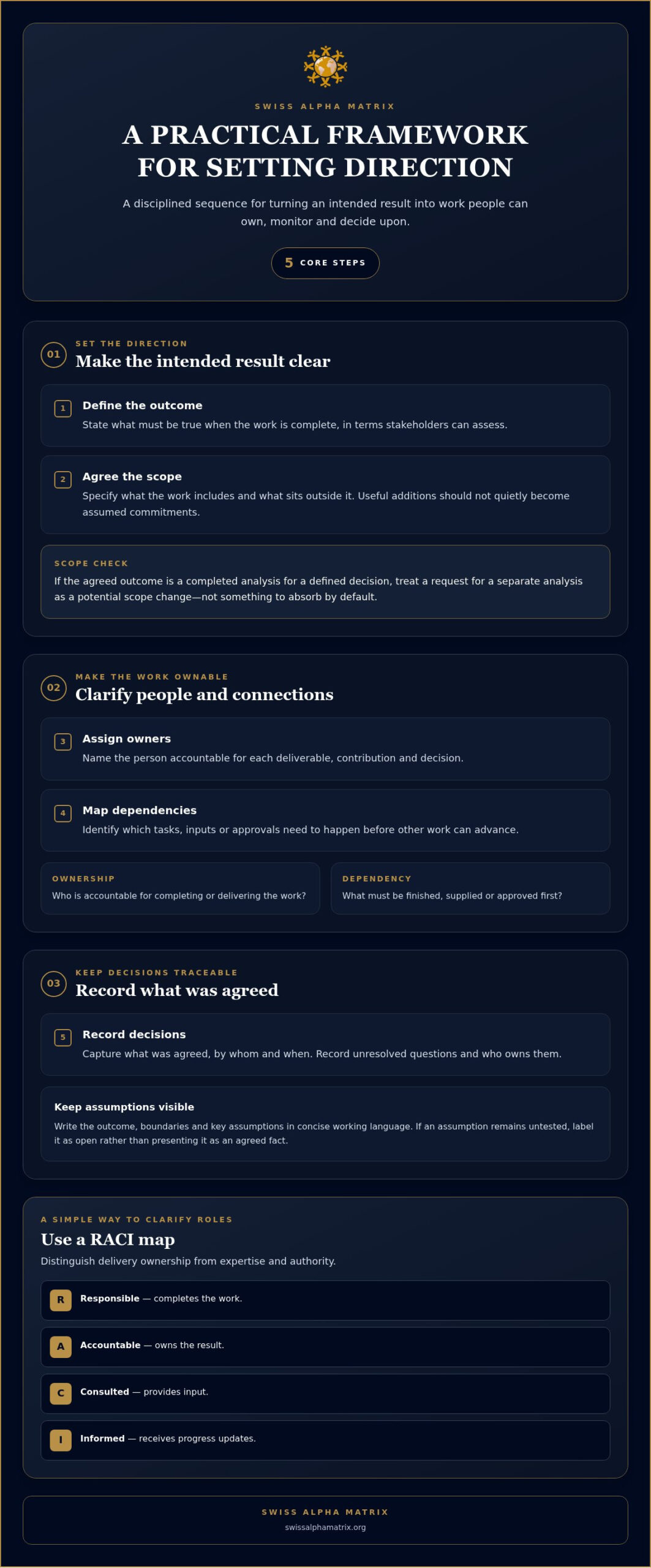
A sound framework doesn’t require elaborate documentation. It requires a disciplined sequence that turns an intended result into work people can own, monitor and decide upon. For a financial initiative, work through these steps before activity gathers momentum:
- Define the outcome. State what must be true when the work is complete, in terms stakeholders can assess.
- Agree the scope. Specify what the work includes and what sits outside it, so useful additions don’t quietly become assumed commitments.
- Assign owners. Name the person accountable for each deliverable, contribution and decision.
- Map dependencies. Identify which tasks, inputs or approvals need to happen before other work can advance.
- Record decisions. Capture what was agreed, by whom and when, along with unresolved questions and their owners.
A clear objective is a practical control on scope. If the agreed outcome is a completed analysis for a defined decision, a request for a separate analysis may be valuable, but assess it as a potential scope change rather than absorbing it by default. This distinction helps stakeholders preserve focus while leaving room for reasoned adjustments.
How to define scope, outcomes and decision rights
Write the intended outcome, boundaries and key assumptions in concise working language. Note which deliverable is required, which related activities are excluded and what conditions the plan currently assumes. If an assumption remains untested, label it as open rather than presenting it as an agreed fact.
Then distinguish delivery ownership from expertise and authority. A simple RACI map records who is responsible for completing work, accountable for its result, consulted for input and informed of progress. Its purpose is to expose gaps, duplicated accountability or a decision with no identified authority, not to turn coordination into a template exercise. In complex financial programmes, capital-protection decisions also depend on making evidence, assumptions and risk exposure clear.
How to map milestones and dependencies
Milestones should mark meaningful checkpoints, such as completion of a review or readiness for a decision, rather than list every small task. Each checkpoint should clarify what evidence or approval is needed to proceed. This gives stakeholders a useful view of whether work is advancing toward its outcome, not merely generating activity.
Map dependencies by recording what must happen first, who owns that input and which subsequent activity relies on it. A concise dependency log can include:
- The prerequisite deliverable, approval or decision
- The owner and expected timing
- The downstream work affected if it changes or is delayed
For financial programmes where coordination across workstreams calls for additional structure, Swiss Alpha Matrix provides complex project management alongside internal ownership.
Lightweight Coordination or Independent Project Oversight?
The appropriate level of governance depends less on the project’s label than on its complexity, interdependence and decision exposure. A contained initiative with clear ownership may need only disciplined internal coordination. Work involving several stakeholders, evidence-intensive decisions or material financial exposure can benefit from a more formal, independent perspective. The purpose isn’t to add process by default, but to address a defined control need, such as unclear accountability, competing assumptions or limited visibility across workstreams.
Structure can remain proportionate. The distinction is not between informal work and bureaucracy, but between the level of oversight needed to make responsibilities, risks and decisions visible.
| Consideration | Lightweight internal coordination | Independent project oversight |
|---|---|---|
| Work profile | Contained scope, few dependencies | Interconnected workstreams or complex delivery |
| Decision context | Decisions sit within one team’s remit | Multiple stakeholders or evidence-intensive decisions |
| Useful emphasis | Action log and regular check-in | Structured challenge, risk visibility and impartial review |
This comparison is a guide, not a rigid threshold. Governance should respond to the actual exposure and coordination burden, and can be adjusted if the work changes.
When is a lightweight approach sufficient?
Internal coordination is often sufficient when one team can make the necessary decisions, ownership is clear and dependencies are limited. A short action log, with an owner and due date for each open item, can support a regular check-in focused on progress, obstacles and decisions. Keep the record concise, but don’t leave responsibility implicit: even simple coordination depends on named owners and a traceable account of what was agreed.
When might independent oversight add value?
Independent oversight can be useful when a programme has material exposure, several stakeholder groups, tightly linked workstreams or decisions that depend on robust evidence. A perspective outside day-to-day delivery can test whether assumptions are supported, identify incomplete information and bring emerging risks into view for the people with decision authority. It informs governance; it doesn’t guarantee an outcome or replace internal ownership.
Consider independent financial project management alongside the organisation’s existing decision framework. Swiss Alpha Matrix provides complex project management and program oversight for complex financial work, complementing internal ownership with a disciplined, evidence-led perspective. Its financial project management support brings structured oversight and independent challenge to defined governance needs.
How to Monitor Progress, Risks and Decisions Without a PMO
A project management office can provide formal structures, but useful oversight doesn’t depend on having one. A concise working view can help a non-specialist understand whether delivery remains aligned with the intended outcome, what needs attention and which decisions cannot wait. Keep the record focused on status, open actions, dependencies, risks and decisions required, rather than collecting detail that doesn’t inform action.
Separate evidence from interpretation. “The review is complete” is a factual update if completion is documented; “the review is on track” is an assessment that should be supported by the remaining work and its dependencies. A forecast is different again: it describes an anticipated outcome and should state the assumptions behind it. If information is incomplete, label the uncertainty instead of presenting a projection as settled fact.
A useful status report connects evidence to exposure, then identifies the next decision required.
What should a useful project update contain?
Show progress against the intended outcome, material deviations from the agreed plan, accountable owners for open actions and decisions required, including who has authority to make them. Keep the level of detail proportionate to project complexity and the audience’s purpose: an executive view should foreground implications and choices, while supporting detail can remain in the underlying record.
Date each update and maintain a dated record of actions and decisions. This helps distinguish the current position from earlier assumptions and shows what changed, when it changed and who owns the follow-up. Set the reporting cadence around the work and its decision points rather than following an arbitrary template.
How to make risks and dependencies actionable
Describe each risk through its supporting evidence, potential consequence, owner and proposed response. Mark whether it is a confirmed issue, an assumption or a matter still requiring validation. For a dependency, record the prerequisite, the work it affects and the consequence if timing or evidence changes. This precision helps prevent an unresolved question from being mistaken for a known problem.
- Evidence: What is known, and what remains unverified?
- Exposure: Which outcome, decision or downstream activity could be affected?
- Ownership: Who is responsible for assessment or response?
- Decision: What intervention is needed, from whom and by when?
Escalation is a timely request for a decision or intervention, not a transfer of ownership. Present material exposure with ranked options, the implications of each and any assumptions that influence the recommendation. Decision-makers can then weigh the trade-offs without reconstructing the underlying status from scattered updates.
For complex financial work, independent financial project management from Swiss Alpha Matrix supports evidence-led decisions and clearer visibility of risk through structured oversight.
How Swiss Alpha Matrix Supports Complex Financial Project Management
Even when objectives, responsibilities and reporting are clear, a complex financial programme may require oversight beyond the capacity or remit of its internal owners. Swiss Alpha Matrix provides complex project management, program oversight and audit-grade due diligence. These services complement internal leadership with a structured, evidence-led perspective on delivery, risk and decisions, while formal authority remains with the appropriate sponsors and governance bodies.
Effective oversight makes the position easier to assess without creating another layer of process for its own sake. Swiss Alpha Matrix analyses material risk exposure and develops ranked, evidence-based remediation strategies to clarify what may affect a programme and where attention is warranted. Executive-level intelligence packs consolidate exposure metrics, decision options and actionable next steps. These tools inform judgement; they don’t remove uncertainty or guarantee a particular outcome.
What an independent, evidence-led perspective contributes
Swiss Alpha Matrix combines financial discipline, commercial precision and Swiss discretion. Its team includes former Managing Directors and senior executives from Tier-1 global banks, bringing decades of transactional, regulatory and risk-management expertise. This background is relevant where sponsors need scrutiny that is financially informed and attentive to delivery dependencies.
Audit-grade modeling can make the basis for an assessment traceable, while contingency architecture can clarify how a plan might respond to adverse scenarios. These disciplines support capital-protection decisions by exposing assumptions and potential sensitivities for consideration; they are not assurances that losses or disruption can be prevented. Independent financial project management can strengthen oversight while leaving ownership and decisions with the parties authorised to make them.
How to prepare for a project oversight discussion
A focused discussion starts with a clear account of the work and the questions sponsors need resolved. A short briefing can include:
- The project objective and the intended outcome
- The key stakeholders, accountable owners and decision-makers
- Known dependencies between workstreams, approvals or inputs
- Material risks, current evidence and decisions facing sponsors
- Assumptions and unresolved questions, clearly separated from documented facts
This needn’t amount to a complete project dossier. The purpose is to establish the current position, identify where visibility or independent challenge could be useful, and focus attention on decisions with material implications. Distinguishing confirmed information from open questions gives the discussion a more reliable foundation.
Swiss Alpha Matrix provides disciplined oversight and audit-grade due diligence for complex financial programmes. Learn more about its work on a complex financial project.
Make Your Next Project Decision with Greater Clarity
The next step needn’t be a wholesale change to how your team works. Begin by identifying where a project’s decision-making is most exposed: a critical dependency, an unresolved assumption or a point where stakeholders lack a shared view of progress. Addressing that specific need can help sponsors focus attention where it matters while keeping governance proportionate to the work.
For complex financial programmes, independent financial project management provides a considered structure for examining evidence, surfacing material risks and informing decisions, while internal owners retain their responsibilities. Swiss Alpha Matrix brings the experience of former Managing Directors and senior executives from Tier-1 global banks to its work in complex financial management, oversight and due diligence. The appropriate level of support depends on the programme’s requirements and decision context.
If your project needs a clearer view of its oversight requirements, discuss your complex financial project with Swiss Alpha Matrix.
Frequently Asked Questions
Can I manage a project without formal project management training?
Yes. You can coordinate project work without formal project management training when your approach fits your responsibility and the work’s complexity. For example, if you’re coordinating a reporting change, agree who supplies each input and how completion will be judged. Keep your role within your authority, and don’t treat familiarity with a process as a substitute for specialist judgement where the work requires it. Seek appropriate expertise when the project’s risks exceed your experience.
What is the difference between project management and project coordination?
Project coordination generally keeps communication and assigned activities aligned, while project management covers the wider organisation of work toward its intended result. A coordinator might track when different teams provide information; a project manager may also shape the delivery approach and manage scope, risks and decisions. Organisations use these terms differently, so titles alone don’t establish authority. Agree explicitly who can approve changes, accept deliverables and resolve conflicts within your initiative.
How do I manage a project when I have no authority over the stakeholders?
You can support progress without directing stakeholders by making requests specific, documenting commitments and showing how delays affect others’ work. Instead of sending a general reminder, identify the input needed, its owner and the next decision that depends on it. Keep communications neutral and evidence-based. If a participant can’t commit or a dispute needs resolution, present the matter and its implications to the sponsor or executive with authority to decide.
What should I do when a project’s scope keeps changing?
Assess each proposed change against the agreed outcome before treating it as part of delivery. If a new reporting requirement is raised, for instance, identify the additional work, affected contributors and any decisions or dependencies it changes. Ask the authorised sponsor to approve, decline or defer the proposal, and record that decision. This creates a reliable basis for revising plans and clarifies which commitments are current rather than assumed.
How often should a project team review progress?
Set reviews around the project’s decision points and the pace at which its position can change, rather than relying on a universal interval. A stable workstream may need less frequent discussion than one awaiting a time-sensitive approval or dependent input. At each review, compare new evidence with the prior position, confirm action owners and identify decisions that need attention. Adjust the cadence if risk, activity or sponsor needs materially change.
When should a financial project use independent oversight?
Consider independent oversight when the financial exposure, number of parties or reliance on supporting evidence makes internal reporting insufficient for confident decisions. For example, a sponsor may need a separate assessment of whether underlying assumptions are supported before a major programme decision. Independent financial project management adds structured scrutiny and clarifies options for accountable decision-makers. It complements internal governance; it doesn’t remove risk or guarantee success.
What is a RAID log in project management?
A RAID log records risks, assumptions, issues and dependencies so the team can distinguish different kinds of uncertainty. A potential delay is a risk; an unverified delivery date is an assumption; a missed approval is an issue; and a downstream review awaiting that approval is a dependency. Assign an owner to each relevant entry and note the next action, so the log supports decisions rather than becoming a passive list.