

The assumption that traditional due diligence suffices in a landscape of $1.6 trillion in global FDI flows is a precarious one; true capital preservation requires a far more rigorous architecture of oversight. While a signed agreement represents a formal intent, it often fails to account for the lack of transparency in foreign jurisdictions or the increasing risk of sophisticated financial instrument fraud that can devastate a portfolio. You likely recognize that your internal teams, while capable, may lack the specialized on-ground capacity required to verify assets in real-time across shifting regulatory borders. This is particularly relevant as China’s new Regulation on Outbound Investment, effective July 1, 2026, and the EU’s revised FDI screening protocols introduce unprecedented layers of complexity to cross-border capital deployment.
This discussion explores how institutional-grade project management for international investments and independent validation protect capital in high-stakes international investment programmes. You’ll discover how to secure audit-grade assurance of instrument validity while minimizing capital exposure in volatile markets. We’ll outline a methodology that moves beyond simple administrative tracking toward a model of operational due diligence and precise risk management frameworks; ensuring that every cross-border milestone is executed with the quiet authority and technical accuracy your interests demand.
Key Takeaways
- Learn why sophisticated project management for international investments is the essential transition from administrative tracking to a robust risk-mitigation framework.
- Understand the necessity of audit-grade validation to verify the integrity of financial instruments before capital’s exposed in unfamiliar jurisdictions.
- Analyze the strategic advantages of independent oversight by unemotional experts who prioritize long-term preservation over internal institutional biases.
- Discover how to integrate rigorous regulatory compliance and on-ground verification into every phase of the investment lifecycle.
- Gain insight into a methodology that merges historical Swiss reliability with modern strategic pillars to safeguard complex international mandates.
The Evolution of Project Management for International Investments in 2026
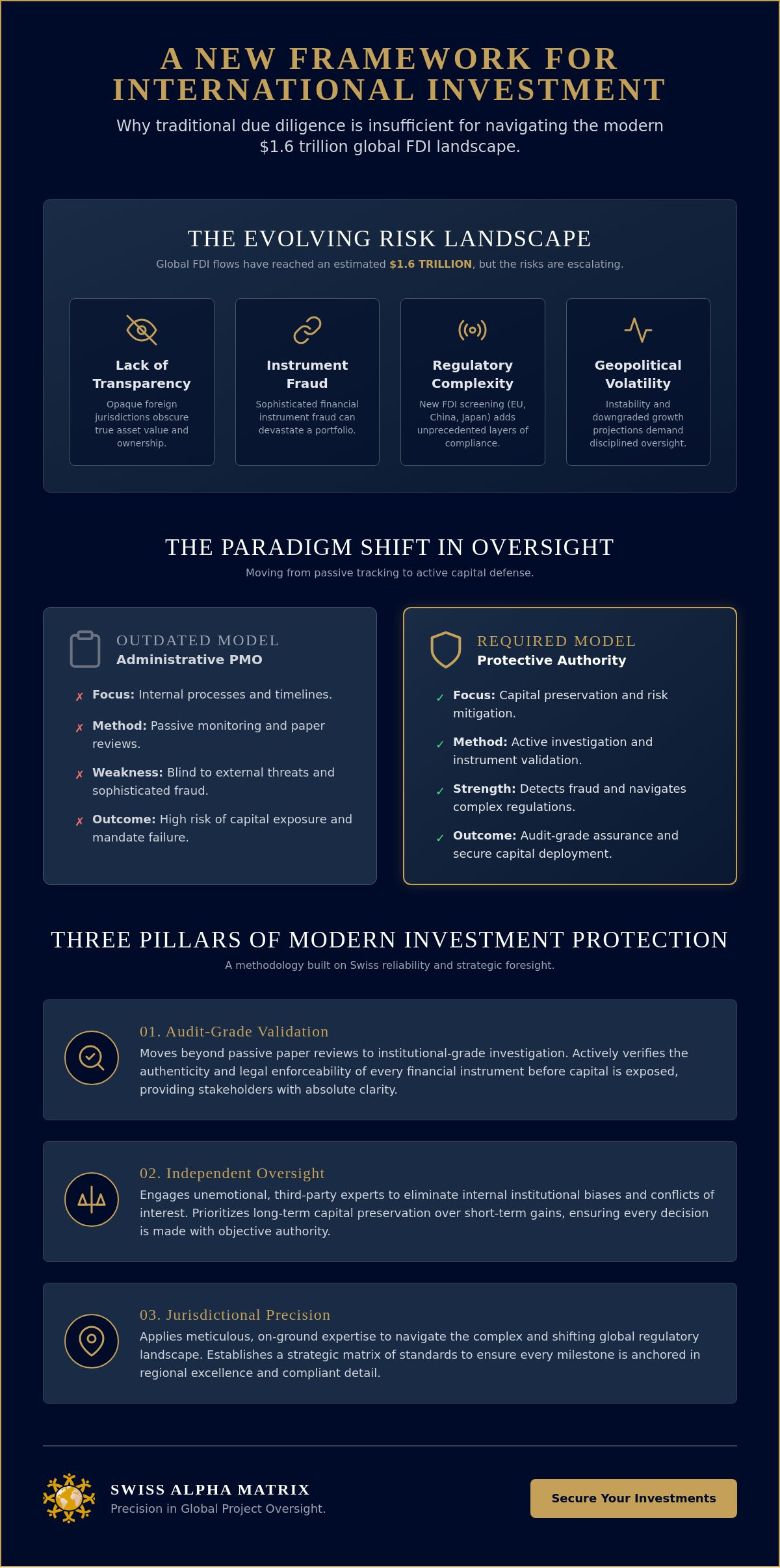
The paradigm of global capital deployment has shifted. Global FDI flows reached an estimated $1.6 trillion in 2025, yet the mechanisms for overseeing these vast capital transfers remain dangerously antiquated in many institutional settings. Conventional administrative approaches often collapse under the weight of modern geopolitical instability. Effective project management for international investments now functions as a comprehensive risk-mitigation framework, designed specifically to address the vulnerabilities inherent in cross-border transactions. It’s no longer sufficient to merely monitor progress; one must actively defend the integrity of the capital throughout the entire lifecycle of the mandate.
Traditional Project Management Offices (PMOs) frequently fail because they prioritize internal resource optimization over external threat detection. While they might excel at managing internal timelines, they’re often ill-equipped to identify sophisticated financial instrument fraud or navigate the nuances of the 2026 regulatory environment, such as China’s expanded Outbound Direct Investment (ODI) regime effective July 1, 2026. We’re seeing a decisive shift toward a “Protective Authority” model. This approach moves beyond passive observation, positioning seasoned experts as master planners who prioritize long-term preservation and technical accuracy over short-term speculative gains.
The Distinction Between General PM and Investment Oversight
General project management focuses on the mechanics of execution, whereas investment oversight centers on the validity of the underlying assets. While Project Portfolio Management provides a useful structure for aligning projects with organizational goals, it doesn’t inherently provide the audit-grade validation required for high-stakes international deals. Technical expertise in validating financial instruments is the dividing line. An “on-time and on-budget” delivery is a failure if the capital’s exposed to unrecognized jurisdictional risks or fraudulent counterparties. True project management for international investments requires a refusal to oversimplify these complex dynamics.
Jurisdictional Risk and the Need for Precision
Navigating the global regulatory landscape requires a level of precision that mirrors the traditional discretion of high-end private wealth management. With the EU’s revised FDI Screening Regulation and Japan’s strengthened Foreign Exchange and Foreign Trade Act (FEFTA) passed in May 2026, the margin for error has evaporated. Geopolitical volatility, which saw global growth projections downgraded to 2.6% in early 2026, necessitates an institutional-grade discipline. This isn’t merely about compliance; it’s about establishing a strategic matrix of standards that ensures every milestone is anchored in regional excellence and meticulous detail. Precision is the only viable defense against volatility.
Audit-Grade Validation: The Core of Secure Capital Deployment
Financial modeling and the construction of elaborate pitch decks, while common in the industry, often create a veneer of security that masks significant underlying vulnerabilities. Secure capital deployment doesn’t begin with a spreadsheet; it begins with the absolute verification of the financial foundations. In the context of project management for international investments, this requires a transition from passive “paper reviews” to active, institutional-grade investigation. Relying on the face value of documentation in a cross-border transaction is a risk that seasoned experts simply don’t take. Instead, a sophisticated approach utilizes bank instrument validation services to ensure that every asset claimed is both authentic and legally enforceable within its specific jurisdiction.
Audit-grade reporting provides executive stakeholders with the clarity required to authorize high-value transfers without the shadow of uncertainty. This level of oversight moves beyond administrative tracking, focusing instead on the forensic deconstruction of entity claims and instrument validity. It’s a process that prioritizes capital preservation by identifying discrepancies before they manifest as losses. For those overseeing complex global mandates, establishing a rigorous risk management framework is the only way to ensure that the intellectual depth of the strategy is matched by the physical reality of the assets involved.
Validating Complex Financial Instruments
The verification of Standby Letters of Credit (SBLC) and other Tier-1 bank instruments requires a technical precision that few internal teams possess. Identifying red flags in sophisticated documentation, such as inconsistent SWIFT protocols or opaque beneficiary structures, is essential for maintaining a secure chain of custody. It’s a meticulous process. We look for technical accuracy. We demand absolute transparency. This institutional discipline ensures that the instruments used to secure capital are as robust as the legal frameworks that govern them, providing a layer of protection that traditional project management frequently overlooks.
The Power of On-Ground Verification
Digital due diligence has its limits, particularly in emerging markets where corporate data may not reflect the operational reality on the ground. Physical site visits and local entity verification are non-negotiable components of project management for international investments. Bridging the gap between a digital record and a physical asset requires an unemotional, expert presence that can verify production capacities, inventory levels, and local regulatory standing. It’s about truth. It’s about precision. On-ground verification transforms a theoretical investment into a validated operational reality, minimizing exposure in volatile environments where transparency is often a rare commodity.
Independent Oversight vs. Internal Management: A Strategic Analysis
The decision to manage high-stakes capital programmes through internal resources often stems from a desire for control; however, this proximity frequently creates a dangerous vacuum of objectivity. Internal teams, though technically proficient in their core operations, are susceptible to the psychological momentum of the deal, where the institutional drive to close a transaction can inadvertently suppress critical risk signals. Professional project management for international investments demands an external, unemotional perspective that remains entirely untethered to internal corporate hierarchies or the pressure of immediate transactional success. This independent oversight functions as a protective authority, ensuring that every jurisdictional nuance, from Japan’s FEFTA amendments passed in May 2026 to Australia’s reform package announced the same month, is analyzed with the cold precision required for capital preservation.
Leveraging former Tier-1 bank expertise provides a level of institutional-grade due diligence that generalist internal managers simply cannot replicate. These seasoned experts bring a pedigree of transactional and regulatory experience, allowing them to identify sophisticated anomalies in financial structures before they escalate into systemic failures. In complex M&A or large-scale capital programmes, independent oversight serves to eliminate the conflicts of interest that naturally arise when those responsible for execution are also those tasked with risk assessment. It’s a strategic separation of powers that mirrors the traditional discretion of private wealth management, prioritizing the long-term integrity of the portfolio over short-term speculative speed.
Eliminating Confirmation Bias in Project Execution
Internal momentum is a powerful force that can override even the most robust risk assessments if not checked by an external validator. Confirmation bias often leads teams to overlook subtle red flags in foreign jurisdictions, particularly when they’re under pressure to meet aggressive project milestones. Independent, audit-grade reports provide the ultimate board-level protection, delivering hard-hitting intelligence that isn’t filtered through the lens of internal politics. By maintaining Swiss discretion while providing absolute transparency, independent oversight ensures that executive stakeholders receive an unfiltered view of the transaction’s health, allowing for informed decision-making that is rooted in reality rather than institutional optimism.
The Role of Senior-Level Expertise
Comparing a generalist project manager to a former senior bank executive reveals a significant gap in regulatory and risk management pedigree. The complexity of modern cross-border mandates requires a deep understanding of the global financial architecture, including the intricate interplay of national security and economic policy. Utilizing independent financial project management ensures that every phase of the project lifecycle is governed by a standard of service that is both broad in its reach and meticulous in its attention to detail. This senior-level expertise is essential for navigating the shifting regulatory environments of 2026, where economic security has become a core concept of international trade and investment.
A Framework for Executing Complex International Mandates
The execution of cross-border transactions demands a departure from generic administrative workflows toward a specialized architecture of oversight. While competitors often view performance monitoring as a concluding phase, a sophisticated approach recognizes that risk is dynamic and requires a perpetual state of vigilance. Effective project management for international investments is built upon rigorous financial advisory methodologies that integrate regulatory compliance into every granular milestone. This structured framework ensures that capital remains protected against the market volatility observed in early 2026, where global growth projections were notably adjusted due to geopolitical instability.
Stage 1: Deep-Dive Operational Due Diligence
Operational integrity cannot be verified through a balance sheet alone. The initial phase involves deep-dive operational due diligence, where we establish an absolute baseline of validity for every entity involved in the mandate. By utilizing cross-border investment due diligence, we map jurisdictional risks with hyper-personalization, ensuring that the master planner identifies vulnerabilities long before capital is committed. Assessing the physical and legal reality of an entity is the only way to bridge the gap between corporate data and actual capacity.
Stage 2: Milestone-Based Oversight and RACI Implementation
Precision in execution is maintained through milestone-based oversight and the strict implementation of a RACI matrix. It’s vital to distinguish between mere deliverables and strategic milestones that trigger capital release. This level of executive accountability ensures that all stakeholders, regardless of their geographic location, operate within a unified communication rhythm. The PMO acts as the protective authority, maintaining a steady, logical pace that avoids the frantic energy often found in high-pressure transaction environments. It’s a structured argument for methodology that encourages confidence in every decision.
Stage 3: Continuous Regulatory and Counterparty Monitoring
The final, yet ongoing, stage involves continuous monitoring of counterparties and evolving international financial regulations. As evidenced by the U.S. Bulk Data Rule enforcement and the shifting ODI regulations in China, the legal landscape is in constant flux. Mitigating counterparty risk requires ongoing instrument validation, ensuring that capital preservation is maintained through to the eventual exit or completion. For those seeking a dedicated partner to navigate these intricate dynamics, our complex project management services provide the regional excellence and meticulous detail required for institutional success.
Swiss Alpha Matrix: Precision in Global Project Oversight
The preservation of institutional capital in an era of heightened geopolitical scrutiny requires a methodology that transcends standard administrative tracking. Swiss Alpha Matrix provides a sophisticated architecture for project management for international investments, merging the technical rigor of Tier-1 global banking with the historical reliability of Swiss discretion. By positioning ourselves as a protective authority rather than a mere service provider, we ensure that every mandate is governed by a standard of precision that prioritizes long-term strategic growth over short-term speculation. This approach is particularly critical as governments increasingly treat access to capital as a matter of national security, a trend that has accelerated throughout 2026 following the expansion of FDI screening regimes in the EU and Japan.
Our mandate-specific framework is designed for the elite tier of investors who value nuance and thoroughness over the oversimplified solutions offered by mass-market consultancies. We understand that in complex cross-border transactions, the margin for error is non-existent. Our methodology moves with a measured, steady, and highly logical rhythm; leading stakeholders through a structured argument for each strategic pillar. This ensures that interests are always in the hands of seasoned, unemotional experts who view capital protection as a moral and professional imperative, maintaining the quiet authority necessary to navigate volatile markets.
The Swiss Alpha Matrix Difference
Direct access to former senior executives from the world’s leading financial institutions defines the Swiss Alpha Matrix difference. Unlike larger firms where mandates are often delegated to junior associates, our clients engage directly with partners who possess a deep pedigree in transactional and regulatory risk. We provide audit-grade reports and precision intelligence that go beyond surface-level summaries, offering the intellectual depth required to navigate the intricate regulatory fragmentation that characterized the first half of 2026. Boutique exclusivity allows for a level of hyper-personalization that is simply unattainable in volume-driven models, ensuring that your project management for international investments is anchored in regional excellence.
Initiating a Strategic Mandate
Transitioning from the inherent anxiety of complex deal-flow to a state of executive-level confidence begins with a single, strategic engagement. When you partner with us, you’re securing an investment legacy through meticulous oversight and an unwavering commitment to technical accuracy. The process is designed to be seamless, moving from broad philosophical alignment to the specific execution of your most critical milestones. We invite you to consult with our senior partners regarding your international investment mandate to experience a standard of service that is as broad in its global reach as it is meticulous in its attention to detail.
Securing the Future of Global Capital Deployment
The landscape of 2026 demands a decisive shift from traditional administrative tracking toward a model of protective authority. We’ve explored how institutional-grade project management for international investments serves as the primary defense against jurisdictional opacity and the rising risk of sophisticated financial fraud. By prioritizing independent oversight and audit-grade instrument validation, executive stakeholders can move beyond deal-flow anxiety toward a state of strategic calm. This methodology ensures that capital preservation remains the central pillar of every cross-border mandate; even as global regulations and market volatility continue to evolve.
Swiss Alpha Matrix stands at the intersection of historical reliability and modern strategic precision. Led by former senior executives from Tier-1 global financial institutions, our firm specializes in audit-grade instrument validation and meticulous on-ground verification. We operate with a foundation of Swiss discretion, providing the institutional-grade precision required to safeguard your most complex interests. It’s time to elevate your oversight standards and ensure your portfolio is managed by seasoned experts who prioritize technical accuracy above all else.
Secure your next cross-border investment with Swiss Alpha Matrix. We’re ready to ensure your legacy is protected with the quiet authority and regional excellence your capital deserves.
Frequently Asked Questions
What is the difference between general project management and investment project management?
General project management focuses on administrative timelines and resource allocation, whereas investment project management prioritizes the technical validation of assets and the mitigation of capital exposure. It requires a specialized understanding of financial instruments and jurisdictional risks that standard administrative frameworks often overlook. This distinction ensures that the focus remains on capital preservation rather than mere operational efficiency; providing a protective layer for institutional interests.
Why is independent instrument validation necessary for international investments?
Independent validation provides an objective assessment of financial instruments, such as Standby Letters of Credit, which internal teams might inadvertently accept at face value due to institutional momentum. It eliminates the risk of accepting fraudulent or unenforceable documentation by conducting a forensic deconstruction of the instrument’s origin and legal standing. This process is essential for maintaining a secure chain of custody throughout high-value international transactions.
How does on-ground verification prevent cross-border financial fraud?
On-ground verification bridges the gap between digital corporate records and the physical reality of assets in foreign jurisdictions. By deploying experts to physically inspect production facilities, verify inventory, and confirm local entity status, we eliminate the possibility of sophisticated digital deception. This physical presence provides a level of certainty that remote due diligence cannot replicate, particularly in markets where transparency is traditionally limited and fraud risks are higher.
What are the key red flags to look for in international investment projects?
Critical red flags include opaque beneficiary structures, inconsistent SWIFT protocols, and a refusal by counterparties to allow independent on-ground verification of physical assets. Additionally, unusual pressure to bypass standard validation phases or the use of non-standard legal templates in high-stakes jurisdictions should be viewed with extreme caution. These signals often indicate attempts to mask underlying insolvency or the use of fraudulent financial instruments that can devastate an investment portfolio.
How do Swiss Alpha Matrix project management services differ from traditional consulting firms?
Swiss Alpha Matrix differs from traditional consulting by utilizing a partner-led model where clients work directly with former Tier-1 global bank executives. We prioritize audit-grade precision and Swiss discretion over the volume-driven approach of mass-market firms. Our project management for international investments focuses on the forensic validation of assets rather than general business advisory; ensuring that every strategic pillar is anchored in technical accuracy and long-term capital preservation.
Can independent project oversight actually speed up the capital deployment process?
Independent oversight accelerates deployment by identifying and resolving technical discrepancies in financial documentation before they cause systemic delays or deal collapses. By establishing a clear RACI matrix and milestone-based oversight, we eliminate the ambiguity that frequently stalls complex cross-border transactions. This structured approach provides executive stakeholders with the confidence required to authorize capital transfers, knowing that every risk has been meticulously validated and mitigated by unemotional experts.
What role does regulatory compliance play in international project management?
Regulatory compliance serves as a non-negotiable framework that governs every phase of the project lifecycle, from initial due diligence to the final exit phase. In 2026, navigating the EU’s revised FDI Screening Regulation or China’s new ODI rules requires a proactive integration of legal standards into project milestones. This ensures that the transaction remains legally enforceable and protected from the significant penalties associated with shifting international financial protocols and national security mandates.
How do former Tier-1 bank executives add value to complex project oversight?
Former Tier-1 bank executives bring a pedigree of transactional and risk management experience that is essential for overseeing project management for international investments. Their ability to recognize sophisticated anomalies in global financial structures allows for a level of due diligence that generalist managers simply cannot achieve. This senior-level expertise ensures that mandates are governed by the same institutional-grade discipline and technical accuracy that characterize the world’s most prestigious financial entities.