

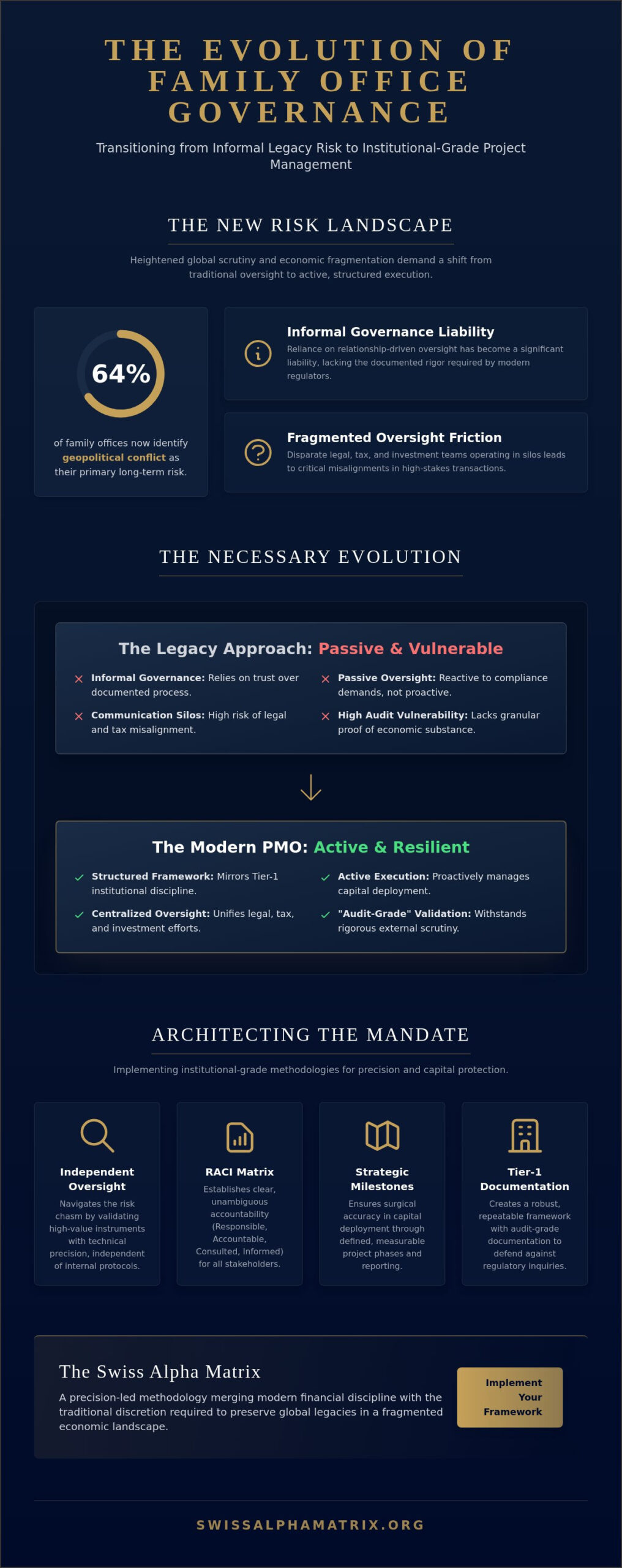
Why does a family office managing upwards of a billion dollars often execute high-stakes cross-border investments with less administrative rigor than a Tier-1 investment bank? You’ve likely experienced the friction that occurs when fragmented oversight meets the uncompromising demands of modern regulatory substance requirements. As 64% of family offices now identify geopolitical conflict as their primary long-term risk, the historical reliance on informal, relationship-driven governance has become a liability. Adopting a structured approach to project management for family offices is no longer an optional refinement; it’s a necessary evolution for those seeking to protect capital in an era of heightened global scrutiny and economic fragmentation.
This discussion outlines how to transplant institutional-grade financial discipline into your private operations to achieve surgical precision in capital deployment. You’ll discover a framework designed to mitigate counterparty risk and eliminate the communication silos that frequently hinder legal and tax alignment. We’ll preview the transition from passive wealth management to a model of active, master-planned execution that ensures your multi-generational projects withstand the rigors of audit-grade validation.
Key Takeaways
- Learn how to transition from informal legacy governance to a professionalized Project Management Office (PMO) that mirrors the stability and rigor of Tier-1 institutional entities.
- Discover why sophisticated project management for family offices is the essential catalyst for achieving “Audit-Grade” validation across complex, cross-border investment mandates.
- Understand the necessity of independent oversight to navigate the risk chasm, ensuring that high-value financial instruments are validated with technical precision rather than relying on standard internal protocols.
- Master the application of the RACI matrix and strategic milestones to establish clear accountability and surgical accuracy during the deployment of multi-generational capital.
- Explore the Swiss Alpha Matrix as a methodology for merging modern financial discipline with the traditional discretion required to preserve global legacies in a fragmented economic landscape.
The Evolution of Project Management for Family Offices
In the sophisticated environment of ultra-high-net-worth (UHNW) mandates, the definition of project management has evolved far beyond simple administrative coordination. It now represents the systematic application of institutional-grade rigor to the strategic preservation and deployment of private capital. Historically, many families viewed oversight as a secondary function, often relying on the informal governance of trusted inner circles. However, as the global financial landscape becomes increasingly fragmented and transparent, the requirement for dedicated project management for family offices has become a primary pillar of operational stability.
This shift from informal family governance to a structured Project Management Office (PMO) is driven by the need for absolute precision in execution. While relationship-based trust is a traditional value, it’s frequently insufficient when navigating the technical complexities of 2026. Generic project management principles often fail within this sector because they don’t account for the unique interplay between private discretion and institutional accountability. For the modern family office, project management serves as the guardian of multi-generational capital, ensuring that every strategic initiative is executed with the same level of discipline found in a Tier-1 banking environment.
From Passive Oversight to Active Execution
The regulatory environment of 2026, punctuated by mandates such as the EU’s Anti-Tax Avoidance Directive (ATAD III) and global minimum tax frameworks, has rendered passive oversight obsolete. Relying on “the way we’ve always done it” creates profound vulnerabilities in cross-border deals where tax authorities now demand granular proof of economic substance within 60 days of a request. Transitioning to a mandate-specific project architecture allows a family office to move beyond reactive compliance. It establishes a proactive stance where capital deployment is supported by documented validation and a clear, repeatable framework that withstands the most rigorous external audits.
The Limitations of Traditional Wealth Management
There’s a critical, often overlooked gap between high-level asset management and the granular execution of complex projects. While traditional wealth managers excel at portfolio performance metrics, they rarely possess the operational mandate to synchronize the disparate efforts of legal, tax, and investment teams. This lack of a unifying force can lead to catastrophic misalignments during high-value transactions. It’s here that the necessity of independent financial project management becomes clear. By providing a central point of senior-level oversight, these frameworks ensure that legal and tax advice aren’t just received, but are surgically integrated into the project’s broader strategic objectives.
Architecting the Mandate: Institutional-Grade Methodologies
Architecting a mandate requires more than just high-level intentions; it demands the implementation of Tier-1 banking standards within a private, highly personalized context. While many entities mistakenly rely on portfolio management software as a panacea for clarity, true operational security arises from an “Audit-Grade” approach to project documentation and risk assessment. This methodology ensures that every instrument, transaction, and counterparty undergoes a validation process as rigorous as those applied by global financial institutions. By integrating institutional-grade financial advisory methodologies into the daily workflow, a family office creates a robust protective barrier around its wealth. This framework doesn’t compromise the traditional discretion valued by ultra-high-net-worth families. It provides the structural integrity necessary to defend that privacy against the increasing transparency demands of modern tax authorities.
The Swiss Matrix Approach to Precision
Precision in capital deployment is often a product of regional excellence and historical reliability. The Swiss Matrix approach leverages this legacy of financial discipline, moving decisively beyond the limitations of traditional, retainer-based consulting. Unlike open-ended advisory roles, project-based advisory focuses on specific, high-stakes outcomes with defined start and end points. This requires what we define as “executive-level intelligence,” which is the ability to make seasoned, unemotional decisions based on verified, on-ground data rather than speculative market sentiment. It’s a fundamental departure from passive management. It ensures that every deployment of capital is a deliberate, meticulously planned event. For principals seeking to institutionalize their operational due diligence, this methodology offers a level of precision that generic tools cannot replicate.
Structuring Complex Financial Programs
A complex financial program is defined by its breadth and the intricate interplay of multiple asset classes across various jurisdictions. Managing these mandates requires a deep understanding of the project lifecycle, which begins at inception and only concludes upon final, verified execution. In high-stakes environments, such as private M&A or the acquisition of bespoke financial instruments, maintaining deal integrity is paramount. Effective project management for family offices must include sophisticated strategies for managing the news cycle to prevent information leakage that could compromise a transaction’s valuation. This level of control is achieved through structured reporting and predefined milestones. It ensures that the principal’s interests remain shielded and the project’s strategic trajectory remains unwavering throughout the entire duration of the mandate.
Navigating the Risk Chasm: Why Independent Oversight is Non-Negotiable
The assumption that a dedicated internal team, regardless of their loyalty or general competence, possesses the forensic capabilities required for complex instrument validation is a pervasive risk. Proximity to the principal often creates blind spots, where the desire to execute a deal can inadvertently override the necessity for cold, unemotional scrutiny. Effective project management for family offices requires an objective layer of independent oversight to bridge the chasm between perceived security and actual capital protection. Without this third-party validation, even the most seasoned internal executives can fall prey to the sophisticated social engineering and technical deceptions prevalent in modern high-value transactions.
While some industry commentators suggest running a family office like a Silicon Valley startup, utilizing tools designed for rapid communication over secure validation, this approach introduces significant vulnerabilities. These “startup tools” lack the cryptographic security protocols and granular audit trails required for institutional-grade mandates. In an environment where 64% of family offices view geopolitical conflict as a primary risk, the speed of a startup is a poor substitute for the “audit-grade” rigor of a Tier-1 bank. Protecting high-value financial instruments from sophisticated fraud requires a methodology rooted in cross-border investment due diligence that extends far beyond digital confirmation. It’s about moving from a culture of trust to a culture of verified evidence.
Audit-Grade Instrument Validation vs. Surface Review
A surface review of a financial instrument often stops at the verification of digital signatures or a cursory check of bank letterheads. In contrast, bank instrument validation services involve a multi-layered forensic process that includes on-ground verification of the issuing entity’s credentials. Physical verification remains the only definitive antidote to increasingly sophisticated financial fraud. By deploying seasoned experts to verify the physical existence and legal standing of a counterparty, a family office minimizes its exposure to “ghost” entities that appear legitimate in a digital-only environment. This independent assessment provides the principal with the certainty that their capital is anchored in reality, not merely in well-crafted documentation.
Counterparty Risk Mitigation in Volatile Markets
The global financial landscape of 2026 is characterized by rapid shifts in institutional stability, making the evaluation of global financial entities a continuous requirement rather than a one-time event. A project manager’s role in this context includes rigorous regulatory compliance and AML oversight, ensuring that every transaction adheres to the evolving standards of international transparency. Consider a recent scenario where independent oversight identified discrepancies in a proposed cross-border instrument that had bypassed an internal team’s standard checks. By insisting on on-ground verification, the mandate identified the instrument as fraudulent before any capital was deployed, saving the family office from a catastrophic loss. This level of protection is the hallmark of professional project management for family offices, where the goal is the absolute preservation of the family’s legacy.
Establishing a Robust Execution Framework: RACI, Milestones, and Reporting
Establishing a robust framework for project management for family offices requires a definitive departure from the “accounting-first” architecture that often characterizes legacy systems; instead, it demands a focus on the human workflow of execution. While software provides the ledger, it cannot define the hierarchy of accountability or the strategic sequencing of complex mandates. A truly institutional-grade execution framework prioritizes the “Executive View,” a high-level dashboard that synthesizes multi-currency ledgers and disparate workstreams into a singular, logical narrative. This approach ensures that the principal remains informed of strategic progress without becoming entangled in the granular technicalities that seasoned experts are retained to manage. By maintaining this separation, the family office preserves its ability to make unemotional, data-driven decisions while ensuring that every operational component remains aligned with the overarching goal of capital protection.
The RACI Analysis for Family Office Stakeholders
The implementation of a RACI Matrix (Responsible, Accountable, Consulted, and Informed) is essential to prevent the decision paralysis that frequently plagues multi-generational family offices. In a high-stakes deal, it’s vital to distinguish between who is “Responsible” for the technical execution and who is ultimately “Accountable” for the outcome, which is typically the principal or a designated senior executive. By clearly defining these roles, the office eliminates the ambiguity that leads to communication silos and ensures that legal and tax advisors are “Consulted” at the precise moments their expertise is required. This structured accountability is reinforced through project reporting that utilizes qualifying clauses to ensure absolute technical accuracy, providing a layer of protection against the misinterpretation of complex financial data.
Project Scheduling for High-Value Mandates
Managing timelines for complex, cross-border transactional programs requires a sophisticated understanding of the difference between simple deliverables and strategic milestones. Deliverables are the individual outputs, such as a due diligence report or a tax opinion; however, milestones represent the successful navigation of critical project phases, such as the completion of complex project management protocols for instrument validation. This distinction is particularly relevant when structuring fee arrangements, as milestone-based fees align the project manager’s interests with the successful advancement of the mandate rather than the mere accumulation of billable hours. A deliverable review matrix is then employed to ensure that every output meets the “Audit-Grade” standards required for multi-generational wealth preservation, ensuring that no detail is overlooked in the pursuit of surgical execution precision.
The Swiss Alpha Matrix: Precision-Led Project Management
The Swiss Alpha Matrix represents a synthesis of traditional discretion and the unyielding rigor of modern institutional finance. It isn’t merely a service; it’s a dedicated partnership designed to protect global legacies through the lens of surgical precision. By merging Swiss-inspired financial discipline with the sophisticated methodologies previously reserved for global banks, we provide a protective layer for UHNW families navigating an increasingly complex regulatory landscape. This approach ensures that project management for family offices is treated with the intellectual depth it requires, moving beyond administrative tasks to become a core strategic function. Our team, composed of former Tier-1 bank executives, provides the senior-level oversight necessary to manage multi-asset class programs with absolute technical accuracy.
Mandate-specific engagements allow for a level of focus that traditional retainer-based models often lack. We provide executive-level intelligence that empowers principals to make precise decisions based on verified, on-ground data. This hyper-personalization is the hallmark of our methodology, ensuring that every strategic pillar of a project is anchored in historical reliability and regional excellence. It creates a sense of inevitable logic and professional calm, allowing the principal to feel that their interests are in the hands of seasoned experts who prioritize long-term preservation over short-term speculation.
Why Independence is Our Core Strength
Independence is the cornerstone of our ability to provide objective, unemotional validation. Unlike traditional asset management entities that may face internal pressures to close sales, our focus remains exclusively on transactional risk mitigation and operational due diligence. We don’t sell products; we validate the integrity of your financial instruments and the stability of your counterparties. This boutique advantage allows us to offer a standard of service that is both broad in reach and meticulous in its attention to detail. By eliminating the conflicts of interest inherent in asset-based compensation models, we ensure that our interests are perfectly aligned with the long-term preservation of your capital.
Next Steps: Securing Your Family Office Mandate
Initiating a project-based advisory engagement begins with a logical, structured assessment of your current operational architecture. During the first 90 days of a mandate, we prioritize establishing a robust PMO and a comprehensive risk management framework tailored to your specific jurisdictional requirements. This initial phase is designed to create immediate clarity and stability, allowing the family office to move from reactive oversight to active execution. If your interests require the precision of a master planner and the discretion of a seasoned partner, we invite you to inquire about our complex project management mandates to discover how we can secure your global legacy for 2026 and beyond.
Securing the Multi-Generational Legacy through Institutional Discipline
The transition from legacy-based governance to a structured, institutionalized operational model is the defining challenge for principals in 2026. By adopting the methodologies discussed, including the RACI accountability matrix and audit-grade instrument validation, you ensure that your interests are protected with the same rigor found in global financial hubs. Professional project management for family offices isn’t just about administrative efficiency; it’s the fundamental safeguard against the increasing volatility and regulatory transparency of the modern era. This framework allows for a level of surgical precision that transforms complex mandates into predictable, repeatable successes, ensuring that every strategic pillar remains aligned with the overarching goal of capital preservation.
As you look toward the next phase of your capital deployment, the integration of executive-level intelligence and on-ground verification becomes the differentiator between speculative risk and strategic growth. Our firm, led by former senior Tier-1 global bank executives, provides the global reach and Swiss-based discretion required to manage your most complex programs with absolute technical accuracy. Through audit-grade reports and a refusal to oversimplify complex dynamics, we help you navigate the risk chasm with unwavering confidence. It’s time to elevate your operations to match the prestige of your legacy. Secure your next mandate with Swiss Alpha Matrix precision and ensure your wealth remains protected for generations to come.
Frequently Asked Questions
What is the role of a PMO in a family office context?
A Project Management Office (PMO) serves as the central governing body that institutionalizes execution across all family mandates. It ensures that strategic initiatives, ranging from cross-border acquisitions to complex regulatory restructuring, are managed with standardized rigor and clear accountability. By centralizing oversight, the PMO eliminates fragmented communication and provides the principal with a consolidated, executive-level view of all active projects, ensuring that no detail is overlooked during high-stakes deployments.
How does project management differ from portfolio management for family offices?
While portfolio management focuses on the ongoing performance and allocation of assets, project management for family offices is concerned with the discrete, high-stakes execution of specific mandates. Portfolio management is a continuous state of monitoring and rebalancing. In contrast, project management is a finite, outcome-oriented discipline. It bridges the gap between investment theory and operational reality, ensuring that the transition of capital or the acquisition of an asset is executed without technical failure.
Why do family offices need independent instrument validation for cross-border deals?
Independent instrument validation provides an objective layer of forensic scrutiny that internal teams, often compromised by proximity or limited technical specialization, cannot offer. In cross-border environments, the complexity of financial instruments increases the risk of sophisticated fraud. Utilizing a third-party expert ensures that the physical existence and legal standing of an instrument are verified through on-ground data rather than relying solely on digital documentation provided by the counterparty.
How can project management help in regulatory compliance for family offices?
Project management provides the structural framework necessary to document and demonstrate economic substance, which is a critical requirement under modern directives such as ATAD III. By establishing clear audit trails and milestones, a family office can respond to tax authority inquiries within the strict 60-day windows often mandated in 2026. It transforms compliance from a reactive burden into a proactive, documented component of the project lifecycle, reinforcing the office’s moral character and professional standing.
What are the key components of an institutional-grade project framework?
An institutional-grade framework consists of a RACI accountability matrix, a deliverable review matrix, and milestone-based reporting. These components ensure that every stakeholder understands their specific role while providing the principal with a high-level “Executive View” of progress. It also integrates multi-currency ledgers and sophisticated risk assessment protocols to maintain the integrity of the project from inception through to final verification, mirroring the discipline of a Tier-1 global bank.
How does Swiss Alpha Matrix ensure discretion during project execution?
Discretion is maintained through the application of a methodology that prioritizes the shielding of the principal’s identity and intent at every stage. We implement strict information silos and manage the news cycle to prevent information leakage that could compromise deal valuations or family privacy. Our team of former Tier-1 bank executives operates with the traditional reserve of private wealth management, ensuring that technical precision never comes at the expense of the family’s confidentiality.
Can project management help mitigate counterparty risk in 2026?
Yes, project management mitigates counterparty risk by institutionalizing the process of operational due diligence and on-ground verification. In a volatile financial landscape, the stability of a global entity must be verified through forensic analysis rather than reputation alone. By setting predefined milestones for counterparty validation, the project manager ensures that capital is only deployed once every risk parameter has been satisfied and documented, protecting the family from institutional instability.
What is the difference between a project deliverable and a milestone in wealth management?
A deliverable is a tangible output, such as a legal opinion or an audit-grade report, whereas a milestone represents the successful completion of a significant project phase. Milestones serve as the strategic anchors of a mandate, indicating that the project has reached a critical juncture, such as the final validation of a cross-border instrument. Understanding this distinction allows principals to align fee structures with the actual advancement of their strategic objectives rather than mere administrative activity.