

In an era where only 50% of institutional projects are deemed successful, the traditional reliance on trust has become an unacceptable liability for the sophisticated investor. You likely recognize that the shifting sands of global trade, marked by the May 2026 activation of the Mercosur-EU free trade agreement and the evolving US reciprocal tariff structures, have made traditional oversight obsolete. The fear of financial instrument fraud and the lack of transparency in foreign jurisdictions are no longer just risks; they’re systemic realities that demand a more dignified, analytical response.
This article explores how a rigorous institutional framework for project management for complex international deals provides the audit-grade verification necessary to neutralize regulatory friction and secure deal integrity. You’ll discover how sophisticated methodologies, rooted in operational due diligence and on-ground verification, ensure that interests remain in the hands of seasoned experts who prioritize long-term preservation over short-term speculation. We’ll examine a structured approach to risk management frameworks that facilitates seamless execution across time zones, ensuring your capital remains protected within an increasingly intricate global landscape that requires absolute precision and technical accuracy.
Key Takeaways
- Distinguish institutional-grade oversight from standard coordination by establishing a centralized Project Management Office that functions as the analytical nervous system for complex financial mandates.
- Implement sophisticated project management for complex international deals to ensure capital preservation through the integration of audit-grade instrument validation and on-ground verification.
- Move beyond traditional due diligence by establishing a rigorous regulatory and compliance baseline that accounts for the specific friction inherent in the 2026 multi-jurisdictional landscape.
- Mitigate counterparty risk by adopting a comprehensive risk management framework that utilizes operational due diligence to expose vulnerabilities often overlooked by surface-level reviews.
- Leverage the expertise of former Tier-1 bank executives to provide the intellectual depth and technical accuracy necessary for the precision execution of global financial mandates.
What is Project Management for Complex International Deals?
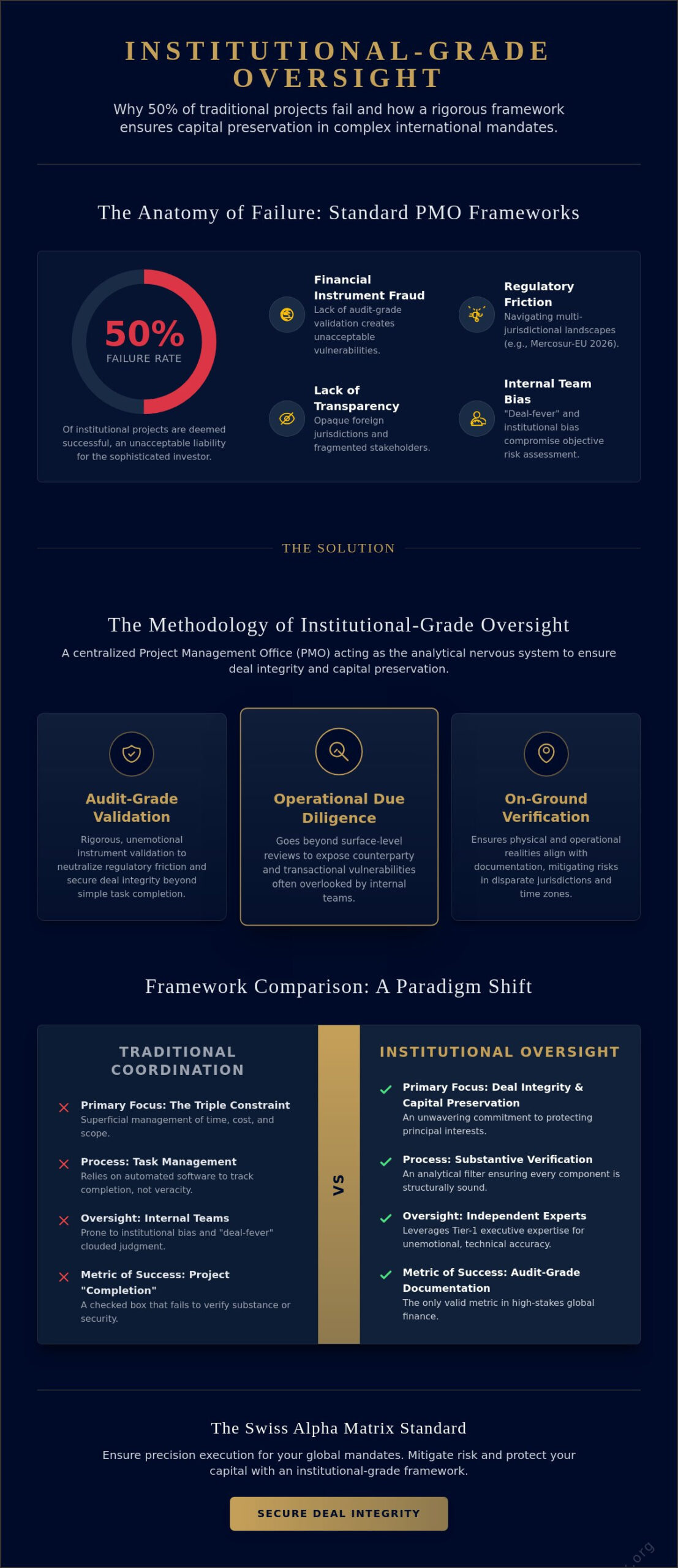
The technical orchestration of project management for complex international deals represents a departure from traditional administrative coordination. It is a disciplined framework designed specifically for multi-jurisdictional financial mandates where the margin for error is non-existent. While foundational Project Management principles focus on the triple constraint of time, cost, and scope, institutional-grade oversight prioritizes deal integrity and capital preservation above all else. This methodology serves as a protective layer, shielding principal interests from the “fog of war” that inevitably descends upon cross-border investments.
In the current climate of 2026, the “Swiss standard” of precision has emerged as the global benchmark for such oversight. This isn’t merely a geographic designation but a commitment to an unemotional, analytical rigor that mirrors high-end private wealth management. Independent advisory plays a critical role here. By maintaining a position of intellectual superiority and professional distance, an independent partner can identify systemic risks that internal teams, often clouded by deal-fever or institutional bias, might overlook. It’s the difference between managing a process and ensuring a successful outcome.
The Anatomy of a Complex Financial Mandate
A complex mandate is defined by its multi-layered regulatory environment. For instance, a transaction might originate in Geneva but require compliance with Hong Kong’s financial statutes and the newly established Mercosur-EU trade protocols that came into effect on May 1, 2026. This regulatory friction is compounded by the presence of high-value financial instruments that require specialized validation to prevent fraud. When stakeholders are fragmented across disparate time zones and legal regimes, the risk of miscommunication grows exponentially. Managing these disparate interests requires a master planner who can synchronize global movements with regional precision.
Why Standard PMO Frameworks Fail in High-Stakes Finance
Generic, software-led task management is fundamentally inadequate for the demands of 2026. Data shows that only 50% of projects are considered successful this year, a statistic driven largely by a reliance on automated tools that lack the nuance of human expertise. These platforms track “completion,” but they cannot verify the moral character or technical accuracy of a counterparty’s submission. Relying solely on internal deal teams is equally hazardous; these teams often possess inherent biases toward closing the deal at any cost. In high-stakes finance, audit-grade documentation is the only valid metric of success. If a component cannot withstand the scrutiny of a rigorous risk management framework, it doesn’t exist. Precision execution demands a refusal to oversimplify the intricate dynamics of the global financial landscape.
The Methodology of Institutional-Grade Deal Oversight
Effective project management for complex international deals requires the establishment of a robust Project Management Office (PMO) that serves as the central nervous system for the mandate. Unlike standard administrative units, an institutional-grade PMO functions as an analytical filter, synthesizing rigorous financial discipline with sophisticated project scheduling. This approach ensures that capital remains protected throughout the lifecycle of the transaction, moving beyond the superficial tracking of tasks toward the substantive verification of assets. By utilizing institutional-grade financial advisory methodologies, a master planner can ensure that every layer of the deal architecture is structurally sound, even when operating across conflicting legal regimes.
Accountability in multi-party transactions is often diluted by the sheer number of stakeholders involved. To counter this, the methodology employs a specialized RACI matrix, which assigns absolute responsibility for every critical path item. This level of precision is vital in 2026, where the integration of AI in risk management, currently utilized by 54% of project managers, must be balanced with seasoned executive judgment. The goal is to create a transparent, audit-ready environment where every movement is documented and every claim is verified through independent oversight. For those requiring this level of technical accuracy, a bespoke risk management framework provides the necessary stability for high-value capital deployment.
Structural Integrity and Risk Frameworks
A bespoke risk management framework must be tailored to the specific jurisdictional hazards of the mandate, accounting for the unique regulatory friction of the current global climate. Operational due diligence serves as the primary tool for verifying counterparty claims, ensuring that the moral character and technical capacity of all participants meet institutional standards. By establishing clear project milestones rather than vague deliverables, the PMO provides decision-makers with a granular view of project progress. This distinction is critical for tracking capital deployment and ensuring that funds are only released when audit-grade verification of the preceding stage is complete.
The Executive Role in Stakeholder Management
Navigating the complex hierarchy of Tier-1 banks and institutional investors requires a sophisticated understanding of corporate diplomacy. It isn’t merely about communication; it’s about managing the news cycle and deal sentiment to prevent premature speculation that could jeopardize the transaction. The PMO ensures that executive-level intelligence reaches decision-makers with zero latency, providing the intellectual depth required for informed choices. This measured, steady flow of information creates a sense of professional calm, allowing principals to focus on strategic growth while experts handle the intricate details of project management for complex international deals.
Beyond Due Diligence: Mitigating Transactional and Counterparty Risk
Trust is a sentiment; verification is a standard. In the high-stakes environment of global finance, relying on a counterparty’s reputation is a strategic vulnerability that can lead to catastrophic capital loss. Surface-level due diligence often fails because it prioritizes the appearance of compliance over the reality of asset security. In 2026, where global trade is reshaped by the Mercosur-EU agreement and volatile US tariff regimes, the “fog of war” in international finance has thickened significantly. Project management for complex international deals must therefore pivot from a trust-based model to one of absolute, empirical verification. The failure rate of projects in 2026 remains stubbornly high at 13%, often because principals mistake a counterparty’s professional veneer for institutional stability. This transition ensures that capital isn’t merely deployed; it’s protected through every stage of the mandate by a master planner who understands that deal integrity is the only valid metric of success.
Instrument Validation as a Project Pillar
The technical validation of financial instruments serves as a critical pillar within any sophisticated project framework. It’s no longer sufficient to accept a Standby Letter of Credit (SBLC) or a Letter of Credit (LC) at face value. The methodology requires bank instrument validation services that verify these documents directly at the source bank. By identifying red flags in financial documentation, such as inconsistencies in SWIFT MT760 formatting or discrepancies in issuing bank protocols, experts can intervene before capital is committed. This audit-grade scrutiny prevents multi-million dollar errors that often arise from sophisticated fraud. It’s an unemotional process that prioritizes technical accuracy over the momentum of the deal, ensuring that the instruments underpinning a transaction are both genuine and enforceable.
The Power of On-Ground Verification
While digital transformation has streamlined many aspects of finance, it’s also created a veil behind which fraudulent entities can hide. On-ground verification remains a non-negotiable component of a secure transaction in 2026. Physical presence allows for the face-to-face verification of entities and the on-site inspection of assets, bridging the gap between digital claims and physical reality. These on-ground insights are essential for cross-border investment due diligence, providing a layer of intelligence that remote analysis simply cannot replicate. Site visits and direct interviews with key stakeholders often expose operational vulnerabilities that would otherwise remain hidden in a purely paper-based review. As the project management software market reaches $9.81 billion in 2026, the temptation to manage deals from behind a screen has never been greater, yet this digital distance is exactly where risk thrives. This level of meticulous attention to detail distinguishes a performance-oriented mindset from those who are merely passive participants in the global market.
Implementing a Framework for Precision Execution
The successful execution of a mandate requires a sequence of five strategic pillars, each designed to eliminate the ambiguity that often plagues multi-party transactions. The process begins with mandate definition, where stakeholder objectives are synchronized to ensure the technical scope is understood by all principals. This is followed by establishing a regulatory and compliance baseline, which accounts for the specific legal requirements of every involved jurisdiction. Once the foundation is set, independent oversight is deployed to monitor all transactional flows, providing a protective layer that operates without institutional bias. Continuous deliverable review and milestone verification ensure that the project remains on its critical path, culminating in final validation and audit-grade project closure. This structured approach to project management for complex international deals ensures that capital preservation is maintained through a series of logical, unwavering steps.
Navigating International Financial Regulations
Aligning project workflows with international financial regulations is a prerequisite for deal integrity in 2026. This involves managing stringent AML and KYC requirements across borders without disrupting the momentum of the transaction. The role of regulatory compliance advisory is central here; it provides the intellectual depth necessary to navigate the complexities of new trade agreements, such as the China-Africa tariff-free protocols and the evolving U.S. metal import duties. By integrating these compliance checks into the project schedule, a master planner can ensure that regulatory friction is mitigated before it impacts execution. For principals seeking to secure their mandates against shifting legal tides, a dedicated regulatory compliance advisory service is essential.
Execution Under Pressure: The RACI Analysis
Precision execution under pressure depends on the absolute clarity of roles, specifically the distinction between “Responsible” and “Accountable” parties. In a multi-jurisdictional context, friction often arises between legal counsel, financial advisors, and project managers due to overlapping mandates. Utilizing a RACI matrix reduces this friction by assigning a single point of accountability for every deliverable. This ensures that technical accuracy is never sacrificed for speed. A deliverable review matrix is employed to maintain institutional standards, requiring that every component of project management for complex international deals meets audit-grade criteria before progression. This measured rhythm of verification creates a sense of professional calm, allowing decision-makers to operate with confidence while experts manage the intricate details of the deal architecture.
The Swiss Alpha Matrix Standard: Precision in Global Mandates
Within the intricate architecture of global finance, the Swiss Alpha Matrix Standard represents a definitive shift toward unemotional, data-driven oversight. This methodology is predicated on the conviction that independent financial project management is the only reliable safeguard for capital in an environment prone to institutional bias. By utilizing the expertise of former Tier-1 bank executives, this framework provides a level of intellectual depth that standard administrative teams simply cannot replicate. These seasoned experts bring a master planner’s perspective to project management for complex international deals, ensuring that every movement is synchronized with the traditional discretion of high-end private wealth management. It’s a standard that merges historical reliability with the regional precision required to navigate the volatile trade landscapes of 2026.
Protecting principal interests requires more than just technical knowledge; it demands a standard of service that is both broad in reach and meticulous in its attention to detail. This standard ensures that executive intelligence reaches decision-makers without the filtering effect of internal politics. By maintaining a position of intellectual superiority, the framework allows for the cold, analytical verification of deal integrity. The result is a steady, logical progression from mandate inception to audit-grade closure, where every financial instrument and counterparty claim has been subjected to rigorous risk management frameworks. In a global market where project success rates have plateaued, this level of precision execution is the distinguishing factor for those who value long-term preservation over short-term speculation.
Boutique Precision vs. Institutional Inertia
Large-scale consultancies often suffer from institutional inertia, where high-profile mandates are delegated to junior staff who lack the “deal-room” experience necessary for complex oversight. In contrast, a boutique approach ensures senior-level attention is applied to every project deliverable, providing the agility required to navigate regulatory shifts in real-time. Whether it’s the sudden invalidation of global tariffs or the implementation of new biometric checks in Europe, a dedicated partner provides the necessary technical accuracy to adjust workflows instantly. This hyper-personalization ensures absolute privacy and confidentiality, reinforcing the exclusive nature of the service while maintaining a performance-oriented mindset that outpaces passive market participants.
Securing Your Deal Integrity Today
Integrating the Swiss Alpha Matrix Standard into your existing deal structure is a deliberate step toward institutional-grade project oversight. The transition begins with the deployment of audit-grade instrument validation and on-ground verification services, which provide an immediate impact on your mandate’s risk profile. By establishing a clear regulatory compliance advisory baseline, you ensure that project management for complex international deals remains seamless across conflicting jurisdictions. Taking this first step allows principals to delegate the intricate details of operational due diligence to experts, providing the professional calm necessary to focus on strategic growth. To secure your next global mandate with this level of precision, you may explore our comprehensive risk management frameworks designed for the complexities of 2026.
Securing Transactional Excellence in an Evolving Global Landscape
The evolution of the global market necessitates a transition from passive oversight to a rigorous, verification-based mandate. The integration of audit-grade instrument validation and on-ground verification services is no longer optional; it’s the fundamental baseline for capital preservation. Establishing a centralized PMO led by seasoned experts ensures that every multi-jurisdictional layer is scrutinized with absolute technical accuracy. This disciplined approach to project management for complex international deals neutralizes the “fog of war” and provides the intellectual depth necessary to manage disparate interests across the globe.
The standard of regional excellence and precision provided by a boutique advisory ensures that your interests are shielded from institutional inertia. Partnering with experts who prioritize long-term stability over short-term speculation provides the professional calm essential for high-stakes execution. Secure your deal integrity with Swiss Alpha Matrix executive advisory, where our team of former Tier-1 global bank executives delivers audit-grade instrument validation standards with Swiss precision and global reach. It’s time to anchor your strategic growth in a framework of absolute deal integrity and master-planned execution.
Frequently Asked Questions
What defines a “complex international deal” in 2026?
In the current landscape, a complex deal is defined by multi-jurisdictional regulatory layers, high-value financial instruments, and fragmented stakeholder interests across shifting trade regimes. These mandates are characterized by the technical friction created by new global tariffs and trade agreements, such as the May 2026 Mercosur-EU deal. Successful execution requires a master planner to synchronize these disparately governed components into a single, cohesive strategy that prioritizes deal integrity over simple completion.
How does independent project management differ from traditional legal due diligence?
Independent project management focuses on the operational and technical verification of the deal’s lifecycle, whereas legal due diligence primarily addresses contractual compliance and liability. While legal counsel ensures documents are valid in a court of law, project management for complex international deals ensures the underlying financial instruments and counterparties actually perform as claimed. This approach bridges the critical gap between theoretical legal protection and the reality of operational execution.
Why is on-ground verification necessary if I have digital bank confirmations?
On-ground verification is essential because digital confirmations can be manipulated by sophisticated fraudulent entities using synthetic identities or compromised protocols. Physical presence allows for the direct inspection of assets and face-to-face verification of principals, providing a layer of moral character assessment that digital screens cannot replicate. Relying on purely digital trails in 2026 is a documented vulnerability that often leads to catastrophic capital loss in cross-border finance.
Can a RACI matrix actually prevent deal failure in multi-jurisdictional transactions?
A RACI matrix prevents failure by eliminating the ambiguity of accountability that often leads to miscommunications in multi-party mandates. By assigning a single “Accountable” individual for every critical path milestone, the framework ensures that no task is neglected due to jurisdictional overlap. This clarity reduces friction between disparate legal, financial, and operational teams, maintaining a steady, logical pace toward an audit-grade project closure.
What are the most common red flags in international financial instrument validation?
Common red flags include inconsistencies in SWIFT MT760 formatting, issuing banks located in jurisdictions with weak regulatory oversight, and discrepancies between digital paperwork and physical asset locations. Red flags also appear when counterparties resist independent audit-grade instrument validation or provide vague explanations for regulatory delays. Identifying these signals early is a core component of a robust risk management framework designed to protect principal capital from sophisticated fraud.
How does Swiss Alpha Matrix handle regulatory friction between different jurisdictions?
We utilize a dedicated regulatory compliance advisory to establish a technical baseline for all involved jurisdictions before the mandate commences. This involves aligning workflows with the specific requirements of regions like the EU, China, or the U.S., ensuring that AML and KYC protocols don’t disrupt deal momentum. By anticipating shifts in trade policy, we maintain technical accuracy and intellectual depth throughout the project management for complex international deals.
What is the ROI of hiring an independent advisor for deal oversight?
The return on investment is found in capital preservation and the total mitigation of multi-million dollar errors that arise from unverified financial instruments. While the cost of independent oversight is a fraction of the total deal value, the cost of a failed mandate is absolute. Hiring an independent advisor provides the intellectual depth required to identify systemic risks that internal teams, often blinded by deal-fever, might overlook.
How do you manage time zone differences in high-stakes financial project management?
Managing time zones requires a measured, steady communication rhythm that moves from broad principles to specific strategic pillars with regional precision. We utilize a centralized Project Management Office (PMO) that functions as an analytical filter, ensuring that executive-level intelligence reaches decision-makers with zero latency. This synchronization ensures that global movements are executed with a sense of professional calm, maintaining deal integrity regardless of geographic distance.