

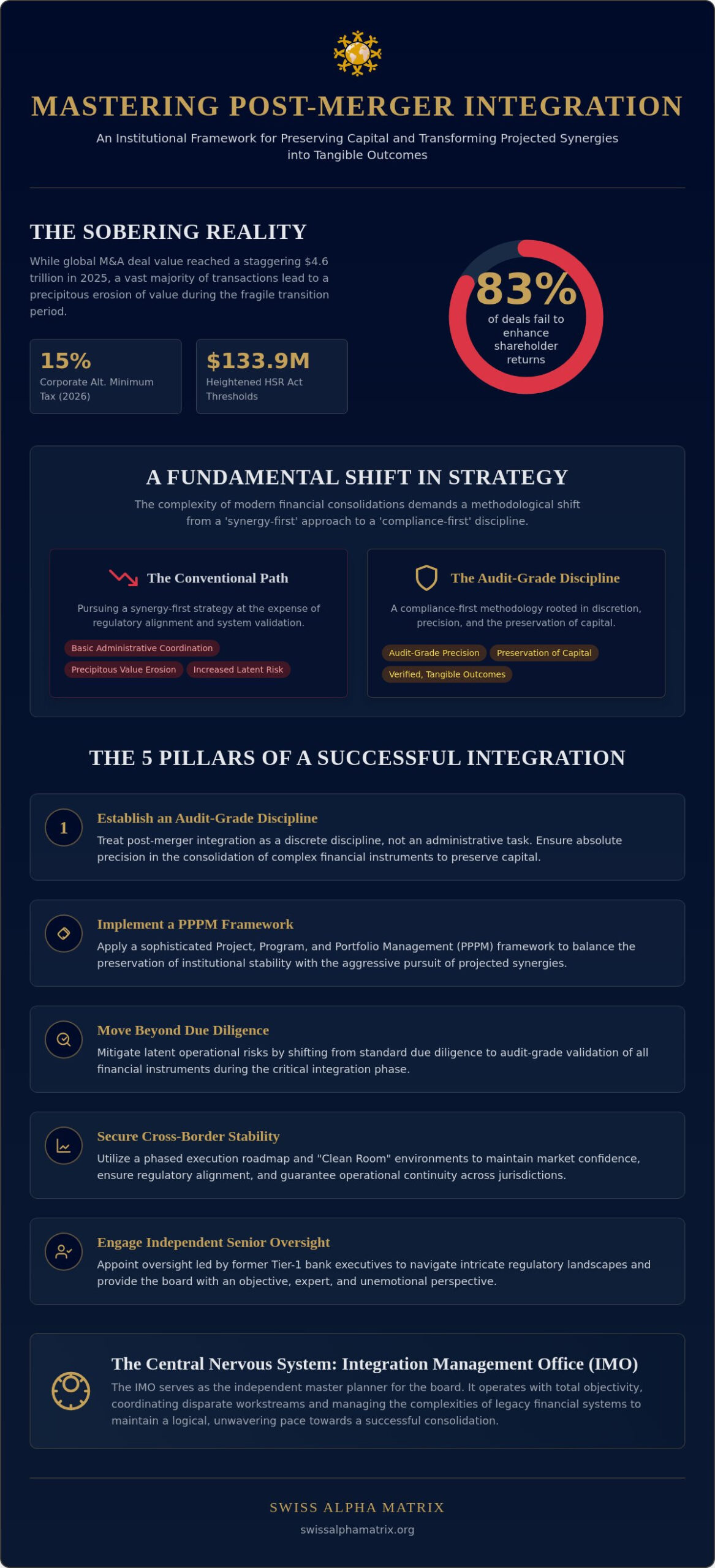
While global M&A deal value reached a staggering $4.6 trillion in 2025, the sobering reality remains that 83% of these transactions fail to enhance shareholder returns, often due to the precipitous erosion of value during the fragile transition period. For institutional entities operating within the 2026 fiscal landscape, defined by a 15% corporate alternative minimum tax and heightened HSR Act thresholds of $133.9 million, the conventional approach to post-merger integration project management is no longer sufficient to safeguard capital. The complexity of modern financial consolidations demands a level of oversight that transcends basic administrative coordination, requiring instead a methodology rooted in the traditional discretion of seasoned experts.
It’s understood that the operational friction between legacy financial systems and the looming threat of regulatory non-compliance in cross-border jurisdictions represent the primary impediments to a successful consolidation. This article offers an institutional framework designed to master these complexities through audit-grade precision and the discipline required for a truly seamless operational transition. We’ll examine the strategic pillars of instrument validation, the critical “shift left” in integration planning, and the rigorous methodologies necessary to ensure that projected synergies are transformed from theoretical aspirations into verified, tangible outcomes.
Key Takeaways
- Establish post-merger integration project management as a discrete, audit-grade discipline that transcends basic administrative coordination to ensure the absolute precision of financial instrument consolidation.
- Implement a sophisticated Project, Program, and Portfolio Management (PPPM) framework to balance the preservation of institutional stability with the aggressive pursuit of projected synergies.
- Mitigate latent operational risks by moving beyond standard due diligence toward audit-grade validation of financial instruments during the critical integration phase.
- Secure cross-border stability through a phased execution roadmap, utilizing “Clean Room” environments to maintain market confidence and operational continuity.
- Engage independent oversight led by former Tier-1 bank executives to navigate the intricate regulatory landscapes and provide the board with an objective, expert perspective.
The Strategic Architecture of Post-Merger Integration Project Management
The execution of Post-merger integration (PMI) within the institutional financial sector is frequently misunderstood as a mere administrative extension of the transaction. In truth, successful post-merger integration project management requires a discrete, audit-grade programme of work characterized by absolute precision. While general corporate mergers might prioritize immediate market share or broad operational synergies, the consolidation of financial entities necessitates a primary focus on the preservation of capital and the rigorous validation of complex instruments. This distinction is critical; a failure to recognize the unique technical debt and regulatory burdens of the financial industry often leads to the precipitous erosion of deal value.
The landscape of 2026, defined by a 15% corporate alternative minimum tax and more stringent HSR Act thresholds, has fundamentally altered the integration hierarchy. It’s no longer viable to pursue a ‘synergy-first’ strategy at the expense of regulatory alignment. Instead, a ‘compliance-first’ methodology is essential, ensuring that every facet of the combined entity meets the exacting standards of cross-border jurisdictions before value extraction begins. This shift requires a level of intellectual depth and technical accuracy that only seasoned, unemotional experts can provide, moving away from the frantic energy of the deal toward a measured, logical transition.
At the heart of this process lies the Project Management Office (PMO), or more specifically, the Integration Management Office (IMO). This entity serves as the central nervous system of the deal, coordinating disparate workstreams while maintaining a logical, unwavering pace. It functions as the independent eye for the board, providing the sophisticated oversight required to identify process overlaps and manage the intricate nature of legacy financial systems. By establishing the IMO as a master planner, the organization ensures that interests remain in the hands of those who prioritize long-term stability over short-term speculation.
Defining the Integration Mandate
A successful mandate requires the setting of clear, non-conflicting objectives that prioritize institutional stability and fiduciary responsibility. Establishing executive-level accountability through independent oversight is paramount to prevent the biases of legacy organizations from clouding strategic decision-making. This alignment ensures that the integration adheres to the Strategic Architecture of Independent Financial Project Management, where regional precision and professional discretion guide the consolidation of global assets. It’s a standard of service that is both broad in reach and meticulous in its attention to detail.
The Role of the Integration Management Office (IMO)
The IMO must be structured to handle the profound complexities of cross-border regulatory environments, operating with total independence from legacy business units to maintain objectivity. By integrating senior-level transactional expertise, specifically drawing upon the institutional memory of individuals who have held leadership roles within Tier-1 banking environments, the IMO provides the sophisticated master planning necessary for success. This structure ensures that post-merger integration project management remains a disciplined exercise in risk mitigation, catering to a sophisticated audience that values nuance, thoroughness, and a high level of professional competence.
Aligning Institutional Discipline: The PPPM Framework in Financial Mergers
Executing a consolidation of significant magnitude requires a transition from reactive problem-solving to a structured, logical methodology. The application of Project, Program, and Portfolio Management (PPPM) principles provides the necessary rigour to manage the vast array of workstreams inherent in high-stakes transactions. Unlike general corporate integrations, where broad milestones might suffice, post-merger integration project management within the financial sector demands a hierarchy of oversight that mirrors the complexity of the assets involved. By adopting a formal PMI framework for post-merger integration, institutions can ensure that the pursuit of synergy does not inadvertently compromise the stability of the core business.
Managing the “Integration Portfolio” is a delicate exercise in balancing Business As Usual (BAU) performance with the aggressive extraction of deal value. This requires the implementation of financial advisory methodologies that prioritize capital preservation through every phase of the transition. To maintain absolute clarity, the use of RACI (Responsible, Accountable, Consulted, Informed) matrices is indispensable. These matrices serve to define accountability across merged executive teams, ensuring that fiduciary duties are clearly assigned and that there’s no ambiguity regarding which leader owns the validation of merged financial instruments. Such precision is a hallmark of a boutique entity that values regional excellence and traditional discretion.
Program Management vs. Individual Project Execution
In the institutional environment, post-merger integration project management must be treated as a program of interdependent workstreams rather than a collection of isolated tasks. The dependencies between the Treasury, Legal, and IT departments are particularly acute; a delay in technical system migration can have immediate, cascading effects on regulatory reporting and liquidity management. The Integration Program is a multi-year institutional commitment that harmonizes disparate operational workstreams into a singular, resilient corporate architecture. For boards requiring an objective perspective, engaging complex project management specialists ensures that these dependencies are managed with the precision of a master planner.
Stakeholder Management at the C-Suite Level
The “clash of cultures” frequently cited in merger failures is often a symptom of poor communication rather than irreconcilable differences. Navigating this dynamic requires structured, unemotional communication that manages the expectations of regulators, shareholders, and institutional partners with equal weight. Transparency is maintained through audit-grade reporting and executive intelligence, providing a steady, logical flow of information that fosters trust. This measured approach leads the reader through a structured argument for the methodology, creating a sense of professional calm that encourages confidence in the most complex decision-making processes.
Beyond Due Diligence: Audit-Grade Validation and Operational Risk Mitigation
The assumption that pre-closing due diligence provides a definitive shield against capital erosion is a dangerous fallacy in high-stakes financial consolidations. While the initial phase identifies obvious hurdles, it’s during the actual execution of post-merger integration project management that the most profound operational risks become visible. In the 2026 fiscal environment, where research suggests that 70-90% of deals fail to achieve their intended synergies, the transition from paper-based assumptions to operational reality requires a level of scrutiny that standard due diligence simply cannot offer. It is a period where latent liabilities within complex instrument portfolios can surface, threatening the very realization of projected value and the stability of the combined entity.
To protect the interests of the newly formed organization, boards must move toward the implementation of bank instrument validation services as a standard post-closing protocol. This rigorous approach ensures that every asset brought into the fold is not only legally sound but operationally viable. By employing cross-border investment due diligence frameworks that extend deep into the integration phase, institutions can identify and isolate toxic exposure before it infects the broader portfolio. This level of institutional discipline distinguishes the master planner from the passive participant, ensuring that long-term preservation remains the primary objective through every technical validation.
Instrument Validation and Capital Adequacy
Verifying the integrity of Standby Letters of Credit (SBLCs) and other high-value instruments is a non-negotiable requirement for maintaining capital adequacy. As institutions navigate the complexities of 2026 international financial regulations, including the nuances of Basel IV implementation, the combined balance sheet must be scrutinized with audit-grade precision. Deep-dive investigations into legacy financial entities often reveal discrepancies that were obscured during the rapid pace of the deal cycle, necessitating a technical accuracy that only seasoned, unemotional experts can provide.
Operational Due Diligence (ODD) Post-Merger
Assessing the resilience of merged IT and compliance frameworks is essential for preventing the 30-50% loss of deal value often attributed to ineffective technical integration. Post-merger ODD moves beyond theoretical models to verify on-ground operational realities, ensuring that compliance frameworks are robust enough to span multiple jurisdictions. By implementing risk management frameworks that prioritize regional precision, organizations can validate that the operational infrastructure is truly capable of supporting the new, larger entity without succumbing to friction or regulatory oversight failures.
The Integration Roadmap: Phased Execution for Cross-Border Stability
A successful transition within the institutional financial sector is never the result of chance; it’s the product of a meticulously sequenced roadmap that prioritizes stability over speed. While tactical guides often focus on the immediate mechanics of the deal, effective post-merger integration project management requires a broader perspective that encompasses the long-term regulatory tail of cross-border consolidations. This process begins with Phase 1: Pre-Closing Alignment, where ‘Clean Room’ environments allow for the analysis of sensitive data by independent experts, ensuring that the combined entity’s strategic architecture is finalized before the legal close. This phase is essential for identifying process overlaps that could otherwise lead to operational friction.
Transitioning into Phase 2, Day 1 Execution, the primary objective shifts toward maintaining business continuity and market confidence. It’s a period characterized by the need for visible stability, where the seamless management of merged financial instruments reinforces the credibility of the new organization. Following this, Phase 3 focuses on the First 100 Days, a period dedicated to the capture of projected synergies and institutional integration. Finally, Phase 4 addresses long-term stabilization and regulatory optimization, ensuring that the entity remains compliant with evolving standards, such as the 2026 Basel IV implementation nuances, long after the initial excitement of the deal has subsided.
Achieving Day 1 Readiness
Day 1 readiness is the culmination of a ‘Critical Path’ that harmonizes Legal, IT, and Treasury prerequisites into a singular, functional state. Achieving audit-grade readiness for regulatory reporting on the first day of operations is a non-negotiable requirement for institutions that value their reputation and capital. Establishing a centralized command centre facilitates immediate issue resolution, providing the board with an independent eye to monitor the transition in real-time. For organizations seeking to secure this level of precision, engaging complex project management specialists provides the necessary institutional discipline to navigate these high-stakes requirements.
The 100-Day Synergy Capture Plan
The transition from stabilization to value realization occurs through a 100-day plan that prioritizes high-value integrations with a direct impact on the bottom line. Monitoring the realization of these synergies requires independent milestone tracking, moving away from the internal biases that often plague legacy teams. The initial 100-day window represents the most critical period for capital preservation, as it is during this timeframe that the structural integrity of the integration is either solidified or compromised. By maintaining a steady, logical pace, the organization can ensure that the pursuit of growth never undermines the traditional values of reliability and regional precision.
The Case for Independent Senior Oversight in Complex Financial Consolidations
Internal teams, while possessive of deep institutional knowledge, often find themselves encumbered by legacy allegiances that make it nearly impossible to maintain the objective distance required for rigorous post-merger integration project management. This proximity frequently obscures the very operational gaps and technical debts that lead to precipitous value erosion during the transition. In contrast, leveraging the expertise of former Tier-1 bank executives introduces a level of institutional discipline that is unburdened by internal politics or historical bias. These seasoned professionals bring decades of transactional and regulatory expertise, allowing them to navigate complex cross-border jurisdictions with a sense of quiet authority and technical accuracy that internal departments simply can’t replicate.
Swiss Alpha Matrix positions itself as the independent eye for the board, combining traditional Swiss discretion with the regional precision required for high-stakes global deals. We’ve observed that many large-scale consulting firms inadvertently function as “document factories,” producing voluminous reports that lack the technical depth required to address specific operational friction between legacy financial systems. Our methodology, however, prioritizes actual gap closure and the audit-grade validation of all merged financial instruments. This focus on technical accuracy ensures that capital protection remains the primary objective, catering to a sophisticated audience that values nuance and thoroughness over broad, surface-level summaries. It’s a boutique standard of service that values privacy and exclusivity, positioning our experts as dedicated partners rather than mere service providers.
The Independent Advisory Advantage
Providing the Board with an unvarnished view of integration progress, characterized by an absolute absence of internal bias, is essential for the fulfillment of fiduciary responsibilities during periods of significant structural change. An independent advisor acts as a neutral arbiter, bridging the divide between merging institutional cultures without the emotional entanglements inherent in internal appointments. This objectivity is vital when making high-stakes capital deployment decisions, ensuring that every strategic move is backed by logical, unwavering evidence and a standard of service that is meticulous in its attention to detail. By maintaining this intellectual superiority tempered by traditional values, the board can proceed with a sense of professional calm.
Partnering for Long-Term Transactional Success
The conclusion of the initial integration phase doesn’t signal the end of institutional risk, as the long-term regulatory tail of a merger can last for years. Transitioning from active post-merger integration project management to ongoing regulatory oversight is essential for securing the future of the combined entity and ensuring the realization of projected synergies. By implementing robust risk management frameworks that anticipate 2026 regulatory shifts, such as the nuances of Basel IV, institutions can ensure their growth is both strategic and sustainable. For those overseeing high-stakes consolidations that require audit-grade precision, we invite you to contact Swiss Alpha Matrix for a discreet consultation on your PMI mandate.
Securing the Institutional Future of the Combined Entity
Mastering post-merger integration project management in the 2026 landscape requires moving beyond generic consulting toward a framework rooted in audit-grade validation and institutional discipline. The realization of projected synergies is fundamentally tethered to the rigorous validation of financial instruments and the steady, logical pace of a compliance-first execution. It’s the meticulous sequencing of the integration roadmap and the unvarnished objectivity of independent oversight that secures the combined entity’s future. By prioritizing capital preservation and regional precision, organizations ensure that the transition from legacy systems to a unified architecture is both resilient and regulatory-compliant.
Organizations aiming to protect their interests through complex consolidations benefit from the boutique discretion and institutional-grade precision offered by Swiss Alpha Matrix. Led by former Tier-1 global bank executives with decades of multi-jurisdictional transactional experience, our team provides the expert master planning necessary to ensure long-term preservation and strategic growth. Secure your integration mandate with Swiss Alpha Matrix executive oversight. With the right strategic partner, the profound complexities of the 2026 market become an opportunity for enduring stability and verified institutional excellence.
Frequently Asked Questions
What is the role of project management in post-merger integration?
Project management serves as the central nervous system of the consolidation, orchestrating the complex alignment of disparate workstreams to prevent the erosion of deal value. It provides a structured methodology for managing dependencies between treasury, legal, and IT departments, ensuring that the pursuit of growth remains tethered to institutional stability. By maintaining a logical, unwavering pace, the project structure allows for the identification of process overlaps that could otherwise lead to significant operational friction.
How long does a typical post-merger integration take in the financial sector?
A comprehensive integration within the institutional financial sector typically spans twelve to thirty-six months, depending on the complexity of the cross-border jurisdictions involved. While the initial stabilization and Day 1 readiness occur in the early stages, the full realization of projected synergies and the complete alignment of legacy financial systems often require a multi-year institutional commitment. This measured rhythm ensures that long-term preservation is prioritized over short-term speculation.
Why do most post-merger integrations fail to deliver projected value?
Failure typically stems from the precipitous erosion of value during the transition, often caused by operational friction between legacy systems and a lack of audit-grade precision. Research indicates that 70% to 90% of deals do not achieve their intended synergies because internal teams are often too close to the legacy organizations to maintain the objective distance required for rigorous oversight. Without independent senior oversight, the technical debt and regulatory burdens of the transaction can quickly overwhelm the combined entity’s capital reserves.
What is the difference between an IMO and a traditional PMO?
An Integration Management Office (IMO) is a specialized entity that transcends the scope of a traditional PMO by focusing exclusively on the unique complexities of merging two distinct corporate architectures. While a standard PMO manages internal projects, an IMO functions as a master planner that coordinates cross-functional dependencies and manages the integration portfolio to balance business continuity with synergy extraction. It acts as the independent eye for the board, providing the sophisticated oversight required for high-stakes financial consolidations.
How does audit-grade validation differ from standard due diligence?
Audit-grade validation is a technical, post-closing protocol that verifies the operational integrity of financial instruments, whereas standard due diligence is often a high-level, paper-based assessment conducted before the deal. This rigorous approach involves on-ground verification and deep-dive investigations into legacy financial entities to identify hidden liabilities that were obscured during the rapid pace of the initial deal cycle. It ensures that every asset brought into the fold is not only legally sound but operationally viable within the new corporate structure.
What are the most critical risks in cross-border financial mergers for 2026?
The most acute risks for 2026 involve regulatory non-compliance within shifting cross-border frameworks, including the specific nuances of Basel IV implementation and the 15% corporate alternative minimum tax. Additionally, the failure to address technical debt during IT integration can lead to significant losses, with ineffective system migration often resulting in a 30% to 50% reduction in the deal’s value. These risks require a level of intellectual depth and technical accuracy that only seasoned, unemotional experts can provide.
Can post-merger integration be managed by internal teams alone?
While internal teams possess deep institutional knowledge, they frequently lack the unvarnished objectivity and specialized bandwidth required for a high-stakes consolidation. Engaging independent oversight ensures that post-merger integration project management remains a disciplined exercise in risk mitigation rather than a compromised process influenced by legacy corporate cultures. External experts, such as former Tier-1 bank executives, provide the necessary distance to navigate complex regulatory landscapes without the emotional entanglements of internal politics.
How do you measure the success of a PMI project management office?
Success is measured by the seamless operational transition of the combined entity and the audit-grade validation of all merged financial instruments. Key performance indicators for post-merger integration project management include the realization of projected synergies within the established timeframe, the retention of critical human capital, and the absolute absence of regulatory fallout across all jurisdictions. Ultimately, success is defined by the creation of a unified, resilient corporate architecture that maintains market confidence and long-term capital stability.