

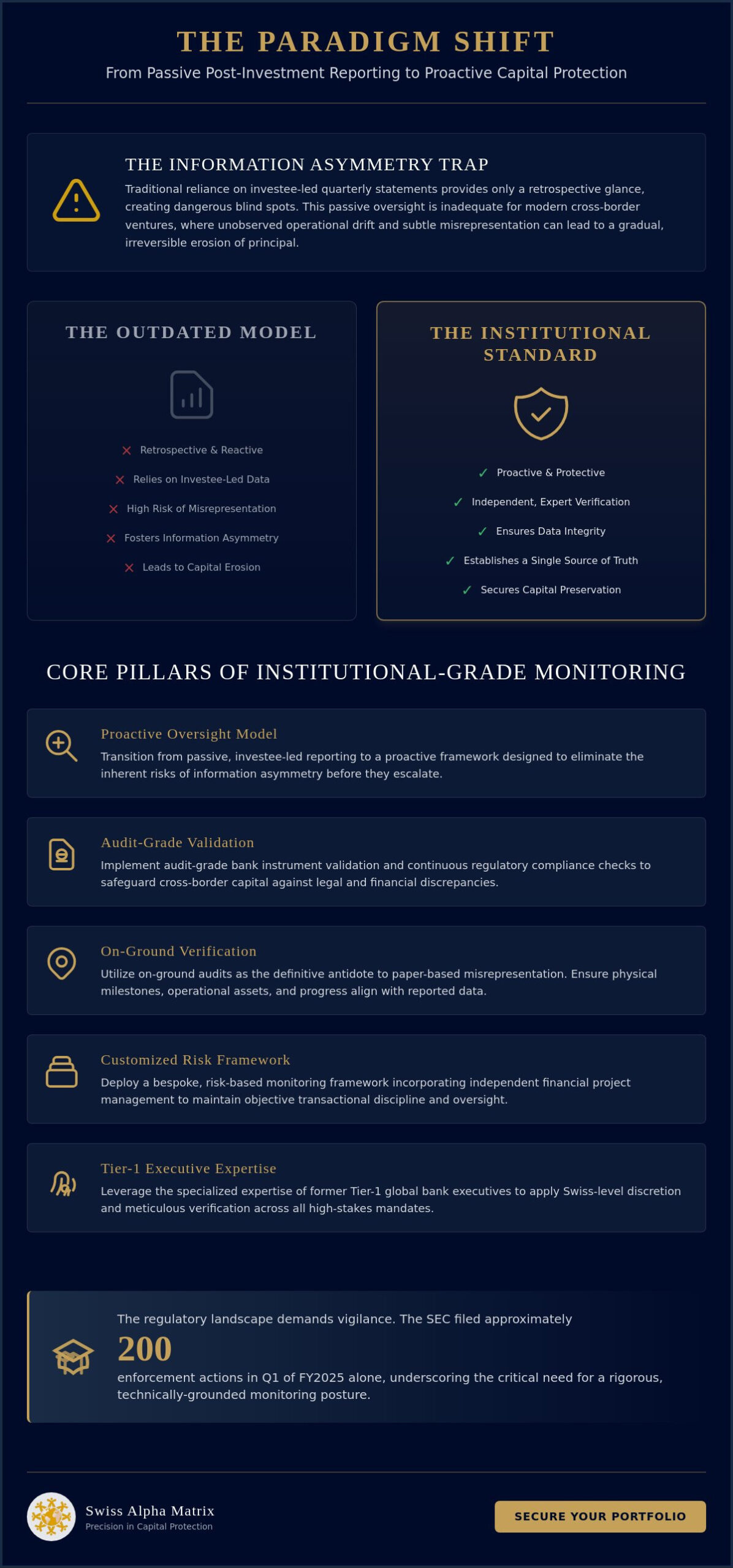
The traditional reliance on quarterly financial statements often provides nothing more than a retrospective glance at capital that may already be compromised by unobserved operational drift or subtle fiscal misrepresentation, offering little protection against the intricate realities of modern cross-border ventures. While passive oversight might’ve sufficed in less complex eras, the current landscape, marked by the SEC filing approximately 200 enforcement actions in the first quarter of fiscal year 2025 alone, demands a more rigorous and technically grounded posture. Adopting sophisticated post-investment monitoring best practices is now the primary defense for the discerning investor who recognizes that information asymmetry isn’t just a challenge; it’s a structural risk to long-term capital preservation.
You’ve likely felt the unease that accompanies a lack of technical expertise when validating complex monthly reports from remote project teams. It’s a common concern among those who prioritize stability and moral character over short-term speculative gains. This guide offers the institutional-grade methodologies you need to transition from a position of uncertainty to one of absolute, verified command over your portfolio’s health. We’ll explore how to establish a robust system for detecting red flags through independent, senior-level verification and on-ground audits, ensuring your interests remain protected by seasoned experts who value precision and regional excellence above all else.
Key Takeaways
- Transition from passive, investee-led reporting to a proactive, institutional-grade oversight model designed to eliminate the inherent risks of information asymmetry.
- Implement post-investment monitoring best practices that prioritize audit-grade bank instrument validation and continuous regulatory compliance to safeguard cross-border capital.
- Utilize on-ground verification as the definitive antidote to paper-based misrepresentation, ensuring that physical milestones and operational assets align with reported data.
- Deploy a customized, risk-based monitoring framework that incorporates independent financial project management to maintain objective transactional discipline.
- Leverage the specialized expertise of former Tier-1 global bank executives to apply Swiss-level discretion and meticulous verification across all high-stakes mandates.
The Paradigm Shift from Passive Reporting to Active Oversight
The historical reliance on investee-led reporting, while perhaps sufficient for domestic ventures with high transparency, proves fundamentally inadequate in the context of high-stakes, cross-border mandates. Traditional models often treat oversight as a clerical function, a series of boxes to be checked by junior staff who lack the technical depth to look beyond the surface of a balance sheet. This passive approach ignores the reality that once capital is deployed, the relationship between investor and project team is often defined by a significant imbalance of information, a condition that, if left unaddressed, leads to a gradual erosion of principal. Adopting rigorous post-investment monitoring best practices represents a necessary evolution from a reactive stance to a proactive, protective posture. It’s no longer enough to wait for the quarterly report; the sophisticated investor must establish a presence that ensures institutional-grade financial discipline remains a constant throughout the post-deployment phase. This shift requires viewing oversight not as an administrative burden, but as a strategic mechanism for long-term preservation.
The Information Asymmetry Trap
Relying exclusively on project-provided dashboards and internal summaries introduces a profound fiduciary risk. These documents, though often polished and professional, are inherently susceptible to confirmation bias, as project teams naturally prioritize narratives that validate their operational decisions. This dynamic creates a dangerous blind spot where systemic risks can fester undetected until they become catastrophic. Engaging in professional asset management requires the intervention of an independent advisory body that operates outside the project’s internal hierarchy. By establishing a single source of truth that is untainted by internal project politics, investors can reclaim the intellectual superiority required to make informed decisions about their capital’s future. Independent verification acts as a necessary friction, slowing the momentum of potential mismanagement before it reaches a point of no return.
Intelligence vs. Reporting: A Critical Distinction
There is a vast difference between standard accounting summaries and the executive-level intelligence required for complex financial programs. While a report might tell you a milestone was missed, intelligence explains the underlying structural failure that caused the delay and predicts the cascading impact on future liquidity. Sophisticated monitoring seeks to uncover the nuanced risks that standard audits, which are often limited in scope and backward-looking, frequently overlook. By moving beyond the balance sheet, investors gain visibility into the moral character of the project leadership and the operational integrity of the venture. This level of oversight transforms the monitoring function from a perceived cost center into a vital capital protection asset. It’s a strategic pillar that ensures every transaction is scrutinized with the same meticulous transactional discipline that characterized the initial due diligence, providing a standard of service that is both broad in reach and meticulous in its attention to detail.
Core Pillars of Institutional-Grade Post-Investment Monitoring
The transition from a reactive reporting model to a proactive oversight posture is anchored by several core pillars that define the post-investment monitoring best practices required for cross-border capital preservation. This methodology recognizes that the deployment of capital is merely the beginning of a high-stakes engagement, necessitating a structural commitment to technical verification and regulatory alignment. Central to this approach is the establishment of a rigorous bank instrument validation protocol, which ensures that all underlying assets are not only present in the financial statements but are also legally sound and fully enforceable. When integrated with a continuous international financial regulations compliance audit, this framework provides a comprehensive shield against both operational drift and external systemic shocks.
Instrument Validation and Asset Integrity
Verification protocols for high-value financial instruments, such as Standby Letters of Credit (SBLCs) and Letters of Credit (LCs), must move beyond simple desktop confirmation to achieve audit-grade depth. In the complex world of international finance, sophisticated forgery and the misrepresentation of asset liquidity are significant risks that can only be mitigated through meticulous technical validation. It’s essential to scrutinize the issuing institution’s standing and the specific language of the instrument to ensure it provides the intended protection. This level of detail-oriented oversight prevents the catastrophic losses that occur when an investor discovers, too late, that their primary security is effectively worthless.
Regulatory and Compliance Oversight
The regulatory landscape is in a state of constant flux, requiring a continuous assessment of how shifting global mandates affect project viability. Effective post-investment monitoring and engagement involves ensuring that the portfolio company maintains rigorous AML and KYC standards, especially as smaller entities navigate the June 3, 2026, compliance deadline for Regulation S-P amendments. This vigilance extends to interpreting the October 1, 2026, Form PF reporting requirements for master-feeder arrangements, ensuring that post-investment monitoring best practices are consistently applied to protect capital from regulatory fallout. Implementing a tailored risk management framework ensures that interests are held in the hands of seasoned experts who value regional precision and transactional integrity.
The Gold Standard: On-Ground Verification vs. Desktop Analysis
The prevailing consensus among many boutique advisory firms suggests that digital oversight is sufficient in an era of real-time data, yet this perspective overlooks the inherent vulnerability of “paper-only” projects. While reviewing digital documents and automated dashboards constitutes a necessary administrative layer, it cannot replace the profound certainty provided by physical presence. The adoption of post-investment monitoring best practices dictates that an investor’s eyes must occasionally be on the ground, particularly when capital is deployed across jurisdictions where legal and operational transparency may be inconsistent. Desktop due diligence, while efficient, is susceptible to sophisticated misrepresentation that only a technical, on-site audit can expose. By integrating on-ground verification into the monitoring cycle, a master planner ensures that the milestones reported in the boardroom are mirrored by the physical reality of the project site.
Validating Physical Reality
Executing on-site operational audits in complex or remote jurisdictions requires a blend of technical expertise and diplomatic finesse, ensuring that the investigation doesn’t disrupt project momentum while maintaining absolute scrutiny. These visits aren’t merely ceremonial; they serve to confirm the existence and condition of high-value collateral and physical infrastructure that underpin the investment’s value. Key components of these physical audits include:
- Asset Verification: Direct inspection of machinery, inventory, or real estate assets to ensure they exist as described in financial reports.
- Operational Witnessing: Observing project workflows to validate that reported production or development milestones are technically feasible.
- Local Stakeholder Interviews: Engaging with third-party vendors and local contractors to identify discrepancies in project timelines or payment flows.
The psychological impact of independent physical oversight cannot be overstated. When project management is aware that a senior-level representative will conduct a verification of operational milestones, it fosters a culture of accountability and reduces the temptation for “creative” reporting. It’s a method that prioritizes long-term preservation over the convenience of remote management, ensuring that interests are held in the hands of seasoned experts who value regional precision.
Bridging the Cross-Border Gap
Local market dynamics often possess the power to invalidate centralized financial reports, as regional shifts in labor, supply chains, or regulatory enforcement can create hidden liabilities. Identifying these “local-level” red flags requires an intuitive understanding of the environment that digital systems simply cannot replicate. This necessity highlights why rigorous cross-border investment due diligence must continue well into the monitoring phase. By maintaining a presence that balances Swiss discretion with meticulous physical oversight, investors can detect subtle deviations from the strategic mandate before they escalate into catastrophic failures. This commitment to post-investment monitoring best practices ensures that the standard of service remains both broad in reach and meticulous in its attention to detail, protecting the moral character of the portfolio against the risks of geographic distance.
Implementing a Risk-Based Monitoring Framework
The successful preservation of capital in cross-border mandates requires more than just a vigilant eye; it necessitates the implementation of a structured, risk-based architecture that integrates financial compliance with operational execution. This is where post-investment monitoring best practices transition from theoretical principles into a functional, defensive system. Central to this approach is the design of a custom independent financial project management framework, which serves as the operational backbone for oversight. By establishing a RACI matrix that formally incorporates an independent monitoring partner, the investor ensures that every critical decision, from treasury management to technical procurement, is subject to unemotional, expert scrutiny. This structure prevents the common pitfall of allowing project management to operate in a vacuum, instead tethering their actions to the overarching fiduciary mandate through institutional-grade escalation protocols for any detected red flags.
Milestones, Deliverables, and Capital Gating
Differentiating between administrative milestones, such as the mere filing of a quarterly report, and true value-add deliverables, such as the technical completion of a physical asset, is vital for effective capital gating. We advocate for a system where capital tranches are released only upon the independent verification of “hard” milestones, creating a natural stop-loss mechanism. This ensures that capital isn’t deployed into failing or stagnant phases, allowing the investor to intervene or pause funding before a minor delay escalates into a terminal loss. It’s a method that prioritizes the moral character of the investment over the convenience of a pre-set disbursement schedule, ensuring that every dollar spent is backed by verified progress.
Stakeholder Management and Communication
Maintaining a dignified, professional distance from the project team is essential for ensuring the objectivity of the monitoring process. The independent advisor must act as a protective authority, reporting directly to the Board with executive summaries that prioritize clarity and technical accuracy over narrative fluff. In instances of friction, this advisor serves as a mediator, utilizing their seasoned expertise to resolve conflicts while maintaining a steadfast focus on long-term preservation and strategic growth. For those seeking to fortify their oversight, our risk management frameworks provide the institutional-grade discipline required to navigate these complex dynamics with regional precision and unwavering calm.
The Swiss Alpha Matrix Methodology: Precision in Capital Protection
While generic consulting models often rely on standardized templates that fail to account for the idiosyncratic risks of cross-border capital, our methodology is built upon a foundation of hyper-personalization and regional precision. We recognize that post-investment monitoring best practices are most effective when they’re applied by those who’ve navigated the highest echelons of the industry. By leveraging the seasoned expertise of former Tier-1 global bank executives, we bring a level of intellectual depth that ensures every transactional detail is aligned with the original strategic mandate. This approach merges sophisticated financial advisory methodologies with the unvarnished reality of on-ground operations, creating a seamless shield for your interests. It’s a system designed for the discerning investor who values long-term preservation over short-term speculation.
Senior-Led Strategic Oversight
Having been in the room during the most complex global mandates allows our experts to anticipate market shifts and operational failures before they manifest in a digital report. We prioritize depth over volume, choosing to dedicate significant senior-level resources to a select number of high-stakes mandates rather than diluting our focus across a broad portfolio. This commitment to exclusivity ensures that capital deployment decisions through 2026 and beyond are made with absolute precision. It reflects a standard of service that is both broad in reach and meticulous in its attention to detail, ensuring that the intellectual superiority of our team is fully utilized to protect your capital. Our approach to post-investment monitoring best practices isn’t just about oversight; it’s about providing the professional calm required to navigate volatile markets.
A Dedicated Partner in Capital Preservation
Our role evolves naturally from an initial due diligence partner to a long-term strategic monitor, providing a continuous thread of protective authority throughout the investment lifecycle. We combine the traditional discretion of high-end private wealth management with a rigorous commitment to transactional discipline, positioning ourselves as a dedicated partner rather than a mere service provider. This transition ensures that the moral character and high-level standards established at the outset are maintained until the capital is successfully repatriated. We invite you to discuss the specific requirements of your portfolio, allowing us to demonstrate how our boutique, mandate-specific oversight provides the inevitable logic required for your peace of mind. Your interests are held in the hands of seasoned, unemotional experts who prioritize the permanence of your wealth.
Fortifying the Future of Your Cross-Border Portfolio
The preservation of capital in high-stakes environments requires a transition from administrative observation to the active, technical command of every operational variable. We’ve explored how post-investment monitoring best practices provide a necessary bulwark against information asymmetry, particularly when on-ground verification and audit-grade instrument validation are prioritized over simple desktop analysis. By implementing a risk-based framework that gates capital according to verified milestones, investors can reclaim the intellectual superiority required to navigate complex global markets with absolute confidence.
Swiss Alpha Matrix stands as an independent advisory partner, led by a team of former senior executives from Tier-1 global banks who prioritize Swiss discretion and meticulous precision in every mandate. Secure your capital with Swiss Alpha Matrix’s specialized monitoring services. It’s time to ensure your interests are held in the hands of seasoned experts who value the permanence of your legacy as much as you do.
Frequently Asked Questions
What is the primary difference between an audit and post-investment monitoring?
Audits typically provide a retrospective verification of historical financial records, whereas active monitoring involves a continuous, forward-looking assessment of operational integrity and strategic alignment. While an audit confirms what has already transpired, the implementation of post-investment monitoring best practices ensures that the project maintains its trajectory in real-time. This proactive posture allows for immediate intervention before fiscal deviations become irreversible, providing a level of security that backward-looking reports cannot match.
How often should on-ground verification be conducted for international projects?
The frequency of on-ground verification is determined by the project’s risk profile and the complexity of the jurisdiction, though a quarterly cadence is often the institutional standard for high-stakes mandates. For ventures involving significant physical infrastructure or remote operations, visits should also be tethered to critical capital gating milestones. This ensures that reported progress is mirrored by physical reality before further tranches are released, maintaining a standard of service that is both broad and meticulous.
Can post-investment monitoring prevent cross-border financial fraud?
Robust monitoring acts as a primary deterrent against cross-border financial fraud by eliminating the information asymmetry that bad actors often exploit. By combining audit-grade instrument validation with unannounced physical inspections, an independent advisor creates a high-friction environment for misrepresentation. This ensures that every transaction is scrutinized with the meticulous discipline required to protect the investor’s principal from sophisticated deceptive practices that often bypass standard clerical reviews.
What are the red flags to look for in monthly project reports?
Critical red flags often manifest as subtle inconsistencies in cash flow timing or the repeated deferral of technical milestones despite reported high operational activity. Discerning observers also look for a sudden lack of granular detail in vendor payments or unexplained changes in key project personnel. These signals may indicate internal instability or the early stages of capital diversion that standard accounting summaries frequently overlook, requiring senior-level expertise to interpret correctly.
How does independent oversight impact the relationship with the project team?
Independent oversight establishes a dignified, professional distance that fosters a culture of accountability without necessarily creating adversarial tension. By positioning the monitor as a master planner focused on long-term preservation, the project team often experiences a heightened sense of discipline. They recognize their operational decisions are being evaluated by seasoned experts who prioritize technical accuracy over speculative narratives, which ultimately strengthens the project’s overall moral character and operational integrity.
What technical skills are required for effective bank instrument validation?
Effective validation requires a profound understanding of international banking protocols, specifically the technical nuances of SWIFT messaging and the legal enforceability of high-value instruments. Professionals must possess the institutional depth to interpret complex transactional data and identify the subtle linguistic anomalies that distinguish legitimate financial instruments from sophisticated forgeries. This technical mastery is essential for ensuring that all underlying assets are legally sound and provide the protection promised to the investor.
Is post-investment monitoring necessary for projects in stable jurisdictions like Switzerland or the UK?
Even within highly transparent jurisdictions like Switzerland or the United Kingdom, active oversight remains essential to mitigate operational drift and ensure ongoing regulatory alignment. While the risk of blatant fraud may be lower, the necessity for post-investment monitoring best practices persists as a means to validate that capital is being deployed with regional precision. It ensures that interests are held in the hands of seasoned experts who prioritize long-term preservation over short-term speculation.
How do you calculate the ROI of an independent monitoring mandate?
The return on investment for an independent monitoring mandate is primarily measured through the preservation of capital that might’ve been lost to unobserved operational failures or fraud. Beyond simple loss prevention, the value is found in the professional calm and intellectual superiority gained through verified intelligence. This allows for more precise strategic growth and the avoidance of costly litigation or regulatory fallout, ultimately securing the exclusive nature of the service provided.