

A standard legal review, while necessary for statutory alignment, is frequently insufficient to protect capital from the sophisticated fraud mechanisms emerging within the current global financial architecture. As the 2026 regulatory landscape matures, the distinction between mere legal adherence and robust operational due diligence switzerland has never been more critical for the discerning executive who prioritizes long-term preservation over short-term compliance. It’s a common sentiment among institutional leaders that the sheer volume of new mandates, such as the Draft Federal Act on Sustainable Corporate Governance and the FINMA Circular 2026/1, has obscured the primary objective of any due diligence exercise, which remains the absolute verification of asset veracity and counterparty integrity.
This framework promises to guide you through the intricate Swiss landscape, moving beyond the contractual cascade of Article 964j to achieve audit-grade capital protection. We’ll explore a methodology that prioritizes on-ground verification and the rigorous interrogation of complex financial instruments, providing a clear distinction between regulatory transparency and strategic risk mitigation. This executive summary previews a structured approach for vetting sophisticated instruments through a lens of regional precision and institutional rigor, ensuring that your interests are managed with the discretion and technical accuracy that Swiss excellence demands.
Key Takeaways
- Understand the fundamental shift from traditional Swiss discretion to the 2026 transparency mandates, ensuring your internal frameworks align with modern institutional expectations.
- Decipher the complexities of Articles 964j-l of the Swiss Code of Obligations to ensure precise compliance regarding conflict minerals and child labor reporting for the 2026 cycle.
- Implement a sophisticated operational due diligence switzerland strategy that utilizes audit-grade validation for financial instruments, moving beyond the inherent limitations of standard bank confirmations.
- Establish physical on-ground verification as a non-negotiable layer of defense to mitigate the risks of sophisticated cross-border investment fraud and confirm asset existence.
- Integrate risk management frameworks into every phase of the capital deployment lifecycle to maintain deal integrity through continuous, milestone-based oversight and executive-level intelligence.
The Evolution of Operational Due Diligence in Switzerland: 2026 Context
The contemporary Swiss financial ecosystem necessitates a refined understanding of Operational due diligence (ODD), where the focus has migrated from the mere verification of legal structures to a comprehensive interrogation of the operational mechanisms that safeguard capital. Within this sophisticated landscape, operational due diligence switzerland acts as the critical bridge between theoretical investment potential and the practical reality of asset security. It’s no longer sufficient to rely on historical reputations or the traditional veil of banking secrecy; instead, the modern allocator must demand a granular level of transparency that mirrors the institutional rigor found in Tier-1 global banking environments.
Switzerland’s enduring status as the primary jurisdiction for complex investment oversight is rooted in its ability to adapt without compromising its core values of precision and reliability. The 2026 environment marks a definitive transition, where the historical preference for discretion is balanced against the necessity for audit-grade verification. This evolution ensures that the jurisdiction remains a sanctuary for high-stakes capital, provided that deployment is preceded by an exhaustive analysis of the counterparty’s operational integrity. Rules change. Markets shift. The requirement for precision remains absolute.
The Institutional Shift Toward Transparency
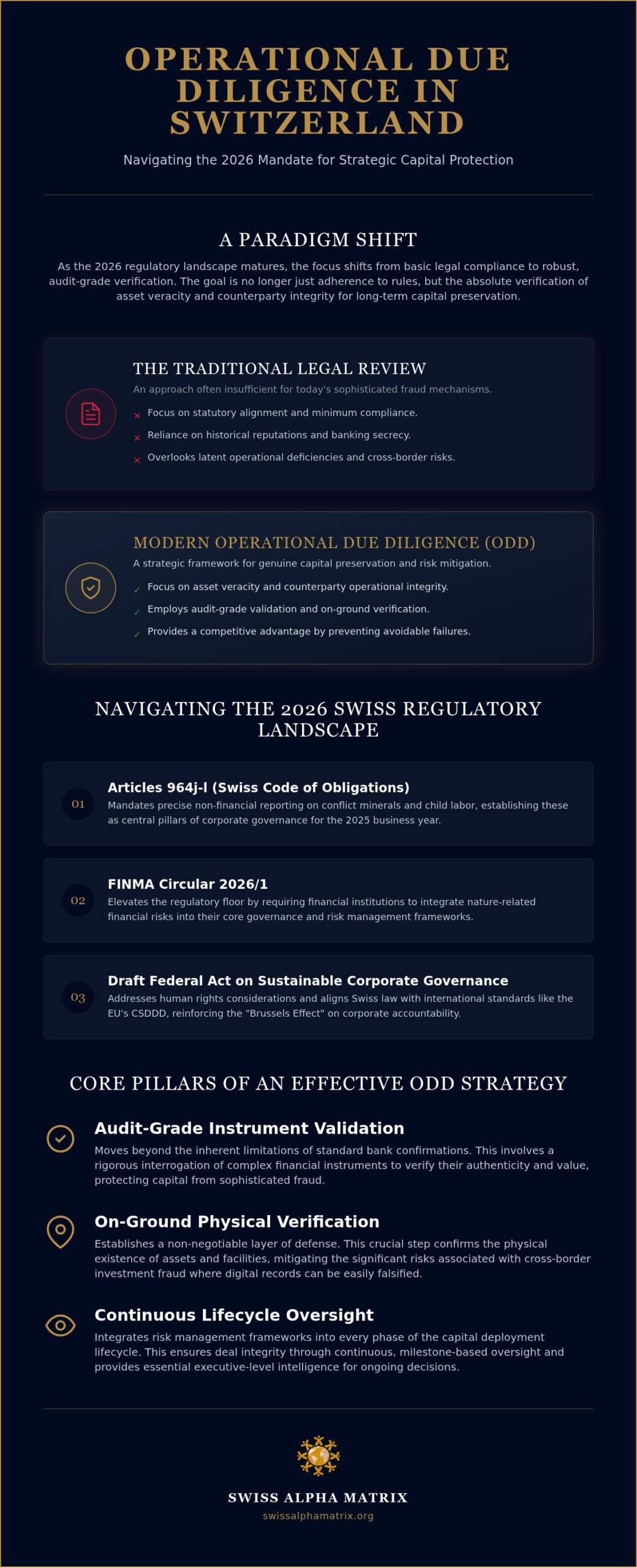
The introduction of international financial regulations has fundamentally reshaped the baseline for Swiss ODD. With the entry into force of the FINMA Circular 2026/1 on January 1, 2026, and the subsequent publication of the Draft Federal Act on Sustainable Corporate Governance on April 1, 2026, the regulatory floor has been significantly elevated. These mandates require financial institutions and large enterprises to integrate nature-related financial risks and human rights considerations into their core governance. Consequently, “Swiss Discretion” has been redefined as the ability to provide precise, proactive disclosure that meets these new federal ordinances while maintaining the traditional standard of regional excellence.
Compliance vs. Strategic Capital Preservation
There exists a profound distinction between statutory reporting and the strategic preservation of capital. While Articles 964j-l provide a legal framework for transparency regarding conflict minerals and child labor, they represent the minimum threshold of adherence rather than a complete risk mitigation strategy. Professional operational due diligence switzerland identifies the latent operational deficiencies that standard legal reviews often overlook, such as the inadequacy of internal controls in cross-border mandates. For the institutional allocator, this level of scrutiny isn’t merely a compliance burden. It’s a competitive advantage that ensures investment performance is not eroded by avoidable operational failures or sophisticated instrument fraud.
Navigating the 2026 Swiss Regulatory Landscape: Articles 964j-l
The 2026 reporting cycle marks a definitive maturation of the Swiss regulatory environment as entities finalize their non-financial disclosures for the 2025 business year. Articles 964j-l of the Swiss Code of Obligations, which mandate specific transparency regarding conflict minerals and child labor, are no longer viewed as peripheral requirements but as central pillars of the corporate governance structure. For the sophisticated allocator, these mandates necessitate a shift from reactive compliance to a proactive stance that mirrors the “Brussels Effect.” This phenomenon, where Swiss law increasingly aligns with the EU’s Corporate Sustainability Due Diligence Directive (CSDDD), ensures that firms operating across borders maintain a singular, high-level standard of accountability that satisfies both domestic ordinances and international stakeholder expectations.
This alignment is not merely a legal formality; it’s a strategic imperative. The Swiss Federal Council’s publication of the Draft Federal Act on Sustainable Corporate Governance on April 1, 2026, further emphasizes this trajectory, expanding the scope of due diligence across the entire value chain. By adhering to these heightened standards, Swiss entities reinforce the jurisdiction’s reputation for reliability, providing a stable foundation for the deployment of institutional capital within an increasingly transparent global framework.
Statutory Duties for Swiss Registered Offices
Applicability for the 2026 cycle is determined by precise thresholds that leave little room for ambiguity. The most stringent due diligence obligations now apply to companies with more than 5,000 global employees or an annual turnover exceeding CHF 1.5 billion. Furthermore, mandatory sustainability reporting, supported by external audits, is required for entities with over 1,000 employees and a turnover of CHF 450 million. Implementing these duties requires a meticulous integration of OECD guidelines into the corporate structure, ensuring that operational due diligence switzerland remains robust enough to withstand institutional scrutiny. Firms must move beyond superficial reviews to establish a verifiable trail of supply chain integrity that meets these 2026 benchmarks.
Integrating ESG into Operational Risk Frameworks
Supply chain transparency has transitioned from a reputational consideration to a core component of cross-border investment due diligence. The risks of non-compliance are substantial, with proposed sanctions potentially reaching 3% of global turnover, in addition to the inherent threat of civil liability and lasting reputational erosion. By referencing established benchmarks like PwC’s business diligence framework, organizations can elevate their internal processes from basic checklists to institutional-grade risk mapping. Those seeking to fortify their frameworks against these evolving mandates often find that a dedicated advisory partner provides the necessary precision to navigate these complexities without compromising strategic growth.
Audit-Grade Instrument Validation: Protecting High-Stakes Capital
Audit-Grade Validation represents the pinnacle of technical scrutiny, specifically designed for Standby Letters of Credit (SBLCs) and bank guarantees where the margin for error is non-existent. While standard bank confirmations provide a superficial layer of comfort, they often fail to interrogate the underlying credit facility’s legitimacy or the signatory’s actual authority. In high-stakes cross-border mandates, relying on a perfunctory verification is a strategic vulnerability. True operational due diligence switzerland requires a forensic approach that goes beyond the digital surface to confirm that the instrument is not only authentic but also enforceable under current international banking protocols.
Digital paperwork, despite its veneer of security, remains the primary vector for sophisticated financial fraud. A common objection among investors is that a SWIFT message or a notarized document should suffice as proof of funds. However, the reality of the 2026 landscape is that “paper-only” assets and unauthorized bank instruments are increasingly difficult to distinguish from legitimate institutional issuances. Aligning your protocols with the 2026 Swiss due diligence obligations means recognizing that digital authentication is merely the starting point, not the conclusion, of a robust validation process. It’s the difference between seeing a document and verifying its institutional reality.
The Mechanism of Independent Financial Review
The identification of “red flags” in complex documentation requires the seasoned eye of former Tier-1 bank executives who understand the nuances of institutional issuance. This process involves a structured interrogation of the instrument’s lifecycle. Key focus areas include:
- Direct issuer verification to confirm the instrument’s entry in the bank’s actual liability ledger.
- Protocol validation to ensure MT760 or MT799 messages adhere strictly to the latest ICC standards.
- Technical interrogation of specific terms and conditions that could render an instrument illiquid or unenforceable during a claim.
This level of technical precision is essential before any capital deployment occurs. It transforms a standard review into a definitive safeguard that protects the integrity of the entire transaction.
Mitigating Counterparty and Intermediary Risk
Counterparty risk often resides within the intermediaries who facilitate these complex transactions. Assessing the operational solvency of these entities is a core pillar of the bank instrument validation services provided by Swiss Alpha Matrix. Independent advisory acts as a necessary barrier against asset inflation, where the value of an instrument is artificially bolstered by non-existent or illiquid underlying assets. By evaluating the operational reality of the intermediary, you ensure that the transaction rests on a foundation of genuine liquidity rather than theoretical promises. This methodology prevents the common pitfall of accepting “paper-only” assets as collateral for real-world capital deployment.
The Non-Negotiable Role of On-Ground Verification
While digital authentication provides an initial layer of security, the proliferation of AI-enhanced forgery in 2026 has rendered purely desk-based reviews inherently vulnerable. For the sophisticated executive, operational due diligence switzerland is incomplete without the integration of physical intelligence. On-ground verification acts as the ultimate filter, separating institutional reality from meticulously crafted digital illusions. By deploying seasoned experts to the site of asset origination, we ensure that capital is not deployed based on a theoretical dossier, but on a foundation of tangible, verified truth. This physical interrogation of claims is the only definitive defense against cross-border investment fraud in a climate where digital footprints are easily manipulated.
Desk-Based vs. On-Ground: A Risk Mitigation Framework
The distinction between electronic review and physical presence is the difference between assumption and certainty. Digital due diligence often relies on third-party databases and scanned documentation, which, despite their convenience, cannot account for the operational reality of a counterparty. A structured comparison highlights the necessity of a dual-layered approach:
| Risk Factor | Desk-Based Review | On-Ground Verification |
|---|---|---|
| Identity Vetting | Electronic document verification | Face-to-face principal interrogation |
| Asset Existence | Satellite imagery and paper titles | Physical site inspection and validation |
| Regulatory Standing | Registry and database checks | Direct consultation with local authorities |
On-ground verification is the physical validation of every claim made in the digital dossier.
Executing Global Mandates with Swiss Precision
Managing site inspections in opaque or high-risk jurisdictions requires an institutional discipline that mirrors the traditional standards of Swiss private wealth management. This physical intelligence gathering isn’t merely a checklist; it’s a strategic deep-dive that informs the financial advisory methodologies used for deal valuation. When physical findings contradict digital claims, the impact on the final risk assessment is immediate and profound. We translate these ground-truth observations into executive-level intelligence reports, providing the C-suite with a clear, unemotional view of the operational landscape. For those requiring absolute certainty before high-stakes capital deployment, our on-ground verification services provide the necessary institutional-grade oversight to protect long-term interests.
Strategic Integration: ODD in the Project Lifecycle
A sophisticated approach to operational due diligence switzerland recognizes that risk mitigation is not a static event but a continuous thread woven into the fabric of capital deployment. While many firms treat due diligence as a preliminary gate, true institutional-grade oversight treats it as a persistent oversight phase within the broader architecture of independent financial project management. This transition from a single checkpoint to a lifecycle-oriented methodology ensures that deal integrity is maintained as market conditions shift and project milestones evolve. By implementing a milestone-based advisory structure, allocators can ensure that every tranche of capital is preceded by a fresh validation of the counterparty’s operational and regulatory standing.
The role of a Strategic Advisory Partner becomes particularly vital during volatile news cycles or periods of regulatory transition, such as the 2026 implementation of CARF and CRS 2.0. In these moments, interests are best served by a partner who manages stakeholder expectations with a sense of quiet authority and technical precision. This long-term perspective prioritizes the stability of the financial program over short-term speculation, providing a protective buffer for the C-suite. Regulatory oversight is thus transformed from a compliance burden into a strategic pillar that supports the permanence of the investment structure.
The Lifecycle of a Strategic Mandate
A structured Project Management Office (PMO) serves as the engine for maintaining institutional discipline across complex, cross-border deals. The process begins with audit-grade instrument validation but extends far beyond the initial signatures. It encompasses post-deployment operational monitoring to ensure that the project’s governance remains intact throughout its duration. Findings from the initial due diligence phases are not merely archived; they are integrated into the project’s RACI matrix, clearly defining responsibilities and accountabilities for every operational risk factor identified. This level of meticulous detail ensures that the strategic mandate is executed with regional excellence and unwavering precision.
The Swiss Alpha Matrix Advantage: Senior-Level Oversight
The efficacy of this framework is fundamentally linked to the caliber of the experts who execute it. By leveraging the expertise of former Tier-1 global bank executives, Swiss Alpha Matrix provides an independent, unemotional layer of project oversight that is rare in the boutique advisory space. Our fixed-fee advisory model is a deliberate choice, aligning our interests solely with the long-term preservation of your capital rather than transactional volume. This commitment to exclusivity and high-level access ensures that your interests are in the hands of seasoned master planners. Secure your next cross-border mandate with Swiss Alpha Matrix to experience a standard of service that is both broad in reach and meticulous in its attention to detail.
Securing the Future of Institutional Capital in 2026
The 2026 landscape demands more than a passive adherence to the Swiss Code of Obligations; it requires a proactive stance where the forensic verification of financial instruments and the physical vetting of assets become the baseline for any high-stakes mandate. By integrating operational due diligence switzerland into the entire project lifecycle, institutional allocators can move beyond the inherent vulnerabilities of digital documentation to achieve a state of audit-grade certainty. This methodology, rooted in regional excellence and meticulous detail, ensures that every capital deployment is supported by ground-truth data rather than theoretical promises.
Our team, led by former senior executives from Tier-1 global financial institutions, provides an independent advisory service focused exclusively on capital protection and the mitigation of sophisticated fraud through specialized on-ground verification. We invite you to Consult with our senior advisors on your 2026 Swiss mandate to ensure your interests are managed with the professional precision and traditional discretion they deserve. Your strategic growth depends on the unwavering stability of your operational foundations.
Frequently Asked Questions
What are the core requirements of Article 964j for Swiss companies in 2026?
Article 964j mandates that Swiss companies importing or processing minerals from conflict-affected areas, or those with reasonable suspicion of child labor, must implement a rigorous due diligence system. For the 2026 cycle, this includes reporting on the 2025 business year. Companies must establish a supply chain policy, implement a traceability system, and ensure that their non-financial reports are approved by the board of directors and published electronically for a period of ten years.
How does Swiss operational due diligence differ from the EU CSDDD?
While the EU’s CSDDD imposes broad environmental and human rights obligations across the entire value chain, it’s clear the current Swiss framework under Articles 964j-l is more targeted toward conflict minerals and child labor. However, the Draft Federal Act on Sustainable Corporate Governance, published on April 1, 2026, signals a pivot toward closer alignment with EU standards, expanding operational due diligence switzerland to include comprehensive environmental and human rights risks for large entities.
Why is on-ground verification necessary if a bank has already confirmed an instrument?
Standard bank confirmations often verify the existence of a message or a document’s format but fail to interrogate the underlying asset’s physical reality or the signatory’s actual authority. In cross-border mandates, digital messages like SWIFT MT760 can be part of sophisticated fraud schemes. On-ground verification serves as the definitive defense, confirming that the facility is not only technically correct but also institutionally authentic and backed by tangible, non-inflated assets in the jurisdiction of origin.
What constitutes “audit-grade” validation for a financial instrument?
Audit-grade validation is a forensic level of scrutiny that goes beyond perfunctory reviews to achieve absolute technical precision. It involves direct issuer verification, where former Tier-1 executives confirm the instrument’s entry in the bank’s actual liability ledger. The process includes a rigorous interrogation of the instrument’s terms, ensuring they adhere to the latest ICC standards and are legally enforceable. This level of validation provides a protective buffer, ensuring that high-stakes capital rests on a foundation of verified institutional reality.
Can Swiss Alpha Matrix conduct operational due diligence for projects outside of Switzerland?
Yes, our expertise extends to global mandates where Swiss precision is required in high-risk or opaque jurisdictions. While our methodology is rooted in the traditional standards of Swiss private wealth management, we deploy on-ground verification services internationally. This ensures that the same institutional-grade operational due diligence switzerland is applied to your cross-border projects, regardless of the geographic location, maintaining a singular standard of capital protection and executive-level intelligence throughout the project lifecycle.
What are the most common operational “red flags” in 2026 cross-border transactions?
Frequent red flags include “paper-only” assets where valuations are artificially inflated and intermediaries who don’t possess verifiable operational solvency. In 2026, we also see an increase in AI-enhanced document forgery and unauthorized bank instruments that appear legitimate on digital registries. Other indicators include unusual pressure for rapid capital deployment and a lack of transparency regarding the physical origin of underlying collateral. Identifying these requires the seasoned eye of experts who understand institutional issuance protocols.
Is independent project management necessary for a standard M&A deal?
Independent project management is essential for M&A deals involving complex financial instruments or multi-jurisdictional stakeholders. Traditional legal and financial reviews often miss the operational risks inherent in the post-merger integration or the technical validation of collateral. By implementing a PMO structure, we ensure that due diligence findings are integrated into a formal RACI matrix. This provides a continuous oversight phase that protects deal integrity from initial validation through to final capital deployment and operational monitoring.
How does Swiss Alpha Matrix maintain discretion during global on-ground investigations?
We maintain discretion by utilizing a boutique approach that prioritizes privacy and exclusivity. Our investigations are conducted with the quiet authority characteristic of high-end wealth management, avoiding the heavy footprint of standard investigative firms. By deploying senior-level executives who understand local nuances, we gather ground-truth data through dignified, professional channels. This ensures that your interests are protected without drawing unnecessary attention to the transaction, preserving the traditional standards of Swiss discretion in every global mandate.