

A transaction can look sound on paper while its operating model remains untested. How to conduct operational due diligence begins with setting clear objectives and scope: assess how the target operates day to day, identify material risks, and understand what its capabilities and obligations mean for the proposed investment. The aim is not to find a flawless business or automatically stop a deal, but to give decision-makers a clearer basis for determining what to do next.
The assessment goes beyond processes and performance measures. It examines whether the target’s systems, controls, supply chain and management structure can support its plans and meet the buyer’s requirements. It also considers employee relationships, leadership and workplace culture, which financial records alone cannot explain.
The diligence team’s experience matters, too. Relevant operational, transactional and regional expertise helps reviewers ask the right questions, interpret evidence in context and distinguish manageable weaknesses from risks that could change the investment case. This article explains the objectives of operational due diligence, the areas to examine across a target’s operations and workforce, and how a qualified team can turn findings into informed transaction decisions.
Key Takeaways
- Set the diligence scope around the transaction’s objectives so the review surfaces risks that could affect value or deal structure.
- Assess leadership, workplace culture and employee relationships alongside formal records to understand the human factors behind performance.
- Examine how systems, controls and operational dependencies may affect resilience and integration after a transaction.
- Match the diligence team’s expertise to the target’s sector, complexity and regional context so findings support sound decisions.
What Objectives Does Operational Due Diligence Pursue?
Operational due diligence examines how a target works and where execution could weaken its investment case. It brings together financial, operational, legal, labor, tax, IT, environmental and commercial analysis. Reviewers assess financial statements, operating metrics, contracts, employee information and other records, linking the company’s financial position to the processes behind it. The objective is to identify material exposure and inform whether stakeholders proceed, renegotiate or withdraw.
In a business transaction or corporate finance assessment, analysts examine balance-sheet assets, tax records, customer relationships and contractual rights. They test projections against operating evidence, investigate unusual movements, and assess whether performance relies on processes or counterparties unlikely to remain in place after completion. A sound approach to how to conduct operational due diligence is to define the scope, request relevant records, test the evidence, resolve discrepancies and prioritize findings.
Private equity reviews often focus on operational improvement, integration and value creation. Venture capital diligence may examine whether people, systems and controls can support growth. Hedge fund operational assessments often emphasize investment operations, valuation controls, service providers and business resilience. In every case, the investment strategy determines which operational risks need the closest scrutiny.
Cybersecurity and data-privacy review can examine access controls, incident response, sensitive-data handling and system dependencies. Business continuity assessment considers recovery arrangements and critical suppliers. The European Union’s Regulation 995/2010 covers legal obligations for operators placing timber and timber products on the market, illustrating why sector-specific requirements belong in scope.
There is no universal checklist. Teams planning how to conduct operational due diligence should tailor their framework to the target’s sector, scale and complexity, organizing evidence across governance, people, processes, technology, compliance and resilience. A useful report describes the business, evidence reviewed, material findings, unresolved questions and transaction implications, including protections, integration priorities and monitoring. Link each conclusion to supporting records and a proposed action.
Human capital and employee engagement
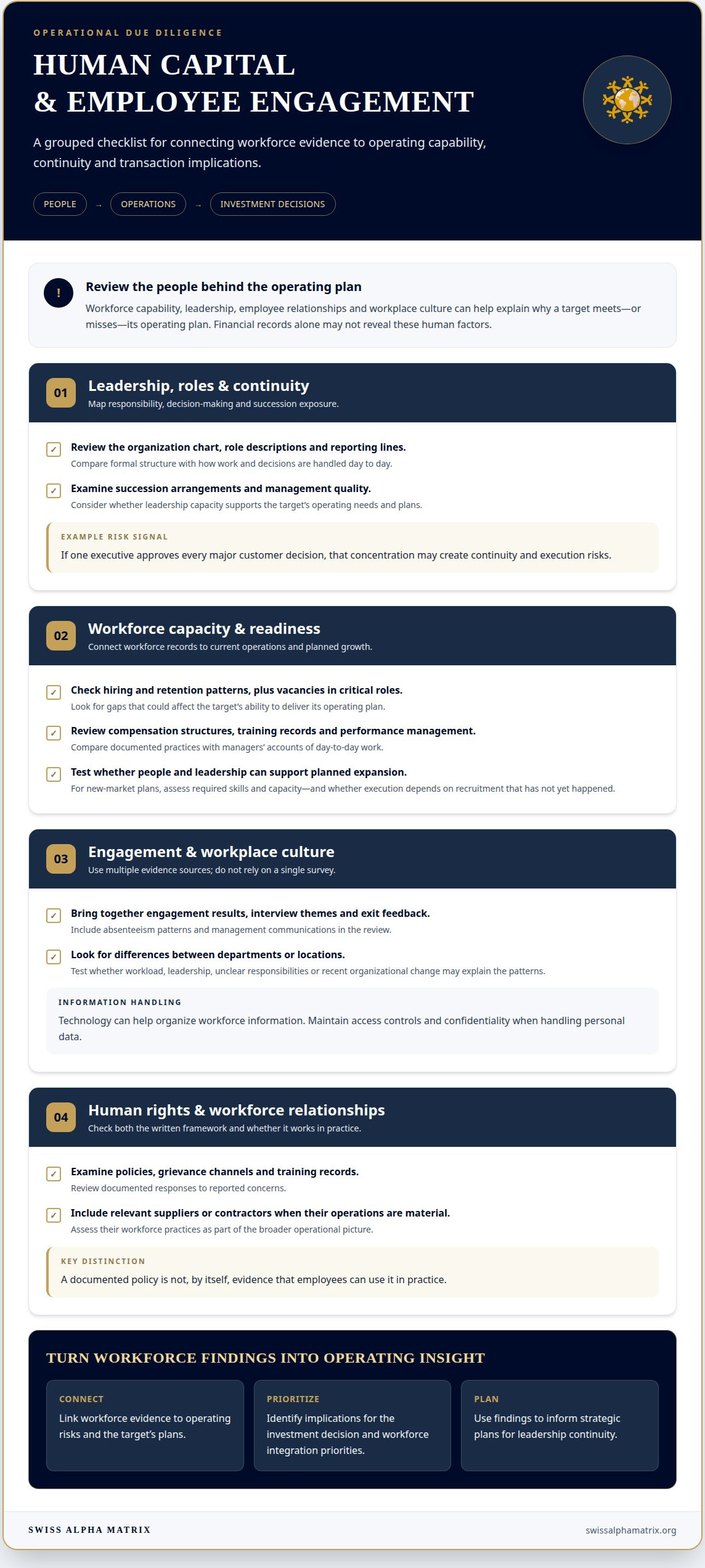
Workforce capability can help explain why a target meets or misses its operating plan. Review the organization chart alongside role descriptions, reporting lines and succession arrangements. For example, if one executive approves every major customer decision, that concentration may create continuity and execution risks. Human capital review also considers management quality, employee relationships, workplace culture and customer loyalty, all of which financial statements may fail to capture.
Human resources diligence should connect workforce records to operating needs. Examine hiring and retention patterns, vacancies in critical roles, compensation structures, training records and performance management. Compare written procedures with managers’ accounts of their day-to-day work. If the target plans to enter new markets, assess whether its workforce has the necessary skills and leadership capacity, or whether the plan relies on recruitment that has not yet taken place.
Assess employee engagement carefully rather than relying on a single survey. Review available engagement results alongside interview themes, exit feedback, absenteeism patterns and management communications. Look for differences between departments or locations, then test whether workload, leadership, unclear responsibilities or recent organizational change may explain them. Technology can help organize workforce information, but access controls and confidentiality remain essential when handling personal data.
Human rights due diligence extends the review across the workforce and relevant business relationships. Examine policies, grievance channels, training records and documented responses to reported concerns; where suppliers or contractors are operationally material, include their workforce practices in the assessment. A diligence process should distinguish a documented policy from evidence that employees can use it in practice. Findings can inform the investment decision, workforce integration priorities and strategic plans for leadership continuity. For a structured review that connects people-related findings with operational risks, consider operational due diligence.
Reviewing a target company’s operations
Assess the target’s operating model against documented performance, dependencies and planned growth. Connect management’s account with day-to-day practice, then consider the implications for valuation or a merger.
Compliance and Regulatory Review
This review tests whether the target’s practices, records and controls align with applicable regulations and contractual commitments. Compliance gaps can create liabilities, disrupt operations or constrain the transaction’s intended value.
Examine licensing records, compliance procedures, training materials, incident logs and open remediation actions. For a target processing personal data in the European Union, assess the relevant data-protection framework, including the General Data Protection Regulation (GDPR). Supplier agreements and monitoring records can also show whether third-party obligations receive practical oversight.
Data, Documentation, and Intellectual Property
Document review compares formal records with evidence of how the business operates in practice. Examine procedures, service agreements, customer and supplier contracts, technology records and relevant legal proceedings for gaps or conflicting terms.
Assess whether intellectual property is identified, documented and protected through appropriate agreements and records. For example, check that development arrangements explain ownership rights and that material software dependencies are recorded. Missing contracts, inconsistent versions or unexplained gaps in operational records can affect valuation and integration planning.
People, Processes, Technology, and Controls
This assessment maps how responsibilities, workflows, systems and controls support daily delivery. Review management coordination, supply-chain handoffs, accounting processes, operational measures and the technology that underpins core services.
Evaluate whether IT systems can support projected growth, how cybersecurity incidents are handled, and whether continuity plans address critical dependencies. Compare stated procedures with observed workflows. For example, manual inventory reconciliation may reveal a control weakness or bottleneck. Supplier and vendor assessment should examine service dependencies, performance evidence, contractual protections and the operational impact of delays or disruption.
Management Questions and Operational Red Flags
Questions for management should test whether its explanations are supported by operating evidence. Ask how leaders monitor service failures, manage supplier disruption, track corrective actions and maintain continuity when key systems or personnel are unavailable.
Red flags include recurring control exceptions, undocumented processes, unexplained performance gaps and reliance on a single critical vendor. Investigate whether management can produce records that show ownership, remediation and follow-through. These findings help assess operational resilience and identify issues that could change transaction terms or post-merger priorities.
Operational due diligence team expertise
Team expertise shapes which evidence is tested, how discrepancies are interpreted and whether findings inform an acquisition decision. A capable review combines operational knowledge with transaction experience and adapts its inquiry to the target’s sector, scale and regional context. The key test is not the team’s title, but whether its members can connect statements and procedures with actual business practices.
Operational due diligence may be conducted by specialist consultants, management consultants, accountancy firms or internal teams. An independent reviewer can challenge assumptions held by the deal team, while internal specialists bring knowledge of the buyer’s systems and integration priorities. For example, a target reliant on complex technology may need assessment of system scalability, controls and security risks alongside operational performance.
Relevant expertise should cover the target’s material functions, not just its financial presentation. Reviewers need to understand how supply-chain, human resources, accounting and technology practices affect delivery. They should trace management statements to records, interviews or observed workflows, identify evidence gaps, and explain how each finding could affect transaction structure, integration or post-acquisition priorities.
Cross-border transactions add a regional dimension. Local experts familiar with the relevant business environment can help interpret operating practices, documentation and commercial relationships in context. Coordinate their work with the broader diligence process so local findings are assessed consistently alongside group-level risks, rather than treated as isolated observations.
Before work begins, define responsibilities, information flows and escalation routes. Assign subject-matter leads to material workstreams, establish how evidence will be recorded, and set a process for resolving conflicting findings. The final assessment should distinguish verified facts from management explanations and connect each material issue to its operational consequence. This disciplined structure makes the team’s analysis more useful to decision-makers. Discuss diligence requirements for your transaction when specialist coordination would strengthen the review.
Swiss Alpha Matrix: Operational Due Diligence
Swiss Alpha Matrix provides Operational Due Diligence for investors assessing a target’s operating model, material exposures and transaction readiness. The service is relevant when internal resources need an independent examination of complex evidence or cross-border operations require on-ground verification to inform an investment decision.
Where they fit the transaction’s requirements, the review can be complemented by Audit-Grade Instrument Validation, On-Ground Verification Services and Complex Project Management. The focus is on testing evidence and giving decision-makers a structured view of operational risks, dependencies and issues requiring attention, rather than treating diligence as a formality.
If a proposed investment requires a disciplined, evidence-led assessment of a target’s operations, contact Swiss Alpha Matrix to discuss the diligence requirements.
Carry Diligence into the Investment Decision
Before moving from review to execution, translate material findings into clear ownership, priorities and monitoring arrangements. Diligence delivers lasting value when decision-makers can trace each proposed action to an identified exposure and carry that rationale through integration. Knowing how to conduct operational due diligence also means treating the assessment as the foundation for disciplined oversight, not just a transaction milestone.
Where a transaction calls for independent scrutiny and coordinated execution, Swiss Alpha Matrix can support the work through Audit-Grade Instrument Validation, On-Ground Verification Services and Complex Project Management. These capabilities can help align evidence review with the practical demands of complex investment programmes, while keeping the decision framework grounded in the transaction’s specific requirements. To discuss the next step for your assessment, contact Swiss Alpha Matrix. A considered process can help stakeholders move forward with greater clarity and purpose.
Frequently Asked Questions
What documents and data should be requested for operational due diligence?
Request records that let reviewers trace reported performance back to operational evidence. A tailored information request may include financial statements, budgets, forecasts, operational metrics, organization charts, contracts, supplier records, policies, employee information, IT documentation, incident logs and business continuity plans. Include intellectual property registers where relevant. A well-indexed data room helps reviewers spot missing or inconsistent records, such as a KPI report that does not reconcile with its supporting operational data.
How long does operational due diligence take and what does it cost?
Operational due diligence for a typical transaction is described as taking six to ten months. Cost depends on the engagement’s scope and complexity, including the target’s sector, geographic footprint, functions under review, available evidence and specialist expertise required. A focused review of a defined operation differs substantially from a broad, cross-border assessment. Setting priorities and access arrangements early helps shape the work plan and resource requirements.