

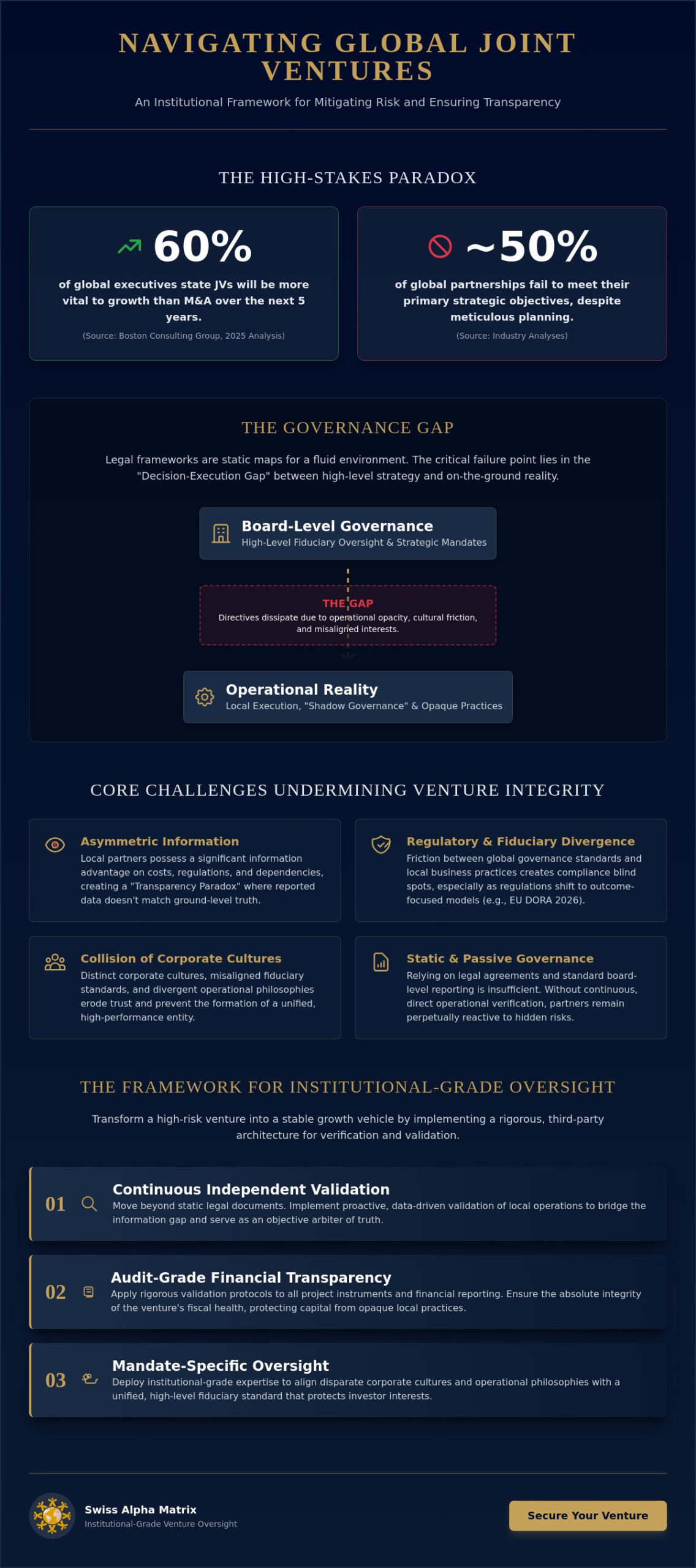
According to a 2025 analysis by the Boston Consulting Group, sixty percent of global executive leaders now assert that the formation of strategic joint ventures will be more vital to their organizational growth over the next five years than traditional mergers or acquisitions. While the strategic allure of cross-border market diversification is undeniable, successfully navigating joint venture complexities requires far more than the mere execution of a legal agreement, demanding instead a rigorous, institutional-grade architecture that effectively bridges the persistent gap between opaque local operations and the necessity of global executive oversight.
You’ve likely felt the inherent fragility of these structures, where asymmetric information and the 2026 transition of the EU’s Digital Operational Resilience Act into strict supervisory expectations create a precarious environment for capital preservation. This article provides a comprehensive framework for achieving audit-grade transparency into your partnership’s financial health, ensuring that your interests remain protected through proactive, data-driven validation. We’ll explore the strategic pillars of operational due diligence and the meticulous oversight required to transform a high-risk cross-border venture into a stable, long-term vehicle for institutional growth.
Key Takeaways
- Recognize the inherent limitations of traditional board-level governance and the critical necessity of bridging the “Decision-Execution Gap” through direct operational verification.
- Master the art of navigating joint venture complexities by implementing a framework that prioritizes continuous, independent validation over static legal documentation.
- Establish audit-grade financial transparency by applying rigorous validation protocols to project instruments, ensuring the absolute integrity of the venture’s fiscal health.
- Deploy a mandate-specific oversight strategy that leverages institutional-grade expertise to align disparate corporate cultures with a unified, high-level fiduciary standard.
The Structural Fragility of Global Joint Ventures
The structural reality of a joint venture often represents a profound collision between distinct corporate cultures, misaligned fiduciary standards, and divergent operational philosophies. While a joint venture serves as a vital instrument for market entry and capital scaling, the statistical reality is sobering; industry analyses frequently indicate that approximately 50% of global partnerships fail to meet their primary strategic objectives. This high rate of attrition persists despite the presence of exhaustive legal documentation and meticulous strategic planning, suggesting that the root of failure lies not in the contract itself, but in the volatile dynamics that emerge post-execution. Successfully navigating joint venture complexities requires an acknowledgment that a contract is merely a static map, whereas the actual partnership is a fluid, often opaque environment that demands continuous, institutional-grade oversight.
To preserve capital and maintain strategic alignment, sophisticated investors must move beyond passive governance. The inherent fragility of these structures necessitates the presence of a third-party arbiter of truth, an entity capable of providing objective validation that transcends jurisdictional borders. Without this independent layer of verification, the partnership remains vulnerable to the hidden erosions of trust and the gradual misalignment of interests that characterize many cross-border failures.
Asymmetric Information and the Transparency Paradox
In the context of cross-border alliances, asymmetric information acts as a silent, corrosive force that frequently undermines deal integrity. Local partners often possess a significant information advantage, holding granular knowledge of regional operational costs, regulatory nuances, and supply chain dependencies that remain obscured from the foreign investor. This imbalance creates a scenario where standard reporting metrics become insufficient, as they often reflect a curated version of reality rather than the ground-level truth. To counter this, sophisticated entities are increasingly mastering cross-border investment due diligence to identify these informational gaps before they escalate into structural failures. Without a mechanism for independent verification, the foreign partner remains in a state of perpetual reactivity, unable to validate the actual performance of the venture.
Regulatory and Fiduciary Divergence
The friction between global corporate governance and local business practices is further intensified by the evolving landscape of international financial regulations, which can create significant compliance blind spots. As jurisdictions shift toward outcome-focused regulation in 2026, the traditional “check-the-box” approach to compliance has become obsolete. Organizations must now reconcile their internal fiduciary requirements with the varying standards of transparency prevalent in emerging markets. The transparency paradox is the widening gap between the formal data reported by a partner entity and the physical, operational reality occurring on the ground. Navigating joint venture complexities in this environment requires a commitment to rigorous, on-ground verification that ensures the venture’s activities align with both global standards and local legal mandates.
The Governance Gap: Where Legal Frameworks Meet Operational Reality
While the formal Legal Framework of Joint Ventures provides a necessary foundation for partnership, it’s often insufficient for maintaining true strategic alignment. Board-level governance, though vital for high-level fiduciary oversight, frequently lacks the granular visibility required to ensure that strategic mandates are translated into local action. This creates a “Decision-Execution Gap,” where the directives issued in the boardroom dissipate before reaching the operational floor. In many cross-border scenarios, local management may engage in “shadow governance,” a practice where official protocols are bypassed in favor of legacy regional habits or undocumented internal hierarchies. Navigating joint venture complexities requires a move beyond these top-down structures, favoring a model that integrates operational-level verification directly into the management lifecycle.
The reliance on periodic reporting often masks these underlying frictions until they manifest as significant capital risks. Bridging this structural divide necessitates the implementation of independent financial project management. This layer of oversight acts as a continuous conduit between the board’s intent and the project’s execution, ensuring that capital is deployed precisely as authorized. To secure your interests, it’s often prudent to engage experts in Operational Due Diligence who can provide the unemotional, technical validation that standard governance models lack.
Decision-Making Deadlocks and Operational Paralysis
Deadlocks are rarely the result of a single catastrophic event; they’re the culmination of unresolved operational frictions. Disagreements over capital call timing, dividend distribution policies, or procurement standards can quickly spiral into paralysis. A pre-emptive framework for dispute resolution, rooted in technical oversight rather than just legal arbitration, is essential. Within this context, the concepts of Swiss discretion and neutrality serve as critical assets. By positioning an independent arbiter between partners, organizations can mediate conflicts through data-driven logic rather than emotional or political posturing, maintaining momentum even when consensus is difficult to reach.
The Limitations of Contractual Protection
Sophisticated investors recognize that even the most “airtight” contract offers limited protection in jurisdictions where the rule of law is inconsistently applied. In these environments, legal recourse is a trailing indicator of failure rather than a preventative measure. The transition from a trust-based model to a verification-based model is no longer optional. Continuous monitoring, as opposed to retrospective periodic auditing, allows for the early detection of financial irregularities or operational drift. This shift ensures that the partnership’s integrity is maintained through active, daily validation of the venture’s physical and fiscal realities.
Mitigating Counterparty Risk through Independent Operational Due Diligence
In the high-stakes environment of cross-border partnerships, operational due diligence must be recognized as a continuous fiduciary obligation rather than a static, pre-deal milestone. While many organizations treat the signing of a contract as the conclusion of their risk assessment, the reality of navigating joint venture complexities suggests that the most significant risks emerge during the operational lifecycle. Relying solely on historical data or self-reported metrics from a partner entity creates a dangerous vacuum of oversight. To maintain strategic alignment, sophisticated investors utilize Harvard Law School’s Joint Venture Governance Index as a baseline for calibrating governance strength, yet even this requires a layer of independent validation to be effective. True risk mitigation demands an unemotional, third-party assessment of a partner’s actual operational capacity versus their stated capabilities.
Independent advisory serves as the only viable mechanism for obtaining an unbiased view of venture performance. Without this external lens, internal reporting remains susceptible to the “transparency paradox” discussed earlier, where local management curates data to align with board expectations rather than ground-level reality. Continuous operational scrutiny ensures that capital deployment remains tethered to the venture’s original mandate, protecting the interests of the foreign partner from the gradual erosion of control.
The Necessity of On-Ground Verification
Desk-based research is a hollow shield in jurisdictions where regulatory divergence is the norm. Validating complex cross-border projects requires a physical presence that can scrutinize asset integrity and conduct local stakeholder interviews away from the influence of the partner’s executive suite. This process uncovers the subtle discrepancies between digital balance sheets and physical inventory or infrastructure. On-ground verification is the physical audit of claims made by a counterparty. By bypassing the curated flow of information, investors can identify operational drift before it manifests as a catastrophic financial loss.
Assessing Counterparty Resilience and Integrity
Evaluating a partner’s institutional character requires moving beyond basic credit scores to analyze their regulatory standing and historical reliability in volatile markets. This assessment is particularly critical when validating the legitimacy of capital contributions. Utilizing bank instrument validation services allows for the rigorous verification of SBLCs or LCs used as project collateral, ensuring that the partner’s financial commitment is both authentic and enforceable. In an era of global trade fragmentation, understanding how a partner navigates local political shifts is essential for long-term stability. A partner’s resilience isn’t just a measure of their current balance sheet; it’s a reflection of their ability to maintain fiduciary integrity under external economic pressure.
Establishing a Framework for Audit-Grade Financial Transparency
True financial transparency in a joint venture environment transcends the mere adherence to IFRS or GAAP standards; it requires a forensic commitment to validating the technical integrity of every asset and instrument involved. Navigating joint venture complexities involves recognizing that financial reporting is often a lagging indicator of health, whereas the validation of funding sources is a leading indicator of risk. By establishing an institutional framework for audit-grade transparency, partners can move beyond the superficial trust of shared balance sheets to a model of continuous, data-driven verification. This level of scrutiny ensures that the partnership’s fiscal foundation is not merely a collection of ledger entries, but a verified reality supported by authentic collateral.
Instrument Validation and Capital Protection
The risks associated with non-performing financial instruments are particularly acute in jurisdictions where the regulatory oversight of banking institutions may lack the rigor of global standards. Establishing audit-grade validation for bank-issued documents, specifically regarding the liquidity and authenticity of SBLCs or LCs, is a critical prerequisite for any substantial capital commitment. This process systematically dismantles the “paper-only” wealth trap, a common failure point where a counterparty’s perceived solvency is based on sophisticated but ultimately unenforceable documentation. Navigating joint venture complexities in the current regulatory environment demands that every instrument is not just present, but performant under the specific legal and financial conditions of the venture.
The Milestone-Based Funding Model
A project management approach that mandates milestone-based funding serves as the ultimate safeguard against the misallocation of capital. By tying capital release to verified deliverables, the board maintains a persistent lever of control over the venture’s operational trajectory, ensuring that funds aren’t exhausted before tangible progress is achieved. This strategy is best managed through a RACI matrix, identifying who is Responsible, Accountable, Consulted, and Informed, to eliminate the ambiguity that often plagues complex transaction reporting. Utilizing institutional-grade financial advisory methodologies allows for the creation of a rigorous review cycle, ensuring that capital is only deployed when technical and financial milestones have been independently validated.
To ensure financial integrity in complex transactions, executives should adhere to the following technical checklist:
- Instrument Authenticity: Direct, independent confirmation of all bank-issued collateral through secure institutional channels.
- Milestone Alignment: Explicit linkage between capital disbursement and the physical verification of predefined operational stages.
- Transparency Protocols: Implementation of real-time visibility into the venture’s primary accounts, bypassing curated monthly summaries.
- Accountability Mapping: Utilization of a RACI matrix to ensure every financial report is signed off by a verified local and global authority.
For organizations seeking to fortify their partnership foundations, our Audit-Grade Instrument Validation services provide the technical assurance necessary for secure capital deployment.
Strategic Oversight: The Swiss Alpha Matrix Approach to JV Management
The Swiss Alpha Matrix methodology represents a fundamental departure from traditional consultancy, merging rigorous financial discipline with the seasoned perspective of senior-level banking expertise. In an era where sixty percent of global executives view partnerships as the primary engine for growth through 2026, the necessity for a sophisticated oversight framework has never been more acute. Successfully navigating joint venture complexities requires an advisory partner that operates with the same fiduciary gravity as a private wealth institution, prioritizing the long-term preservation of capital over short-term operational convenience. Our approach is rooted in the belief that deal integrity is maintained not through trust, but through the continuous, technical validation of every strategic and financial pillar within the venture.
By engaging on a mandate-specific basis, we provide the granular attention to detail required for complex project oversight, ensuring that each intervention is tailored to the unique jurisdictional and operational nuances of the partnership. This methodology refuses to oversimplify the intricate dynamics of cross-border capital deployment; instead, it embraces complexity to engineer stability. Through a combination of regional precision and global reach, we act as a protective authority, ensuring that your interests are managed by experts who value historical reliability as much as modern strategic alignment.
Independent Project Management as a Risk Hedge
Our firm functions as a seamless extension of your executive team, providing the unvarnished intelligence necessary for informed decision-making in high-stakes environments. By leveraging the expertise of former Tier-1 bank executives, we apply a level of risk management that standard consulting firms simply cannot replicate. This institutional-grade oversight serves as a critical hedge against the “Decision-Execution Gap” and the shadow governance often found in remote operations. We bring a Swiss-level attention to detail to every on-ground verification and instrument validation, ensuring that the information reaching your boardroom is both technically accurate and fiduciarily sound. This independent layer of project management transforms passive participation into active, informed leadership.
Moving Toward Execution Precision
The journey from identifying structural fragilities to achieving execution precision requires a commitment to rigorous, continuous monitoring. As the regulatory landscape shifts toward the October 2026 implementation of the Financial Data Transparency Act, the burden of data accuracy and operational visibility will only increase. Organizations must move beyond retrospective auditing toward a model of real-time validation. For executives facing the multifaceted challenges of international partnerships, the following next steps are recommended to secure your strategic position:
- Review Technical Governance: Assess whether your current board-level reporting is supported by independent, on-ground verification.
- Validate Financial Instruments: Ensure all bank-issued collateral and funding instruments have undergone audit-grade validation.
- Implement Milestone Controls: Transition to a funding model where capital disbursement is strictly tied to verified deliverables.
- Engage Specialized Oversight: Incorporate mandate-specific advisory to bridge the gap between global strategy and local execution.
Precision in execution is the only true defense against capital erosion in complex transactions. We invite stakeholders to engage with our team for a comprehensive, deep-dive assessment of their current or planned partnerships to ensure every mandate is executed with institutional-grade integrity. Contact Swiss Alpha Matrix for specialized advisory on your complex joint venture mandates.
Securing the Fiduciary Future of Cross-Border Partnerships
The successful orchestration of a global alliance requires a departure from the traditional reliance on static legal structures. By prioritizing operational-level verification and audit-grade financial transparency, organizations can bridge the pervasive governance gap that often leads to structural fragility. Navigating joint venture complexities in a fragmented regulatory environment demands a commitment to unvarnished intelligence and the technical validation of every underlying bank instrument. It’s no longer sufficient to trust the reported data; one must verify the physical and fiscal reality on the ground to maintain true strategic alignment.
Our firm, led by former Tier-1 global bank executives, brings decades of transactional and regulatory experience to the most intricate partnership structures. We provide the meticulous oversight and regional precision necessary to transform high-stakes mandates into stable, long-term engines of strategic growth. Through a refusal to oversimplify and a dedication to Swiss-level discretion, we ensure your interests are managed with the highest standard of moral character and technical competence. Your capital deserves the protection of seasoned experts who prioritize long-term preservation above all else. We look forward to helping you achieve a standard of partnership that is both broad in reach and meticulous in its attention to detail.
Secure your next cross-border mandate with Swiss Alpha Matrix advisory.
Frequently Asked Questions
What are the most common causes of joint venture failure in cross-border deals?
The primary catalysts for failure are asymmetric information and the pervasive Decision-Execution Gap, where strategic mandates issued at the board level fail to reach the operational floor. While legal documentation may be exhaustive, the collision of distinct fiduciary standards and corporate cultures often leads to a gradual erosion of trust. Partnerships frequently collapse when local management prioritizes legacy regional habits over the venture’s official protocols, leading to structural misalignment.
How can we ensure financial transparency when the local partner manages the books?
Organizations can secure audit-grade transparency by implementing a milestone-based funding model and maintaining real-time, independent visibility into the venture’s primary accounts. Relying on curated monthly summaries provided by a local partner is insufficient for institutional-grade oversight. Instead, a framework of continuous verification ensures that every ledger entry is tethered to a physical reality, effectively bypassing the curatorial influence of the counterparty to protect invested capital.
Why is independent instrument validation necessary if we have bank-issued documents?
Validation is essential because bank-issued documents, such as Standby Letters of Credit or Letters of Credit, can be sophisticated yet ultimately non-performing or fraudulent in certain jurisdictions. Standard legal review often fails to confirm the technical liquidity or the authentic provenance of these instruments. Navigating joint venture complexities requires a forensic commitment to ensuring that a partner’s capital contributions are both authentic and enforceable through secure institutional channels.
What is the role of a PMO in managing a complex joint venture?
A Project Management Office (PMO) serves as a critical third-party arbiter of truth that bridges the gap between strategic intent and operational reality. It provides the unvarnished intelligence necessary for board-level decision-making, ensuring that capital deployment remains strictly aligned with the original mandate. In complex environments, a PMO led by seasoned experts acts as a protective authority that maintains deal integrity throughout the entire project lifecycle.
How does on-ground verification differ from standard operational due diligence?
On-ground verification is the physical audit of claims made by a counterparty, whereas standard due diligence is often limited to desk-based research and digital validation of historical data. This more rigorous process involves scrutinizing asset integrity and conducting local stakeholder interviews away from the influence of the partner’s executive suite. It remains the only viable method for identifying operational drift and informational advantages before they manifest as significant financial losses.
Can independent oversight prevent regulatory compliance issues in foreign markets?
Independent oversight provides a proactive framework for navigating multi-jurisdictional regulations, such as the 2026 supervisory expectations of the EU’s Digital Operational Resilience Act. By focusing on actual outcomes rather than mere policies, such oversight identifies compliance blind spots before they attract regulatory scrutiny. This approach ensures the venture remains resilient against evolving legal standards and the heightened transparency requirements of global financial regulators.
How do we resolve decision-making deadlocks in a 50/50 joint venture?
Deadlocks are best resolved through technical oversight and the application of Swiss discretion to mediate operational frictions through an unemotional lens. By positioning an independent arbiter between partners, conflicts regarding capital calls or dividend policies can be settled through data-driven logic rather than political posturing. This framework prevents the operational paralysis that often occurs in 50/50 structures when consensus is difficult to reach through traditional governance.
What should be included in an institutional-grade due diligence checklist for 2026?
An institutional-grade checklist for navigating joint venture complexities in 2026 must include the fair value measurement of contributed assets under ASU 2023-05 and the data standards required by the Financial Data Transparency Act. It should also incorporate the Treasury advisory on red-flag typologies for illicit activities. Rigorous validation of a partner’s regulatory standing and the technical authenticity of their fiscal contributions remains a paramount requirement for long-term capital protection.