

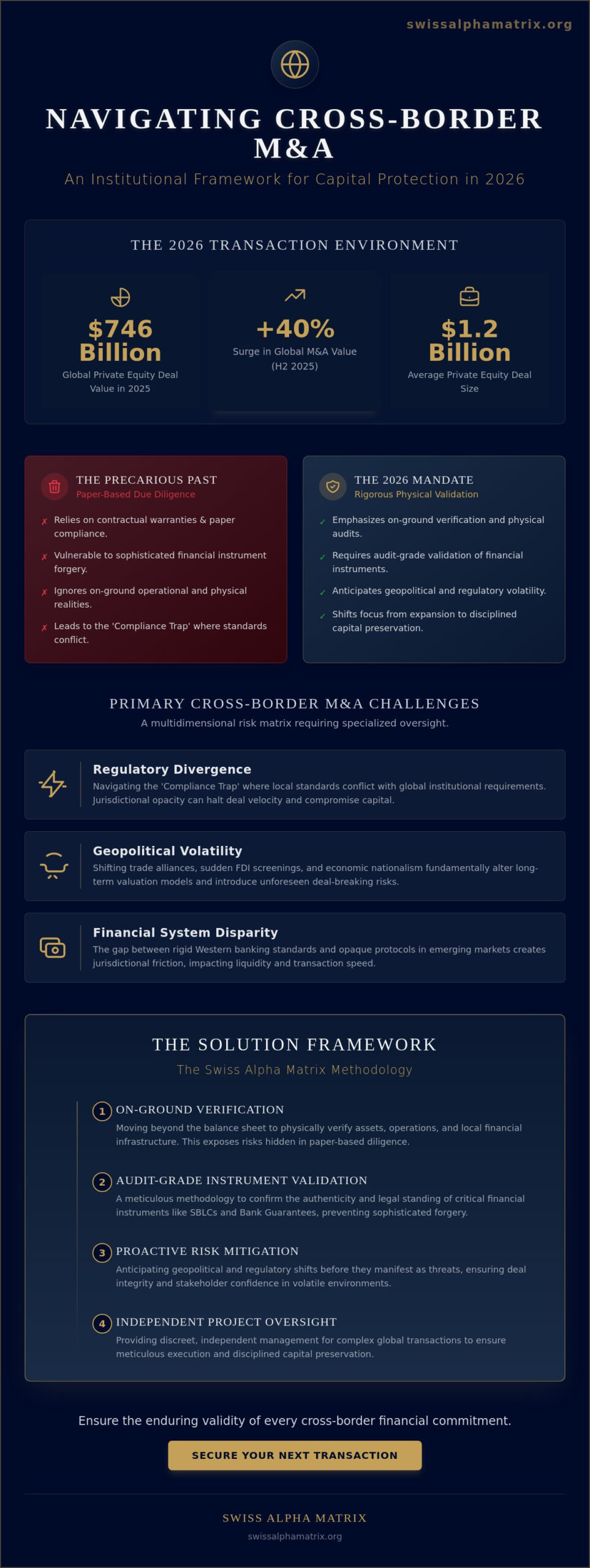
The traditional reliance on purely legalistic due diligence has become a precarious strategy for the modern institutional investor, as the true integrity of a transaction often resides far beyond the reach of standard contractual warranties. In 2026, the most successful global acquisitions are those that move past mere paper compliance to embrace a rigorous model of physical and financial validation. You understand that the inherent cross-border m&a challenges, particularly regarding jurisdictional regulatory opacity and the verification of foreign financial instruments, require a level of scrutiny that transcends conventional advisory roles. It’s clear that as global private equity deal values reached $746 billion in 2025, the complexity of these international maneuvers has only intensified.
This article provides an executive-level analysis of the structural and operational hurdles currently defining the market, from the updated HSR Act filing threshold of $133.9 million to the permanent 12.6% GILTI tax rate under the One Big Beautiful Bill Act. We’ll explore a robust framework for capital protection that emphasizes on-ground verification and audit-grade instrument validation. By the conclusion, you’ll possess a strategic methodology designed to minimize post-merger integration friction and ensure the enduring validity of every cross-border financial commitment.
Key Takeaways
- Learn how to navigate the ‘Compliance Trap’ where local standards conflict with global institutional requirements, ensuring that regulatory divergence doesn’t compromise deal velocity.
- Identify the critical vulnerabilities within paper-based due diligence and the specific on-ground verification protocols required to expose sophisticated financial instrument forgery.
- Acquire a step-by-step methodology for audit-grade instrument validation to ensure the authenticity of SBLCs and bank guarantees within high-stakes international mandates.
- Establish a robust institutional framework to mitigate the primary cross-border m&a challenges of 2026, shifting your strategy from opportunistic expansion to disciplined capital preservation.
- Discover the Swiss Alpha Matrix Methodology for independent financial project management, designed to provide meticulous oversight and discretion for the most complex global transactions.
The Structural Complexity of Cross-Border M&A in 2026
The global transaction environment of 2026 is defined by a fundamental pivot from the opportunistic expansionism seen in previous years toward a disciplined philosophy of strategic capital preservation. While the second half of 2025 witnessed a 40% surge in global M&A value, the current climate demands a more nuanced appreciation of the structural friction inherent in multi-jurisdictional deal flow. We view cross-border m&a challenges not as isolated obstacles to be cleared, but as a multidimensional risk matrix where financial, regulatory, and operational variables intersect with varying degrees of volatility. The average private equity deal size has climbed to $1.2 billion, a figure that leaves little margin for the structural oversights that often plague complex international transitions.
Sophisticated institutional entities now recognize that successful capital deployment requires an independent advisory perspective capable of dissecting intricate deal structures across disparate legal systems. This shift is necessitated by the increasing involvement of Western governments in sectors critical to national security, such as energy and critical minerals. Relying on standard templates is no longer sufficient when the underlying financial architectures of the participating nations are in a state of flux. To protect institutional interests, a rigorous framework must be applied to ensure that every layer of the transaction reflects the physical and financial reality of the target asset.
The Divergence of Global Financial Systems
The widening gap between Western banking standards and the protocols utilized in emerging markets represents a significant hurdle for liquidity and transaction speed. While developed markets adhere to rigid institutional-grade reporting, emerging economies often operate under localized monetary policies that can abruptly shift, impacting the immediate availability of capital. Jurisdictional friction occurs when the mechanisms for capital deployment in one territory lack the transparency or legal recognition required by the compliance frameworks of another. This divergence necessitates a granular approach to operational due diligence that moves beyond the balance sheet to examine the actual plumbing of the local financial environment.
Geopolitical Volatility and Deal Integrity
Shifting trade alliances and the rise of economic nationalism have fundamentally altered long-term valuation models for cross-border mergers and acquisitions. What was once a stable corridor for investment may now be subject to sudden foreign direct investment (FDI) screening or antitrust scrutiny, particularly as the EU Foreign Subsidies Regulation (FSR) maintains its €500 million turnover notification threshold. Managing stakeholder expectations during these periods of regulatory uncertainty requires a dedication to cross-border investment due diligence that prioritizes the integrity of the deal over its velocity. These cross-border m&a challenges are best mitigated through a proactive risk management framework that anticipates geopolitical shifts before they manifest as terminal threats to the transaction’s success.
Regulatory Divergence and the Burden of Compliance
The acceleration of global capital movement has been met with a parallel intensification of oversight, creating a landscape where deal velocity is often secondary to the rigors of institutional scrutiny. The evolution of international financial regulations has transformed the compliance function from a checklist into a strategic pillar. In 2026, the ‘Compliance Trap’ represents a significant risk for the unwary investor, occurring when local operational standards in a target jurisdiction fail to meet the stringent requirements of global institutional frameworks. These cross-border m&a challenges aren’t merely administrative; they’re structural impediments that can lead to terminal capital stagnation if not addressed through a dedicated regulatory compliance advisory partner.
Adherence to Financial Action Task Force (FATF) and OECD standards is no longer a passive requirement but an active component of risk mitigation. These frameworks dictate the flow of cross-border capital, and any deviation can trigger profound counterparty risk. We view regulatory oversight as a protective mechanism that ensures the integrity of the transaction, rather than a hurdle to be bypassed. By aligning local execution with global institutional standards, we provide a sense of inevitable logic to the transaction process, fostering confidence among stakeholders who prioritize long-term stability over short-term gains.
Anti-Money Laundering (AML) and KYC Evolution
The identification of the Ultimate Beneficial Owner (UBO) has reached an unprecedented level of complexity, as corporate structures become more opaque and digital asset regulations begin to permeate traditional M&A. Standardizing documentation across disparate regulatory regimes requires a meticulous attention to detail that standard legal due diligence often overlooks. The emergence of sophisticated digital asset frameworks now influences how traditional entities are vetted, necessitating a standard of verification that accounts for both legacy and modern financial instruments. This evolution demands a performance-oriented mindset that refuses to oversimplify the intricate nature of global identity verification.
Jurisdictional Legal Nuances
The fundamental distinction between Civil Law and Common Law jurisdictions continues to create friction in the negotiation of indemnification and confidentiality clauses. These legal challenges in cross-border M&A often manifest as a ‘Strategy Gap’ between the expectations of global headquarters and the realities of local execution. Navigating these nuances requires more than just an understanding of the law; it demands an institutional framework that can bridge the divide between diverse legal philosophies. By maintaining a measured and logical pace throughout the transaction lifecycle, we ensure that the specific legal requirements of each territory are integrated into the broader strategic architecture without compromising the deal’s overall integrity or the protection of the client’s interests. This disciplined approach is essential for managing the cross-border m&a challenges that arise when localized execution meets global standards.
The Fallacy of Paper-Based Due Diligence
Reliance on standard audit reports, while a foundational requirement for any transaction, presents a precarious veneer of security that often fails to account for the physical and operational friction inherent in international markets. In the context of 2026, where sophisticated financial instrument forgery has become increasingly prevalent in emerging economies, the assumption that a desk-based review is sufficient for risk mitigation is a dangerous oversight. While a “Big 4” audit provides a necessary layer of accounting accuracy, it’s frequently constrained by the scope of the engagement and the quality of data provided by the target entity. True institutional rigor requires a clear distinction between the legal existence of an asset and its actual operational viability. These cross-border m&a challenges demand a transition from passive document review to active, empirical validation of the underlying reality.
The mastery of global acquisitions depends on an advisory’s ability to see past the curated narrative of a digital data room. Standard reports may confirm that a bank guarantee exists on paper, but they rarely verify the standing of the issuing branch or the liquidity of the underlying instrument in a distressed scenario. We prioritize a standard of service that is meticulous in its attention to detail, ensuring that capital is never committed to a transaction based on unverified representations. This disciplined approach distinguishes a performance-oriented mindset from those who merely facilitate the movement of paper.
The Limitations of Remote Verification
Digital data rooms provide a convenient repository for documentation, yet they remain insufficient for high-stakes capital protection because they can’t verify the physical condition or even the existence of asset-heavy holdings. On-ground verification services are essential to bridge the gap between digital claims and physical truth, particularly in jurisdictions where public records may be unreliable or subject to local influence. Physical on-site inspection serves as the only definitive antidote to document-based fraud, ensuring that the assets described in the prospectus are both present and functional.
Operational Due Diligence Beyond the Balance Sheet
Operational due diligence must extend beyond the balance sheet to evaluate the integrity of human capital and the resilience of local supply chains within a fragmented global economy. This level of scrutiny involves assessing the institutional culture and the ethical standards of key personnel to ensure long-term alignment with the acquiring entity’s values. Integrating specific financial advisory methodologies allows for a higher degree of operational transparency, exposing hidden liabilities that standard audits might miss. By addressing these cross-border m&a challenges with a master planner’s precision, an organization can secure its interests against the sophisticated deceptions that often thrive in the shadows of international commerce.
A Framework for Audit-Grade Instrument Validation
The structural integrity of an international transaction is fundamentally tethered to the authenticity of the financial instruments that facilitate it, yet this remains one of the most overlooked cross-border m&a challenges in contemporary deal-making. As we established in previous discussions regarding the fallacy of paper-based due diligence, the transition from passive acceptance of financial representations to an active, forensic validation of those instruments is non-negotiable for the institutional investor. We employ a rigorous bank instrument validation services methodology that prioritizes the technical examination of Standby Letters of Credit (SBLCs), Documentary Letters of Credit (LCs), and bank guarantees. This institutional framework ensures that the capital commitments underpinning a deal are not only legally existent but financially enforceable and free from the taint of sophisticated third-party fraud.
Independent oversight provides a layer of capital deployment precision that standard advisory roles often lack, particularly when navigating the intricate financial architectures of 2026. By removing the emotional urgency of the transaction, we focus on the quiet authority of empirical data, ensuring that every instrument is vetted against global institutional standards. This disciplined approach serves to protect the transaction from the rising tide of sophisticated forgery that thrives in the gaps between disparate regulatory regimes, providing a sense of inevitable logic to the final closing process.
The Technical Process of Verification
Precision in capital deployment is achieved through the utilization of secure institutional channels for instrument authentication, moving beyond the surface-level verification typically provided by standard legal counsel. Our methodology involves cross-referencing bank commitments directly with the actual institutional capacity of the issuing entity, ensuring that the financial backing is as robust as the documentation suggests. This technical scrutiny often reveals discrepancies in asset-to-liability ratios or jurisdictional restrictions that could impede the instrument’s liquidation. For executive stakeholders, audit-grade reporting provides the necessary empirical data to make informed decisions, transforming a speculative venture into a structured, logical progression toward closing.
Mitigating Transactional Counterparty Risk
Developing a multi-layered risk management framework is essential for international deals where the traditional protections of one’s home jurisdiction may not apply. This framework extends to ensuring the absolute validity of escrow arrangements and collateralization, which are often the first points of failure in complex mandates. Independent verification isn’t merely a tactical advantage; it’s a fundamental support for the fiduciary duties of the board, providing a documented trail of due diligence that protects against claims of negligence. By establishing an unwavering standard for instrument integrity, you’re not just closing a deal; you’re preserving the long-term character and stability of your institution’s capital. Secure your transaction’s foundation by engaging with our Audit-Grade Instrument Validation experts to ensure your cross-border m&a challenges are met with technical precision.
Institutional Project Oversight: The Swiss Alpha Matrix Methodology
The final resolution of intricate global mandates requires a synthesis of Swiss discretion and institutional-grade financial discipline, a combination that transcends the capabilities of traditional transactional advisory. We believe that true success in international transactions isn’t merely found in the signing of a contract, but in the meticulous oversight of the entire project lifecycle. The necessity of independent financial project management becomes evident when one considers the sheer volume of variables involved in a multi-jurisdictional deal. By positioning ourselves as a dedicated partner rather than a mere service provider, we ensure that the long-term preservation of capital remains the primary objective, effectively mitigating the inherent cross-border m&a challenges that often derail less disciplined pursuits.
Our approach is informed by the transactional intelligence of former Tier-1 bank executives who possess an intimate understanding of the internal mechanics of global finance. This level of expertise allows for a more profound analysis of risk, moving beyond surface-level compliance to address the underlying operational and financial realities. It’s a philosophy rooted in historical reliability and regional precision, where the character of the transaction is as important as its valuation. This methodology ensures that every strategic pillar is aligned with the broader goal of stability and growth, providing a sense of professional calm that encourages confidence in the most complex decision-making processes. We don’t just facilitate transactions; we protect the institutional legacy of our clients through a standard of service that is both broad in reach and meticulous in its attention to detail.
Precision in Execution
Managing complex project lifecycles across multiple time zones and jurisdictions requires the steady hand of a Master Planner. We focus on ensuring that deal milestones are met with absolute accuracy, reducing institutional exposure through unemotional, expert-led oversight. This measured rhythm of communication ensures that stakeholders are informed of progress without the frantic energy often associated with high-stakes M&A. By maintaining a logical flow from broad principles to specific strategic execution, we navigate the cross-border m&a challenges of a fragmented global economy with a standard of excellence that distinguishes a performance-oriented mindset from passive participation.
The Value of Executive-Level Intelligence
Translating complex jurisdictional risks into actionable executive insights is the hallmark of sophisticated project oversight. We provide the ‘Audit-Grade’ confidence required for high-value capital deployment, ensuring that every financial commitment is backed by verifiable truth. This standard of excellence is designed for a specific caliber of audience that values nuance, thoroughness, and a high level of professional competence. To secure the integrity of your next international mandate and ensure your interests are in the hands of seasoned experts, Engage Swiss Alpha Matrix for specialized cross-border project management and experience a partnership defined by exclusivity and intellectual superiority.
Securing the Future of Institutional Capital Deployment
The transition from speculative expansion to disciplined capital preservation in 2026 requires more than a standard advisory approach, as it demands a rigorous commitment to the physical and financial validation of every transaction pillar. By moving beyond the limitations of remote verification and addressing the inherent cross-border m&a challenges through audit-grade protocols, institutional investors ensure that their mandates are executed with absolute precision. This framework, rooted in the verification of on-ground realities and the technical authentication of bank instruments, provides the stability necessary to navigate a fragmented global economy with confidence. It’s a methodology that prioritizes the enduring character of your capital over the fleeting velocity of the deal.
Our methodology, managed by former Tier-1 global bank executives, merges Swiss-standard discretion and precision with the high-level standard of service required for complex mandates. We provide the unemotional expertise and audit-grade validation protocols that transform a high-risk venture into a structured, logical progression toward long-term growth. To ensure your interests are protected by a master planner’s precision, Secure Your Global Capital Deployment with Swiss Alpha Matrix. We look forward to establishing a dedicated partnership that prioritizes the strategic integrity and long-term preservation of your capital.
Frequently Asked Questions
What are the most common regulatory challenges in cross-border M&A?
The primary regulatory hurdles involve navigating disparate antitrust thresholds and the increasing intensity of national security screenings. In 2026, the HSR Act’s minimum transaction threshold rose to $133.9 million, necessitating a granular understanding of filing requirements. These hurdles are compounded by the EU Foreign Subsidies Regulation, which mandates notifications for targets with turnovers reaching €500 million.
How does on-ground verification differ from standard financial due diligence?
On-ground verification involves the physical inspection of tangible assets and the direct vetting of operational personnel to confirm that the physical reality aligns with the digital prospectus. Standard financial due diligence typically relies on the remote review of digital data rooms and ledger entries provided by the target. This empirical approach is essential for exposing discrepancies that digital records can easily obscure.
Why is bank instrument validation critical for international transactions?
Validation ensures that the financial instruments underpinning a transaction, such as SBLCs or bank guarantees, are authentic, liquid, and issued by institutions with the actual capacity to honor them. It’s a critical defense against the sophisticated forgery that has become increasingly prevalent in emerging markets. Without this technical scrutiny, an institution risks committing capital to a deal supported by unenforceable financial commitments.
What role does cultural intelligence play in cross-border M&A negotiations?
Cultural intelligence facilitates the navigation of negotiation styles and decision-making hierarchies that vary significantly across geographic regions. It serves as a necessary bridge between diverse institutional standards, preventing the friction that often leads to deal fatigue or misunderstandings. Understanding these nuances allows a master planner to maintain a measured, logical pace while respecting the regional precision required for successful integration.
How can firms mitigate the risk of financial fraud in emerging markets?
Mitigating fraud requires a multi-layered risk management framework that prioritizes operational due diligence over simple paper-based audits. Firms should employ on-ground verification services to cross-reference local claims with physical evidence and institutional standing. This disciplined approach addresses the core cross-border m&a challenges by ensuring that every layer of the transaction is vetted by seasoned, unemotional experts.
What is the importance of independent project oversight in complex deals?
Independent oversight provides a neutral layer of discipline that ensures deal milestones are met without the emotional urgency often felt by the primary parties. It allows for meticulous project management across multiple time zones and jurisdictions, ensuring no detail is overlooked. This level of scrutiny protects the fiduciary interests of the board by providing an objective trail of due diligence throughout the project lifecycle.
Can standard legal counsel handle all cross-border M&A challenges?
Legal counsel is essential for contractual architecture; however, they often lack the technical capacity for audit-grade instrument validation or on-ground operational vetting. Specialized advisors are required to bridge the gap between legal theory and the physical operational reality of the target. Addressing the full spectrum of cross-border m&a challenges requires a synthesis of legal expertise and institutional-grade financial intelligence.
How do jurisdictional differences impact post-merger integration?
Jurisdictional differences manifest in conflicting labor laws, reporting standards, and corporate governance requirements that can cause significant post-deal friction. For instance, the permanent 12.6% GILTI tax rate under the One Big Beautiful Bill Act necessitates precise tax structuring from the outset. Failure to harmonize these disparate systems early leads to operational inefficiencies and potential regulatory non-compliance that can erode the deal’s long-term value.