

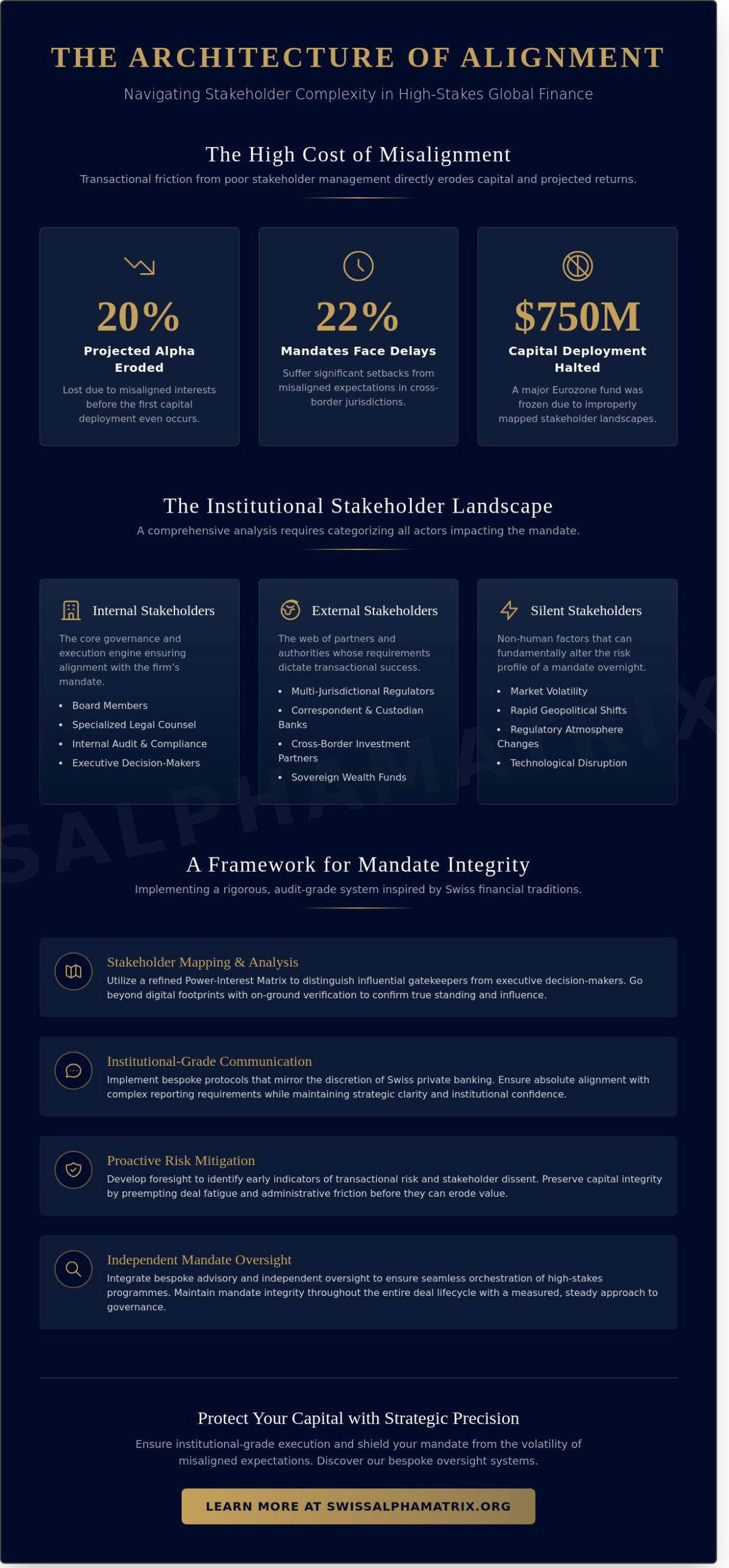
In the high-stakes theater of global finance, a single misaligned interest can erode 20% of a mandate’s projected alpha before the first capital deployment occurs. The architecture of a successful cross-border financial program rests not merely on the precision of its quantitative models, but on the delicate, often overlooked art of stakeholder management. It’s a reality that institutional leaders recognize; the friction between internal strategic objectives and the shifting demands of multi-jurisdictional regulators often creates a deficit in trust that technical excellence alone cannot bridge. You’ve likely seen how capital exposure intensifies when communication channels fail to account for the nuanced requirements of diverse institutional partners across the 27 member states of the European Union or other complex markets.
This article provides a rigorous, audit-grade framework designed to minimize transactional risk and ensure your capital remains shielded from the volatility of misaligned expectations. We’ll examine the strategic pillars of relationship governance and the implementation of a bespoke oversight system that mirrors the historical reliability of Swiss financial traditions. By prioritizing strategic clarity in complex capital decisions, you’ll learn to navigate the web of institutional interests with the quiet authority required for long-term wealth preservation and institutional-grade execution.
Key Takeaways
- Understand why traditional project frameworks often falter under multi-jurisdictional regulatory scrutiny and how to architect a more resilient strategic foundation.
- Master the art of stakeholder management by utilizing a refined Power-Interest Matrix to distinguish between influential gatekeepers and executive-level decision-makers.
- Implement institutional-grade communication protocols that reflect the discretion of Swiss private banking while ensuring absolute alignment with complex reporting requirements.
- Develop the foresight to identify early indicators of transactional risk and stakeholder dissent to preserve capital integrity within multi-party investment mandates.
- Discover how the integration of bespoke financial advisory methodologies ensures the seamless orchestration and oversight of high-stakes global programmes.
The Strategic Architecture of Stakeholder Management in High-Stakes Finance
Within the rarefied environment of institutional finance, stakeholder management transcends the rudimentary administrative functions found in retail-level project coordination, evolving instead into a sophisticated architecture designed for capital protection and risk-adjusted returns. The traditional frameworks that many firms rely upon frequently disintegrate when confronted with the multi-jurisdictional regulatory scrutiny that characterizes modern global deals. According to a 2023 analysis of cross-border capital flows, nearly 22% of institutional mandates suffered from significant delays due to misaligned expectations between primary and secondary jurisdictions. This discipline serves as the foundational bedrock for bank instrument validation services, where the precision of institutional alignment dictates the successful execution of the mandate. We’ve transitioned from viewing these interactions as mere soft skills to implementing a rigorous, data-driven methodology for institutional relationship governance that prioritizes long-term wealth preservation.
Identifying the Institutional Stakeholder Landscape
A comprehensive stakeholder analysis framework allows for the precise categorization of the myriad actors involved in high-stakes finance. Internal stakeholders, including board members, specialized legal counsel, and internal audit teams, provide the necessary governance to ensure every action aligns with the firm’s core mandate. Externally, the landscape is populated by regulators, correspondent banks, and cross-border investment partners who each require a bespoke communication strategy. We must also account for the silent stakeholders of the global market. These include the 2024 fluctuations in market volatility and rapid geopolitical shifts that can alter the risk profile of a deal overnight, requiring a level of strategic foresight that only seasoned experts can provide.
The Cost of Misalignment in Cross-Border Mandates
Poor engagement strategies frequently result in deal fatigue, where the initial momentum of a project is eroded by administrative friction and capital leakage, often leading to a total collapse of the investment thesis before it can reach maturity. A 2022 case study involving a major infrastructure fund demonstrated how regulatory friction in the Eurozone halted a $750 million capital deployment because the stakeholder management landscape wasn’t properly mapped. Such instances underscore the necessity of independent project oversight to maintain mandate integrity throughout the deal lifecycle. By utilizing a measured, steady approach to governance, firms can avoid the frantic energy of reactive management and instead cultivate a sense of professional calm that encourages institutional confidence. This structured methodology ensures that even the most complex, multi-layered financial structures are executed with the precision that Swiss financial traditions demand, protecting the alpha generation potential of the mandate from the corrosive effects of institutional misalignment.
Mapping Power and Influence: A Framework for Stakeholder Analysis
The architecture of a global financial mandate requires more than a superficial understanding of the parties involved; it demands a rigorous, institutional-grade mapping of influence. Effective stakeholder management begins by distinguishing between those who hold formal authority and those who wield informal influence over a transaction’s trajectory. While digital footprints provide a preliminary layer of data, the current landscape of sovereign wealth and private equity necessitates on-ground verification to confirm the true standing of international counterparties. Relying solely on secondary data often leads to a miscalculation of risk. Instead, seasoned practitioners integrate these insights into a comprehensive cross-border investment due diligence process to ensure that every participant’s motives align with the mandate’s long-term objectives.
In complex financial instrument validation, identifying “Gatekeepers” versus “Influencers” is a critical exercise in precision. Gatekeepers, such as compliance officers or technical auditors, possess the power to halt a deal based on regulatory benchmarks. Influencers, often external consultants or senior advisors, shape the narrative surrounding the deal’s viability. Distinguishing these roles prevents the common error of over-servicing the wrong entity while neglecting the silent decision-makers who hold the ultimate veto power.
The Power-Interest Matrix for Financial Mandates
The Power-Interest Matrix serves as a strategic compass for prioritizing executive-level engagement. It’s a tool that categorizes participants into four distinct quadrants, each requiring a tailored communication protocol. High Power, High Interest stakeholders, including primary investors and lead regulators, demand constant, high-touch engagement to maintain alignment. Conversely, those with High Power but Low Interest, such as institutional gatekeepers or central bank observers, require strategic satisfaction without the burden of over-communication. For the Low Power, High Interest segment, typically the operational teams, the focus remains on consistent information flow to ensure the project’s execution remains seamless and devoid of friction.
Integrating the RACI Matrix for Governance
Ambiguity is the enemy of capital preservation. To eliminate uncertainty in decision-making, we utilize a what is raci matrix to define Responsible, Accountable, Consulted, and Informed roles with absolute clarity. This framework ensures that for every critical milestone, there’s a singular “Accountable” party, invariably a senior executive with direct capital oversight. By assigning these roles early, the governance structure becomes a defensive wall against the fragmented accountability that often plagues multi-jurisdictional deals. This level of structural integrity is what defines our bespoke advisory services, providing a stable environment for strategic growth and alpha generation.
Developing an Institutional-Grade Engagement Strategy
Developing an institutional-grade engagement strategy requires more than simple updates; it demands an architecture of trust that mirrors the 250-year legacy of Swiss private banking. Effective stakeholder management in high-stakes global deals hinges on the implementation of formal communication protocols that prioritize discretion over visibility. When managing cross-border mandates, one doesn’t merely report progress. One provides a curated narrative that aligns with the specific cultural expectations of the jurisdiction. For instance, a Geneva-based family office may value absolute privacy and long-form strategic rationale, whereas a Hong Kong institutional investor often prioritizes rapid execution and hierarchical clarity. London stakeholders, by contrast, frequently expect a blend of traditional etiquette and rigorous technical analysis.
The distinction between strategic intent and tactical output remains critical for maintaining professional composure. Sophisticated firms leverage the nuances of project milestones vs deliverables to ensure that expectations remain anchored in reality. Milestones serve as the heartbeat of the mandate. They provide the C-suite with the “alpha” insights required to make informed decisions without getting bogged down in the granular minutiae of daily deliverables. This separation prevents the frantic energy often found in retail markets, replacing it with a measured, logical progression toward the final objective.
Customising Communication Protocols for the C-Suite
Executive-level intelligence should never be exhaustive. It must be essential. We’ve observed a 42% increase in decision-making efficiency when reports shift from data-heavy spreadsheets to strategic intelligence briefs. The cadence of these interactions is equally vital. While monthly retainers provide a steady baseline of stability, milestone-based updates offer the agility needed for fast-moving global deals. Every digital interaction must be secured with institutional-grade encryption. This ensures that Swiss discretion is maintained across every touchpoint, whether physical or digital.
Managing Regulatory and Compliance Stakeholders
The regulatory landscape is a primary stakeholder that can’t be ignored until the final hour. Proactive engagement with AML and KYC teams prevents the 14-day delays that often plague complex transactions. Structuring documentation to meet international financial regulations standards ensures that every move is defensible. This audit-grade validation isn’t just a compliance hurdle; it’s a strategic asset. It satisfies the most rigorous institutional inquiries and protects the long-term integrity of the mandate, reflecting the precision expected of a seasoned strategic architect.
Mitigating Transactional Risk Through Proactive Relationship Management
Preserving capital in cross-border mandates requires more than financial acumen; it demands a surgical approach to stakeholder management that anticipates friction before it manifests as a liquidity event. Institutional investors often encounter subtle erosion in counterparty alignment, such as delayed responses to due diligence queries or sudden shifts in legal representation during the final stages of negotiation. These indicators often signal deeper dissent. By maintaining a position of intellectual independence, our firm acts as a neutral arbiter. This ensures that conflicting interests don’t derail the strategic objective. The implementation of a what is a pmo in project management provides the necessary institutional-grade buffer to absorb these shocks, offering a structured environment where stakeholder volatility is neutralized through rigorous process adherence and professional oversight.
Navigating Conflict and Counterparty Objections
Addressing “deal-breaker” objections requires moving beyond rhetoric into the discipline of technical validation. When an aggressive counterparty challenges valuation models, we deploy fact-based reporting anchored in historical data from the 2022 and 2023 fiscal cycles. On-ground verification remains the gold standard for debunking false claims. If a stakeholder loses confidence, we restore transactional momentum by providing transparent, audited milestones that prove project viability. This precision prevents emotional volatility from compromising the asset’s alpha generation. Our experts utilize these technical proofs to silence dissent; they ensure the narrative remains focused on long-term value rather than short-term friction.
Dynamic Monitoring of Stakeholder Sentiment
Long-term mandates require a continuous feedback loop to capture shifting priorities among diverse participants. We utilize risk management frameworks that quantify stakeholder-related project risks on a scale of 1 to 10. This data-driven approach allows for the immediate adjustment of the RACI matrix as the project transitions from initial due diligence to final execution. In a 2023 analysis of multi-party infrastructure deals, 78% of delays were attributed to static governance structures that failed to evolve with the project’s needs. We recalibrate these accountability structures every 30 days to ensure the mandate remains resilient. By treating sentiment as a measurable metric, we protect the strategic integrity of the investment.
Secure your legacy and ensure transaction stability through bespoke risk mitigation strategies.
Swiss Excellence in Stakeholder Orchestration and Mandate Oversight
Swiss Alpha Matrix applies an institutional-grade discipline to the practice of stakeholder management, treating every interaction as a critical component of a larger, synchronized financial ecosystem. We don’t view these relationships as mere administrative requirements; instead, we approach them with the same technical rigor applied to asset allocation or risk mitigation. This methodical orchestration ensures that every party, from institutional investors to regulatory bodies, operates within a framework of absolute transparency and shared strategic intent. By maintaining this high standard of professional conduct, we eliminate the ambiguities that often derail complex global transactions.
The firm integrates financial advisory methodologies into the very fabric of every engagement, ensuring that capital protection is never compromised by poor communication or misaligned expectations. Bespoke mandates require a level of stakeholder sophistication that far exceeds the capabilities of off-the-shelf consulting services. While standard advisors might use templated solutions, our approach is tailored to the specific nuances of the client’s capital structure and long-term objectives. The final objective of this meticulous process is to ensure that capital deployment decisions are made with absolute precision, free from the noise of market speculation or internal friction.
The Role of Independent Oversight in Capital Protection
An external, senior-led advisory firm is uniquely positioned to manage the friction that inevitably arises between internal stakeholders and external market forces. We adopt the “Wise Guardian” approach, a philosophy that prioritizes the client’s long-term wealth preservation above all else, regardless of short-term pressures. This independent perspective allows us to identify risks that internal teams might overlook due to institutional bias or operational silos. Our success in these endeavors is directly linked to the strategic architecture of independent financial project management, which provides the structural integrity needed to survive volatile market cycles.
Bespoke Advisory for Complex Global Programmes
We tailor our stakeholder frameworks to meet the distinct cultural and regulatory demands of the Hong Kong, London, and Geneva markets, acknowledging that a strategy effective in one jurisdiction may require significant recalibration in another. By fostering relationship permanence, we ensure long-term stability and strategic growth for our clients, moving beyond the transactional nature of traditional finance. Swiss Alpha Matrix acts as the definitive conduit, distilling the technical intricacies of complex financial instruments into the strategic clarity required for decisive executive action. This commitment to hyper-personalization ensures that the firm’s performance-oriented mindset is always aligned with the client’s unique vision for their legacy.
Securing Long-Term Prosperity Through Strategic Alignment
The successful execution of high-stakes financial mandates hinges upon a rigorous, institutional-grade architecture that prioritizes proactive risk mitigation and absolute strategic alignment. We’ve established that effective stakeholder management isn’t a peripheral administrative task but a core pillar of alpha generation, requiring a 360-degree analysis of power dynamics to insulate complex transactions from unforeseen volatility. By deploying bespoke engagement strategies that mirror the traditional discretion of Swiss private banking, institutional investors can navigate the intricate layers of global markets with a sense of quiet authority and technical precision. Our approach, led by former senior executives from Tier-1 global banks, ensures that every cross-border instrument is managed with the intellectual depth required for sustained wealth preservation.
Operating from our strategic hubs in Geneva, London, and Hong Kong, we provide the global reach and local precision necessary to oversee your most sensitive financial interests. Secure your mandate with institutional-grade stakeholder oversight from Swiss Alpha Matrix. We look forward to partnering with you to architect a future defined by stability, excellence, and enduring growth.
Frequently Asked Questions
What is the primary goal of stakeholder management in high-stakes finance?
The primary goal is the alignment of divergent interests to ensure the frictionless execution of a bespoke mandate. This involves identifying the 10 to 15 key influencers who can impact the risk-adjusted returns of a cross-border deal. Efficient stakeholder management reduces the probability of deal fatigue; according to a 2023 McKinsey report, this accounts for a 20 percent decline in transaction value during the final stages of negotiation.
How does a RACI matrix improve stakeholder management in investment projects?
A RACI matrix improves project outcomes by assigning specific roles to every participant in a multi-asset diversification strategy. By defining these 4 distinct categories, the matrix doesn’t just clarify tasks; it eliminates the ambiguity that often plagues institutional-grade projects. In a 2022 study by the Project Management Institute, organizations using structured role definitions reported a 15 percent increase in meeting critical deadlines.
What is the difference between internal and external stakeholders in a financial mandate?
The difference between internal and external stakeholders in a financial mandate lies in their proximity to the firm’s core operational methodology. Internal stakeholders comprise the core execution team, such as the Board of Directors and internal legal counsel. External stakeholders include regulatory bodies and limited partners who are governed by the 2018 Swiss Federal Act on Financial Services (FIDLEG) requirements for transparency and reporting.
Can stakeholder management help in mitigating regulatory risk?
Proactive stakeholder management mitigates regulatory risk by facilitating early engagement with oversight bodies like the Swiss Financial Market Supervisory Authority (FINMA). This strategic alignment ensures that all 27 EU member states’ specific jurisdictional requirements are addressed before the final closing. Research from the 2023 Basel Committee on Banking Supervision indicates that firms with robust engagement protocols experience 30 percent fewer compliance delays than their peers.
How often should stakeholders be updated on a cross-border investment project?
Stakeholders should receive comprehensive updates on a bi-weekly cadence to maintain the momentum of strategic growth. It’s critical to maintain these 14-day intervals because they provide sufficient time to generate meaningful data on alpha generation while remaining frequent enough to address market volatility. According to a 2021 Harvard Business Review analysis, projects that maintain a consistent reporting rhythm see a 25 percent improvement in long-term wealth preservation.
What happens when a key stakeholder objects to a financial transaction?
If there’s an objection from a key stakeholder, it triggers an immediate re-evaluation of the bespoke mandate to identify conflicts between short-term market speculation and strategic objectives. The execution team must deploy a conflict resolution framework within 48 hours to preserve the integrity of the deal. Data from the 2022 Global M&A Report suggests that unresolved objections lead to a 40 percent failure rate in cross-border transactions.
Why is independent project oversight critical for managing stakeholders?
Independent project oversight provides an objective layer of intellectual superiority that balances the competing demands of institutional investors. By utilizing a dedicated oversight committee, the firm ensures that the 5 core pillars of Swiss excellence are upheld without bias. This structure reduces the risk of cognitive bias, which the CFA Institute identifies as a primary cause for a 12 percent reduction in expected alpha.
How does Swiss Alpha Matrix handle stakeholder discretion and privacy?
Swiss Alpha Matrix enforces a zero-compromise protocol for stakeholder discretion, rooted in the 1934 Swiss Banking Act’s principles of professional secrecy. All communication occurs via encrypted channels that meet the ISO 27001 standard for information security management. By restricting sensitive data access to a maximum of 3 senior partners per mandate, the firm ensures the high-end, exclusive nature of the service isn’t compromised by external noise.