

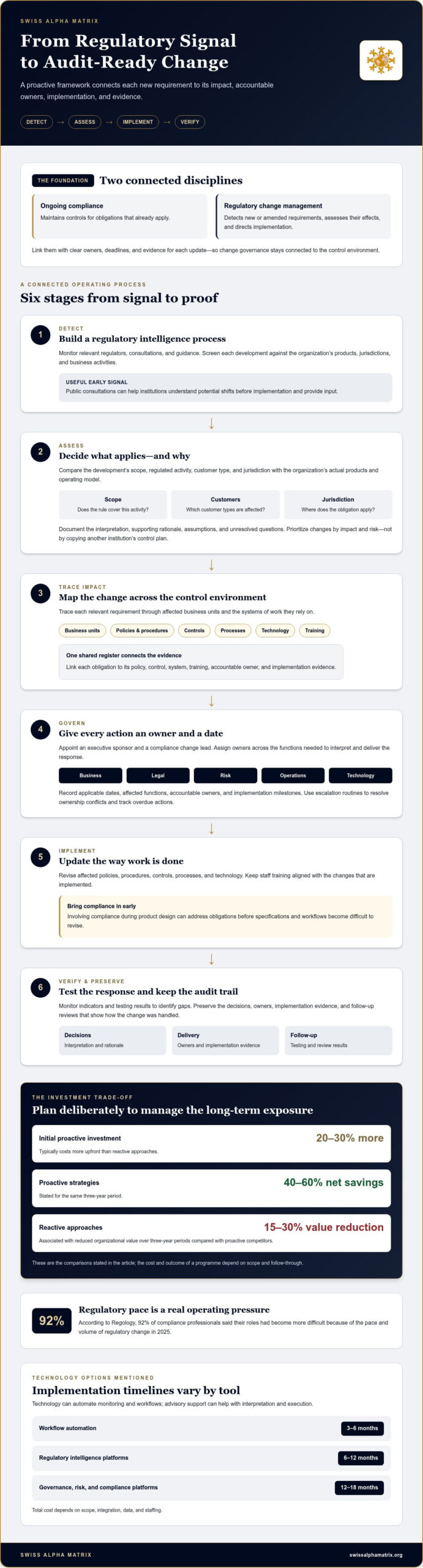
Reactive compliance can cost more over time than a deliberately funded change programme. Comparisons associate reactive approaches with a 15-30% reduction in organisational value over three-year periods, while proactive strategies are stated to deliver net savings of 40-60% over the same period. The trade-off is that initial proactive investment typically costs 20-30% more, making disciplined planning central to managing regulatory changes in finance.
Leaders naturally focus on the visible costs of new controls, training, and implementation. But delayed interpretation, rushed policy changes, and fragmented evidence can add operational and audit burdens. An effective framework directs resources toward obligations with the greatest impact.
This article explains how to establish a proactive change process, assess regulatory developments across jurisdictions, update policies and training, and maintain clear audit trails with accountable owners. It also shows how risk management and operational due diligence can support complex financial programmes, making regulatory change a controlled business discipline rather than a recurring emergency.
Key Takeaways
- Separate ongoing compliance from change management: assign clear ownership for detecting new requirements, assessing their effects, and implementing responses.
- Trace each relevant change through affected business units, policies, controls, processes, and technology before deciding how to respond.
- Keep procedures and staff training aligned with implemented changes, then monitor indicators and testing results to identify gaps that need attention.
- For cross-border operations, map overlapping obligations by jurisdiction and business activity so local requirements remain visible within a coherent control framework.
- Maintain an audit trail that records decisions, accountable owners, implementation evidence, and follow-up reviews.
1. How Do You Build a Proactive Regulatory Change Management Framework?
Compliance management maintains controls for existing obligations. Regulatory change management detects new or amended requirements, assesses their effects, and directs implementation. A practical framework links both disciplines: compliance defines the control environment, while change governance assigns owners, deadlines, and evidence for each update. According to Regology, 92% of compliance professionals said their roles had become more difficult because of regulatory change’s pace and volume in 2025.
Begin with a defined intelligence process. Monitor relevant regulators, consultations, and guidance, then screen each development against products, jurisdictions, and business activities. The Office of the Comptroller of the Currency listed change management over significant operational changes among its bank supervision strategies for 2021. Public consultations also give institutions an opportunity to provide input and understand potential shifts before implementation.
Available tools include regulatory intelligence platforms, workflow automation software, and broader governance, risk, and compliance platforms. Services can include compliance advisory and implementation support; technology automates monitoring and workflows, while advisory work supports interpretation and execution. Implementation timelines in the market facts are 6-12 months for intelligence platforms, 3-6 months for workflow automation, and 12-18 months for GRC platforms; total cost depends on scope, integration, data, and staffing.
Regulatory examination scope varies with an institution’s size, complexity, risk profile, customer base, and business focus. Banks, credit unions, insurers, and investment firms should map changes to their own products, operations, and applicable obligations, rather than copy another institution’s control plan. Document the reasoning and prioritize changes according to impact and risk.
U.S. financial regulation involves agencies including the Securities and Exchange Commission, Federal Reserve, Office of the Comptroller of the Currency, and Consumer Financial Protection Bureau. The relevant regulator depends on the institution and activity. For example, the CFPB’s Section 1071 rule requires covered financial institutions to collect and report small-business lending data, including applicant demographic information.
Deadlines depend on each rule’s compliance date and the institution’s obligations. For the CFPB’s Section 1071 small-business lending rule, the revised compliance date is January 1, 2028. A change register should record each applicable date, affected function, accountable owner, and implementation milestone.
To coordinate departments, appoint an executive sponsor and a compliance change lead, then assign owners from business, legal, risk, operations, and technology. Use a shared register to connect each obligation to its policy, control, system, training, and evidence. Establish escalation routines to resolve ownership conflicts and track overdue actions.
Proactive compliance requires investment, but comparisons indicate that initial proactive investment typically costs 20-30% more than reactive approaches. Over three-year periods, proactive compliance strategies are stated to deliver net savings of 40-60%; reactive approaches are stated to reduce organizational value by 15-30% over those periods compared with proactive competitors. These figures make implementation scope and sustained follow-through important considerations.
Penalties are only one exposure. A missed obligation can also lead to remediation, examination findings, disrupted operations, and reputational harm. Leadership should review significant changes, resource the response, and monitor unresolved risks; compliance teams should assess obligations, preserve decisions, and test implementation. ISO 37301 provides a framework organizations can use to build compliance and regulatory change systems.
2. How Can Fintech Companies Manage Regulatory Change Effectively?
For fintechs, managing regulatory changes in finance starts with linking new developments to the products and activities they actually operate. A payments platform, for example, should assess relevant changes against its payment services, customer onboarding, transaction workflows, and partner arrangements. Connect each development to business and risk data to separate material obligations from unrelated regulatory noise.
Assess applicability methodically. Compare a rule’s scope, regulated activity, customer type, and jurisdiction with the organization’s products and operating model. When applying older laws to newer business models, fintechs can document their interpretation, supporting rationale, assumptions, and unresolved questions. In managing regulatory changes in finance, involving compliance early in product design can address obligations before specifications and workflows become difficult to revise.
Next, map the affected control environment. Identify policies, procedures, process documentation, risk and control self-assessments, and testing programmes that need revision. A change affecting customer data collection, for example, may touch product screens, staff procedures, data fields, retention controls, and quality testing. Assign an owner to each item, then use oversight meetings to resolve dependencies.
Cross-functional planning turns assessment into an actionable response. Bring compliance, product, engineering, operations, legal, and risk teams together to identify sequencing constraints and agree on decision rights. Prioritize changes by potential impact and risk. For state licensing and reporting obligations, fintechs can maintain a licensing calendar with reminders and templates, and track relevant state agencies.
Assess downstream effects before implementation begins. A revised customer disclosure, for instance, may require coordinated updates to digital interfaces, customer support scripts, approval workflows, and quality assurance. Record each dependency, its owner, evidence requirements, and approval path. A disciplined approach to managing regulatory changes in finance makes policy effects visible across business units, rather than confining analysis to compliance.
Implementation should preserve operational continuity. Use phased releases where appropriate, test revised workflows, and inform affected stakeholders before launch. Testing should establish whether controls work as designed and staff can follow updated processes. If testing reveals gaps, document the remediation, assign responsibility, and retain the decision trail in the change record.
For fintechs managing a complex assessment or coordinating implementation across teams, Regulatory Compliance Advisory can support structured interpretation and execution. The central discipline is to connect each applicable change to its business impact, accountable owner, revised control, and evidence of completion.
3. Policy updates, training, and ongoing monitoring
Regulatory change management continues after an obligation is identified. Maintain a monitoring process that captures new laws, amendments, guidance, and interpretations, then routes relevant developments to accountable teams. Financial services regulations evolve continuously, with hundreds of new rules, guidance documents, and interpretations published annually across jurisdictions. Centralized monitoring helps distinguish relevant developments from general regulatory noise.
For each applicable change, update the policy and the operational material that makes it actionable. Revise procedures, control descriptions, testing plans, and process documentation together, then record approvals and effective dates. A revised customer data requirement, for example, may affect collection procedures, access controls, employee scripts, and monitoring tests. Coordinated updates reduce the risk of conflicting instructions.
Training should follow the changed duty, audience, and workflow. Give affected employees focused instruction on what has changed, which actions they must take, and how they should escalate exceptions. The 2026 State of Learning & Development in Financial Services Report reported compliance as banks’ and credit unions’ dominant training goal, up 14 points from 2025. Treat training as continuous, rather than an annual event alone.
Then test whether revised controls operate as intended. Review performance and risk indicators, complaint data, testing results, and exception patterns. Internal audits and independent reviews can validate implementation, while ongoing monitoring identifies remediation needs. For fair lending processes, the available guidance highlights internal audits, algorithmic model fairness testing, and employee training on ECOA obligations. Document findings and assign owners for follow-up.
Monitoring should reflect the institution’s jurisdictions and activities. In the United States, fintechs should track the CFPB for consumer financial protection; the SEC and FINRA for securities and investments; and the CFTC for derivatives and digital assets. The OCC and Federal Reserve are relevant to bank partnership oversight, while FinCEN covers anti-money laundering and transaction monitoring requirements. State licensing agencies also affect money transmission, lending, and privacy obligations.
Technology can support continuous supervisory analysis, but it does not replace accountable review. Regulators use SupTech techniques, including machine learning and natural language processing, to examine trends in institutional submissions and improve examination efficiency. Firms using automated tools should test source quality, output guardrails, and human review before adding generated language to policies or procedures.
Monitoring also means recognizing changes to supervisory approaches. The OCC and FDIC removed reputation risk as a standalone category in their supervisory frameworks on April 7, 2026. A controlled update process should assess what such a change means for internal risk language, reporting, and oversight, while preserving relevant underlying risk analysis.
For each update, retain a traceable record of the source, applicability decision, policy revision, training completion, control testing, and remediation. This evidence helps leaders see whether implementation reached the relevant teams and processes. It also gives audit and compliance functions a consistent basis for reviewing outstanding issues and confirming that approved changes remain embedded in operations.
4. Challenges of overlapping and cross-border regulations
Cross-border firms face requirements from federal agencies, state regulators, and international bodies, often covering the same activity in different ways. Global regulatory change frequency doubled over the past five years. This pace can leave internal teams reconciling overlapping definitions, reporting expectations, and implementation schedules while business continues across jurisdictions.
For a U.S. fintech, state-by-state requirements can create a broad compliance perimeter: companies operating across the country may need to track requirements in fifty jurisdictions. A licensing or reporting change in one state may affect a product workflow without applying elsewhere. Maintain a jurisdiction-by-activity matrix linking each product, customer type, and operational process to applicable obligations.
Cross-border privacy requirements show why one global policy may not fit every market. The General Data Protection Regulation establishes stringent requirements for personal data handling in Europe, according to the European Union. Map where data is collected, accessed, stored, and transferred, then identify which regional controls need local procedures. This makes differences visible without fragmenting enterprise-wide oversight.
Overlapping rules can also create uncertainty about ownership. A single customer journey may involve product, compliance, operations, data, and technology teams, each interpreting an update through its own responsibilities. For each change, designate one accountable owner, consult affected functions, and record the rationale for shared or separate controls. Escalate conflicting interpretations through established governance instead of allowing parallel decisions.
When regulatory updates arrive in high volumes, relevant obligations can be obscured by low-impact material. Apply consistent screening criteria, including jurisdiction, regulated activity, affected customer, and potential control impact. Classify each update as applicable, not applicable, or requiring analysis, and document the reasoning. This gives reviewers a clear basis for prioritizing work and revisiting decisions when business activities change.
Common implementation problems include fragmented systems, unclear deadlines, competing priorities, and outdated procedures. A centralized change register can connect source material to business impact, reporting duties, policy owners, implementation milestones, and evidence. Reconcile it with licensing calendars and operational plans so dependencies remain visible when different departments manage related obligations on separate schedules.
Regional requirements may differ in terminology, supervisory expectations, and reporting formats. Preserve local distinctions in control documentation while applying common enterprise standards for ownership, approvals, and evidence. For example, a shared control objective can support consistent oversight, while jurisdiction-specific procedures document distinct reporting steps. This limits duplication without assuming one process meets every local requirement.
Treat regulatory change as ongoing, not as a one-time implementation exercise. Set review triggers for new products, market entry, acquisitions, and material workflow changes. Periodically reassess the jurisdiction map and open actions against current operations. These steps help an evolving organization identify when earlier applicability decisions or control designs no longer reflect its cross-border activities.
5. Documentation, audit trails, and accountability
A reliable audit trail should let reviewers reconstruct how a regulatory change moved from detection to implementation. For each change, preserve its source, applicability analysis, risk assessment, decision rationale, assigned owner, approvals, and completion evidence. A dated record of each revision helps distinguish the approved policy from earlier drafts. This documentation makes the decision process visible, not just the final control.
Maintain a regulatory inventory organized by jurisdiction, business activity, obligation, and accountable function. Link each entry to its governing source and related policies, controls, reporting duties, and workflows. For example, a lending obligation may connect to a product process, a data control owner, and a reporting task. Review the inventory when products, markets, or operating models change.
Each record needs clear status and ownership. Capture whether an obligation is under analysis, applicable, assigned, implemented, or awaiting validation. Name one accountable executive or function, then identify supporting teams and approval authority. A compliance lead may interpret the requirement while product and technology owners implement related changes. Defined roles prevent shared responsibility from becoming no responsibility.
Use workflow software to manage actions, dependencies, approvals, and overdue tasks. Configure records to retain the assigned owner, due date, status changes, supporting evidence, and escalation history. A dashboard can help governance teams distinguish blocked work from completed actions. Software should support consistent records, while designated staff remain responsible for interpreting obligations and approving decisions.
Remediation begins when testing, internal review, or an examination identifies a gap. Record the finding, affected obligation, root cause, risk assessment, corrective action, responsible owner, and target completion milestone. If a control fails to capture required information, for example, document the process defect, revise the control, and test the correction. Link the original finding to its remediation evidence.
Close actions only when evidence demonstrates completion. A revised policy alone may not show that affected workflows changed or staff received updated instructions. Require the control owner to submit implementation evidence, then assign an independent reviewer to validate it. If testing finds a remaining weakness, reopen the action and record the next corrective step rather than obscuring the unresolved issue.
Leadership oversight should reflect the risk and status of open actions. Governance meetings can review overdue remediation, unresolved interpretations, resource constraints, and changes affecting multiple programmes. Escalation criteria should specify when senior approval is needed, while minutes preserve decisions and assigned follow-ups. This creates accountability across compliance, operations, technology, and business leadership.
For complex financial instruments, a structured validation review can help clarify the evidence and oversight required; review instrument validation needs as part of a disciplined documentation process.
Swiss Alpha Matrix: Audit-Grade Instrument Validation
Swiss Alpha Matrix supports stakeholders who need independent scrutiny of financial instruments, counterparties, or complex programme execution. Its Audit-Grade Instrument Validation can help assess instrument documentation and evidence; On-Ground Verification Services and Operational Due Diligence address questions that require practical, operational review.
Turn to these capabilities when a transaction or regulatory response depends on reliable validation, cross-border execution, or coordinated project oversight. Complex Project Management can structure responsibilities, milestones, and dependencies across participating teams. These services complement an institution’s internal compliance ownership; they do not replace its governance, legal advice, or regulatory accountability.
Discuss how Swiss Alpha Matrix can support your requirements by contacting the firm or visiting swissalphamatrix.org.
Make Regulatory Readiness Part of Strategic Planning
Treat regulatory readiness as an ongoing part of business planning, not an exercise activated only by new rules. As products, counterparties, and markets evolve, leadership can use change reviews to test whether operational assumptions, investment decisions, and oversight arrangements remain aligned. This makes managing regulatory changes in finance part of institutional resilience and long-term stewardship.
Where complex transactions or programmes require additional independent scrutiny, Swiss Alpha Matrix offers Audit-Grade Instrument Validation, On-Ground Verification Services, and Complex Project Management. These capabilities can support stakeholders who need instrument evidence reviewed, operational conditions verified, or execution coordinated across multiple parties. They complement the organization’s own compliance responsibilities and internal governance.
Consider the next material change on your horizon and identify where external validation or structured project coordination would strengthen execution. Contact Swiss Alpha Matrix to discuss the requirements of your programme. A measured, well-documented approach can help your organization meet change with greater clarity and control.
Frequently Asked Questions
What Are the Costs of a Reactive Approach to Regulatory Change?
A reactive approach can consume resources through rushed remediation, repeated testing, audit preparation, and operational disruption. Market comparisons state that reactive approaches can reduce organizational value by 15-30% over three-year periods, compared with proactive competitors. Regulatory penalties can also reach $25,000 per day, according to the supplied market facts. The full exposure depends on the obligation, the duration of the gap, and the business affected.
How Can Fintech Companies Manage Regulatory Change Effectively?
Fintech companies should connect regulatory developments to the products and activities they actually operate. Before launching a new lending feature, for example, teams can assess applicable obligations, document interpretations, and identify impacts on customer journeys, data, controls, and reporting. Involve compliance during product design, then assign implementation owners across product, operations, and technology. This makes regulatory review part of delivery planning instead of a late-stage launch obstacle.
How Do You Build a Proactive Regulatory Change Management Framework?
Build the framework around clear decision rights and traceable actions. Establish an intake process for regulatory developments, define how applicability and risk are assessed, and assign accountable implementation owners. Set governance routines for unresolved interpretations and overdue actions. A committee can review changes affecting multiple business lines, for example, while a designated executive approves material risk decisions. Revisit the framework when products, operating models, or market presence change.
How much does proactive compliance cost compared to reactive approaches?
Initial proactive compliance investments typically cost 20-30% more than reactive approaches, according to the supplied market facts. That comparison describes relative investment, not a fixed budget: total expenditure depends on the organization’s existing controls, technology, staffing, and scope of change. A useful assessment separates one-time implementation work from ongoing monitoring and training, then compares those commitments with the likely remediation and disruption associated with delayed action.
What Are the Financial Benefits of Proactive Compliance?
Proactive compliance strategies are stated to deliver net savings of 40-60% over three-year periods. The supplied market facts also state that proactive organizations can reduce audit costs by 50-70% compared with reactive competitors. To evaluate the financial case internally, track remediation effort, repeat findings, audit preparation, and duplicated work before and after improvements. These measures help leadership understand where resources are being spent and which controls merit further investment.
What Is the Current Regulatory Environment Facing Financial Institutions?
The U.S. environment combines federal oversight with state-driven and sector-specific requirements; there is no single U.S. data privacy law. The SEC, Federal Reserve, OCC, and CFPB are among the agencies regulating financial activity. A firm’s obligations depend on its activities, products, and jurisdiction. For planning, maintain a regulator and obligation map that distinguishes institution-wide requirements from rules tied to particular services, customer relationships, or locations.
Which Industries Are Affected by Regulatory Change?
Regulatory change affects banking, credit unions, fintech, insurance, securities, investment services, and consumer lending, among other financial activities. Specific requirements vary: broker-dealers face investment-related obligations, while money transmitters must track relevant licensing requirements. Financial firms handling sensitive customer information also need to consider privacy and security duties. Map obligations to actual products and operations, since an industry label alone may not reveal an organization’s full regulatory exposure.
What are the key regulatory changes affecting U.S. financial institutions in 2026?
Developments to track include the OCC and FDIC removing reputation risk as a standalone category in their supervisory frameworks on April 7, 2026. FinCEN proposed AML/CFT program reforms, and the FFIEC proposed CAMELS rating-system revisions. Banking consumer-protection rules under TILA and RESPA have been updated to increase transaction transparency. The CFPB’s Section 1071 rule has a revised compliance date of January 1, 2028.