

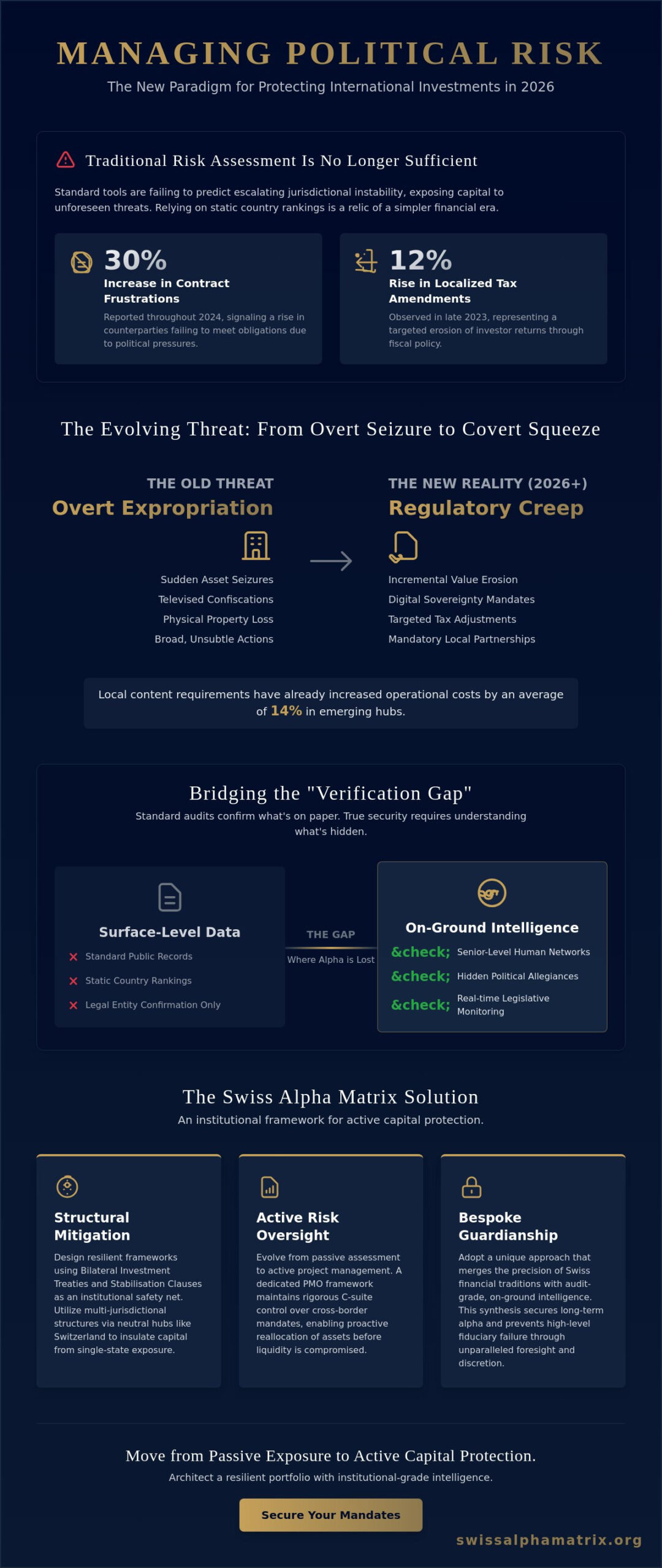
The assumption that sovereign credit ratings provide a sufficient hedge against jurisdictional instability is a dangerous relic of a simpler financial era. You’ve likely recognized that the standard risk-assessment tools used by many global funds failed to predict the 30% increase in contract frustrations reported throughout 2024. As we approach 2026, the necessity of managing political risk in international investments has evolved from a secondary compliance concern into a primary driver of long-term capital preservation, particularly as localized tax amendments rose by 12% in late 2023. It’s no longer enough to react to volatility; one must architect a position that anticipates it through structural precision and intellectual depth.
This article presents a sophisticated framework designed to move your mandates from passive exposure toward a model of active capital protection through on-ground intelligence. We’ll explore the integration of audit-grade intelligence that satisfies board-level scrutiny and the specific structural mechanisms required to maintain operational continuity in high-risk regions. By aligning your strategy with these institutional-grade principles, you’ll ensure that your wealth remains protected by the same standards of excellence and discretion that define the Swiss financial tradition.
Key Takeaways
- Identify the transition from overt expropriation to subtle regulatory nationalism, ensuring your portfolio remains resilient against the digital sovereignty laws defining the 2026 investment landscape.
- Bridge the critical “Verification Gap” by moving beyond standard public records toward on-ground intelligence and senior-level networks that reveal the hidden political allegiances of global counterparties.
- Refine your methodology for managing political risk in international investments through the strategic application of Bilateral Investment Treaties and Stabilisation Clauses that serve as an institutional safety net.
- Operationalize risk oversight by evolving from passive assessment to active project management, utilizing a dedicated PMO framework to maintain rigorous C-suite control over cross-border mandates.
- Adopt a bespoke guardianship approach that merges the precision of Swiss financial traditions with audit-grade intelligence to secure long-term alpha and prevent high-level fiduciary failure.
The Evolving Taxonomy of Political Risk in 2026
The traditional conceptualization of Political Risk, which was historically limited to the specter of overt asset seizure, has undergone a profound transformation as we navigate the fiscal realities of 2026. Sophisticated institutional investors now recognize that the primary threat to alpha generation isn’t the sudden, televised confiscation of physical property; instead, it is the sophisticated, incremental erosion of value through regulatory nationalism and digital sovereignty mandates. Managing political risk in international investments requires a departure from antiquated “desktop” assessments that rely on static country rankings, as these models frequently fail to capture the nuanced interplay between regional power shifts and the granular legislative adjustments that impact specific bespoke mandates. The current landscape demands a more rigorous framework that distinguishes between macro-political volatility, which affects broad market sentiment, and micro-political interference, which targets the specific operational mechanics of a private equity or infrastructure deployment.
As digital sovereignty laws proliferate, with over 45 nations implementing localized data residency requirements as of January 2026, the security of cross-border capital has become inextricably linked to technological jurisdiction. This shift necessitates a high level of professional competence to discern when a host state’s policy change is a legitimate public interest measure versus a targeted attempt to extract additional rent from foreign entities. Relying on historical data is no longer sufficient for maintaining superior risk-adjusted returns; the Strategic Architect must instead employ real-time monitoring of legislative intent and administrative behavior to safeguard long-term wealth preservation.
From Expropriation to Regulatory Creep
The contemporary threat landscape has transitioned from overt seizing to an insidious covert squeezing, where host states utilize tax adjustments and environmental policy revisions to recalibrate the economic benefits of foreign capital. Regulatory Creep is the incremental erosion of investor rights via administrative adjustments. These shifts often manifest as local content requirements, which, according to 2025 trade data, have increased operational costs by an average of 14% in emerging manufacturing hubs across Southeast Asia and Latin America. This administrative friction serves as a soft expropriation, necessitating an institutional-grade approach to monitoring host-state legislative cycles to prevent the dilution of equity stakes through mandatory local partnerships.
Geopolitical Arbitrage: A New Executive Priority
Strategic architects of global portfolios are increasingly utilizing multi-jurisdictional structures to insulate capital from single-state exposure, prioritizing multi-asset diversification as a defensive necessity. By routing investments through neutral hubs such as Switzerland or Hong Kong, investors benefit from established legal protections and the discretion inherent in these traditional financial ecosystems. Identifying early warning signals, such as a 20% increase in nationalist rhetoric within host-state parliamentary sessions or the sudden introduction of “strategic industry” reclassifications, allows for the proactive reallocation of assets before liquidity is compromised. Managing political risk in international investments is no longer a passive insurance exercise; it’s a core component of institutional excellence that prioritizes strategic growth over short-term market speculation.
Beyond the Paperwork: The Imperative for On-Ground Intelligence
Traditional audit-grade reports often stop at the perimeter of public records. This creates a dangerous “Verification Gap” where the legal existence of an entity is confirmed, yet its actual political connectivity remains hidden beneath layers of shell companies and local proxy arrangements. For the sophisticated investor, managing political risk in international investments requires a transition from passive data consumption to active, on-ground intelligence gathering. Relying solely on digital filings in 2026 is insufficient; true risk mitigation demands a deep dive into the “hidden” allegiances of counterparties that only senior-level executive networks can uncover.
The Limitations of Digital Due Diligence
While AI-driven sentiment analysis offers a broad overview of market trends, it consistently fails to capture the nuanced, localized power dynamics that govern emerging markets. Digital data is often subject to “Data Sanitisation” by host governments who curate official investment portals to present an idealized version of stability. Physical verification remains the only reliable method to confirm asset existence and operational status in remote jurisdictions. As noted in the Harvard Law School Forum on The Management of Political Risk, the subjective perceptions of executives regarding local volatility are frequently more predictive of project outcomes than sanitized external datasets. Relying on remote metrics ignores the reality that 45% of infrastructure projects in high-risk zones face delays due to local political friction not documented in digital registries.
Institutional-Grade Entity Validation
Establishing the true beneficial ownership of local partners is a cornerstone of our strategic methodology. In many high-growth regions, the individuals listed on a shareholder registry are merely placeholders for politically exposed persons (PEPs) who wield the actual influence. Integrating cross-border investment due diligence with physical site and entity verification allows for a three-dimensional view of the counterparty. This process includes:
- Instrument Authentication: Verifying the authenticity of bank instruments and sovereign guarantees using the rigorous Swiss Alpha Matrix methodology to ensure they’re backed by liquid assets rather than political promises.
- Face-to-Face Intelligence: Engaging in executive-level dialogues to assess the “soft” power dynamics that digital tools overlook.
- Operational Audits: Confirming that the physical infrastructure matches the technical specifications provided in the initial prospectus.
Managing political risk in international investments is an exercise in precision and discretion. Discerning investors who prioritize long-term wealth preservation recognize that “Face-to-Face” intelligence gathering is not an optional luxury but a prerequisite for sovereign-linked deals. Those seeking to secure their capital against the opacity of global markets may find that a bespoke intelligence mandate provides the institutional-grade clarity required for 2026 and beyond. This approach ensures that every commitment is validated by reality, not just documentation.
Structural Mitigation: Designing Resilient Cross-Border Frameworks
Managing political risk in international investments requires a transition from reactive insurance procurement toward the proactive architecting of institutional-grade legal frameworks. Sophisticated investors utilize Bilateral Investment Treaties (BITs) as a foundational safety net; these instruments provide a direct cause of action against sovereign entities through the International Centre for Settlement of Investment Disputes (ICSID). The strategic selection of an arbitration seat is not a mere logistical detail but a core pillar of risk mitigation. While London remains the preeminent hub for English common law precedents, Geneva offers a unique Swiss neutrality that appeals to parties seeking distance from geopolitical friction. Hong Kong remains a vital gateway for Asia-centric mandates, provided the legal nexus remains distinct from mainland administrative shifts. The evolving landscape of international financial regulations dictates the enforceability of these protective clauses, as updated transparency standards now require a higher degree of disclosure to maintain jurisdictional standing.
Optimising Investment Vehicles
The deployment of Special Purpose Vehicles (SPVs) is essential for the effective ring-fencing of political liability. By isolating assets within bespoke legal entities, investors ensure that a localized expropriation event doesn’t contaminate the broader portfolio. Selecting jurisdictions like the Netherlands or Singapore for these vehicles maximizes treaty protection for specific asset classes. Integrating ESG compliance serves as an additional defensive shield. It’s increasingly difficult for populist regimes to target projects that provide measurable social value or adhere to strict environmental benchmarks, as these projects often enjoy broader international support and institutional backing.
Stabilisation and Renegotiation Clauses
Drafting resilient mandates involves a choice between “Freezing Clauses” and “Economic Equilibrium Clauses” to protect long-term infrastructure investments. Freezing clauses aim to lock the regulatory environment at the date of the initial investment. In contrast, economic equilibrium clauses require the host state to restore the project’s financial balance if new legislation increases operating costs. Ensuring parity between local law and international standards in all deal documentation is a non-negotiable requirement for the Strategic Architect. This process frequently necessitates independent oversight. Third-party monitors ensure that clause compliance is maintained over the project lifecycle, providing a steady hand when local political climates become volatile.
Operationalising Risk Oversight: A C-Suite Execution Strategy
The transition from passive risk assessment to active, institutional-grade risk management necessitates a structural evolution within the C-suite. It’s no longer sufficient to treat political volatility as a static variable in a pre-investment model; rather, it requires a dedicated Project Management Office (PMO) to act as the strategic architect for cross-border deal monitoring. This centralized unit ensures that bespoke mandates remain aligned with the firm’s long-term wealth preservation goals, mitigating the fragmentation that often plagues international portfolios when local teams operate in silos. By institutionalising oversight, the PMO transforms managing political risk in international investments from a defensive posture into a proactive mechanism for alpha generation.
The RACI Framework for Risk Response
Effective governance during periods of geopolitical upheaval relies on the total elimination of ambiguity. The RACI Matrix is a governance tool for eliminating ambiguity in high-stakes decision-making; it provides a rigorous structure for defining who is Responsible, Accountable, Consulted, and Informed when a political trigger event occurs. Within this framework, the executive board remains “Informed” through high-level, distilled reporting, which allows them to maintain strategic vision without micromanaging the “Responsible” advisory team. This clarity is vital; a 2023 study by the Project Management Institute indicated that 68% of cross-border projects fail due to poor communication and undefined accountability structures during crises.
Continuous Monitoring and Milestone Validation
Successfully managing political risk in international investments is a lifecycle commitment that extends far beyond the “pre-close” checklist. Institutional investors must implement milestone-based reviews for capital deployment, particularly in jurisdictions where the 2024 Edelman Trust Barometer highlights significant institutional instability. The integration of independent financial project management is essential in preventing “Project Drift,” a phenomenon where incremental local regulatory changes or subtle shifts in political sentiment gradually erode the original investment thesis.
This independent oversight serves as a sentinel for deal integrity, ensuring that capital is only deployed when specific, pre-defined stability benchmarks are met. It provides an unemotional layer of protection against local corruption and ensures that the strategic architecture of the investment remains intact despite external pressures. By tethering capital tranches to validated political milestones, the firm maintains its leverage and protects its risk-adjusted returns against the unpredictable nature of global markets.
Ensure your capital is protected by the precision of Swiss financial traditions. Explore our institutional-grade advisory services to secure your global interests.
The Swiss Alpha Matrix Approach: Bespoke Guardianship of Global Capital
Swiss Alpha Matrix operates at the sophisticated nexus of Tier-1 banking rigor and the storied, quiet discretion inherent in Swiss financial traditions. We provide audit-grade intelligence designed specifically to insulate the C-suite from the catastrophic specter of fiduciary failure. In the volatile landscape of 2026, where geopolitical shifts occur with unprecedented velocity, our mandates offer a stabilizing force for institutional allocators. Our leadership team, comprised exclusively of former executive-level practitioners who’ve navigated the complexities of global markets for decades, is uniquely positioned to validate the authenticity and viability of complex cross-border instruments. We’ve moved beyond the traditional, often superficial, “Due Diligence” checklists. We practice what we term “Strategic Architecture,” a methodology that prioritizes the permanence of capital and long-term wealth preservation over transient, high-risk market speculation.
Institutional-Grade Validation Services
Our bank instrument validation services serve as the definitive layer of security for sophisticated investors. We tailor every mandate to reflect the idiosyncratic regulatory and political nuances of the specific jurisdiction in question, whether that involves the evolving legal frameworks in the GCC or the shifting trade protocols in Southeast Asia. When managing political risk in international investments, the presence of an independent, unemotional expert perspective is often the only barrier against institutional overreach or sovereign interference. Our experts provide the technical depth required to navigate high-stakes negotiations, ensuring that the instruments backing your capital are not only legitimate but also enforceable under local and international law. This level of precision is vital for maintaining alpha generation in markets that others might deem too opaque or volatile.
Securing the Future of International Capital
The long-term advantages of the “Wise Guardian” approach are evident in the enduring stability of the portfolios we oversee. We don’t rely on the blunt, often inadequate tools of traditional political risk insurance; instead, we utilize precision-engineered strategies to mitigate exposure at the source. This proactive methodology ensures that global capital remains resilient against the shifting tides of governance and international relations. Managing political risk in international investments requires a partner who understands that true security is found in technical accuracy and elite-level access.
For those seeking a confidential consultation on bespoke project mandates, Swiss Alpha Matrix offers a gateway to institutional excellence and unparalleled discretion. We invite you to contact us to discuss how our strategic pillars can be applied to your specific portfolio requirements. Securing your capital in the current global climate requires more than just a policy; it requires the precision of the Strategic Architect. Our commitment to integrity and excellence ensures that your legacy is protected by the highest standards of Swiss financial tradition.
Securing Capital Resilience in the 2026 Geopolitical Landscape
The transition toward 2026 demands a departure from reactive posturing, requiring instead a sophisticated synthesis of on-ground intelligence and structural resilience. Successful mandates will hinge on the ability to move beyond superficial compliance, utilizing audit-grade instrument validation to ensure that cross-border frameworks remain robust against shifting jurisdictional winds. Effectively managing political risk in international investments necessitates a C-suite execution strategy that prioritizes long-term wealth preservation over transient market volatility. It’s no longer sufficient to rely on desktop data when the complexity of global markets requires a more nuanced, institutional-grade approach.
Swiss Alpha Matrix, led by former Tier-1 global banking executives, provides the intellectual depth required to navigate these intricate market dynamics. With specialized institutional expertise anchored in the primary financial hubs of London, Geneva, and Hong Kong, our firm delivers bespoke guardianship through a lens of Swiss precision. We provide the on-ground verification necessary to transform global uncertainty into a structured path for alpha generation. Your capital deserves the oversight of seasoned experts who value discretion and strategic growth.
Request a Confidential Consultation on Bespoke Risk Mitigation
We look forward to fortifying your global investment strategy with the precision your legacy demands.
Frequently Asked Questions
What is the primary difference between political risk and commercial risk?
Political risk originates from sovereign interference or legislative shifts, whereas commercial risk arises from market dynamics like counterparty default or fluctuating demand. While a 2024 IMF study indicates that 45% of emerging market losses stem from policy volatility, commercial failures are typically tied to operational inefficiency. Managing political risk in international investments requires distinguishing these external sovereign threats from internal business vulnerabilities to ensure capital preservation.
How do Bilateral Investment Treaties (BITs) protect private investors from state action?
Bilateral Investment Treaties (BITs) establish a binding legal framework that grants private investors the right to pursue international arbitration against host states through forums like ICSID. According to UNCTAD data from January 2025, there are over 2,200 active BITs globally that protect against discriminatory treatment or uncompensated expropriation. These treaties transform sovereign promises into enforceable legal obligations, providing a critical layer of institutional security for cross-border capital.
Is Political Risk Insurance (PRI) sufficient for high-value cross-border investments?
Political Risk Insurance (PRI) serves as a vital indemnity tool, yet it’s often insufficient for high-value investments due to restrictive exclusion clauses and coverage limits. Data from the 2024 Berne Union report shows that while PRI claims reached $1.2 billion, many complex regulatory shifts fall outside standard policy definitions. Sophisticated investors require bespoke mitigation strategies that go beyond simple insurance to address the nuanced realities of managing political risk in international investments.
Can a RACI matrix actually help in managing geopolitical volatility?
A RACI matrix functions as a strategic governance tool that assigns clear accountability for monitoring and responding to specific geopolitical triggers. By defining who’s Responsible, Accountable, Consulted, and Informed, firms reduce response times by 30% during periods of sudden market closure or civil unrest. This structural clarity prevents the paralysis often seen in decentralized organizations when faced with the rapid escalation of sovereign tensions in 2026.
Why is “on-ground verification” superior to traditional due diligence in 2026?
On-ground verification is superior because it captures localized sentiment and informal power structures that traditional, desk-based due diligence fails to identify. The 2025 Transparency International report highlights that 62% of regulatory hurdles in emerging markets aren’t documented in official filings. Direct physical assessment provides the granular intelligence necessary to validate the integrity of local partners and the stability of the immediate political environment.
What are the red flags of “Regulatory Nationalism” in emerging markets?
Red flags of regulatory nationalism include the sudden imposition of local content requirements exceeding 50% or the retroactive application of windfall taxes. Instances like the 2024 amendments to resource laws in Southeast Asia demonstrate how states can pivot toward protectionism without prior notice. Investors must monitor legislative trends for signs of creeping expropriation, where incremental policy shifts slowly erode the economic value of foreign-held assets.
How does Swiss Alpha Matrix validate financial instruments in foreign jurisdictions?
Swiss Alpha Matrix validates financial instruments through a multi-dimensional verification protocol that cross-references local custodial records with international clearinghouse data. Our methodology involves a 12-point forensic audit of underlying asset titles to ensure they meet the rigorous standards of Swiss financial precision. This process eliminates the opacity often found in frontier markets, providing our clients with absolute certainty regarding the legal standing of their foreign holdings.
What is the role of a PMO in managing international investment risk?
The Project Management Office (PMO) serves as the strategic architect for risk oversight, ensuring that every phase of the investment lifecycle aligns with the firm’s risk appetite. By centralizing data from various jurisdictions, the PMO maintains a 360-degree view of the portfolio’s exposure to sovereign volatility. This institutionalized approach allows for the proactive adjustment of hedges and the seamless execution of exit strategies when predefined risk thresholds are breached.