

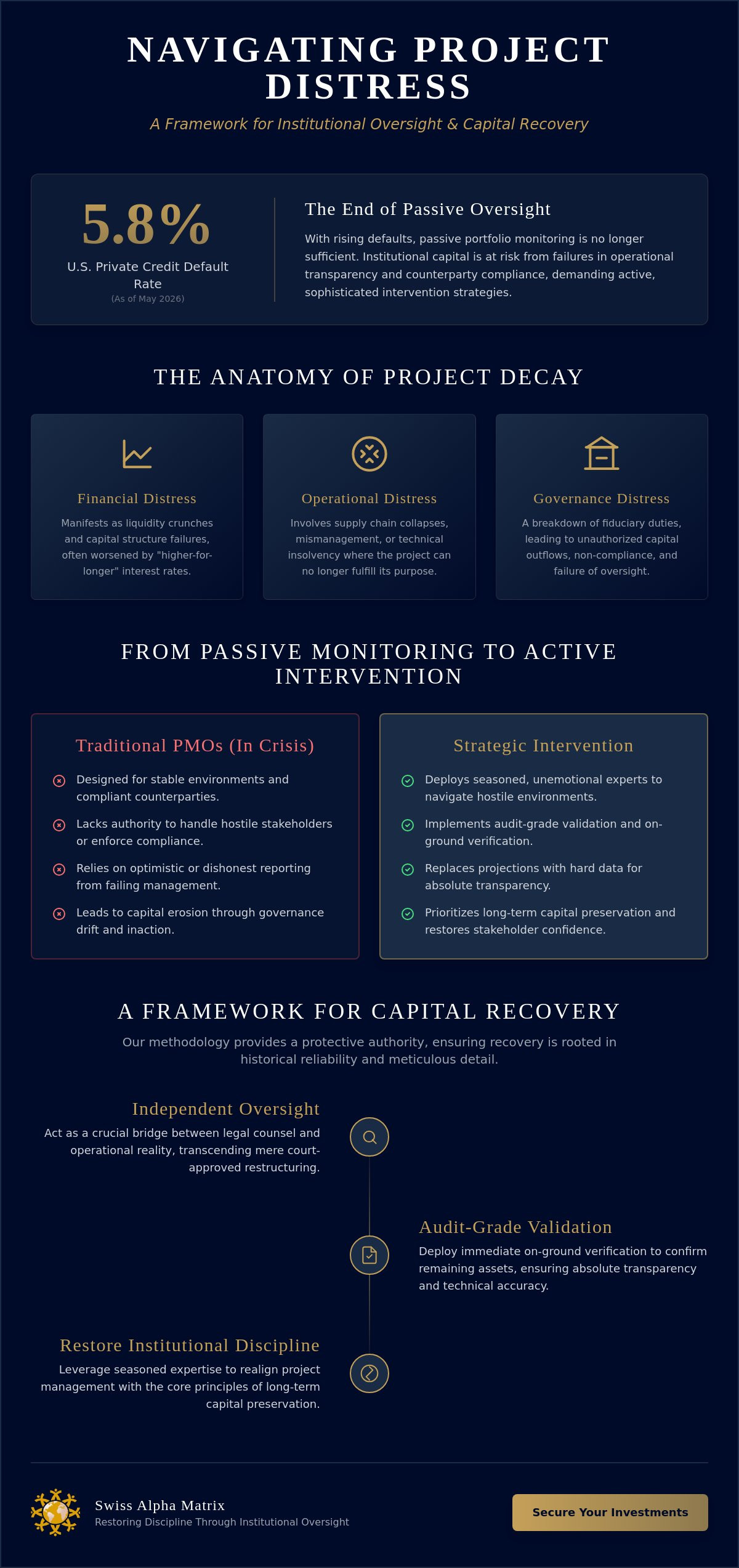
With the U.S. private credit default rate reaching approximately 5.8% as of May 2026, the era of passive oversight has reached a definitive conclusion. For institutional entities, the erosion of capital due to poor project governance is rarely a matter of market volatility alone, but rather a failure of operational transparency and counterparty compliance. It’s understandable that stakeholders feel a profound sense of vulnerability when cross-border operations become opaque and traditional safeguards falter. This article provides the sophisticated methodologies required to stabilize, oversee, and recover value from complex financial projects in distress. We’ll introduce rigorous project intervention strategies for financial investments that prioritize long-term preservation and strategic growth over short-term speculation.
By moving from broad philosophical principles to specific strategic pillars, we provide a clear roadmap for project stabilization and audit-grade validation of remaining assets. This exploration details how disciplined management and regional precision can restore stakeholder confidence, ensuring that interests remain in the hands of seasoned experts who value intellectual depth and technical accuracy. Our methodology serves as a protective authority, positioning the recovery process as a master plan rooted in historical reliability and meticulous attention to detail.
Key Takeaways
- Distinguish between the passive nature of distressed debt investing and the active, institutional oversight required to manage operational friction within complex, cross-border projects.
- Develop a sensitivity to early-stage operational variances, recognizing that reporting delays often serve as a definitive precursor to instrument mismanagement or governance failure.
- Evaluate the necessity of independent oversight as a bridge between legal counsel and operational reality, implementing sophisticated project intervention strategies for financial investments that transcend mere court-approved restructuring.
- Deploy a rigorous framework for capital recovery through immediate on-ground verification and audit-grade validation of assets to ensure absolute transparency and technical accuracy.
- Restore institutional discipline and stakeholder confidence by leveraging seasoned expertise to realign project management offices with the principles of long-term capital preservation.
Defining the Landscape of Distressed Investment Projects in 2026
The prevailing discourse surrounding distressed assets often focuses on the secondary market acquisition of debt, yet this perspective overlooks the intricate operational realities of the projects themselves. In the current fiscal year, where the U.S. private credit default rate has reached approximately 5.8% as of May 2026, institutional stakeholders face a landscape defined by increasing complexity and opaque counterparty risks. Managing these at-risk assets requires a departure from passive portfolio monitoring. It necessitates the implementation of robust project intervention strategies for financial investments to prevent the total erosion of capital.
The Taxonomy of Project Failure
To effectively intervene, one must first categorize the nature of the decay through a disciplined lens. Project failure is rarely a singular event; it’s a progression across three distinct domains.
- Financial Distress: This manifests as liquidity crunches or the fundamental failure of capital structures to support ongoing obligations, often exacerbated by the “higher-for-longer” interest rate environment.
- Operational Distress: This involves supply chain collapses, mismanagement, or technical insolvency where the project can no longer fulfill its primary purpose despite available funding.
- Governance Distress: This represents the breakdown of fiduciary duties. In the context of special purpose vehicles (SPVs), it’s defined as the systematic failure of the governing board to exercise independent oversight, leading to unauthorized capital outflows or non-compliance.
The 2026 economic environment is characterized by a significant shift in global regulation. With China’s new Outbound Investment Regulation effective July 1, 2026, and the UK’s updated Money Laundering Regulations published in June 2026, cross-border programs are under unprecedented scrutiny. These shifts don’t just add administrative burden; they create operational friction that can push a marginally stable project into a state of distress. Independent advisory becomes the essential mechanism for navigating this “fog of distress,” providing the technical accuracy required to distinguish between temporary setbacks and terminal failure.
Why Traditional Project Management Fails in Crisis
Standard Project Management Offices (PMOs) are designed for stable environments where counterparties are compliant and reporting is honest. When a project enters distress, these standard frameworks often collapse because they lack the authority or the expertise to handle hostile stakeholders. Effective turnaround management demands more than “business as usual” reporting. It requires audit-grade validation and on-ground verification to replace the optimistic projections of failing management teams with hard data. Deploying specialized project intervention strategies for financial investments ensures that the recovery process is guided by seasoned, unemotional experts who prioritize long-term preservation over short-term speculation.
The Anatomy of Project Decay: Identifying Red Flags Early
The dissolution of investment value is rarely a sudden catastrophic event, but rather the culmination of incremental operational failures that, if left unaddressed, remain undetected by standard fiscal audits that prioritize balance sheet figures over procedural integrity. Identifying Red Flags Early requires a departure from the traditional reliance on lagging financial indicators, shifting the focus instead toward the qualitative shifts in counterparty behavior and administrative hygiene. When institutional stakeholders fail to recognize these subtle variances, they inadvertently permit the erosion of capital through what we define as governance drift. This phenomenon is particularly prevalent in cross-border special purpose vehicles (SPVs), where the physical distance between the investor and the project site often masks the breakdown of fiduciary discipline and the eventual misalignment of strategic goals.
Effective project intervention strategies for financial investments rely on the early detection of reporting delays, which frequently serve as a definitive precursor to instrument fraud or more systemic mismanagement. A counterparty that was once meticulous in its quarterly submissions but suddenly adopts an opaque, defensive, or uncharacteristically vague posture in communication is signaling a fundamental shift in operational stability. These deviations shouldn’t be dismissed as merely administrative inconveniences; they’re the primary indicators that the underlying project governance is no longer aligned with the original investment mandate, necessitating a more rigorous oversight framework.
Operational and Financial Leading Indicators
Operational red flags are the leading indicators of impending financial distress. These indicators often manifest as a growing discrepancy between the digital reporting provided by project managers and the physical asset reality on the ground, a gap that is frequently wider in jurisdictions with less stringent regulatory oversight. For instance, a persistent delay in providing site access or a sudden turnover in key project personnel should be viewed with a high degree of skepticism. A proactive monitoring cadence, established with a sense of quiet authority, allows for the detection of these shifts before they manifest as a terminal liquidity crunch or a total loss of capital.
The Role of Audit-Grade Instrument Validation
In a distressed environment, the authenticity of collateral becomes a critical point of failure that can jeopardize the entire recovery process. Utilizing bank instrument validation services serves as the first line of defense against capital loss, providing a layer of technical assurance that standard audits often lack. It’s insufficient to rely on unverified documentation when a project crisis is unfolding, as the risk of encountering fraudulent Standby Letters of Credit (SBLCs) or Letters of Credit (LCs) increases significantly during periods of financial strain. By verifying these instruments through institutional channels, stakeholders can ensure that their recovery efforts are built upon a foundation of technical accuracy rather than optimistic assumptions. For those seeking to stabilize their portfolios, conducting Operational Due Diligence provides the necessary clarity to navigate these complex dynamics with professional calm.
Beyond Legal Restructuring: The Case for Independent Oversight
While legal frameworks provide the necessary structure for debt realignment, they often lack the granular operational mechanisms required to ensure project solvency. This reliance on court-approved plans without corresponding execution is what we term the “Legal Trap.” In this scenario, a project remains technically compliant with a restructuring agreement while continuing to suffer from the same operational inefficiencies that precipitated the initial crisis. By deploying specialized project intervention strategies for financial investments, stakeholders can bridge the chasm between legal theory and physical reality, ensuring that the recovery process is defined by technical accuracy rather than optimistic projections.
Removing incumbent management from the recovery steering committee is not merely a punitive measure; it is a strategic necessity to mitigate inherent conflicts of interest. Those who oversaw the project’s descent are often emotionally or professionally tethered to the very decisions that led to the distress, making them susceptible to the sunk cost fallacy. The introduction of an independent oversight body provides a psychological dividend, as the presence of unemotional, expert management serves to restore institutional trust among creditors and regulatory bodies alike. This shift ensures that every decision is filtered through a lens of capital recovery and long-term preservation.
The Advisor vs. Legal Counsel Dynamic
There is a fundamental distinction between the objectives of legal counsel and those of an independent advisor. Legal counsel naturally prioritizes the mitigation of liability and the fulfillment of contractual obligations, whereas financial advisory methodologies focus on the rigorous execution of operational milestones. Synchronizing the RACI (Responsible, Accountable, Consulted, and Informed) matrix between these two entities is essential to prevent administrative friction. In sensitive cross-border negotiations, the tradition of Swiss discretion allows for a nuanced approach that protects the privacy of high-net-worth individuals while maintaining a standard of professional calm that encourages consensus among disparate stakeholders.
Capital Preservation as the Primary Objective
When a project enters a state of distress, the mandate must shift decisively from growth or expansion to stabilization and recovery. Establishing an institutional framework for managing distressed assets allows for the implementation of rigorous cost-containment measures that do not compromise the project’s core integrity. This disciplined management ensures that remaining liquidity is directed toward high-impact recovery activities rather than being dissipated through continued mismanagement. By prioritizing capital preservation, the independent oversight body creates a stable foundation upon which restored stakeholder confidence can be built, moving the project from a state of vulnerability to one of disciplined, strategic growth.
A Strategic Framework for Stabilising Complex Cross-Border Programs
Stabilising a failing cross-border initiative requires a measured, steady approach that moves from broad diagnostic principles to specific strategic pillars with professional calm. It’s not enough to simply inject capital into a distressed entity; one must address the underlying governance failures and operational friction that precipitated the crisis. The implementation of sophisticated project intervention strategies for financial investments involves a five-step institutional framework designed to reclaim control and protect remaining equity through disciplined management.
- Step 1: Immediate Operational Audit and On-Ground Verification. We begin with an unvarnished assessment of the current state, replacing the management team’s optimistic forecasts with audit-grade data and physical evidence.
- Step 2: Stakeholder Alignment and PMO Realignment. This involves the fundamental restructuring of the Project Management Office to ensure all parties operate under a single, transparent mandate focused on recovery.
- Step 3: Instrument Validation and Asset Ring-Fencing. We verify the authenticity of all underlying collateral and implement strict controls to prevent further unauthorized capital outflows or asset dissipation.
- Step 4: Institutional-Grade Reporting Cadence. Establishing an unwavering communication rhythm provides the transparency required to restore confidence among senior creditors and institutional partners.
- Step 5: Execution of the Exit or Turnaround Strategy. The final phase focuses on the logical conclusion of the intervention, whether through a structured divestment or a return to operational solvency.
The Criticality of On-Ground Verification
While modern technology provides a useful interface for data analysis, it cannot replace the intellectual depth and technical accuracy of physical inspection. Digital data rooms are often insufficient for cross-border investment due diligence, particularly in jurisdictions where regulatory oversight is opaque or non-compliant. The successful execution of project intervention strategies for financial investments demands face-to-face counterparty vetting and physical site visits to verify the actual condition of assets. This on-ground presence ensures that we aren’t merely reviewing a curated digital narrative, but are instead observing the physical reality of the project’s operations.
Operational Due Diligence (ODD) in the Recovery Phase
During the recovery phase, we conduct a rigorous reassessment of the project’s operational viability under its new constraints. This process involves identifying specific leakage points where capital is being mismanaged or diverted, often through inefficient procurement processes or opaque vendor contracts. By establishing a new baseline for project milestones and deliverables, we provide a structured argument for the methodology of recovery. If your portfolio requires this level of meticulous oversight to protect long-term interests, you can explore our Complex Project Management services to begin the process of institutional stabilisation.
Swiss Alpha Matrix: Restoring Discipline through Institutional Oversight
Swiss Alpha Matrix operates with a sense of quiet authority, leveraging Tier-1 global banking experience to navigate the most intricate instances of financial distress. We merge traditional financial discipline with meticulous project management, ensuring that interests are in the hands of seasoned, unemotional experts who prioritize long-term preservation over speculative recovery. By deploying specialized project intervention strategies for financial investments, we restore the institutional rigour required to stabilise at-risk capital in an increasingly volatile global market. Our persona is that of a master planner, providing the intellectual depth required to resolve complex dynamics without oversimplifying the underlying risks that threaten capital integrity.
Our Methodology: Precision, Discretion, Excellence
Our approach to independent financial project management serves as a protective authority for institutional stakeholders and family offices who value technical accuracy. We apply the historical reliability and rigour of Swiss wealth management to the inherent chaos of distressed projects, providing a Single Source of Truth that replaces the ambiguity of failing management teams with audit-grade intelligence. By centralizing reporting and oversight, we eliminate the fragmentation that often characterizes distressed cross-border programs, allowing for a unified strategic response. This process facilitates a seamless transition from reactive crisis management toward long-term frameworks that are meticulously aligned with current international financial regulations; it ensures that every operational milestone is documented with professional calm. It’s this commitment to regional excellence and precision that distinguishes our performance-oriented mindset from passive market participants.
Securing the Future of the Investment
The successful execution of project intervention strategies for financial investments doesn’t conclude with mere stabilisation; it requires the establishment of permanent governance structures to prevent a resurgence of operational decay. We focus on securing the future of the investment by providing executive-level clarity that allows stakeholders to move from a defensive posture to one of strategic growth. These structures include the realignment of fiduciary duties and the implementation of robust risk management frameworks that transcend the immediate crisis. We don’t merely provide surface-level advice; we act as dedicated partners who prioritize moral character and high-level standards. Our commitment to excellence ensures that interests are managed with the technical depth and professional competence that high-net-worth individuals and institutional entities expect. This standard of service is both broad in reach and meticulous in its attention to detail, offering a level of hyper-personalization that is essential in high-stakes crises. For those requiring a dedicated partner to oversee complex recovery operations, we invite you to contact our senior partners for a confidential project review.
Securing Institutional Resilience in Complex Recovery Operations
The restoration of capital in distressed environments is a function of disciplined management and technical accuracy rather than mere financial restructuring. By recognizing early-stage operational variances and implementing independent oversight, institutional stakeholders can bridge the gap between legal theory and physical reality. We’ve explored how a structured framework, prioritizing audit-grade validation and on-ground verification, serves as the definitive mechanism for reclaiming control over at-risk assets.
Success in these high-stakes scenarios requires sophisticated project intervention strategies for financial investments that move beyond passive monitoring. Led by former Tier-1 global banking executives, our approach combines a global reach with Swiss precision to provide the intellectual depth necessary for capital preservation. Our expertise in audit-grade instrument validation ensures that every strategic decision is built upon a foundation of technical certainty. We invite you to Consult with our Senior Partners on Distressed Project Recovery to begin realigning your portfolio with the principles of long-term stability and strategic growth. It’s a journey toward restored stakeholder confidence through unwavering professional calm.
Frequently Asked Questions
What is the first step when an investment project shows signs of distress?
The first step is always the execution of an immediate operational audit coupled with rigorous on-ground verification to replace management’s digital narrative with unvarnished data. This allows for the identification of specific leakage points before they manifest as terminal financial loss. By prioritizing technical accuracy over optimistic projections, stakeholders can establish a stable baseline for the recovery process. It’s a necessary shift toward transparency.
How does independent project management differ from traditional consulting?
Traditional consulting often prioritizes theoretical advice, whereas independent project management focuses on the disciplined execution of operational milestones. This hands-on approach involves the implementation of project intervention strategies for financial investments that provide direct oversight of counterparties. It’s a shift from passive observation to active, authoritative management. This ensures that fiduciary duties are strictly upheld throughout the recovery phase.
Why is on-ground verification essential for cross-border distressed assets?
On-ground verification is essential because digital reporting often fails to capture the physical reality of assets in jurisdictions with opaque regulatory oversight. Relying solely on data rooms during a crisis is a high-risk strategy that can mask instrument fraud or systemic mismanagement. Physical site visits provide the regional precision required to validate the actual condition of collateral. We don’t accept curated narratives at face value.
Can a distressed project be saved without filing for bankruptcy?
Saving a project without bankruptcy is achievable through the prompt application of operational discipline and the realignment of governance structures. This process involves stabilizing liquidity and realigning stakeholder interests without the need for court-mandated insolvency. By focusing on capital preservation, seasoned experts can navigate the project back toward a state of strategic growth. It requires a master plan rooted in historical reliability.
How do you validate financial instruments like SBLCs in a crisis?
Validating financial instruments like SBLCs requires audit-grade procedures that leverage institutional banking channels to confirm authenticity. In a crisis, it’s insufficient to trust documentation provided by a distressed counterparty without secondary, independent verification. This technical assurance protects the investment from the risks of fraudulent collateral. These risks often emerge during periods of severe financial strain. We prioritize technical depth over convenience.
What role does a RACI matrix play in distressed project recovery?
A RACI matrix serves to clarify accountability, ensuring that legal teams, project managers, and oversight bodies operate without administrative friction. In distressed scenarios, it’s critical to define who is responsible and accountable for specific recovery milestones to prevent governance drift. This structured communication rhythm maintains the professional calm required to lead a project through complex distress. It’s a foundational element of disciplined management.
Is independent oversight necessary if we already have a dedicated PMO?
Independent oversight is necessary because an internal PMO often suffers from a conflict of interest or a sensitivity to the sunk cost fallacy. Deploying external project intervention strategies for financial investments provides the intellectual depth needed to challenge failing strategies. It ensures that the recovery process is guided by unemotional experts. These professionals aren’t tethered to the decisions that led to the initial decay.
How does Swiss Alpha Matrix ensure discretion in high-profile project failures?
Swiss Alpha Matrix ensures discretion by adhering to the traditional values of private wealth management and maintaining a boutique, elite persona. We recognize that high-profile failures demand absolute privacy; therefore, our communication remains formal and characterized by a sense of quiet authority. This standard of service protects the reputation of institutional entities. We meticulously manage the complexities of capital recovery while maintaining absolute technical accuracy.