

What if the most persuasive management presentation is only the beginning of the assessment? A polished account of strategy can inspire confidence, yet leave important questions unanswered about execution, risk oversight, and accountability. Investors need to look beyond leadership claims, especially when operating evidence is incomplete, reviewers apply different standards, or cross-border structures make independent verification more difficult. A management due diligence framework brings discipline to the assessment by testing what leaders say against their decisions and the available evidence.
This article sets out an evidence-led process for assessing whether a management team has the capability and integrity to deliver its strategy. It covers practical criteria for examining leadership competency, conduct, and execution, as well as ways to identify inconsistencies and distinguish verified findings from matters requiring further inquiry.
It also explains how to combine interviews, records, operating evidence, and independent verification, then translate findings into proportionate investment conditions, oversight, or decisions. The goal is not to reduce complex leadership assessments to a score, but to support clear, comparable conclusions and sound investment judgement.
Key Takeaways
- Set assessment criteria around the investment thesis and each leader’s responsibilities, rather than relying on a single, uniform scorecard.
- Use a management due diligence framework to test leadership capability, integrity, decision-making, execution, and governance against relevant evidence.
- Compare interviews, records, references, and observation according to the claims each can verify, while recording contradictions and confidence levels.
- Follow a defined workflow from mandate and risk identification to corroborated findings so conclusions remain consistent across reviewers.
- Consider independent support when cross-border structures, complex verification, or material evidence gaps limit the strength of an internal review.
Why a Management Due Diligence Framework Must Test More Than the Leadership Story
A compelling strategy depends on the people expected to deliver it. Management due diligence is a structured review of leadership capability, conduct, and execution. It assesses whether decision-makers can turn the stated plan into disciplined action. The Management due diligence overview provides a foundational definition. For investors, the practical question is how to test management claims against the requirements and risks of a specific investment.
This review complements, rather than replaces, other diligence work. Financial diligence examines the reliability and implications of financial information. Legal and commercial diligence address their respective exposures and assumptions, while operational diligence assesses processes and controls. Management assessment asks who is responsible for those areas, how decisions are made, whether accountability is clear, and how leaders respond when conditions diverge from the plan. Because leadership decisions can shape strategy delivery, control quality, and responses to risk, a sound business case cannot be assessed independently of the people expected to execute it.
Interviews are useful evidence sources, but they are not proof. For example, a leader’s account of how a risk was managed should be tested against relevant records, observed practices, or independent references where available. If the explanation conflicts with the documented record, treat the discrepancy as a finding to investigate, not a detail to smooth over.
What does management due diligence assess?
Assessment should consider relevant experience, decision quality, integrity, and demonstrated ability to execute. It should distinguish individual suitability from collective effectiveness. A capable chief executive may still be part of a leadership team with unclear responsibilities, weak challenge, or gaps in essential expertise. Set the scope and weighting according to the transaction, investment mandate, sector, role-specific responsibilities, and material risks. For example, the criteria for a regulated financial programme may differ from those for a business whose investment thesis depends on operational transformation.
When should investors assess management competency?
Review may be appropriate before an investment, during acquisition diligence, when forming a strategic partnership, or as part of ongoing oversight. Match the depth of review to the decision and the available evidence. Greater complexity, material execution risks, cross-border structures, or unresolved inconsistencies may call for broader verification. A narrower mandate with well-supported evidence may need a more focused review. There is no universal checklist for every organisation. A well-designed management due diligence framework defines what must be established for the decision, identifies where evidence is insufficient, and keeps conclusions tied to the specific investment case.
The Core Dimensions of a Management Due Diligence Framework
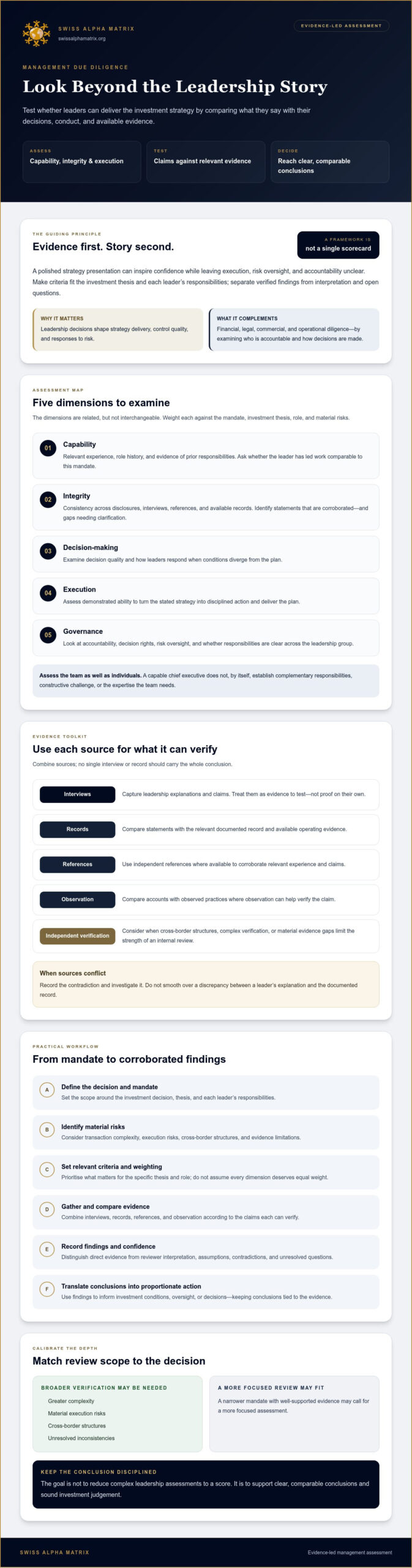
A useful management due diligence framework examines five related dimensions: capability, integrity, decision-making, execution, and governance. These dimensions are not interchangeable, and they should not receive equal weight by default. A transaction based on rapid operational change may place greater emphasis on execution and decision rights. Another mandate may make risk oversight or sector-specific experience more material. Weight each criterion against the investment thesis and the responsibilities of the leaders being assessed.
Assess individuals and the team. A strong executive record does not, by itself, show that responsibilities are complementary, challenge is constructive, or accountability is clear across the leadership group. To keep conclusions disciplined, separate what the evidence directly shows from reviewer interpretation, assumptions, and unresolved questions.
- Capability: Relevant role history, references, and evidence of prior responsibilities. Did the individual lead work comparable to this mandate?
- Integrity: Consistency across disclosures, interviews, references, and available records. Are material statements corroborated, or do gaps need clarification?
- Decision-making: Examples of choices, trade-offs, and responses to setbacks. How did leaders assess alternatives and change course?
- Execution: Plans, assigned ownership, resources, and milestones. Do stated priorities translate into a credible delivery structure?
- Governance: Role descriptions, decision rights, escalation practices, and succession planning. Who is accountable, and how can concerns be raised?
How to assess leadership capability and execution
Compare prior responsibilities and outcomes with the demands of the current mandate. Do not use titles or years of experience as substitutes for relevant evidence. Ask leaders to explain a specific strategic decision: which options they considered, what trade-off they accepted, what changed after implementation, and what they learned from a setback. Then check whether the current strategy has named owners, appropriate resources, and milestones that can be monitored. Ambition without clear accountability is not yet an execution plan.
How to assess integrity, governance, and team effectiveness
Check whether material claims remain consistent across disclosures, interviews, references, and available operating records. Record a discrepancy or allegation as a matter requiring verification, not as an established fact. Examine how executives challenge assumptions, escalate concerns, manage conflicts, and take accountability when plans underperform. Confirm that decision rights are understood across the team, and consider whether essential responsibilities depend too heavily on one individual.
A concise evidence record can preserve these distinctions. For each finding, note the source, claim tested, corroboration, contradiction, reviewer interpretation, and open question. Where operational context or evidence collection calls for independent support, Swiss Alpha Matrix provides operational due diligence and verification.
Management Due Diligence Methods Compared: Interviews, Records, References, and Observation
No single evidence source can establish management capability. A structured interview reveals how executives explain their reasoning, while records, references, and direct observation offer different forms of corroboration. A disciplined management due diligence framework combines these methods and records both what each supports and what it cannot establish.
Which evidence sources reveal management capability?
- Structured interviews: Use consistent, role-specific questions to test how executives describe decisions, ownership, trade-offs, and lessons from setbacks. Interviews reveal reasoning and consistency, but confident answers alone do not verify past performance.
- Document review: Examine available plans, decision records, reporting, and operating indicators to check whether stated priorities were implemented. Records can substantiate activity, but may be incomplete or selectively provided, and may not explain the context behind a decision.
- References: Ask people with relevant first-hand experience to corroborate specific responsibilities and conduct. Record how closely each source worked with the executive, what they could directly observe, and any potential bias or limits to their knowledge.
- On-ground observation: Where appropriate, observe management practices and operating conditions directly. This can provide useful context, but it offers a limited view of performance and should not replace broader evidence.
Cross-border structures may require additional care with access, context, and accountability. The considerations in this cross-border investment due diligence guide can help frame those complexities.
A compact evidence register makes comparisons more consistent. For each material claim, record:
- Source and claim tested: Identify who or what supports the claim and the specific assertion being examined.
- Corroboration and contradiction: Note confirming evidence, conflicting information, and whether the sources are genuinely independent.
- Confidence and limitations: State the reviewer’s confidence, its basis, and any access restrictions or missing records.
How should reviewers handle conflicting evidence?
Log each material inconsistency with its source, potential explanation, and outstanding verification need. A missing document is a documentation gap, not proof of misconduct. Likewise, an interview explanation does not resolve a contradiction unless it can be tested. Do not turn uncertainty into reassurance or an adverse conclusion without supporting evidence.
Escalate unresolved matters according to the investment mandate, potential consequences, and applicable governance process. Record when evidence could not be accessed, why the limitation matters, and whether further verification or a decision condition is warranted. Clear documentation preserves the distinction between established facts, reviewer judgement, and open questions.
How to Assess Management Team Competency Step by Step
A disciplined review starts with the investment decision, not a generic checklist. This management due diligence framework moves from mandate definition to documented findings, with each stage tied to the evidence needed to test a specific assumption.
- Define the mandate. Identify the critical leadership roles, investment assumptions, and material risks that depend on management performance. Specify what the assessment must establish before the investment decision.
- Set role-specific criteria. Translate the mandate into responsibilities and evidence requirements for each key executive. For example, assess a leader responsible for a transformation plan against the experience and authority needed to deliver it.
- Gather and test evidence. Use relevant interviews, records, references, and observation to examine the claims tied to each criterion. Record the source, its proximity to the matter, corroboration, contradictions, confidence level, and remaining questions.
- Assess gaps and limitations. Separate an evidenced shortfall from information that is unavailable or unverified. Consider plausible alternative explanations, document access restrictions, and identify what further inquiry could resolve the uncertainty.
- Prepare decision-ready findings. Connect each material conclusion to the investment assumption it affects, the evidence supporting it, and the decision or follow-up action it may require.
What should a management assessment scorecard include?
A scorecard should capture role-specific criteria, expected evidence, reviewer notes, confidence, and open questions. If you use qualitative ratings, define each level in advance and require supporting evidence. Avoid false precision from an unexplained numerical score. Flag critical gaps separately so a serious concern cannot be obscured by stronger results elsewhere. Where leadership capability intersects with processes and controls, investors may also consult this guide to operational due diligence.
How do findings inform an investment decision?
Map each finding to the assumption it affects and a proportionate response. A remediable capability gap may inform an integration priority, oversight arrangement, or clearly assigned follow-up. A material inconsistency may require further verification or escalation before a decision. Document the assessment’s limitations, alternative explanations considered, decision owner, and any action required after approval. This helps distinguish a manageable development need from unresolved uncertainty.
Independent operational due diligence or on-ground verification can strengthen the evidence base. Learn about Swiss Alpha Matrix’s verification and due diligence services.
From Management Findings to Independent Oversight and Next Steps
Assessment findings are useful when they shape decisions and oversight, rather than remaining in a diligence report. Internal review draws on institutional context and direct access to decision-makers, but may be limited by available capacity, familiarity with management, or reliance on materials supplied by the organisation. External advisory can add independent scrutiny and specialised verification, but its value depends on a clearly defined mandate, suitable access, and transparent reporting. A combined approach can preserve internal ownership of the investment decision while adding independent challenge where the evidence warrants it.
When is independent management verification appropriate?
Consider independent review when investment conclusions rely heavily on management-provided materials, cross-border structures complicate verification, or material evidence gaps remain. On-ground verification may help when operating claims cannot be resolved through records alone. Before drawing conclusions about individuals or entities, define the scope, access, sources, and limitations of the work. Record a lack of access as an unresolved constraint, not as confirmation.
Swiss Alpha Matrix’s operational due diligence, on-ground verification, and complex project management capabilities may be relevant when a mandate requires independent evidence or structured coordination. For broader context on oversight and delivery, see this guide to independent financial project management.
How can investors turn findings into ongoing oversight?
Translate material findings into an oversight plan with named owners, reporting requirements, decision checkpoints, and escalation routes. For example, if delivery depends on a critical leadership commitment, specify who will monitor the related milestone and what action is needed if progress falls short. Revisit assumptions when leadership changes, milestones slip, or new evidence emerges. Set the appropriate cadence and thresholds according to the mandate and the significance of the underlying risk.
A well-governed management due diligence framework keeps a clear record of what was verified, what remains uncertain, and who is responsible for follow-up. Internal teams can retain oversight, seek independent support for defined verification needs, or combine both approaches as complexity requires. For further context on mandate-specific assessment and related diligence work, visit Swiss Alpha Matrix.
Make Leadership Evidence Part of the Investment Decision
A sound management assessment looks beyond presentations and tests leadership claims against relevant records, references, and operating evidence. Criteria should reflect the investment thesis and each executive’s responsibilities. Findings should distinguish verified facts from interpretation and unresolved questions. This management due diligence framework helps investors translate evidence into proportionate conditions, oversight, or further verification, rather than relying on a single score or impression.
Where complexity, cross-border structures, or evidence gaps call for additional scrutiny, Swiss Alpha Matrix offers independent advisory focused on specialised due diligence and complex financial programmes. Its team includes professionals with experience in senior roles at Tier-1 global banks, with capabilities in operational due diligence, on-ground verification, and project management.
Discuss your mandate and assessment requirements with Swiss Alpha Matrix to consider a due diligence approach suited to your needs.
Frequently Asked Questions
What is management due diligence?
Management due diligence is a structured assessment of the leaders responsible for an organisation’s strategy, controls, and performance. It examines relevant experience, judgement, conduct, accountability, and the team’s ability to execute its mandate. For investors, the purpose is to test whether leadership claims have appropriate evidence, identify material uncertainties, and understand how findings may affect an investment decision or later oversight.
How do you assess management team competency?
Assess competency by defining the responsibilities critical to the investment, then comparing each leader’s relevant experience and decisions with those demands. Use consistent, role-specific interviews and corroborate material claims through available records, references, or observation. Evaluate the team as well as individuals: clear responsibilities, constructive challenge, and coordinated execution matter. Record evidence quality, contradictions, confidence, and open questions so conclusions remain traceable and proportionate.
What questions should investors ask a management team?
Ask questions that elicit specific decisions and evidence, rather than broad assurances. For example: “Which strategic trade-off has most affected execution, and why?” “Who owns this milestone, and how is progress monitored?” “What changed after a significant setback?” “How are concerns escalated when assumptions prove incorrect?” Compare responses across executives and against available records. The aim is to understand reasoning, accountability, and consistency, not simply presentation style.
Can management due diligence be objective?
It can be made more consistent and evidence-led, although it cannot eliminate professional judgement. Define criteria in advance, apply comparable questions to relevant roles, document source quality, and distinguish verified facts from interpretation and unresolved issues. Where practical, use reviewers with appropriate independence and record alternative explanations for discrepancies. A management due diligence process is more defensible when conclusions are supported, limitations are visible, and confidence reflects the strength of the evidence.
What documents are reviewed in management due diligence?
Documents depend on the mandate, organisation, and available access. Reviewers may examine leadership biographies, role descriptions, organisational charts, strategic plans, board or committee materials, decision records, performance reporting, and relevant operating reports. The purpose is to test particular claims, such as who owns a priority or whether a plan was implemented. Note missing or restricted records as limitations, not as confirmation of management’s account.
How is management due diligence different from operational due diligence?
Management due diligence focuses on leadership capability, conduct, decision-making, accountability, and execution. Operational due diligence examines the organisation’s operating arrangements, processes, controls, and infrastructure. The reviews are distinct but can inform one another. Evidence of a control weakness, for instance, may prompt questions about oversight and escalation by the responsible executives. Coordinate scope to clarify responsibilities and avoid duplication while preserving relevant connections between leadership and operations.
When should investors use an independent management due diligence adviser?
Independent support may be appropriate when investment decisions rely heavily on management-provided information, evidence is incomplete or inconsistent, or cross-border complexity makes verification difficult. Define the adviser’s scope, access, deliverables, and limitations before drawing conclusions. Swiss Alpha Matrix is an independent advisory firm focused on specialised due diligence and complex financial programmes, with capabilities including operational due diligence, on-ground verification, and project management. Its team includes professionals with experience in senior roles at Tier-1 global banks.