

A strong investment case is not established by projections alone. Investment due diligence is a structured assessment of financial records, past performance, and other material information, considered alongside risks that could affect a transaction or an investor’s interests. For deals involving New York counterparties or capital, investment due diligence services in New York can bring financial crime exposure, deal-specific risks, conflicts of interest, and investor alignment into a disciplined review.
A thorough review tests both the investment’s financial case and the people, relationships, and operating conditions behind it. It clarifies what the evidence supports, which assumptions warrant closer scrutiny, and what risks may affect the decision.
This article explains what investment due diligence involves, how financial and qualitative reviews contribute to the assessment, and why sanctions, corruption, fraud, conflicts, and alignment matter in transactions. It also outlines how independent verification and operational due diligence can add practical value when a deal spans multiple parties, jurisdictions, or complex financial instruments.
Key Takeaways
- Assess financial records alongside sanctions, corruption, fraud, and other integrity risks that may affect the investment.
- Match the scope of review to the transaction, examining both financial evidence and qualitative factors such as management, culture, and relationships.
- Identify potential conflicts by clarifying incentives, decision-making authority, and how the parties’ interests align over the life of the deal.
- Tailor due diligence to the asset, structure, jurisdictions, and evidence available, with focused verification where information or operations are complex.
Financial crime, sanctions, corruption, and fraud risks
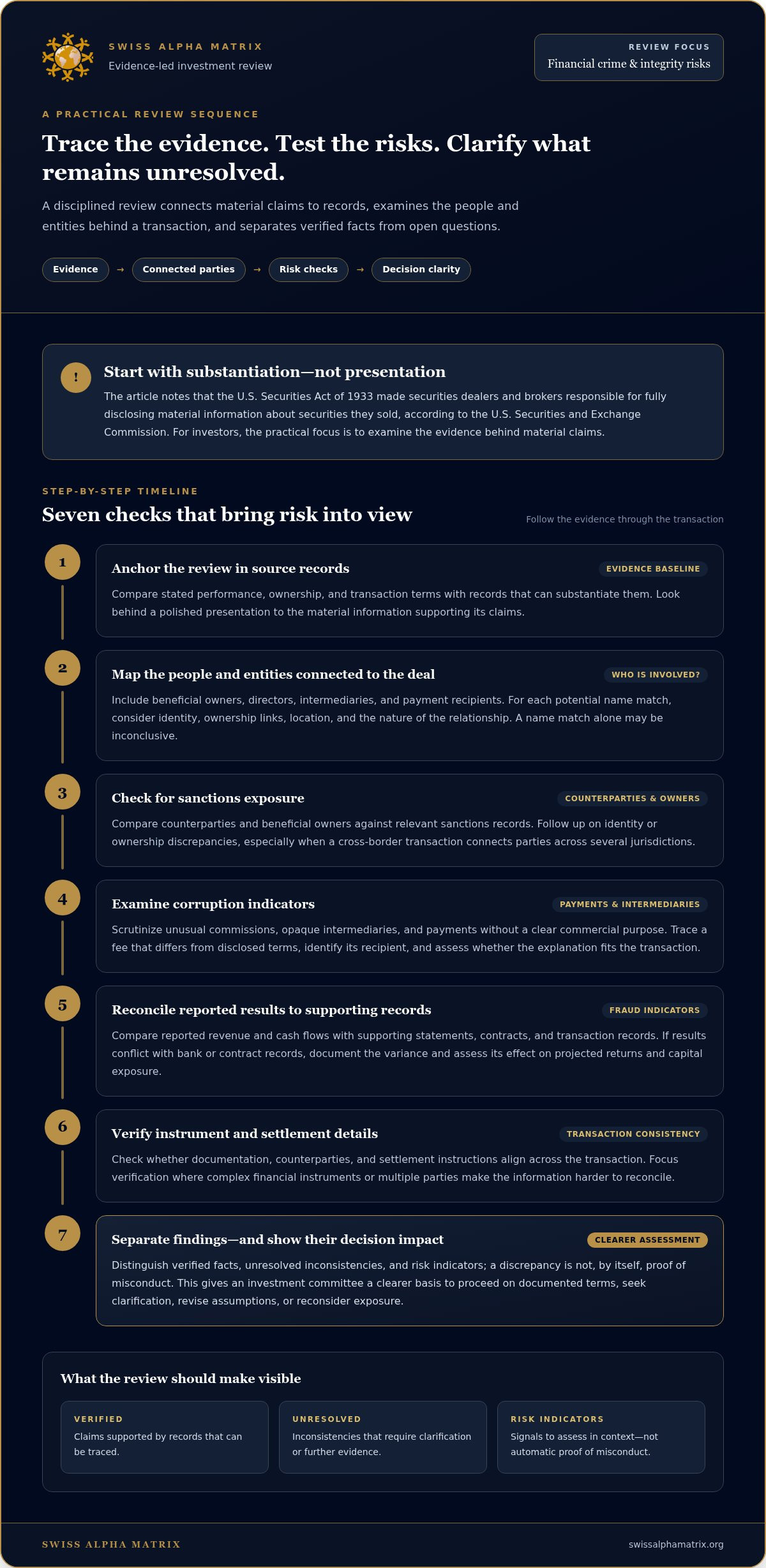
The U.S. Securities Act of 1933 made securities dealers and brokers responsible for fully disclosing material information about securities they sold, according to the U.S. Securities and Exchange Commission. For an investor, that disclosure principle makes evidence central: review the source behind material claims, rather than relying on a polished presentation. Compare stated performance, ownership, and transaction terms with records that can substantiate them.
Financial crime screening examines the people and entities connected to a transaction, including beneficial owners, directors, intermediaries, and payment recipients. A name match alone may be inconclusive. Identity, ownership links, location, and the nature of the relationship help establish whether it concerns the relevant party. In a cross-border deal involving a New York investor, those connections may extend across several jurisdictions.
- For sanctions exposure, compare counterparties and beneficial owners against relevant sanctions records, then resolve identity and ownership discrepancies.
- For corruption risk, examine unusual commissions, opaque intermediaries, and payments lacking a clear commercial purpose.
- For fraud indicators, reconcile reported revenue and cash flows with supporting statements, contracts, and transaction records.
- For instrument concerns, verify that documentation, counterparties, and settlement instructions align across the transaction.
These checks are most useful when tied to a specific investment decision. If an intermediary receives a fee that differs from the disclosed terms, trace the payment, identify its recipient, and assess whether the explanation fits the transaction. If reported results conflict with bank or contract records, document the variance and its effect on projected returns and capital exposure.
Findings should distinguish verified facts, unresolved inconsistencies, and risk indicators rather than treating every discrepancy as proof of misconduct. This gives an investment committee a clearer basis for deciding whether to proceed on documented terms, seek clarification through the deal process, revise assumptions, or reconsider its exposure. For investment due diligence services in New York, a disciplined record of evidence and open issues helps decision-makers see what the review supports and where risks remain.
Investment due diligence for M&A, private equity, pre-IPO, and joint ventures
Review scope depends on the transaction: ownership, valuation assumptions, control rights, and execution risks vary by deal structure.
Diligence Across Investment Types
Due diligence tests the evidence and assumptions behind a proposed investment, tailoring its focus to the deal structure. In an M&A transaction, examine financial statements, projections, market position, litigation, and third-party relationships. Private equity review also considers the company’s performance and operational capacity. Pre-IPO analysis tests material information and readiness, while a joint venture review focuses on governance, contributions, and shared decision rights. These distinctions help investors assess where equity value may depend on execution or counterparties.
Applicable New York and U.S. Regulations
No single rule governs every diligence exercise; relevant requirements depend on the security, transaction structure, and each party’s role. Federal securities rules and New York requirements may apply differently to issuers, brokers, and advisers, so establish those roles before assessing compliance. For a Rule 506 offering, key persons are required to complete the disqualification questionnaire. This regulatory review helps investors identify disclosure and eligibility issues for further assessment.
Financial, Commercial, Legal, and Operational Review Steps
Financial review reconciles statements, cash flows, debt, and projections; commercial review tests market assumptions, customer concentration, and competitive position. Legal review examines transaction documents, ownership, litigation, and contractual obligations. Operational review assesses leadership, staffing, systems, and the ability to deliver projected results. Taken together, these steps connect reported performance with the conditions required to sustain it. Swiss Alpha Matrix’s operational due diligence can support review of operational risks in a complex transaction.
Documents and Data for Investor Review
Request audited or management financial statements, budgets, forecasts, debt schedules, capitalization tables, and material customer or supplier contracts. For a pre-IPO investment, include offering materials and records supporting material claims. For an acquisition or venture, review governance documents, ownership details, key agreements, litigation summaries, and operational procedures. Compare dates, definitions, and figures across documents. For example, a revenue forecast should reconcile with underlying contracts and historical results. An organized document set lets investors trace assumptions to evidence and identify gaps relevant to valuation, control, or execution.
Conflicts of interest and investor alignment
Deal economics, decision rights, and provider independence can shape whether an investment serves each party’s stated interests.
Identifying Conflicts of Interest
A conflict exists when a party’s financial or personal interest may influence its judgment or recommendations. Investors can map those incentives against the transaction’s decision-making structure. For example, a manager’s compensation may reward asset growth, while an investor prioritizes capital preservation and liquidity.
Review the backgrounds and interests of sponsors, advisers, executives, and significant counterparties. Compare disclosed compensation, ownership, related-party arrangements, and allocation policies with the investment’s governing documents. In a joint venture, one party may control supplier selection while another bears part of the cost. Examine this arrangement closely because control and economic exposure may not be aligned.
Alignment also depends on how parties share risk and exercise authority. Examine who approves major decisions, how additional funding obligations work, and whether investors receive consistent information. A clear record helps distinguish a disclosed commercial incentive from an unresolved conflict that could affect valuation, governance, or exit options.
Verifying Provider Credentials and Independence
Provider verification means assessing relevant expertise, work methods, and relationships that could influence the review. To assess a New York due diligence provider’s credentials and independence, review its personnel’s relevant experience, the proposed scope and evidence standards, and written disclosures of financial or business relationships with deal parties. Ask how findings are documented and potential conflicts handled.
Compare the provider’s stated role with the engagement terms. Determine, for example, whether its analysis is independent of the investment sponsor’s commercial interests and whether it can report adverse findings without changing the scope. Request a description of the review process, the records it will examine, and how it will distinguish verified facts from unresolved issues.
A title alone does not establish independence. Consider who pays the provider, whether it has a separate relationship with the issuer or manager, and whether its conclusions are supported by traceable evidence. These checks help investors judge whether the work can inform their decision rather than simply affirm the transaction’s existing narrative.
Context-specific due diligence
The review should reflect the asset, investor, and purpose of the commitment. A private fund, cross-border venture, and direct company investment each create different exposures. For an informed decision, match the evidence examined to the transaction’s structure, operating model, and investor circumstances.
For an alternative investment manager, assess the stated strategy against its track record, team, and investment process. A verifiable history covering 10 or more years, including full market cycles, can help show how the strategy performed under differing conditions. Review Form ADV filings and any SEC examination history as part of the assessment. Compare reported performance with the strategy’s stated risks and the manager’s explanation of changes in personnel or approach.
Investor circumstances also matter. Some alternative investments may generate unrelated business taxable income for tax-exempt accounts or IRAs, while others may require investors to file taxes in multiple states. Many issue Schedule K-1 forms rather than Form 1099; K-1s often arrive late in March or April, potentially delaying tax filing. These features can affect suitability, administration, and reporting obligations, so identify their relevance to the account before assessing the investment’s overall fit.
For a fund commitment, organize the review around the investor’s exposure and the vehicle’s structure:
- Compare strategy, liquidity terms, and reported performance with the investor’s time horizon and capital needs.
- Assess manager background, governance, valuation procedures, and material changes to the investment process.
- Review tax reporting implications for the account type and the states connected to the investment.
- For a cross-border asset, examine where operations occur, who controls them, and how evidence supports reported activity.
Operational due diligence can focus on whether systems, controls, personnel, and counterparties support the stated strategy. For example, a fund investing across jurisdictions needs processes that make ownership, transaction records, and reporting traceable. Discuss context-specific operational due diligence to align the review with the investment’s structure and purpose.
Swiss Alpha Matrix: Audit-Grade Instrument Validation
Swiss Alpha Matrix provides Audit-Grade Instrument Validation for transactions where investment decisions depend on the integrity of financial instruments and supporting documentation. When material records, counterparties, or operational details need closer scrutiny, On-Ground Verification Services and Operational Due Diligence can add relevant evidence. Complex Project Management can coordinate work across parties and workstreams in a transaction.
These services are a natural next step when an investment review identifies evidence gaps, layered documentation, or cross-border operational complexity. The right focus depends on the instrument, transaction structure, and questions to resolve. The aim is to give decision-makers a clearer basis for assessing exposure before committing capital.
To discuss a transaction-specific review, contact Swiss Alpha Matrix or visit swissalphamatrix.org.
Set a Clear Course for the Next Decision
Before committing capital, define how due diligence findings will shape the decision. Establish which issues require revised assumptions, which affect transaction terms, and who has authority to resolve open questions. This governance discipline turns analysis into a practical decision framework rather than a document separate from the investment process. For investors assessing investment due diligence services in New York, align the review’s scope with the decision ahead and the evidence needed to make it.
That alignment can also clarify how findings will be communicated across investment committees, co-investors, and transaction teams. A well-framed mandate gives each participant a shared basis for weighing evidence, documenting rationale, and preserving accountability as a deal progresses. To discuss the requirements of a forthcoming investment review, contact Swiss Alpha Matrix. A measured, evidence-led process can help bring greater clarity to the decisions that shape long-term investment interests.
Frequently Asked Questions
What is investment due diligence?
Investment due diligence is an evidence-based assessment conducted before a funding or acquisition decision. It tests whether the investment’s rationale is supported by records, operating realities, and the parties’ obligations. For example, an investor considering a stake in a growing company might compare its expansion plan with staffing capacity, customer contracts, and working-capital needs. The purpose is to make assumptions and exposures visible before capital is committed.
How long does the due diligence process usually take?
The duration depends on the scope, complexity, and quality of available records. Institutional-quality alternative investment due diligence typically takes 45-60 days; simpler opportunities may be reviewed in four to six weeks, while more complicated investments can take three to six months. Delays can arise when records are fragmented, several parties must provide evidence, or material questions require additional analysis before the review can be completed.
Why is due diligence so important?
Due diligence helps investors decide whether an opportunity’s expected return justifies its risks and terms. It can reveal when a proposed investment depends on assumptions that warrant more scrutiny, such as a forecast reliant on one major customer or an operating plan dependent on a key executive. That understanding supports more disciplined decisions about valuation, conditions, exposure, or whether to proceed, rather than relying solely on the sponsor’s investment narrative.
What investment due diligence services do New York firms provide?
Services vary by mandate and may include financial, commercial, legal, and operational review, along with examination of investment instruments and transaction execution. For investors seeking investment due diligence services in New York, Swiss Alpha Matrix offers Audit-Grade Instrument Validation, On-Ground Verification Services, Complex Project Management, Operational Due Diligence, Regulatory Compliance Advisory, and Risk Management Frameworks. Scope should reflect the transaction’s structure and the specific decision the investor must make.
How long does investment due diligence typically take in New York?
In New York, timing depends chiefly on transaction complexity and access to reliable records, not the city alone. A domestic acquisition with organized documentation may move differently from a cross-border investment involving multiple entities, operating locations, or counterparties. Reviews also take longer when important assumptions need independent corroboration or several workstreams must be reconciled before decision-makers can assess the findings.
What risks and red flags should investors look for in a target company?
Look for operational signs that reported performance may not be sustainable: unexplained departures among senior leaders, repeated changes in key reporting definitions, dependence on one supplier, or customer relationships without durable contractual support. A forecast that assumes rapid expansion without corresponding hiring or capacity plans also warrants scrutiny. Evaluate each indicator in context, then trace its potential effect on execution, cash generation, governance, and the investment’s stated rationale.