

A well-presented investment report can still leave the central decision unsupported. An investment due diligence report template should do more than organise completed checks: it should show how verified evidence informs material risk ratings, assumptions, and recommendations. Without that traceability, findings are difficult to compare, and distinctions between fact and judgment can disappear.
A sound report structure is repeatable, but not rigid. The analysis should reflect the mandate, investment, and jurisdictions involved, while making clear what was reviewed, what remains uncertain, and which issues require a decision. When documentary analysis alone cannot establish operational realities, on-ground verification can provide another layer of evidence.
This framework sets out the core sections of an executive-ready report and explains how to connect each finding to its source, significance, and proposed response. It covers risk ratings, limitations, cross-border considerations, and decision points, so the finished document serves as a disciplined record for capital allocation, not just a completed checklist.
Key Takeaways
- Use the report as a decision record that connects the investment mandate, supporting evidence, material risks, and investment implications.
- Build an investment due diligence report template around a consistent sequence, then tailor its scope to the transaction, asset, and jurisdictions involved.
- Label evidence by source, date, relevance, reliability, and corroboration status so reviewers can assess the basis for each finding.
- Distinguish the overall recommendation from individual findings, and make the reasoning behind each decision option explicit.
- Consider operational or on-ground verification when documentary review alone cannot establish how an asset or business performs in practice.
What an Investment Due Diligence Report Must Help You Decide
An investment due diligence report is a decision record. It connects the mandate and scope of review to the evidence examined, the material risks identified, and the implications for committing capital. Its purpose is not simply to document activity, but to make the reasoning behind a decision clear to those authorised to approve, defer, or reject it. A useful overview of due diligence describes the broader practice; an investment report applies that discipline to a specific opportunity and decision.
A checklist and a report serve related but distinct functions. The checklist tracks requested work, documents received, and outstanding enquiries. The report explains what that work means. A completed checklist may show that financial statements were reviewed; a decision record explains what the review supports, where uncertainty remains, and how the conclusions affect the investment thesis.
The report’s scope should reflect the investment type, transaction stage, and mandate. An early screening may focus on whether an opportunity merits further analysis, while confirmatory diligence tests assumptions before a commitment. Ongoing oversight may focus on changes in exposure, performance, controls, or operating conditions. A reusable investment due diligence report template provides a consistent structure, but the analysis still needs to address the asset, transaction, material risks, and assumptions at hand.
Who uses the report, and at what decision point?
Investment committees, principals, executives, and other authorised decision-makers need conclusions they can act on and evidence they can examine. The level of detail should match the decision. Screening requires a clear view of whether to advance; confirmatory review should expose unresolved matters that could alter terms or approval; ongoing oversight should make changes and escalation points visible. State decision-critical issues clearly rather than burying them in supporting materials.
What a strong report can and cannot establish
Diligence assesses evidence and exposure; it does not eliminate investment risk or guarantee an outcome. Distinguish verified facts from management representations, estimates, and analytical judgments. For example, audited historical figures, an unaudited forecast, and an analyst’s sensitivity assessment have different evidential standing. Do not present them as interchangeable. Identify the basis for each conclusion and disclose material limitations or assumptions.
A defensible capital decision rests on conclusions traceable to relevant evidence, with material uncertainties and their investment implications stated plainly. The report should not claim certainty where none exists. It should explain what supports the decision, what could change it, and where further scrutiny may be warranted.
Investment Due Diligence Report Template: The Core Sections
A reliable report structure gives reviewers a consistent path from mandate to decision without implying that every transaction needs identical analysis. Use the investment due diligence report template as a starting point, then tailor its coverage to the subject, transaction stage, relevant jurisdictions, and decision rights. Cross-border mandates require particular care: the cross-border investment due diligence framework offers broader context on how jurisdictions shape review scope.
Start with an executive summary that identifies the opportunity, principal material issues, and decision required. Keep it concise, but make each conclusion traceable to findings in the report or appendices. Decision-makers should be able to understand the central implications without mistaking a summary judgment for supporting evidence.
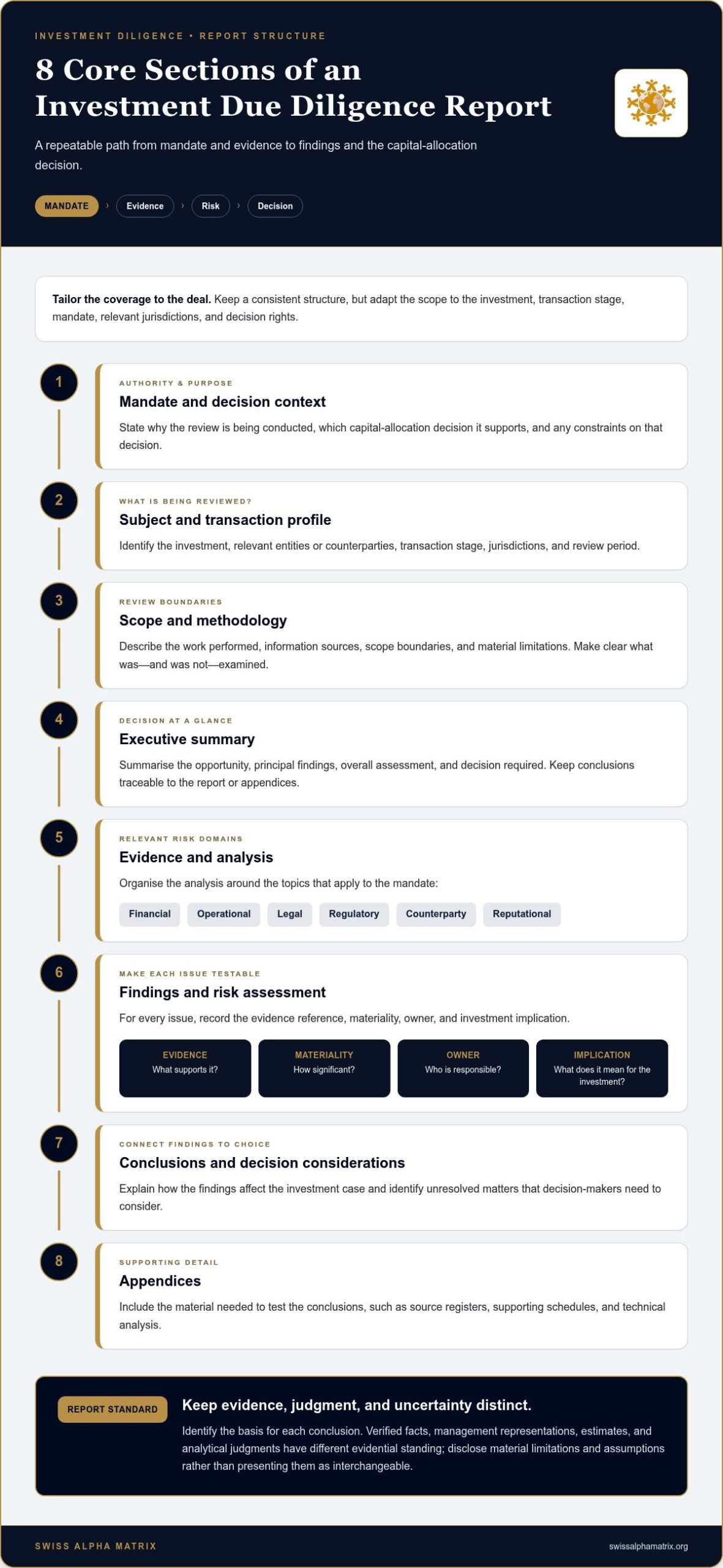
Then organise the report in a sequence that moves from authority and scope to substantiated conclusions:
- 1. Mandate and decision context: State the purpose of the review, the capital-allocation decision it supports, and any decision constraints.
- 2. Subject and transaction profile: Identify the investment, relevant entities or counterparties, transaction stage, jurisdictions, and review period.
- 3. Scope and methodology: Describe the work performed, information sources, scope boundaries, and material limitations.
- 4. Executive summary: Present the opportunity, principal findings, overall assessment, and decision required.
- 5. Evidence and analysis: Organise relevant financial, operational, legal, regulatory, counterparty, and reputational topics as applicable.
- 6. Findings and risk assessment: Record each issue with its evidence reference, materiality, owner, and investment implication.
- 7. Conclusions and decision considerations: Explain how findings affect the investment case and identify unresolved matters for decision-makers.
- 8. Appendices: Provide source registers, supporting schedules, technical analysis, and other detail needed to test the conclusions.
Build the report around scope, subject, and evidence
Define the review perimeter before interpreting results. Name the entities and jurisdictions covered, specify the period, and state what the work did and did not examine. This helps prevent readers from treating an unreviewed area as cleared. Arrange the analysis by relevant risk domain, adapting the categories to the mandate rather than including headings that suggest work was performed when it was not.
Present findings so executives can act
Use a consistent format for each finding: condition, evidence, materiality, implication, and action. Assign an accountable owner and a precise source reference. Distinguish confirmed facts from open questions, assumptions, estimates, and management statements. Keep detailed registers and technical schedules in appendices, while giving the main report enough context for executives to understand why each finding matters.
For mandates requiring disciplined, independent scrutiny, mandate-specific due diligence and oversight can help align report scope, source traceability, and decision requirements.
How to Evaluate Evidence, Materiality, and Investment Risk
A finding is only as dependable as its supporting evidence and the clarity with which its limits are stated. In an investment due diligence report template, record enough information for a reviewer to locate each material source and understand how it supports the conclusion. Useful evidence labels include source, date, relevance to the investment question, reliability, and corroboration status. This makes the analytical trail visible instead of leaving reviewers to infer how a conclusion was reached.
Create a traceable evidence record
Give every material conclusion a reference to a document, interview, data source, or other supporting record. Note who or what produced it, when it was reviewed, any limitations, and whether independent corroboration exists. A management presentation, for instance, may explain a stated operating process, but it does not by itself establish that the process is consistently followed in practice.
Document review has limits. If a question concerns actual operating conditions, control execution, or an asset’s observable state, records may need to be supplemented by relevant operational or on-ground verification. State whether that work took place and what it established. Do not imply that documentary evidence answers questions it cannot resolve.
Keep evidence categories distinct in the report:
- Verified fact: Supported by a source reviewed and assessed as reliable for the stated point. Record the source and review date.
- Representation: A statement made by management or another interested party that has not been independently established. Identify its origin.
- Assumption: A premise used in analysis, such as an input to a forecast. Explain why it is used and how it affects the conclusion.
- Unresolved matter: A question for which available evidence is incomplete, inconsistent, or insufficient. Describe its potential decision relevance.
Keep conflicting evidence visible. Record the sources and the nature of the inconsistency, assess their relative reliability and recency, and explain whether the conflict changes the analysis. If it cannot be resolved within scope, identify the uncertainty and its possible investment consequence rather than choosing the more convenient account.
Rate risk without creating false precision
Set qualitative rating criteria before applying them across findings. Consider potential impact, likelihood, and context, including the exposure’s relationship to the investment thesis and whether existing controls change the consequences. An isolated issue may warrant a different assessment from a recurring weakness with broader implications, even if both fall within the same diligence category.
Risk ratings are useful only when their criteria are documented, applied consistently, and tied to the evidence supporting each assessment. Alongside each rating, state the rationale and potential investment consequence, such as whether the issue could affect expected performance, execution, or approval conditions. Where evidence is limited, qualify the rating instead of presenting it as a precise measurement.
Turn Due Diligence Findings into Clear Decision Options
Findings become useful to decision-makers when the report explains how they affect the investment case as a whole. Keep the overall recommendation distinct from individual risk ratings: one serious issue may shape the decision, while several lower-level findings may collectively change the opportunity’s risk profile. Explain how evidence and materiality lead to the stated investment implications, so the recommendation is neither a summary of isolated scores nor a conclusion unsupported by the analysis.
Decision options should describe the opportunity’s status and the basis for that status. Depending on the mandate and findings, the report may recommend:
- Proceed: Available evidence supports the investment case, with no identified issue that materially changes the decision.
- Proceed subject to conditions: Approval is supportable only if specified matters are resolved or defined safeguards are put in place.
- Defer: A decision should wait for material information or clarification that could change the assessment.
- Decline: The identified exposure, evidence limitations, or conflict with the mandate does not support proceeding.
These are decision frameworks, not automatic outcomes. Explain why the selected option fits the mandate and how unresolved matters affect it. A conditional recommendation, for example, should name the condition and the evidence needed to show it has been met. It should not present an open question as resolved.
Write an executive summary that preserves nuance
Lead with the decision requested, followed by the most material findings and their investment implications. Summarise evidence that supports the thesis alongside significant limitations. Use measured language to distinguish established conclusions from qualified assessments. Keep technical schedules and detailed analysis available in the report, but make the decision narrative understandable without requiring committee members to reconstruct it from appendices.
A useful summary answers three questions directly: What is being considered? What could most affect the investment decision? What action is recommended, and on what basis? If a key conclusion depends on an assumption or incomplete evidence, name that dependency. This helps authorised readers judge whether the recommendation is robust, conditional, or sensitive to further information.
Convert open issues into accountable next steps
Turn each unresolved matter into a proportionate action. Record an accountable owner, the evidence or response required, and an appropriate review point. Distinguish matters that must be addressed before approval from measures that can be monitored after investment. State how each open item affects the recommendation rather than presenting future work as a substitute for a current conclusion.
For example, if a material operational question remains unverified, specify what evidence would resolve it and whether the decision should be deferred or made conditional. Connect each finding to a concrete decision option and an appropriate oversight action. To align findings, decision options, and oversight requirements within a mandate, explore mandate-specific due diligence and project oversight.
Apply the Template to Complex Deals with Independent Oversight
A reusable report structure brings consistency, but complex transactions require a scope and depth of review tailored to the mandate. Adapt the investment due diligence report template to the asset’s characteristics, transaction structure, relevant jurisdictions, dependencies between parties, and decision rights. This keeps the work focused on exposures that could affect execution or capital protection, rather than applying uniform coverage that obscures what matters in a particular deal.
Adapt the report to cross-border complexity
For a cross-border transaction, map the entities, counterparties, jurisdictions, and dependencies within the mandate. A transaction may involve several operating entities, financing relationships, or delivery arrangements; explain how each relates to the investment case. Identify jurisdiction-specific questions for appropriately scoped review, and avoid broad conclusions that exceed the evidence or mandate. Where regulatory context informs the analysis, the international financial regulations guide provides further context.
Tailoring also means deciding where documentary analysis is sufficient and where it leaves a material question unanswered. Records may describe an asset, control environment, or operating process without establishing its condition or performance in practice. In those circumstances, on-ground verification can test relevant assumptions against observed conditions. Clarify what was examined, what was verified, and what remains outside the review’s evidential reach.
Connect report findings with execution oversight
Keep conditions and actions identified in the report visible as the transaction advances. Translate each material action into a milestone, with a responsible party, the evidence needed to demonstrate progress, and a review point aligned with the decision process. This helps decision-makers distinguish a condition that must be resolved before proceeding from an implementation matter that can be monitored later, without treating either as complete prematurely.
Independent review can add discipline by testing assumptions, assessing source reliability, and examining whether material actions appear operationally ready. Swiss Alpha Matrix provides mandate-specific due diligence and complex project oversight, informed by senior executives’ experience at Tier-1 global banks. Where the mandate calls for it, documentary analysis can be complemented by on-ground verification, connecting written evidence with operational realities. Together, these methods support a considered view of exposure and execution readiness while preserving the distinction between evidence and judgment.
A carefully tailored investment due diligence report template is a foundation, not a substitute for transaction-specific analysis. Its value lies in maintaining a traceable line from mandate to findings and from findings to execution, with independent scrutiny applied where it can inform the decision. To discuss a complex investment mandate, speak with Swiss Alpha Matrix.
Make the Framework Part of Your Investment Discipline
A report framework creates lasting value when it informs not only the approval decision, but also how the mandate is revisited as circumstances change. Treat the investment due diligence report template as a working reference: revisit its assumptions when new information emerges, and use its decision record to keep later judgments anchored to the original investment rationale.
This approach supports continuity without turning the report into a static compliance exercise. It gives authorised decision-makers a considered basis for assessing whether new developments warrant closer scrutiny, a change in oversight, or a fresh review of the investment thesis. The appropriate cadence and scope depend on the mandate and the nature of the exposure.
For complex investment programmes, independent scrutiny can bring analytical discipline to capital-allocation decisions while keeping the review specific to the circumstances at hand. Discuss a complex investment mandate with Swiss Alpha Matrix to consider how tailored due diligence and project oversight can support your decision process. A clear framework is a sound beginning; thoughtful application gives it lasting value.
Frequently Asked Questions
Is there a standard investment due diligence report format?
There is no single format for every investment, although organisations can use a consistent report structure. An investment due diligence report template can establish common headings and documentation practices, then be adapted to the asset, transaction stage, mandate, and intended decision. A review of a financial instrument, for example, may require different supporting analysis from a review of an operating business. Make the purpose and boundaries of each review clear.
What is the difference between an investment due diligence report and a checklist?
A checklist helps manage the review process; a report explains what the work established and what it means for the decision. A checklist might record that a document was requested or received. The report explains whether it answers the investment question, leaves a gap, or raises a concern that warrants further analysis. Keeping both helps teams track completion while giving decision-makers an analytical record rather than a list of tasks.
Who should prepare an investment due diligence report?
The report should be prepared by people with relevant analytical expertise, access to appropriate evidence, and a clear understanding of the mandate and decision being supported. Depending on the investment, this may require input across financial, operational, risk, and jurisdiction-specific areas. Establish who is responsible for analysis, review, and approval, and disclose material limitations or potential conflicts. Independent scrutiny can strengthen the assessment when decision-makers need a separate evaluation of key assumptions or sources.
How should a report handle information that cannot be independently verified?
Identify the information as an unverified representation or estimate, name its source, and state why independent verification was not possible within the review. Explain whether it materially affects a valuation assumption, forecast, or operational conclusion. For example, if a projection depends on management-provided sales figures that could not be reconciled to underlying records, describe that dependency and how it limits confidence in the analysis. Do not present the claim as an established fact.
How often should an investment due diligence report be updated?
Update timing should follow the decision context and the pace at which material facts may change, rather than an assumed universal interval. Revisit the report before a delayed approval if key information, transaction terms, counterparties, or market conditions have changed. After investment, an update may be appropriate when a material event affects an earlier assumption or identified exposure. Keep the original version and document what changed, why, and whether the decision implications differ.
Can an investment due diligence report replace legal or regulatory advice?
No. A due diligence report can identify issues relevant to a transaction and record the scope of regulatory or legal review, but it does not replace advice from appropriately qualified legal or regulatory professionals. For a cross-border transaction, requirements may depend on the jurisdictions, entities, instruments, and activities involved. Distinguish analytical findings from formal legal conclusions and identify matters requiring jurisdiction-specific interpretation. A general template does not resolve them.
What should an executive summary include in an investment due diligence report?
An executive summary should identify the investment under review, the decision requested, the principal reasons for the assessment, and any material caveats that could affect approval. State the recommended next step and make clear whether it depends on outstanding information or conditions. Direct readers to the detailed analysis supporting key judgments so committee members can locate the basis for a conclusion without relying on an unsupported headline rating.