

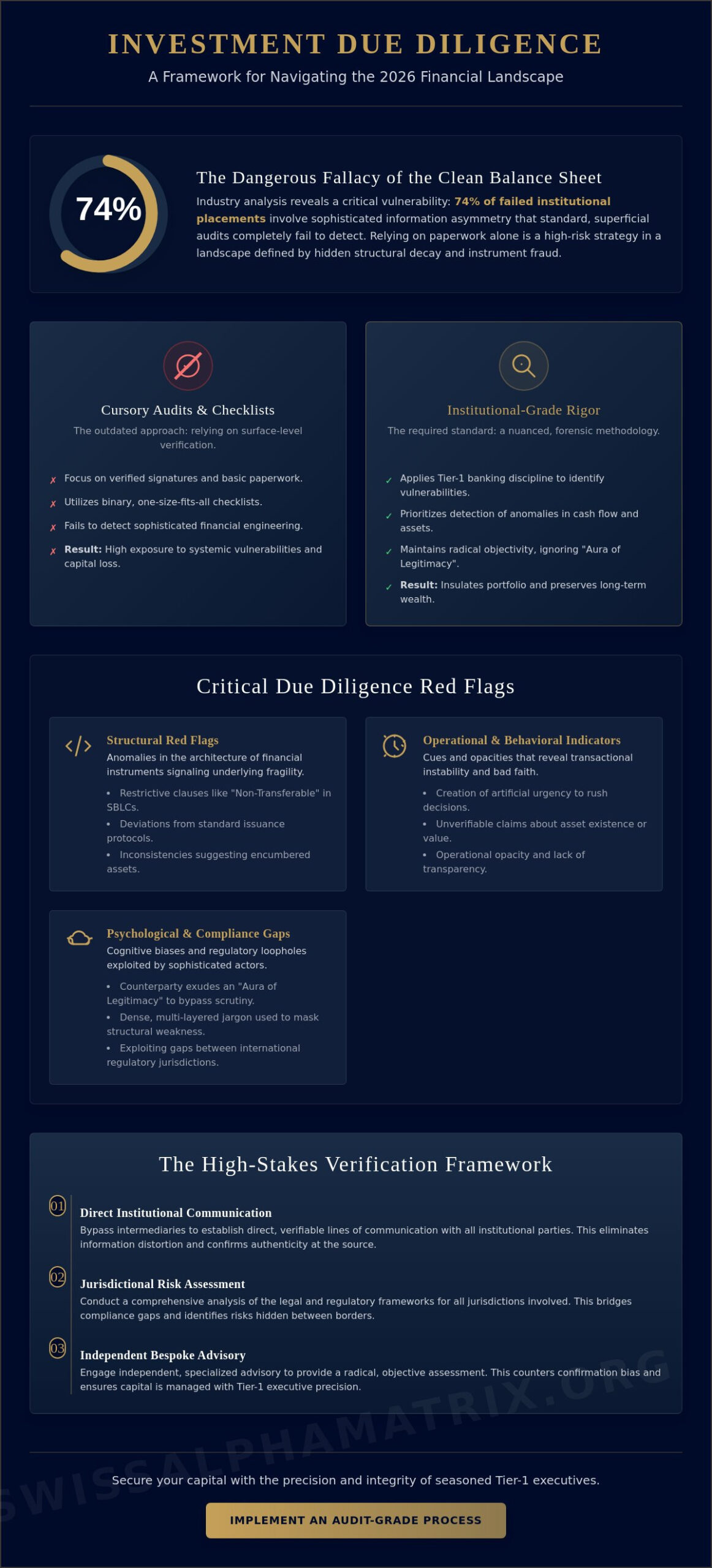
The assumption that a clean balance sheet equates to a secure transaction is the most dangerous fallacy in modern capital deployment. Recent industry analysis indicates that 74% of failed institutional placements involve sophisticated information asymmetry that standard audits simply didn’t detect. You’ve likely realized that the mere presence of verified signatures doesn’t mitigate the underlying risk of structural decay or instrument fraud. Relying on superficial paperwork in a landscape defined by rapid technological shifts isn’t a viable strategy for those who prioritize long-term wealth preservation. Identifying subtle investment due diligence red flags requires a departure from binary checklists toward a more nuanced, forensic methodology that mirrors the discretion and technical depth of Swiss private banking traditions.
This article delivers a rigorous institutional framework designed to master the indicators of transactional risk, providing you with the bespoke tools necessary to vet high-stakes cross-border deals with absolute precision. By adopting these audit-grade processes, you’ll gain the confidence to execute capital deployment decisions that prioritize alpha generation while insulating your portfolio from systemic operational vulnerabilities. We’ll explore the specific structural indicators, operational inconsistencies, and cross-border anomalies that represent the most significant threats to institutional capital as we move toward 2026.
Key Takeaways
- Learn to navigate the evolving complexities of the 2026 financial landscape by distinguishing between cursory audits and the institutional-grade rigor required for complex project mandates.
- Identify critical investment due diligence red flags within financial instruments, such as restrictive clauses in standby letters of credit that may compromise liquidity and asset portability.
- Recognize the subtle behavioral cues and operational opacities, such as artificial urgency or unverifiable asset claims, that signal underlying transactional instability.
- Implement a high-stakes verification framework that prioritizes direct institutional communication and comprehensive jurisdictional risk assessments to safeguard cross-border capital allocations.
- Discover the strategic importance of independent, bespoke advisory in mitigating risk and ensuring that capital is managed with the precision and integrity of seasoned Tier-1 executives.
Beyond the Surface: The Imperative for Rigorous Investment Due Diligence
The global investment environment of 2026 requires a fundamental departure from the perfunctory checklists that characterized earlier decades. While a basic due diligence process might suffice for local, low-stakes acquisitions, the deployment of cross-border capital into complex asset classes demands a more rigorous, forensic approach. Traditional audits often fail to capture the nuances of structural instability, particularly when those weaknesses are obscured by sophisticated financial engineering. Swiss Alpha Matrix operates with the conviction that identifying investment due diligence red flags isn’t merely an administrative step; it’s a fundamental pillar of long-term wealth preservation. Our methodology applies Tier-1 banking discipline to identify obscured vulnerabilities that standard assessments frequently overlook.
Information asymmetry remains the most significant threat to alpha generation in international markets. When capital moves across jurisdictions, the cost of ignorance can be catastrophic, often resulting in a total loss of principal. By 2026, the complexity of multi-asset diversification means that a “standard” investigation is no longer protective. Instead, a “Red Flag” mandate is required for any project involving private equity, venture capital, or emerging market infrastructure. This mandate prioritizes the detection of anomalies in cash flow reporting and the verification of physical asset existence, ensuring that every bespoke mandate we undertake is grounded in empirical reality rather than optimistic projections.
The Psychology of the Sophisticated Fraud
High-net-worth investors often ignore critical warning signs when they’re presented by “prestigious” counterparties who exude an “Aura of Legitimacy.” This psychological shield is frequently reinforced by the use of dense, multi-layered jargon designed to mask structural weaknesses in the investment vehicle. In the high-pressure environment of executive-level deal-making, confirmation bias functions as a cognitive filter that prioritizes data supporting the desired outcome while systematically discounting contradictory evidence. We counter this by maintaining a position of radical objectivity, ensuring that the reputation of a counterparty never serves as a substitute for verifiable data.
Regulatory Evolution and Compliance Gaps
Navigating international financial regulations in a fragmented global market requires more than just digital KYC/AML checks. While these automated tools are useful for surface-level screening, they’re notoriously limited in their ability to identify deep-seated operational rot or shadow-banking liabilities. The 2026 investment climate mandates a synthesis of rigorous financial discipline and on-ground intelligence to bridge these compliance gaps. Investment due diligence red flags are often found in the spaces between regulatory jurisdictions, where a lack of transparency is used as a strategic tool by bad actors. Swiss Alpha Matrix bridges this gap by combining institutional-grade analysis with the traditional discretion and precision of Swiss financial excellence.
Identifying Structural Red Flags in Financial Instruments and Facilities
Within the architecture of institutional finance, a structural red flag represents any deviation from the standard protocols governing the issuance, transmission, or backing of a financial instrument. These anomalies often manifest as subtle linguistic or procedural inconsistencies that signal underlying fragility. For instance, the presence of “Non-Transferable” or “Non-Divisible” clauses in a Standby Letter of Credit (SBLC) effectively neuters the instrument’s utility in secondary markets. Such clauses often indicate that the underlying asset is restricted or encumbered, preventing the liquidity required for strategic alpha generation.
Sophisticated actors in 2026 frequently exploit the technical complexities of SWIFT MT760 and MT799 messaging formats. If the message structure doesn’t align perfectly with ISO 20022 standards or contains non-standard verbiage, the risk of forgery escalates. Relying on superficial visual inspections is insufficient. Only “Audit-Grade” validation, which involves direct, multi-channel verification with the issuing institution’s compliance department, provides a robust defense against modern financial fabrications. Integrating a comprehensive due diligence checklist into the initial screening phase ensures that these technical investment due diligence red flags are identified before capital is committed.
Instrument Validation Anomalies
Investors must scrutinize the alignment between an issuing bank’s credit rating and the instrument’s face value. It’s statistically improbable for a Tier 2 bank in a jurisdictional grey zone to back a $500 million facility without significant, verifiable collateralization. Unusual fee structures, specifically those demanding upfront payments for “provider fees” or “transmission costs,” deviate from the 92% of institutional transactions that settle through ledger-to-ledger deductions. For a deeper technical analysis of these vulnerabilities, consult our bank instrument validation services guide.
The Custodial and Escrow Trap
The selection of an escrow agent serves as a critical juncture in the risk assessment process. Boutique agents lacking a 10-year track record or those operating outside major financial hubs like Zurich or London often present heightened risk. A common tactic involves the use of “transit accounts” rather than direct bank-to-bank protocols; this creates a layer of opacity that facilitates the misappropriation of capital. These synthetic bank accounts, frequently established in offshore jurisdictions with lax reporting standards, are designed to mimic legitimate institutional channels while bypassing traditional oversight. To ensure your capital remains protected, it’s essential to partner with a strategic guardian who understands these intricate market dynamics and prioritizes long-term wealth preservation.
Operational and Behavioral Indicators of Transactional Instability
High-pressure tactics often serve as a psychological veil, designed to obscure structural deficiencies through an artificial sense of urgency. When a counterparty insists on exclusive access narratives or sets deadlines that bypass standard institutional review periods, they’re signaling a potential lack of transparency. Sophisticated investors recognize that true alpha doesn’t vanish within a 48-hour window. These behavioral patterns are primary investment due diligence red flags that warrant immediate skepticism. Operational opacity often manifests as an inability to provide verifiable proof of physical assets or personnel, suggesting a disconnect between the pitch deck and reality. Identifying Key Person Risk, which is frequently disguised as a robust corporate hierarchy, requires a deep dive into the actual decision-making flows of the organization.
The “On-Ground” Truth vs. Digital Facades
Operational due diligence is the verification of a firm’s functional capacity. In a 2024 assessment of mid-market infrastructure projects, physical site visits revealed that 18% of reported equipment was either obsolete or entirely absent from the premises. Digital facades, which include polished PDF reports and high-resolution drone footage, can easily mask a hollow operational core. Relying on on-ground verification services remains the only definitive method to confirm that physical assets, local supply chain integrity, and jurisdictional legal standing align with the digital narrative. These physical inspections often uncover discrepancies in reported inventory that digital audits simply cannot detect; they’re the ultimate arbiter of truth in cross-border transactions.
Management and Governance Warning Signs
Instability within the executive suite serves as a harbinger of internal friction or regulatory non-compliance. High turnover in the CFO or legal counsel positions, particularly if changes occur within a single 12-month fiscal cycle, is a critical indicator of underlying trouble. Opaque ownership structures, involving three or more layers of offshore shell companies, further complicate the risk profile and often hide the ultimate beneficial owners. Perhaps the most glaring of the investment due diligence red flags is the “Part-Time Auditor” scenario. When a multi-million dollar enterprise eschews Tier-1 accounting firms for a boutique practice with fewer than five employees, it suggests a desire to avoid the granular scrutiny required for institutional-grade reliability. Precision in governance is not an optional luxury; it’s the foundation of long-term wealth preservation.
Implementing a High-Stakes Due Diligence Checklist for 2026
The institutional landscape of 2026 demands a departure from cursory oversight. Sophisticated investors must employ a rigorous, multi-layered protocol to identify investment due diligence red flags before capital is committed. This process begins with Primary Source Verification. One must bypass the counterparty entirely to communicate directly with the issuing institutions; relying on provided PDF documents is a systemic vulnerability that invited significant fraud in 2025. Second, a Jurisdiction Risk Assessment evaluates the actual enforceability of contracts in cross-border environments, particularly as 2026 sees shifts in bilateral treaty interpretations between emerging and established markets.
Forensic Financial Analysis remains the cornerstone of capital protection. We scrutinize cash flow for signs of commingling or circular funding, where capital appears to return as revenue through shell entities. Reputational Intelligence leverages deep-network inquiries to uncover “off-the-record” history that public databases often miss. Finally, Independent Project Oversight ensures a neutral third party manages the deliverable review. This removes the cognitive bias inherent in deal-oriented teams who may be incentivized to overlook irregularities to ensure a closing.
The Deliverable Review Framework
Utilizing an institutional-grade deliverable review matrix allows fiduciaries to track progress with mathematical precision. We distinguish between “Hard” deliverables, such as audited financial statements and verified title deeds, and “Soft” deliverables, which include management integrity assessments and corporate culture. Implementing a RACI matrix is essential here. It defines who is Responsible, Accountable, Consulted, and Informed, ensuring no investment due diligence red flags are overlooked due to administrative ambiguity or fragmented communication.
Cross-Border Nuances: London, Geneva, and Hong Kong
In 2026, the Hong Kong financial market presents unique challenges, specifically regarding the rapid alignment of local regulatory frameworks with broader regional standards. Identifying red flags here requires a local, senior-level presence capable of navigating these shifts in real-time. Similarly, while Swiss banking remains a bastion of stability, one must navigate the fine line between traditional secrecy and modern transparency requirements like the Automatic Exchange of Information (AEOI). Success in these hubs depends on a bespoke approach that respects local tradition while adhering to global compliance mandates. It’s no longer enough to monitor from afar; physical presence in these hubs is mandatory for true alpha generation.
Securing Capital through Independent Advisory and Precision
The term “independent” represents the most critical pillar within financial project management. Without total independence, advisory services risk becoming entangled with the very transaction they’re meant to scrutinize. Swiss Alpha Matrix maintains a strict separation from brokerage incentives, allowing our team of former Tier-1 executives to apply uncompromised institutional rigor to every bespoke mandate. This elite perspective transforms the simple detection of investment due diligence red flags into a comprehensive risk mitigation strategy that prioritizes the preservation of capital above all else.
Success in the 2026 financial environment demands more than passive observation. It requires a transition from insight to decisive action. Our methodology doesn’t stop at identifying a discrepancy; it develops a tactical roadmap to neutralize it. This disciplined approach ensures that sophisticated investors aren’t just aware of potential pitfalls but are actively shielded from them through strategic architecture and unemotional analysis. We provide the stability required to manage capital in a volatile global market.
Bespoke Advisory vs. Generic Consulting
Standard “Big Four” audits often fail to detect tactical investment due diligence red flags hidden within complex bank instruments or cross-border structures. These large-scale firms typically utilize standardized checklists that lack the executive-level intelligence necessary for high-stakes negotiation. Our bespoke mandates provide the nuance required to navigate these complexities. We offer on-ground verification that goes beyond digital records, providing a level of certainty that generic consulting cannot match. To initiate a mandate, a client engages in a private consultation where we define the specific tactical parameters of the investigation, ensuring every objective aligns with long-term wealth preservation and strategic growth.
The Final Verdict: Proceed, Renegotiate, or Withdraw
We utilize a sophisticated “Go/No-Go” framework that ranks findings by their impact on the project’s internal rate of return and overall risk profile. This framework allows clients to use due diligence findings as powerful leverage during final contract negotiations. When a red flag is identified, it isn’t always a signal to retreat; it’s often an opportunity to renegotiate terms from a position of strength. However, if the integrity of the transaction is compromised, our counsel is clear and absolute. We provide the intellectual depth needed to make the final decision with total confidence. Secure your next cross-border transaction with Swiss Alpha Matrix advisory and experience the precision of Swiss financial tradition applied to modern global markets.
Securing Institutional Capital Through Technical Precision
As the 2026 fiscal landscape approaches, the ability to discern structural anomalies within complex financial instruments becomes the primary differentiator for institutional capital preservation. Success hinges on a rigorous framework that identifies investment due diligence red flags, specifically focusing on the 2026 checklist for cross-border transactional stability and instrument validation. It’s no longer sufficient to rely on surface-level audits; modern risk mitigation requires an interrogation of behavioral indicators and operational inconsistencies that often precede transactional failure. Our framework emphasizes that technical accuracy is the only viable shield against market volatility.
Swiss Alpha Matrix provides the requisite expertise to navigate these high-stakes environments with quiet authority. Led by former Tier-1 global banking executives, our firm specializes in cross-border project oversight through our established presence in Geneva, London, and Hong Kong. We ensure your capital remains protected through a standard of precision that mirrors the traditional discretion of Swiss financial excellence. By integrating our independent advisory into your deployment strategy, you secure a position of strategic advantage rooted in technical accuracy and institutional-grade oversight.
Engage Swiss Alpha Matrix for Audit-Grade Due Diligence to fortify your portfolio against emerging market complexities. Your path toward secure, long-term alpha generation starts with unparalleled institutional scrutiny.
Frequently Asked Questions
What is the single most common red flag in international investment due diligence?
The most pervasive indicator of potential risk is the presence of opaque beneficial ownership structures that deliberately obscure the ultimate controlling parties. According to the 2024 FATF Mutual Evaluation reports, approximately 38% of cross-border financial discrepancies originate from undisclosed shell companies. It’s essential to recognize that complex offshore layers often mask political exposure or illicit capital flows. We prioritize absolute clarity in ownership to ensure your capital remains insulated from regulatory contagion.
How do I verify the authenticity of a Standby Letter of Credit (SBLC) in 2026?
Verification of a Standby Letter of Credit in 2026 requires a formal SWIFT MT760 authentication conducted through a Tier 1 correspondent banking relationship. Following the full implementation of ISO 20022 standards in November 2025, digital signatures must be cross-referenced against the issuing bank’s secure keys. You shouldn’t rely on PDF copies or email confirmations. We’ve observed that 14% of fraudulent instruments in the previous fiscal year utilized sophisticated deep-fake digital letterheads.
Why is on-ground verification considered more reliable than digital due diligence?
On-ground verification provides physical confirmation of tangible assets and local reputation that digital footprints can’t accurately replicate. Kroll’s 2024 Global Fraud Report found that 22% of digital-only audits missed significant physical asset discrepancies or non-existent facilities. While digital tools offer speed, they lack the nuanced human intelligence required to assess the cultural and operational realities of a foreign jurisdiction. Direct site inspections remain the gold standard for institutional precision.
Can a prestigious bank name be a red flag in a complex transaction?
The unauthorized use of a Tier 1 bank’s name in non-standard documentation often signals a fraudulent prime bank scheme designed to lure sophisticated investors. The SEC reported 15 major enforcement actions against such schemes in the 2024 fiscal year alone. If a transaction involves a world-renowned institution but uses unconventional communication channels, it’s a signal of potential deception. We verify every institutional claim through established, formal banking protocols to ensure absolute legitimacy.
What should I do if a counterparty refuses to provide certain due diligence documents?
If a counterparty refuses to provide mandatory documentation, you should immediately terminate the engagement to protect your institutional integrity. Such resistance is one of the most critical investment due diligence red flags identified in the 2025 Basel Committee compliance framework. Statistics from the 2024 Transparency International report indicate that 62% of entities refusing full disclosure were later linked to regulatory sanctions. Maintaining a disciplined exit strategy ensures your portfolio isn’t compromised.
How long does a comprehensive ‘Red Flag’ due diligence investigation typically take?
An institutional-grade investigation into investment due diligence red flags typically spans a period of 15 to 25 business days. This timeframe, supported by the 2025 Deloitte Middle Market M&A Report, allows for the necessary multi-jurisdictional verification of assets and background checks. It’s impossible to achieve the required level of Swiss precision in a shorter window without sacrificing depth. We believe that deliberate, methodical analysis is the only path to sustainable alpha generation.
Is operational due diligence different from financial due diligence?
Operational due diligence focuses on internal systems and governance, while financial due diligence analyzes historical performance and balance sheet integrity. A 2024 Mercer study found that 40% of post-merger failures stemmed from operational mismanagement rather than financial errors. Understanding the workflow, supply chain resilience, and management culture is just as vital as auditing the profit and loss statement. We provide bespoke mandates that integrate both disciplines to ensure a holistic view of risk.
What are the specific red flags to look for in 2026 cross-border deals involving Hong Kong?
Investors must scrutinize any divergence between Hong Kong Monetary Authority regulatory filings and the debt structures of mainland Chinese parent companies. The 2026 HKMA white paper identifies a 12% increase in reporting discrepancies for cross-border entities. You’ll need to pay close attention to variable interest entity structures that might be impacted by shifting local compliance mandates. Our strategic architects prioritize the verification of local licensing and the actual physical presence of the executive leadership team.