

The most profound threat to institutional stability in 2026 isn’t the erratic pulse of the markets; it’s the silent erosion of trust caused by a systemic failure to verify the physical realities underlying complex cross-border mandates. As senior executives, you’ve likely observed that while digital documentation offers a veneer of transparency, it frequently masks deep-seated information asymmetries that desktop due diligence simply cannot penetrate. To bridge this gap, a sophisticated operational risk assessment checklist must evolve beyond mere compliance, functioning instead as a precision instrument for capital preservation and strategic oversight.
You’re already aware that the current regulatory environment, defined by the full implementation of DORA and the recalibrated Basel III frameworks, demands a level of oversight that transcends traditional reporting structures. This article presents an exhaustive protocol for identifying and quantifying hidden vulnerabilities, offering the quiet authority and technical depth required to mitigate counterparty fraud effectively. We’ll examine a framework that prioritizes on-ground verification over theoretical models, providing the audit-grade clarity necessary for seasoned experts to navigate the intricacies of global finance with absolute confidence and meticulous attention to detail.
Key Takeaways
- Discern the evolution of operational risk from traditional internal process failures toward complex external transactional vulnerabilities inherent in modern cross-border mandates.
- Deploy a robust operational risk assessment checklist designed to penetrate the “digital mirage” of remote due diligence through meticulous, on-ground verification protocols.
- Integrate an independent oversight framework that reinforces the Three Lines of Defence, ensuring absolute precision in instrument validation and project management.
- Mitigate exposure to counterparty fraud by identifying the systemic limitations of unverified desktop KYC and AML protocols in high-stakes environments.
- Transition toward a proactive oversight strategy that aligns institutional risk management with the long-term preservation of capital and strategic growth objectives.
The Paradigm Shift: Defining Operational Risk in High-Stakes Financial Mandates
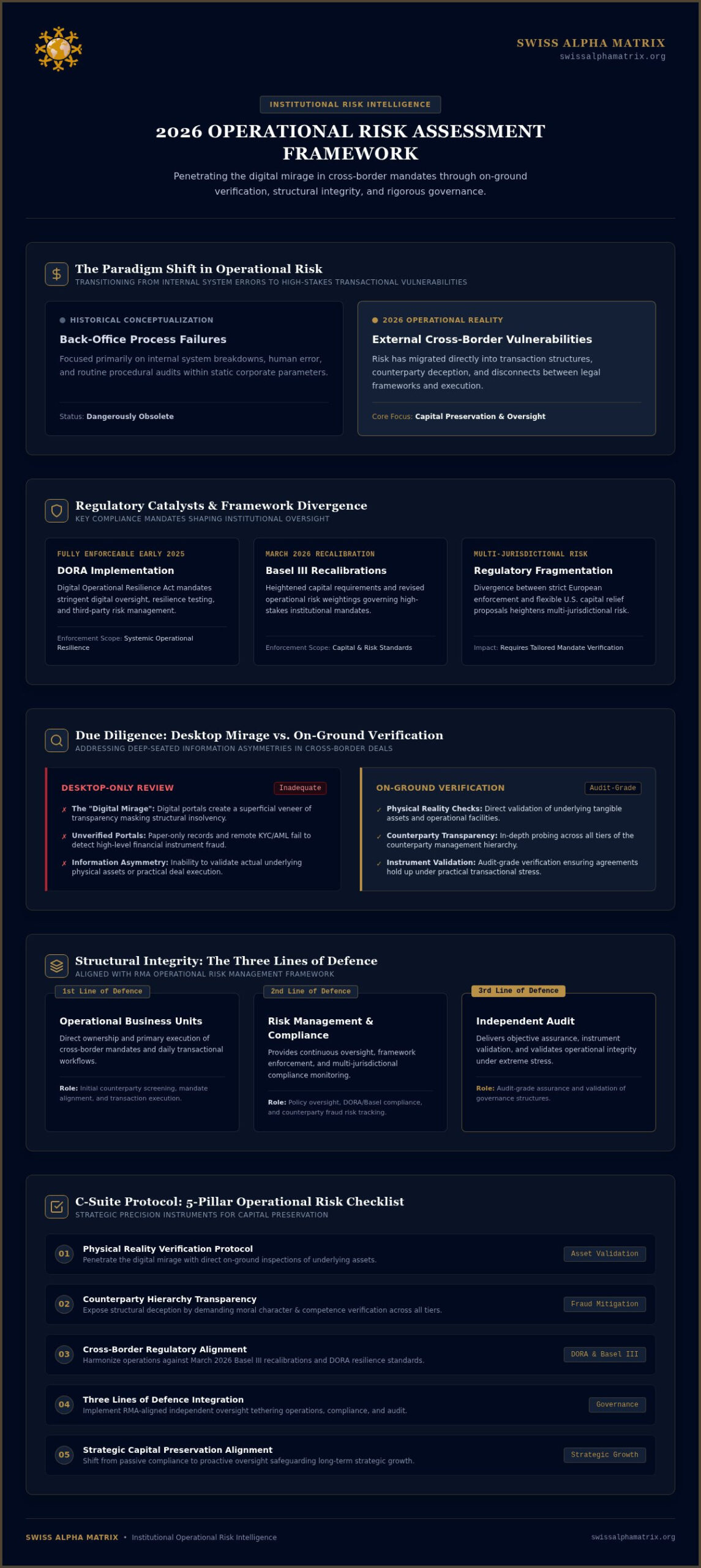
The historical conceptualization of operational risk as a mere failure of internal systems or human error has become dangerously obsolete in the current financial epoch. As we navigate the complexities of 2026, senior executives must recognize that risk has migrated from the back office to the very heart of the transaction, manifesting as external vulnerabilities within cross-border mandates. This shift necessitates a robust operational risk management strategy that prioritizes the detection of counterparty deception and structural weaknesses over simple process audits. Operational risk assessment stands as the definitive strategic pillar for capital preservation, serving to safeguard institutional interests against the encroaching tide of sophisticated financial malfeasance.
While systemic risks are often factored into broader market volatility models, idiosyncratic operational failures in high-stakes deals remain notoriously difficult to quantify without a specialized operational risk assessment checklist. These failures often arise from a fundamental disconnect between the perceived legal framework and the practical execution of cross-border agreements, where the absence of physical verification leads to catastrophic capital erosion. Identifying these vulnerabilities requires a shift from passive observation to an active, inquisitive oversight methodology that demands transparency at every level of the counterparty hierarchy.
The Institutional Definition of Risk
Modern frameworks must now account for the March 2026 Basel III recalibrations and the stringent oversight demands of the Digital Operational Resilience Act (DORA), which became fully enforceable in early 2025. The divergence between European enforcement and the more flexible U.S. capital relief proposals creates a fragmented regulatory environment that heightens the risk profile of multi-jurisdictional mandates. Aligning a risk framework with the specific nuances of an investment programme isn’t merely a compliance exercise; it’s an essential component of strategic project management that ensures all parties adhere to the highest standards of moral character and professional competence.
Why Traditional Due Diligence is No Longer Sufficient
The proliferation of high-level financial instrument fraud has rendered traditional, desktop-based due diligence entirely inadequate for modern institutional requirements. Relying on “paper-only” reviews or unverified digital portals creates a precarious veneer of security that often masks underlying insolvency or fraudulent intent. To achieve true transactional integrity, firms must adopt rigorous cross-border investment due diligence that incorporates on-ground verification and audit-grade validation of all underlying assets, ensuring that interests aren’t compromised by the inherent limitations of remote KYC and AML protocols.
Structural Integrity: The Core Pillars of an Institutional Risk Assessment
Establishing a resilient framework for complex financial projects requires more than cursory compliance; it demands the implementation of a rigorous Three Lines of Defence model tailored for the intricacies of cross-border mandates. The first line resides within the operational business units, while the second encompasses the risk management and compliance functions that provide necessary oversight. The third line, independent audit, provides the objective assurance required to validate the entire structure. Integrating a comprehensive RMA Operational Risk Management Framework ensures that governance remains robust even under extreme transactional stress, providing a steady hand in volatile markets.
A comprehensive operational risk assessment checklist must therefore function as a living document, tethering these lines of defence to the physical reality of the mandate. Independent oversight acts as the critical connective tissue, ensuring that transactional integrity isn’t sacrificed for the sake of execution speed. By strictly adhering to international financial regulations, including the 2025 DORA mandates and the March 2026 Basel III re-proposals, institutions can maintain audit-grade documentation for every risk-weighted decision. This level of precision ensures that an operational risk assessment checklist serves as an effective shield against unforeseen vulnerabilities.
Pillar I: Counterparty and Entity Validation
Verifying the legal and operational existence of financial intermediaries is the first safeguard against institutional decay. It’s not enough to review a registry entry; one must assess the historical track record and current regulatory standing of all project stakeholders. In opaque jurisdictions, identifying the ultimate beneficial ownership (UBO) is paramount to preventing exposure to sanctioned entities or illicit capital flows. This level of scrutiny distinguishes a seasoned partner from a passive participant, ensuring that interests remain in the hands of experts who prioritize long-term preservation.
Pillar II: Instrument and Asset Authentication
The second pillar focuses on the technical validation of the underlying value drivers within a transaction. The criticality of bank instrument validation services cannot be overstated when dealing with Standby Letters of Credit (SBLCs) or complex derivative instruments. Fraudulent documentation has reached a level of sophistication that easily bypasses standard bank checks, requiring a protocol-driven approach that includes direct verification with issuing institutions. Institutions that don’t prioritize this technical rigor face significant exposure to counterparty fraud. For mandates requiring this level of precision, engaging with specialised risk management frameworks provides the necessary layer of capital protection.
Beyond the Ledger: Why Desktop Due Diligence Fails Operational Reality
The digital era has ushered in a phenomenon we term the “Digital Mirage,” where sophisticated online portals and real-time dashboards provide a seductive yet often hollow sense of institutional security. While these systems offer immediate data access, they frequently mask operational insolvency or strategic misalignments that remain invisible to remote observers. Relying solely on desktop due diligence is a precarious strategy, particularly when navigating the opaque environments of cross-border finance. Standard remote KYC and AML protocols, while necessary for initial screening, possess inherent limitations in detecting the nuanced signatures of high-level counterparty fraud. A truly robust operational risk assessment checklist must therefore demand evidence that exists beyond the digital ledger, ensuring that capital deployment is predicated on physical reality rather than curated data streams.
Consider the anonymized instance of a multi-billion dollar infrastructure mandate where digital records indicated a thriving corporate entity with significant liquidity. A subsequent on-ground investigation revealed that the purported headquarters was merely a serviced office with no permanent staff, and the “liquid assets” were encumbered by undisclosed liens. By incorporating CISA Risk Assessment Methodologies alongside specialized institutional oversight, firms can move past these digital facades. Physical verification serves as the only definitive antidote to the sophisticated deception that characterizes modern global markets.
The Role of On-Ground Verification Services
Authenticating the existence of physical assets and the presence of key personnel requires a level of regional precision that digital tools cannot replicate. On-ground verification services provide the necessary local intelligence to discern whether a counterparty’s operational infrastructure matches its institutional claims. Swiss Alpha Matrix bridges this critical gap, deploying former Tier-1 bank executives to conduct meticulous site visits and face-to-face interviews. This methodology ensures that every line item on an operational risk assessment checklist is validated by direct observation, transforming theoretical due diligence into audit-grade certainty.
Assessing ‘Soft’ Operational Risks
Beyond tangible assets, a mandate’s success often hinges on the intangible governance standards and corporate culture of the counterparty. Evaluating ‘soft’ risks involves analyzing the robustness of internal compliance infrastructures and identifying potential key-man dependencies that could destabilize boutique financial entities. If a project’s continuity rests solely on the expertise of a single individual, the operational risk profile increases exponentially. A seasoned master planner looks for evidence of institutional permanence and a culture that prioritizes long-term stability over short-term speculation, ensuring that the partnership is rooted in shared values and professional competence.
The 2026 Operational Risk Assessment Checklist: A C-Suite Protocol
The transition from a theoretical framework to operational execution requires a structured protocol that serves as the definitive operational risk assessment checklist for C-suite executives overseeing cross-border mandates. This protocol is not a static document; it’s a four-phase methodology designed to ensure transactional integrity from inception to final settlement. Phase 1 initiates with pre-mandate scoping, ensuring that the project’s objectives align perfectly with the institution’s risk appetite and strategic goals. Phase 2 moves into the technical deep-dive, where entity and instrument validation are conducted with audit-grade precision. Phase 3 subjects the mandate to rigorous regulatory stress testing, accounting for the 2026 AML and Basel III requirements to ensure resilience under scrutiny. Phase 4 establishes the mechanisms for ongoing monitoring and independent oversight, providing the continuous validation necessary to mitigate emerging threats.
Adhering to this operational risk assessment checklist allows seasoned experts to identify vulnerabilities before they manifest as capital loss. By moving through these phases with measured, steady logic, the master planner ensures that interests are protected by a standard of service that is both broad in reach and meticulous in its attention to detail. This structured argument for methodology creates a sense of professional calm, encouraging confidence throughout the decision-making process.
Category A: Financial Instrument Integrity
Executives must demand absolute clarity regarding the underlying assets. Verification via independent SWIFT communication is non-negotiable, as is a thorough review of the issuing bank’s liquidity profile to ensure it remains consistent with the mandate’s requirements. It’s essential to scrutinize the documentation for restrictive clauses that might inadvertently impact the instrument’s callability or transferability in a distressed scenario. Precision in these technical metrics establishes immediate credibility and ensures that capital deployment is rooted in verified reality.
Category B: Counterparty Operational Viability
Validation of the counterparty extends beyond mere legal existence. The checklist requires confirmation that the entity possesses the precise licenses necessitated by the transaction’s specific jurisdiction. A documented history of successful execution in analogous cross-border deals provides the necessary baseline for trust, which must then be reinforced by the results of a physical on-ground site visit and comprehensive executive interviews. This high level of professional competence distinguishes dedicated partners from passive participants.
Category C: Project Management and Execution
The structural success of a high-stakes mandate depends on a robust independent financial project management framework. Establishing a RACI matrix ensures that every critical transactional milestone has clear ownership, preventing the ambiguity that often leads to operational failure. Reporting lines to executive stakeholders must remain direct and transparent, bypassing intermediary layers to ensure that the protective authority of the C-suite is maintained throughout the project lifecycle. For institutions seeking to implement this rigorous standard, engaging with our specialised risk management frameworks ensures that your mandates are protected by the highest level of professional competence.
Strategic Alignment: Integrating Independent Oversight into Transactional Workflows
Transitioning from a reactive audit posture to a proactive oversight strategy represents the final, most critical evolution in institutional risk management. Traditional audits, while necessary for historical record-keeping, often arrive too late to prevent the erosion of capital in high-stakes, cross-border mandates where vulnerabilities can manifest with alarming speed. By integrating independent oversight directly into transactional workflows, senior executives can identify and mitigate risks in real-time, ensuring that the project’s trajectory remains aligned with institutional objectives. This methodology relies on the consistent application of a sophisticated operational risk assessment checklist that functions as a dynamic shield rather than a static compliance requirement, providing the intellectual depth necessary to navigate multi-layered sentence structures of global finance.
Utilizing institutional-grade financial advisory methodologies ensures that every phase of a project is subjected to the same level of technical rigor found in Tier-1 global banking environments. This approach maintains the delicate balance between Swiss-level discretion, which protects the privacy and exclusivity of high-end mandates, and the absolute transparency required by institutional stakeholders to satisfy regulatory scrutiny. It’s this commitment to regional excellence and technical accuracy that distinguishes a performance-oriented mindset from passive participation in the markets. Ultimately, precision in assessment leads to certainty in execution.
The Swiss Alpha Matrix Advantage
Swiss Alpha Matrix provides access to the caliber of expertise typically reserved for global financial giants, delivered with the hyper-personalized attention of a boutique advisory firm. Our former Tier-1 bank executives produce audit-grade reports that satisfy the most stringent board requirements, providing the technical validation necessary to justify complex capital deployment. We ensure that capital isn’t just deployed into a project; it’s actively protected through every milestone by a dedicated partner who prioritizes long-term preservation and strategic growth over short-term speculation. This standard of service is both broad in reach and meticulous in its attention to detail, reflecting a personality rooted in historical reliability.
Next Steps for Executive Stakeholders
To fortify your current institutional position, we recommend the following strategic actions:
- Conduct an immediate gap analysis of current risk assessment protocols to identify where digital due diligence fails to capture operational reality.
- Engage independent advisors for high-stakes, cross-border instrument validation to provide an essential layer of protection against counterparty fraud.
- Establish a recurring review cycle for long-term financial programmes to ensure your operational risk assessment checklist remains aligned with the shifting regulatory landscape of 2026.
Taking these steps ensures that your interests are in the hands of seasoned, unemotional experts who value privacy and exclusivity above all else.
Securing the Institutional Future through Meticulous Oversight
Transitioning from a theoretical understanding of risk to a robust execution strategy requires a fundamental shift in how senior executives perceive transactional integrity. The evolution of the operational risk assessment checklist from a back-office formality to a C-suite strategic pillar ensures that cross-border mandates remain resilient against the sophisticated threats of 2026. By prioritizing physical, on-ground verification over the inherent limitations of digital due diligence, institutions can move beyond the digital mirage to achieve absolute certainty in capital deployment.
Swiss Alpha Matrix provides the elite expertise necessary to navigate these complexities, offering bespoke, mandate-specific advisory led by former Tier-1 bank executives with decades of global regulatory expertise. Our commitment to audit-grade reporting and regional precision ensures that your interests are protected by a dedicated partner who values traditional discretion as much as modern technical accuracy. It’s time to elevate your oversight framework to mirror the quality and moral character of your institution, ensuring that every project is managed with the quiet authority that seasoned experts provide.
Secure your mandate with audit-grade validation from Swiss Alpha Matrix
Frequently Asked Questions
What is the difference between operational risk and financial risk in 2026?
Operational risk in 2026 focuses on the resilience of processes and the validity of execution, whereas financial risk pertains to market volatility and creditworthiness. Under the Digital Operational Resilience Act (DORA), institutions must prove they can maintain critical services during disruptions. Financial risk is managed through capital buffers, but operational integrity requires an exhaustive operational risk assessment checklist to identify vulnerabilities in third-party dependencies and internal controls. It’s the difference between managing market fluctuations and preventing systemic process collapse.
Why is a standard KYC check insufficient for complex financial instrument validation?
Standard KYC protocols merely verify the legal identity of a counterparty, while complex instrument validation requires technical authentication of the asset itself. Sleek digital portals can easily mask fraudulent SBLCs or LCs that lack genuine liquidity or interbank backing. Professional validation involves direct SWIFT communication and independent verification of the issuing bank’s rating. Without this technical rigor, senior executives remain exposed to sophisticated fraud that identity-based checks are fundamentally unequipped to detect or prevent.
How does on-ground verification differ from traditional due diligence?
On-ground verification involves physical site visits and face-to-face executive interviews to validate the corporate headquarters and key personnel of a counterparty. Traditional due diligence often relies on desktop reviews and unverified digital documentation, which can be easily manipulated in opaque jurisdictions. By deploying global on-ground capabilities, firms ensure that the physical reality matches the institutional claims. This methodology bridges the gap between digital data streams and the tangible operational existence of a financial partner.
What are the common red flags in operational risk assessments for cross-border deals?
Common red flags include serviced office addresses, opaque ultimate beneficial ownership (UBO) structures, and a refusal to use independent SWIFT communication channels. If a counterparty insists on non-standard documentation or presents restrictive clauses that limit an instrument’s callability, the risk profile increases significantly. An effective operational risk assessment checklist should also flag key-man dependencies and a lack of documented history in similar cross-border mandates. Identifying these signals early prevents catastrophic capital erosion and protects long-term interests.
How often should an operational risk assessment be updated for multi-year projects?
For multi-year projects, an operational risk assessment should be updated at least annually, or more frequently if triggered by significant regulatory shifts. The March 2026 Basel III proposals and ongoing AML updates mean that frameworks must remain dynamic to ensure compliance. Strategic oversight requires a recurring review cycle that accounts for changes in counterparty standing or geopolitical stability. Maintaining this steady rhythm of validation ensures that capital isn’t just deployed, but actively protected through every phase.
Can independent project oversight reduce insurance premiums for large transactions?
Independent project oversight provides underwriters with audit-grade evidence of a firm’s commitment to risk mitigation, which can lead to more favorable insurance terms. By demonstrating a robust framework for instrument validation and on-ground verification, institutions reduce the perceived likelihood of counterparty fraud or operational failure. While we don’t provide legal representation, our specialized advisory creates a transparent record of due diligence. This level of professional competence signals to insurers that the mandate is managed with meticulous precision.
What role does the RACI matrix play in mitigating operational risk?
The RACI matrix is a fundamental component of strategic project management that establishes clear ownership for every transactional milestone. It defines who is Responsible, Accountable, Consulted, and Informed, thereby preventing the ambiguity that often leads to operational oversights. In complex cross-border deals, clear reporting lines to executive stakeholders ensure that decisions are made with absolute transparency. This structured approach to accountability minimizes the risk of process failure and ensures that interests remain in the hands of seasoned experts.