

What if a complete-looking file confirms what a counterparty claims, but not what is happening in practice? For investors searching “independent verification agent hong kong,” the central question is not simply whether documents exist. It is whether the underlying facts, ownership and execution can be independently corroborated.
Registry records and submitted documents can establish important points, yet leave operational realities, cross-border relationships or inconsistencies untested. A proportionate mandate starts with the transaction’s material risks and defines what can be verified, which sources can support each finding, and where access limitations may affect the assessment.
This guide explains what an independent verification agent should examine, how to scope Hong Kong-related mandates in light of applicable requirements, and how to complement documentary analysis with on-ground checks. It also distinguishes evidence that supports a decision from information that is merely present in a file. Swiss Alpha Matrix brings financial discipline, audit-grade instrument validation and practical verification together, with senior-led oversight designed to turn findings into clear, decision-useful risk intelligence for capital deployment and transaction oversight.
Key Takeaways
- Define the transaction decision and its material risks first, then build the verification mandate around facts that could affect that decision.
- An independent verification agent hong kong mandate should distinguish documented claims from facts that have been independently corroborated.
- Compare verification approaches by mandate fit, independence, senior oversight, evidence discipline and the clarity with which exceptions are reported.
- Combine documentary analysis with operational or on-ground checks when access and the transaction’s risk profile make them relevant.
- Agree permissions, confidentiality, evidence handling and reporting audiences before work begins.
Why appoint an independent verification agent in Hong Kong?
A transaction file can be orderly and still leave consequential questions unanswered. An independent verification agent in Hong Kong examines relevant transaction evidence and operational facts against a defined mandate. The review tests specific claims against available records and, where appropriate, independent corroboration. Its purpose is to show decision-makers what has been substantiated, what remains uncertain, and how access or evidence limitations affect the assessment.
This work forms part of a broader due diligence process, but it has clear boundaries. Verification is not legal representation, regulatory approval, an audit opinion or an investment recommendation. It does not determine whether a transaction suits an investor or guarantee an instrument’s performance. Instead, it provides structured findings that can inform decisions alongside legal, financial and commercial advice.
What does an independent verification agent verify?
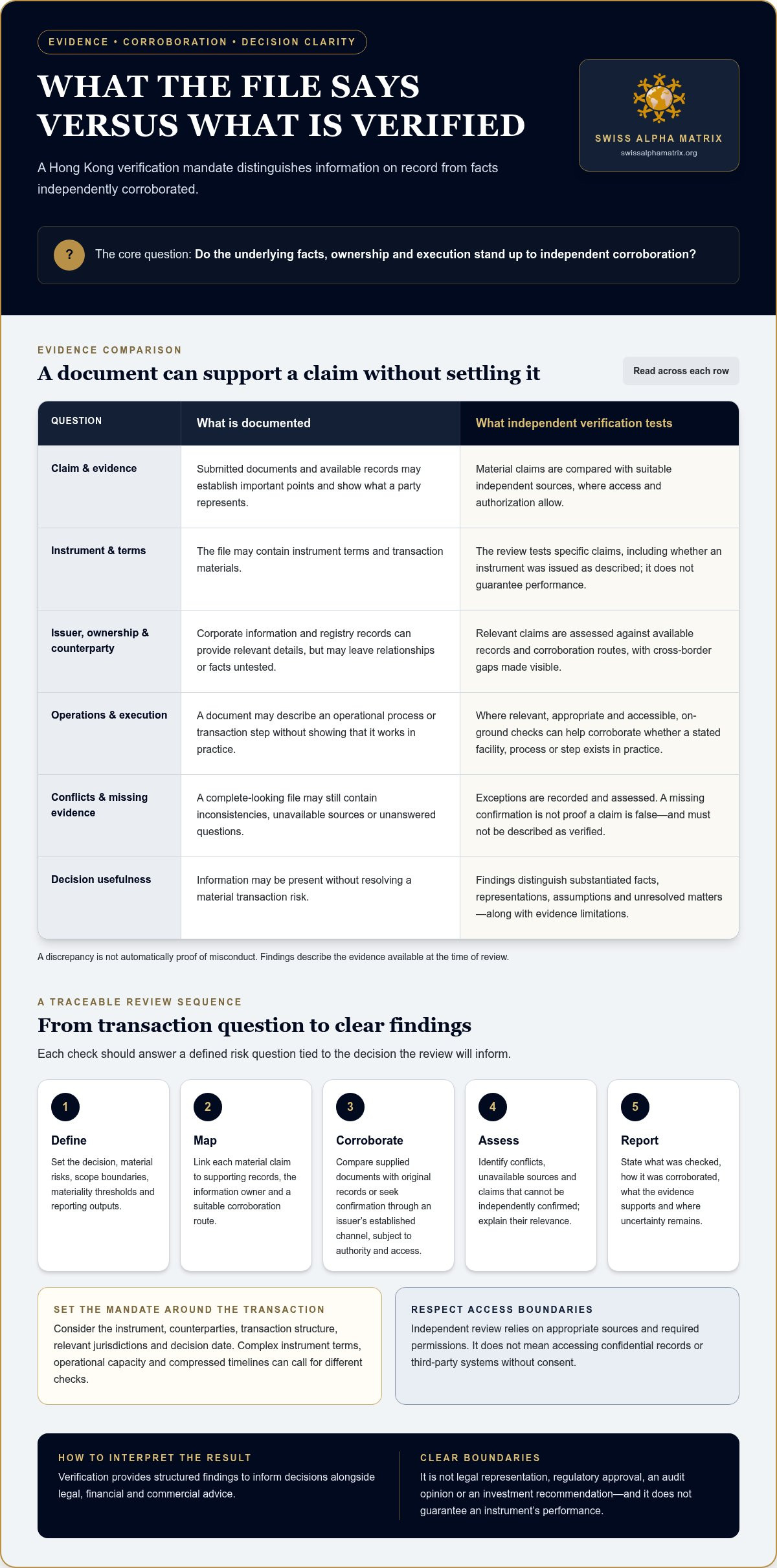
The mandate separates claims about the instrument, its issuer, the counterparty and the transaction process. Documentary review may examine available records, instrument terms, corporate information and transaction materials. Corroboration may include checking information through relevant independent channels or assessing operational facts on the ground, where appropriate and accessible. A discrepancy is not automatically proof of misconduct, but it should be recorded, assessed and distinguished from confirmed information. Findings describe the evidence available at the time of review; they cannot ensure that a transaction will perform as represented.
When does a Hong Kong mandate call for independent review?
Independent review can be useful in cross-border financing, investment programmes and complex instrument-related transactions, particularly when decision-critical information is spread among issuers, intermediaries, counterparties and records held in different jurisdictions. A document in one location may describe an arrangement whose operational steps, ownership details or supporting evidence sit elsewhere. Coordinating those sources can expose gaps that a single registry search or document pack may not resolve.
Scope should follow the transaction, not a generic checklist. An instrument with complex terms may require different validation from a financing that depends on a counterparty’s operational capacity. A compressed decision timeline may also affect which questions can be answered and what evidence is accessible. Shape the mandate around the instrument, counterparties, transaction structure, relevant jurisdictions and decision date. For a broader framework on coordinating evidence across borders, see cross-border investment due diligence.
How a Hong Kong verification mandate tests evidence beyond paperwork
A rigorous mandate follows a traceable sequence: define the questions, map the evidence, corroborate material facts, assess exceptions and report what the evidence supports. Each check should answer a defined risk question tied to the transaction decision. A record may appear authoritative, for example, yet fail to establish that an instrument was issued as described or that a stated operational process is working.
An independent verification agent hong kong mandate should also respect access boundaries. Original records, issuer channels, counterparties and operational evidence can be assessed only through appropriate sources and with the required authority or permissions. Independent review does not mean accessing confidential records or third-party systems without consent.
From mandate design to evidence mapping
At the outset, establish the decision the review will inform, scope boundaries, materiality thresholds and reporting outputs. Then map each material claim to its supporting records, the party responsible for the information and a suitable route for corroboration. Depending on the mandate, this may involve comparing supplied documents with original records or seeking confirmation through an issuer’s established channel, subject to access and authorization.
Keep the evidence trail explicit. Record where each item came from, when it was reviewed, what it supports and any limitation or dependency that affects its weight. This helps decision-makers distinguish verified facts from representations, assumptions and unresolved matters.
On-ground verification and exception handling
Documentary review may not settle operational questions, such as whether a stated facility, process or transaction step exists in practice. Where the mandate, permissions and access allow, on-ground checks can provide practical corroboration. The role of on-ground verification explores this approach and its limits.
Handle exceptions methodically, without jumping to conclusions. If records conflict, a source is unavailable or a claim cannot be independently corroborated, the report should identify the issue, explain its relevance to the decision and state what remains open. A missing confirmation is not, by itself, proof that a claim is false. Equally, it should not be presented as verified.
This method gives readers a practical basis for assessing evidence quality: what was checked, how it was corroborated and where uncertainty remains. Swiss Alpha Matrix’s mandate-specific due diligence, instrument validation and on-ground verification bring financial discipline to that process. To understand how this approach can be tailored to a transaction, explore independent verification support.
How to compare Hong Kong verification agents for a high-stakes mandate
For a high-stakes engagement, the phrase “independent verification agent hong kong” should lead to an assessment of mandate fit, not just a comparison of broad service claims. Consider whether the proposed work addresses the transaction’s actual risk questions, how independence and conflicts are handled, whether senior specialists remain accountable for the analysis, and how evidence limitations will be reported. A disciplined mandate is designed around the client’s decision needs, not a predetermined conclusion.
Independence, conflicts, and senior accountability
Ask how relevant commercial or professional conflicts are identified, disclosed and managed within the engagement. Independence matters when the reviewer can state where evidence supports a claim, where it does not and what remains unresolved. Senior oversight should continue beyond an initial review. The specialists responsible for material judgements should remain accountable for the analysis and executive reporting, keeping findings connected to the decision they are intended to inform.
Evidence standards and Hong Kong context
Check whether reporting clearly separates independently verified facts, information supplied by the client or counterparties, and unresolved matters. References to the SFC, HKMA or Companies Registry should be interpreted in relation to the specific transaction and question being examined, not treated as broad endorsement or proof of an instrument’s quality. For wider context on regulatory frameworks, see international financial regulations.
The distinctions below clarify what different mandates are designed to establish:
| Mandate type | Typical scope and evidence | Local execution and limitations | Typical output |
|---|---|---|---|
| Financial verification | Tests defined claims about instruments, issuers, counterparties or transaction processes against records and appropriate corroboration. | May include on-ground checks where relevant, authorized and accessible; does not replace legal advice or guarantee performance. | Evidence-led findings, exceptions and limitations for decision-makers. |
| Licensing consultancy | Focuses on licensing or regulatory questions within its agreed remit. | Does not, by itself, verify every transaction-specific instrument or operational claim. | Regulatory or licensing guidance within scope. |
| Legal counsel | Addresses legal rights, obligations and interpretation. | Legal representation is distinct from independent factual verification. | Legal advice or representation, as engaged. |
| Identity verification | Checks identity attributes of a person or entity using relevant identity evidence. | Identity confirmation alone does not establish instrument authenticity or transaction execution. | Identity-check result within the system’s scope. |
Swiss Alpha Matrix’s senior-led work combines mandate-specific due diligence, audit-grade instrument validation and on-ground verification. Findings distinguish substantiated evidence from assumptions. The useful comparison is not which mandate sounds broadest, but which one can answer the transaction’s defined questions using transparent methods and clearly stated limits.
What to define before commissioning Hong Kong verification
A well-structured brief starts with the decision the review must inform, not a general request to “check the transaction.” The independent verification agent hong kong mandate can then be proportionate to the evidence required, the parties involved and the time available. Define the consequences of unresolved information so the review can prioritize questions that could materially affect the decision, rather than expanding into unrelated legal or investment advice.
Build a decision-led verification brief
Set out the instrument, issuer, counterparties, transaction stage and jurisdictions, along with the key risks the review is meant to address. For each priority question, identify the records or corroboration routes that may help answer it. Establish scope boundaries, required outputs and any materiality thresholds that will guide the assessment. A clear remit allows findings to distinguish substantiated information from assumptions and open questions.
Address access at the outset. Identify what information the client can provide, which parties may need to authorize access and what permissions are required before records or operational facts can be examined. Agree how sensitive materials will be shared, handled and retained, and who may receive or use the findings.
Agree reporting, confidentiality, and escalation
Specify the intended reporting audience and the level of detail each recipient needs. A decision-maker may need an executive summary of material findings, while the transaction team may require supporting evidence, limitations and outstanding dependencies. Agree how significant exceptions will be escalated, who will receive them and how they will be recorded. A clear protocol helps prevent an unverified claim or access constraint from being mistaken for a confirmed conclusion.
Set milestones around the practical sequence of work: evidence access, review, permitted corroboration, resolution or documentation of exceptions, and executive-level reporting. Timing should reflect the decision deadline and availability of relevant evidence, not an assumed standard timetable. Fees and milestones should also be tailored to the agreed scope, complexity, jurisdictions and access requirements rather than inferred from generic benchmarks.
Before commissioning, align the brief, permissions, confidentiality arrangements and reporting expectations so the mandate stays focused and decision-useful. Discuss a tailored verification mandate with Swiss Alpha Matrix.
How Swiss Alpha Matrix supports independent verification in Hong Kong
Swiss Alpha Matrix approaches independent verification as a defined transaction mandate, bringing together due diligence, audit-grade instrument validation and on-ground verification when the evidence requirements call for it. Led by former senior executives from Tier-1 global financial institutions, the firm draws on transactional, regulatory and risk-management expertise to examine evidence with financial discipline and practical context. The objective is to clarify what the available evidence supports, where limitations remain and which matters may warrant executive attention, not to produce a predetermined conclusion.
For executives seeking an independent verification agent hong kong mandate, findings should be relevant to the decision at hand, not presented as a generic document review. Reporting can connect verified evidence, material risks and unresolved questions to transaction oversight while keeping the boundaries of the review clear.
A mandate tailored to transaction complexity
The appropriate workstreams depend on the transaction. Documentary analysis may be central when the key question concerns an instrument’s terms or supporting records. On-ground verification may complement that review when operational facts need practical corroboration and access permits. For complex cross-border engagements, these workstreams can be coordinated around agreed objectives, evidence access, milestones and executive reporting, keeping the work aligned with the decision timeline.
Where instrument authenticity is central to the mandate, Swiss Alpha Matrix’s bank instrument validation services provide further context on the firm’s approach to instrument review. The scope and reporting are tailored to the specific instrument, counterparties and available evidence.
Discuss scope, evidence, and decision requirements
An initial discussion can begin with the transaction, principal parties, instrument or programme under review, jurisdictions involved and decision deadline. From there, the mandate can focus on the questions that matter most, the records and permissions required, and the form of findings executives need to assess material risks. Scope and deliverables are tailored to the engagement, with evidence limitations and open questions made visible rather than obscured by broad conclusions.
Swiss Alpha Matrix brings discreet, senior-led oversight to cross-border programmes, connecting verification work with clear risk intelligence for executive consideration. To discuss a defined Hong Kong-linked transaction and its evidence requirements, discuss an independent verification mandate.
Set a Clear Standard for Transaction Evidence
A sound verification mandate starts with the decision it must inform, then defines which claims, parties and records are material to that decision. Documentary review provides an important foundation, while independent corroboration and on-ground checks, where appropriate and accessible, help clarify whether key facts hold beyond the file. Findings should distinguish verified evidence from supplied information, limitations and unresolved questions.
Choosing an independent verification agent hong kong means looking beyond document volume to mandate fit, independence, senior oversight and reporting executives can use. Swiss Alpha Matrix brings former senior executives from Tier-1 global financial institutions to mandate-specific due diligence, audit-grade instrument validation and on-ground verification for complex cross-border programmes. This work connects evidence and risk assessment to transaction oversight without promising outcomes.
A clearly defined scope helps support a more considered assessment of material risks and evidence gaps. Discuss a Hong Kong verification mandate with Swiss Alpha Matrix and take the next step with a structured view of the facts.
Frequently Asked Questions
What does an independent verification agent in Hong Kong do?
An independent verification agent in Hong Kong examines transaction evidence and operational facts against a defined mandate. The review may test claims about an instrument, issuer, counterparty or transaction process using relevant records and appropriate corroboration. Findings distinguish substantiated information from representations and unresolved issues, helping stakeholders assess risk. This work is not legal advice, licensing consultancy, regulatory approval, an audit opinion or an investment recommendation, and it does not guarantee transaction performance.
How do you verify a financial instrument independently?
Start with a defined mandate: identify the instrument, the claims to test and the transaction decision the review must inform. Map those questions to available records, assess relevant source evidence and seek independent corroboration through appropriate channels, subject to access and authorization. Record conflicting or unavailable evidence as an exception rather than treating it as confirmed. An independent verification agent Hong Kong stakeholders engage should report what was checked, what the findings support and what remains unresolved.
Can an independent verification agent confirm whether an SBLC is genuine?
An agent can assess available evidence concerning a standby letter of credit (SBLC), including its terms, supporting records and any confirmation obtainable through appropriate issuer channels with the necessary authority. The conclusion should state which claims were corroborated, which relied on supplied information and what could not be established. A review can inform a transaction decision, but it cannot guarantee payment, enforceability or future performance, and it does not replace legal advice.
When should a company appoint an on-ground verification agent in Hong Kong?
Consider on-ground verification when material operational claims cannot be adequately assessed from documents alone, or when relevant evidence is spread across organizations or jurisdictions. It may help test a defined fact tied to a transaction, provided the required access and permissions are in place. Establish the decision deadline early, since access, coordination and unresolved questions can affect what is verifiable before a transaction milestone.
What is the difference between verification and due diligence?
Due diligence is a broader investigation of a counterparty, transaction or operational risk profile. Verification is a focused examination of specified claims and supporting evidence. A mandate might test an instrument or confirm a defined operational fact, while broader due diligence assesses the counterparty and programme context. The two can complement one another: focused findings contribute evidence to a wider assessment, and the broader review helps set verification priorities.
How long does an independent verification engagement take?
There is no single timetable for an independent verification engagement. Duration depends on the agreed scope, project complexity, access to relevant evidence, number of counterparties and jurisdictions involved. Review and reporting milestones can be planned around the transaction decision date, but delays in permissions or evidence access may affect progress. Defining priorities and access requirements at the outset helps establish a realistic schedule.
What should a verification report include?
A decision-useful verification report should state the mandate’s scope and questions, identify the evidence reviewed, and explain the findings and their basis. It should distinguish verified facts from information supplied by the client or counterparties, and clearly record limitations, exceptions and outstanding questions. Conclusions should connect material evidence to the relevant transaction decision without overstating certainty or implying that verification guarantees an outcome.