

A project can be marked complete and still leave important questions unanswered: Were the agreed deliverables accepted? What explains any variance from plan? Which actions remain open? Learning how to write a project closure report means answering these questions with evidence, not relying on a polished summary or recollections that may differ.
A disciplined structure helps you document missed objectives without losing context and distinguish verified outcomes from assumptions. Record decisions and acceptance clearly, and make unresolved matters visible rather than obscuring them.
This guide takes you through drafting and reviewing a closure report, from confirming objectives and deliverables to documenting performance, financial and administrative closure, variances, approvals, and follow-up actions. It also explains how to capture lessons learned in a way that supports future governance and executive decisions. The goal is a defensible record that brings the project to a considered close and preserves useful insight for what comes next.
Key Takeaways
- Start with authoritative project records, then compare approved objectives and baselines with deliverables and acceptance evidence.
- Learn how to write a project closure report with a clear sequence covering the mandate, delivery, performance, variances, risks, and open actions.
- Use a planned-versus-actual comparison to make outcomes, supporting evidence, and explanations easier to review.
- Draft for a defined audience, use neutral language, and follow a structured approval and distribution process.
- For complex projects, connect decision history and material exposures to clear ownership and practical options for executives.
How to Write a Project Closure Report That Records What Was Delivered
A project closure report is the formal record of a project’s final outcomes, decisions, and remaining obligations. It sets out what was authorised, what was delivered, which objectives were achieved or left incomplete, and what requires further action. Learning how to write a project closure report starts with treating it as an accountable record, not a polished account of success.
Its purpose differs from a celebratory summary, routine status update, or full lessons-learned discussion. Those documents may communicate progress or explore experience. A closure report establishes the project’s final position and the basis for that assessment. Closure does not require every objective to have been met. It requires the actual status, including shortfalls and unresolved items, to be stated with appropriate context. For a broader view of how closure fits within the discipline, see this Project Management Overview.
What belongs in a project closure report?
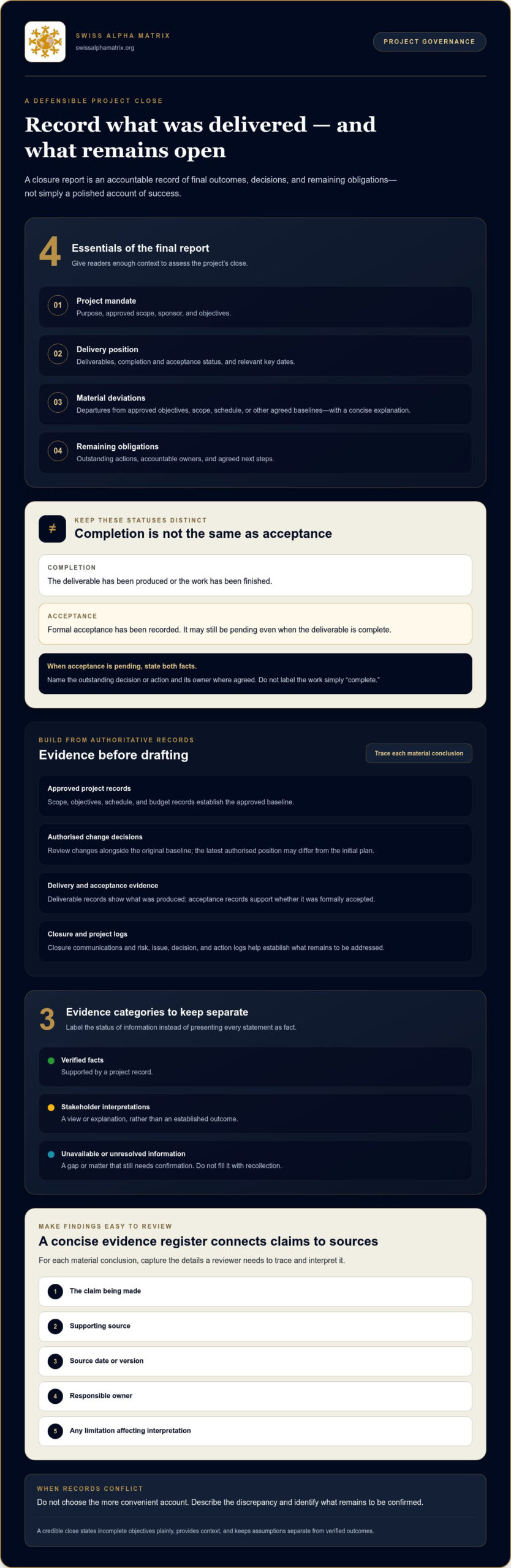
Give readers enough context to understand the project and assess its close. Identify its purpose, approved scope, sponsor, and objectives, then summarise delivery against those commitments. Distinguish completion from acceptance: a deliverable may have been produced while formal acceptance remains pending.
- Project mandate: Purpose, scope, sponsor, and approved objectives.
- Delivery position: Deliverables, completion and acceptance status, and relevant key dates.
- Material deviations: Departures from approved objectives, scope, schedule, or other agreed baselines, with a concise explanation.
- Remaining obligations: Outstanding actions, accountable owners, and agreed next steps.
For example, if a deliverable is complete but stakeholder acceptance is pending, record both facts rather than labelling the work simply “complete.” Name the outstanding decision or action and its owner where agreed. This distinction helps sponsors and future teams see what has been delivered, what has been accepted, and what remains open.
Why does a formal closure record matter?
A documented close gives sponsors and stakeholders a shared reference point. It makes the project’s final position reviewable, supports accountability for decisions and follow-up, and helps future teams understand which commitments were fulfilled. Without this record, later decisions may rely on partial recollections or summaries that omit important qualifications.
Clear outcomes also support informed follow-on decisions. A sponsor considering whether to continue related work, allocate resources, or address an unresolved dependency needs a reliable account of delivery and remaining exposure. The report connects project oversight with subsequent governance by showing what happened and what still requires attention.
Credibility rests on candour, not perfection. State an incomplete objective plainly, explain the relevant context, and identify any agreed response without presenting assumptions as settled facts. A closure report written this way preserves an accurate institutional record and gives organisational learning a sound foundation. Deeper analysis of causes and lessons can sit in the appropriate review.
Gather Evidence Before Drafting the Project Closure Report
Before deciding how to write a project closure report, establish what each conclusion can be traced to. Start with the approved project record, then identify the most authoritative source for every material result. The source depends on the subject: an approved scope document can establish the mandate, while a dated acceptance record can establish whether a deliverable was accepted. This discipline keeps memory, interpretation, and informal updates from being presented as verified facts.
Which records should inform the report?
Assemble the records that define what was approved, what changed, and what was completed. Review the original baseline alongside subsequent decisions, because the latest authorised position may differ from the initial plan. Relevant records include:
- Approved scope, objectives, schedule, and budget records.
- Change decisions that modified the project’s authorised commitments.
- Deliverable records and evidence of acceptance, where available.
- Closure communications, plus risk, issue, decision, and action logs.
Use each record only to support the claim it can substantiate. A completion update may indicate that work was finished, but an acceptance record provides a stronger basis for stating that a deliverable was formally accepted. If records conflict, don’t resolve the discrepancy by choosing the more convenient account. Describe the difference and identify what remains to be confirmed.
How can findings remain traceable?
Create a concise evidence register before drafting. For each material conclusion, note the claim, supporting source, source date or version, responsible owner, and any limitation that affects interpretation. This index gives reviewers a direct route from a report statement to its underlying record, without requiring them to reconstruct the project history from a large document set.
Keep three categories distinct: verified facts supported by a record, stakeholder interpretations that represent a view rather than an established outcome, and information that is unavailable or unresolved. Label estimates as estimates and disputed interpretations as disputed. If a source cannot be located, don’t fill the gap with recollection. State the limitation and, where appropriate, assign an owner to follow it up.
For example: “The final review was completed after the approved milestone, according to the dated review record; the delay deferred acceptance, and the project log assigns follow-up to the delivery lead.” This links the variance to evidence, consequence, and owner without overstating the cause. If the evidence establishes that a delay occurred but not why, report the timing and impact while leaving the cause open.
In complex programmes, traceability also supports disciplined oversight by making material exposures and decisions easier to assess. Swiss Alpha Matrix’s complex project management connects programme information to clear executive decisions.
Structure the Report Around Outcomes, Variances, and Open Items
A clear structure takes readers from the project’s mandate to its final position without confusing results, explanations, and follow-up responsibilities. When deciding how to write a project closure report, organise it to answer three questions: What was intended? What occurred? What remains to be addressed? The report should be proportionate to the project, while making material outcomes and exceptions easy to find.
A practical sequence is:
- Executive summary: State the overall result, material variance, and most important open item.
- Mandate: Set out the approved purpose, scope, and objectives.
- Delivery: Summarise deliverables and their completion or acceptance status.
- Performance: Compare actual results with the relevant approved baselines.
- Variances: Explain material departures and their documented consequences.
- Risks: Distinguish closed risks from residual exposures.
- Actions: Record outstanding commitments, owners, and agreed disposition.
How should the report present planned and actual results?
Describe the approved objective first, then state its final status and supporting evidence. A compact comparison can include objective or deliverable, approved plan, actual result, status, evidence, and explanation or impact. For example, record a deliverable as completed but acceptance pending if that is what the evidence shows. Include scope, schedule, or budget variance when it is material and supported by records. Explain consequences and related decisions without recasting a changed commitment as original success.
Keep findings separate from lessons. A finding states what the evidence establishes; a lesson interprets why an outcome matters for future work. Recommendations propose how that lesson could be applied, while actions specify a task, accountable owner, and agreed next step. This distinction prevents a general observation from being mistaken for a commitment someone has accepted.
How should risks, lessons, and actions be recorded?
Show whether each material risk was closed or remains an exposure requiring oversight, and identify where responsibility passes after project closure. Base lessons on findings, explain the rationale for recommendations, and assign open actions to named roles or owners where agreed. State each action’s disposition, such as transferred for follow-up or awaiting a decision, so unresolved work does not disappear into a broad “lessons learned” section.
Tailor the level of detail to project complexity and stakeholder needs. Don’t omit inconvenient outcomes; present them at the appropriate level. An executive audience may need a concise summary of material variances, residual exposures, and decisions, while a delivery team may need supporting detail on dependencies and ownership. Keep the underlying account consistent across both views. The structure should make important evidence and open items visible while allowing readers to move from conclusions to supporting detail.
Write, Review, and Finalise the Project Closure Report
A reliable drafting process turns validated project records into a document that stakeholders can assess, approve, and retain. To decide how to write a project closure report, establish who will use it and what decisions it needs to support. Prepare the analysis, test it against the source record, and write the executive summary only after findings and unresolved matters are clear.
What is a practical drafting sequence?
Set the intended audience, decision purpose, reporting scope, and document owner before drafting. These parameters determine the appropriate level of detail and who should review particular findings. Build the report in a consistent order, keeping evidence, analysis, recommendations, and supporting appendices distinct so each conclusion can be traced to its basis.
- Confirm the brief: Define the audience, purpose, scope, and person responsible for maintaining the document.
- Organise the source material: Arrange validated findings and supporting records under the relevant report sections.
- Draft the analysis: Explain outcomes, variances, and open items in concise, neutral language, distinguishing documented facts from interpretation.
- Write the executive summary: Condense the final findings and material decisions after the body of the report is stable.
- Complete the review and approval: Resolve factual queries, record approval, and distribute the controlled final version to its intended audience.
Use measured wording. “The acceptance record is pending” is more precise than “the deliverable was successfully closed” when formal acceptance has not occurred. If the evidence supports an outcome but not its cause, report the outcome and state that the cause remains undetermined. Clarity should not depend on overstating certainty.
How should the report be reviewed and approved?
Assign reviews according to subject matter. Relevant owners can validate factual details, deliverable status, and actions assigned to them. The document owner can check consistency across the full report. Reviewers should test each statement against its source, not merely confirm that the prose sounds plausible.
- Check names, dates, figures, approval references, and cross-references against the project record.
- Reconcile inconsistent figures where possible. If a disagreement remains, identify it transparently and avoid presenting either account as settled fact.
- Confirm that each open action has an agreed owner and disposition, or clearly state where responsibility remains unresolved.
- Record approval and preserve the final version with the associated project records. Use controlled distribution so readers can distinguish it from drafts.
Assess closure quality by completeness, traceability, and explicit ownership: material findings are covered, conclusions lead to evidence, and remaining responsibilities are clear. For complex programmes requiring structured oversight, explore complex project management to support disciplined decision-making.
Apply Evidence-Led Closure Reporting to Complex Projects
In a complex project, the final result may depend on linked workstreams, multiple decision-makers, changing assumptions, and obligations that continue beyond the formal end date. A closure report must do more than state whether work is complete. Give each material conclusion a clear evidence trail, preserve the decision history needed to understand how the project reached its final position, and identify who owns any continuing matter.
This is especially relevant when a project carries material financial exposure. A concise executive summary can present the measures used to oversee the project, explain what each indicates, and distinguish resolved exposure from items that require ongoing attention. Pair those findings with the decision at hand and the available options, such as proceeding, transferring oversight, or deferring a decision while evidence is outstanding. Base options on the project’s actual mandate and record, not a universal template.
What changes when a project carries material financial exposure?
Make material risks, assumptions, dependencies, and decisions explicit, with enough context for a sponsor to understand their relevance at closure. For each residual exposure, state its current status, supporting evidence, and owner for continued oversight. If a risk has been resolved, show the basis for that assessment. If its status remains uncertain, make the limitation visible rather than implying the matter is closed.
This precision supports considered capital-protection decisions by helping executives distinguish verified outcomes from unresolved questions before deciding what should happen next. The report need not reproduce every underlying analysis. It should make decision-relevant evidence, qualifications, and implications accessible, with supporting detail traceable in the project record.
How does closure connect to wider project governance?
Closure is one point in a project lifecycle, not a substitute for continuing oversight where exposures, dependencies, or responsibilities remain. Make handover explicit in the final record: identify what passes to ongoing governance, who is accountable, and which decisions remain open. This preserves continuity without suggesting that administrative closure extinguishes outstanding obligations.
Consistent documentation can strengthen programme oversight when the reporting approach is tailored to the project’s purpose, scale, and decision-makers. For complex financial programmes, institutional-grade financial advisory methodologies provide a context for considering how disciplined evidence informs governance and capital protection.
Swiss Alpha Matrix provides program oversight and audit-grade due diligence. In these areas, evidence traceability and clear decision records are central to sound professional practice. If your work involves complex financial programmes, explore independent financial project management for a perspective on aligning oversight with a project’s specific mandate.
Make the Final Record a Foundation for Better Decisions
A closure report’s value need not end when the project file is archived. Use its documented decisions and remaining obligations as a reference point for future governance, including how the next mandate is scoped, overseen, and assessed. That is the enduring value of learning how to write a project closure report: decision-makers can carry forward what is known while keeping uncertainty visible rather than allowing it to harden into assumption.
For complex financial programmes, evidence and oversight are especially consequential. Swiss Alpha Matrix’s team includes former senior executives from Tier-1 global banks, and the firm provides audit-grade due diligence, instrument validation, and program oversight. These capabilities support a considered approach to complex project decisions, grounded in financial discipline and clear accountability.
If your organisation is evaluating oversight for a complex programme, explore Swiss Alpha Matrix’s approach to complex project oversight. A carefully maintained record can become more than a formal close; it can provide a sounder basis for the decisions that follow.
Frequently Asked Questions
Who should write a project closure report?
A project manager commonly coordinates the report, while a designated workstream lead may prepare it when responsibility sits within a specific area. The coordinator gathers contributions rather than certifying every detail personally. For example, a finance owner can check expenditure figures, while a delivery lead confirms completion status. The sponsor or authorised stakeholder reviews the final account. Agreeing these roles at the outset reduces duplicated drafting and unreviewed assumptions.
When should a project closure report be prepared?
Start assembling the record before delivery ends, then prepare the final draft once outcomes can be assessed. Early preparation gives the team time to capture decisions while their context is available, rather than reconstructing them later from scattered correspondence. If final acceptance or handover is pending, state that position and identify the next review point. The project’s status should remain clear even if administrative details are not yet complete.
What is the difference between a project closure report and a lessons-learned document?
A closure report establishes the formal account of the project, while a lessons-learned document focuses on insights that may shape future work. For instance, the closure record might state that a planned review was delayed; a separate learning record could explore how review dependencies should be managed next time. Keeping the purposes distinct helps decision-makers locate the authoritative project record while preserving practical recommendations for wider use.
What should a closure report say when project objectives were not fully met?
State the objective and its final status candidly, then explain the context that materially affected the result. A changed priority, approved scope adjustment, or unresolved dependency may help readers interpret a shortfall, but should not obscure it. Identify the decision-maker, the consequence for expected outcomes, and any follow-up required where the record supports those details. This gives sponsors a usable account of performance without framing an incomplete objective as either an unexplained failure or a success.
Should a project closure report include unresolved risks?
Yes. Include unresolved risks if they may affect a deliverable, dependency, decision, or continuing obligation after the project ends. For example, if an external approval remains pending, describe what is known about its status and what decision or monitoring is still required. Don’t suggest the risk has disappeared merely because project activity has stopped. A clear handover helps the receiving owner maintain appropriate oversight.
How long should a project closure report be?
There is no single appropriate page count. Make the report long enough to support its intended decisions, but no longer than its evidence requires. A small, contained project may need a brief record, while a complex programme may require appendices for detailed analysis or source references. Keep the main narrative readable for its primary audience. If readers must search extensive background material to find the outcome, move that detail into supporting documentation.
Does a project closure report need formal approval?
Approval depends on the project’s governance arrangements, so follow the authority established for that work. Distinguish factual review from acceptance of conclusions: a subject-matter owner may verify a figure without approving the overall report. Record who endorsed the final version and when, if the process requires it. If a stakeholder disputes a finding, document the differing view and its basis so the record does not imply agreement where none exists.