

What if a project budget overrun is not simply a variance to suppress, but a signal to investigate? When the cost forecast rests on stale assumptions or incomplete commitments, immediate cuts can weaken scope, timing, quality, or stakeholder confidence without resolving the underlying exposure. Understanding how to manage a project budget overrun starts with establishing what the numbers can reliably tell you.
It’s reasonable to want a clear answer quickly, particularly when the variance is material and escalation is sensitive. First determine whether the pressure is temporary or structural, and distinguish confirmed costs from remaining uncertainty. Without that discipline, leaders risk choosing corrective action before understanding its consequences.
This guide sets out a measured recovery process: refresh the forecast final cost, assess remaining exposure, and compare response options against scope, schedule, risk, and capital implications. You’ll learn how to present ranked, evidence-based actions with clear accountability while preserving visibility of material risk. Audit-grade modeling and independent oversight can help bring relevant evidence and decision options into focus when internal reporting needs greater clarity.
Key Takeaways
- Separate actual expenditure, approved changes, committed costs, and the estimate to complete before judging the size or cause of the variance.
- Learn how to manage a project budget overrun by comparing cost containment, scope changes, additional authorised funding, re-sequencing, and pausing against their broader consequences.
- Document approved changes before resetting the forecast, then assign recovery actions to accountable owners with clear dependencies.
- Use independent oversight when material exposure, multiple stakeholders, or gaps in the evidence trail make internal reporting difficult to rely on.
- Present decision-makers with ranked options that make remaining exposure, delivery implications, and quality considerations visible.
How to Manage a Project Budget Overrun: Recognise the Decision Point
A budget overrun can put leaders under immediate pressure. Decisions may be expected before the forecast is complete, while any response could affect delivery commitments and stakeholder confidence. An evidence-led assessment helps distinguish a warning signal from a confirmed funding problem. In practical terms, an overrun exists when actual or forecast project costs exceed the approved cost baseline, the authorised reference point against which spending is measured.
That distinction matters. An adverse variance may indicate that costs are running ahead of plan at a particular reporting date, but it does not, by itself, establish that the project will finish over budget. A confirmed forecast overrun arises when the best available evidence indicates that expected final expenditure will exceed the baseline. The Cost overrun reference provides a general explanation of the concept. For project decisions, the forecast and its supporting assumptions determine the scale of the issue.
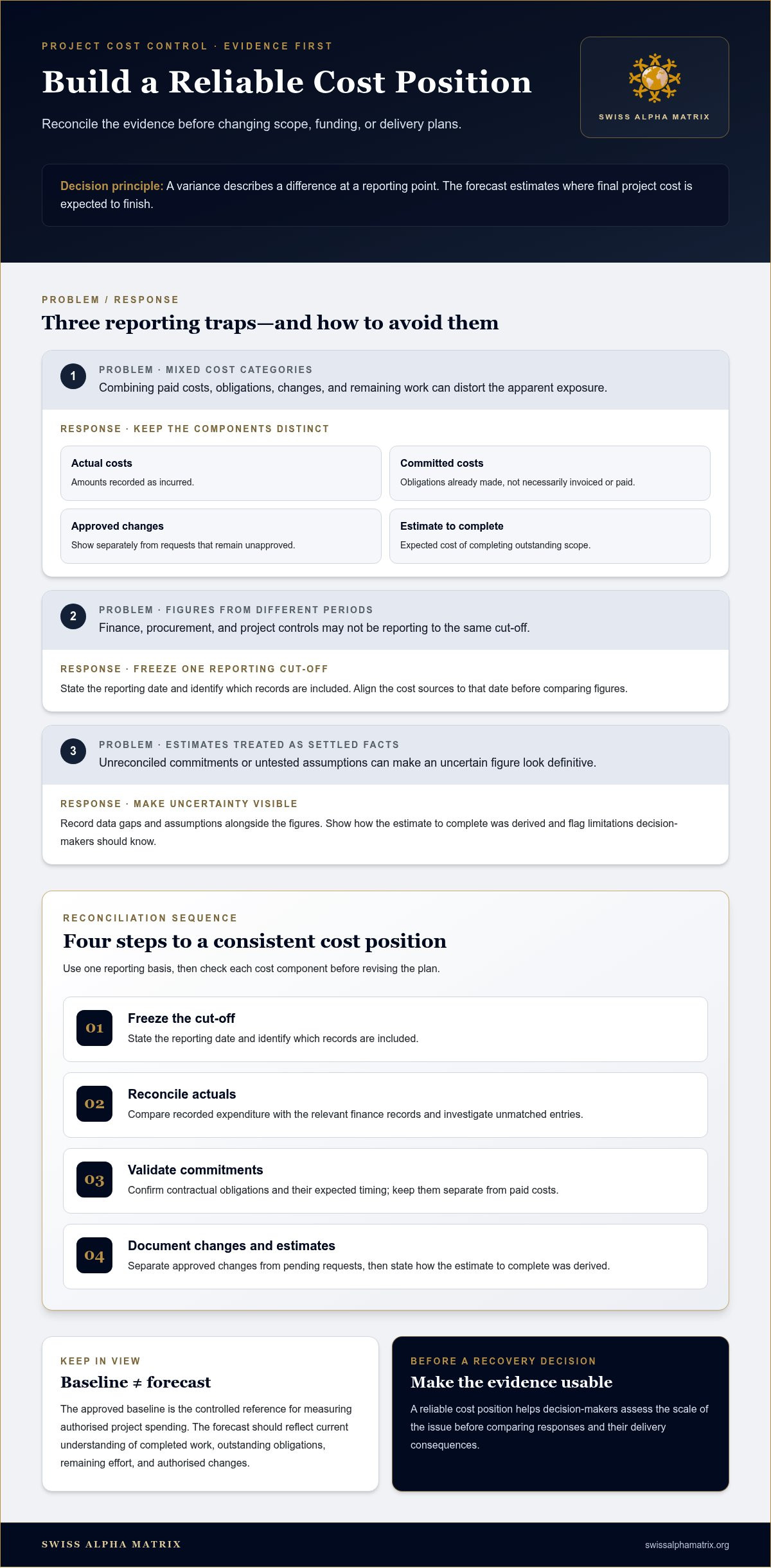
A budget variance describes a difference at a point in time; projected final cost estimates where the project is expected to finish.
Budget baseline, actual cost, and forecast are not interchangeable
The approved baseline is the controlled reference for measuring authorised project spending. Actual costs are amounts recorded as incurred; committed costs are obligations already made but not necessarily invoiced or paid; and estimated remaining work captures the cost expected to complete outstanding scope. Keep these categories distinct in reporting. Treating commitments as if they were fully paid or still avoidable can distort the apparent exposure.
The forecast brings these elements together into an evidence-based view of expected final expenditure. It should reflect the current understanding of completed work, outstanding obligations, remaining effort, and authorised changes, rather than simply carry forward the original estimate. If assumptions have changed, show the effect instead of concealing it within a single aggregate figure.
Why a budget overrun requires a decision, not just a warning
An unexplained variance can point to different underlying conditions: an approved scope change, an estimate that no longer reflects delivery conditions, or emerging execution risk. Each calls for a different response. Cutting expenditure without revisiting the assumptions may make a report appear more controlled while leaving the forecast, delivery plan, or material exposure unresolved.
Early escalation preserves options; it is not about assigning blame. It gives decision-makers time to assess consequences for scope, schedule, quality, risk, and capital before later commitments or dependencies constrain their choices.
For example, a temporary increase in recorded costs may reflect work completed earlier than planned, while a rising estimate to complete may signal that the approved baseline is no longer sufficient. Examine the figures in context rather than treating them as equivalent evidence. Before deciding how to manage a project budget overrun, establish what has changed, which assumptions remain valid, and whether the latest forecast indicates a likely breach of the baseline.
The immediate decision is not whether to hide or announce a variance in isolation. It is whether the evidence supports a revised view of final cost and what decisions must follow. First establish a reliable cost position, then compare recovery options.
Diagnose the Project Budget Overrun with Reliable Cost Evidence
Before changing scope, funding, or delivery plans, establish a cost position that finance, procurement, and project leadership can assess on the same basis. A disciplined diagnostic separates verified expenditure from obligations and estimates, then tests whether the forecast reflects current delivery conditions. Managing a project budget overrun is a question of evidence quality as much as cost control.
Reconcile the cost position before changing the plan
Start with a single reporting cut-off. Align finance records, procurement data, and project controls to that date so the report doesn’t compare figures from different periods. Then reconcile the cost categories, distinguishing payments already recorded, contractual commitments, approved changes, and requests that remain unapproved.
- Freeze the cut-off: State the reporting date and identify which records are included.
- Reconcile actuals: Compare recorded expenditure with the relevant finance records and investigate unmatched entries.
- Validate commitments: Confirm contractual obligations and their expected timing, while keeping them separate from paid costs.
- Document changes and estimates: Show approved changes distinctly from pending requests, then state how the estimate to complete was derived.
Record data gaps and assumptions alongside the figures. If a supplier commitment has not been reconciled, or remaining work relies on an untested productivity assumption, decision-makers should see that limitation rather than mistake an estimate for a settled fact.
Trace the variance to its drivers and confidence level
With a consistent cost position established, test possible drivers without treating any as proven: scope growth, schedule slippage, resource changes, supplier exposure, or other project risks. Compare each suspected cause with supporting records, such as approved change documentation, schedule updates, resource plans, and procurement information. Distinguish recurring cost pressure from a one-off charge or a timing difference that may shift between reporting periods.
For each finding, note the evidence, its date, and the degree of confidence. A confirmed contractual commitment carries a different evidential weight from an informal estimate. Both may matter, but they shouldn’t be presented as equally certain. This distinction helps leaders judge which exposure requires action now and which needs further validation.
Estimate at Completion (EAC) can express the expected final cost when actual expenditure and the estimate to complete are sufficiently reliable and use a consistent scope and method. The Cost Performance Index (CPI), which compares earned value with actual cost, can indicate cost efficiency where earned-value data is maintained appropriately. Neither metric resolves weak inputs: a calculated result may appear precise while remaining sensitive to incomplete or outdated assumptions.
A forecast is only as reliable as the evidence and assumptions used to construct it. Where internal reporting leaves material exposure unresolved, independent oversight and evidence-based risk analysis can support a clearer decision record. Swiss Alpha Matrix provides program oversight and risk-focused advisory for complex programmes, connecting documented exposure with ranked remediation options.
Compare Recovery Options Before Approving a Budget Overrun Response
Once the cost position and likely drivers are understood, compare responses rather than defaulting to the most visible cut. The appropriate intervention depends on whether the pressure is avoidable, recurring, tied to a scope change, or amplified by delivery dependencies. A proportionate decision protects strategic value while making the consequences for cost, timing, risk, and quality explicit.
Apply the same criteria to each option. Separate confirmed effects from outcomes that depend on uncertain assumptions, and show the remaining exposure if the response is not approved.
| Option | When it may fit | Trade-offs to assess |
|---|---|---|
| Contain costs | Evidence identifies avoidable or controllable expenditure. | Test whether reductions address the cost driver without shifting pressure to schedule, delivery dependencies, or quality. |
| Adjust scope | Lower-priority deliverables can be removed or deferred while preserving core objectives. | Make the effect on strategic value, expected benefits, acceptance criteria, and remaining exposure visible. |
| Seek authorised funding | The work remains strategically justified, and other responses would impair essential outcomes. | Present the funding requirement, rationale, alternatives, and approval path; additional funding does not itself resolve the cause. |
| Re-sequence work | Dependencies or resource constraints make a different delivery order more prudent. | Assess knock-on effects on milestones, coordination, resource availability, and total forecast cost. |
| Pause activity | A material risk or unresolved dependency makes continuation imprudent pending a decision. | Consider the cost and consequences of delay, including impacts on commitments, restart assumptions, and strategic value. |
Match the intervention to the source and persistence of the overrun
Cost containment is most defensible when evidence identifies expenditure that can be controlled without undermining required outcomes. Scope adjustment calls for a different test: whether a deliverable is genuinely lower priority, rather than merely expensive or difficult. Re-sequencing or pausing may be appropriate when unresolved risks or dependencies make continued work less prudent, but assess any secondary effects as part of the decision.
Contingency also requires scrutiny, not automatic release. Establish its intended purpose, who owns the allocation, and which approval rules apply. Drawing on contingency may address an identified risk; it should not obscure a structural forecast gap or substitute for an authorised decision.
Make the trade-offs visible to sponsors and investors
Cost reduction is not automatically the safest response. A cut that weakens a critical control, delays a dependent workstream, or compromises a required quality outcome may reduce near-term expenditure while increasing exposure elsewhere. The decision record should show expected cost, schedule, scope, quality, and risk implications for each viable option, distinguishing confirmed impacts from scenarios that rely on assumptions.
For each alternative, document the preferred response, rejected options, rationale, decision owner, and conditions that would prompt review. This makes clear not only what was selected, but why it was proportionate to the evidence available. A structured comparison is central to managing a project budget overrun without disguising material trade-offs. Where complex programme exposure calls for independent decision support, risk-focused project oversight can help frame documented exposure and ranked remediation options.
Implement a Project Budget Recovery Plan with Clear Controls
A selected response becomes useful only when translated into authorised, traceable work. The recovery plan should connect each decision to specific actions, owners, dependencies, and evidence of completion while keeping residual exposure visible. This creates a controlled path from approval to delivery, rather than relying on a general instruction to “reduce costs” or “get back on plan.”
Translate decisions into accountable recovery actions
For every action, record what will change, who is accountable for delivery, how completion will be evidenced, and which authority can approve or amend it. Link the action to affected deliverables and dependencies so a change in one workstream doesn’t silently transfer cost or risk elsewhere. Before implementing any scope or funding change, document the required approval and retain the decision with the plan.
- Action: Define the specific intervention and the outcome it is intended to achieve.
- Owner: Name one accountable lead, with supporting roles identified where needed.
- Dependency: Record prerequisite decisions, deliverables, or external commitments that may affect execution.
- Evidence: Specify the record or result that will demonstrate completion and support the next forecast review.
Keep a concise decision log alongside these actions. Capture the decision date, authority, approved change, rationale, conditions, and subsequent impact. If an assumption later changes, stakeholders can trace whether the original decision remains appropriate without reconstructing the history from separate reports.
Monitor the recovery against an explicit control baseline
Establish the reporting basis for the recovery plan and retain the approved cost baseline as the reference for measuring performance. A revised forecast should reflect authorised changes to scope or funding only after they are documented. Avoid resetting the baseline simply to make the variance appear smaller; preserve the distinction between the original approval, any formally approved adjustment, and the latest estimate of final expenditure.
Report actual costs, commitments, remaining-cost estimates, and forecast changes consistently at each agreed review. Define escalation triggers in advance, such as a renewed adverse variance, an unresolved material risk, a missed recovery action, or reduced confidence because a critical assumption can no longer be supported. A trigger should prompt a review and decision, not an automatic conclusion about the cause.
At each governance review, test whether actions are having the intended effect and whether dependencies or assumptions have shifted. For example, if a planned saving depends on removing a deliverable, confirm that the scope decision was authorised and that dependent work has been adjusted before incorporating the saving into the forecast. Record the result and any remaining exposure.
A disciplined control cycle makes how to manage a project budget overrun a continuing governance practice: actions are owned, approvals remain traceable, and forecasts change in response to evidence rather than aspiration. For support structuring recovery actions, oversight, and decision-ready reporting, explore project recovery oversight from Swiss Alpha Matrix.
When Independent Project Oversight Can Support Budget Decisions
Internal teams may have the expertise to manage a project and still lack a consolidated view of its financial exposure. Independent scrutiny can be useful when several stakeholders hold different parts of the evidence, reporting lines are unclear, or decisions have material implications for capital allocation. Its purpose is not to presume that a project has failed, but to help decision-makers assess the position on a consistent, evidence-based basis.
An overrun alone doesn’t establish misconduct, poor performance, or a need for external intervention. The case for additional oversight depends on the decision context: whether leaders can reconcile the cost position, assess assumptions with confidence, and identify who has authority to approve a response. For complex programmes, this helps keep scrutiny proportionate to the exposure.
Signals that internal reporting may not be sufficient
Consider whether cost records from finance, procurement, and delivery teams align to the same reporting period; whether key assumptions are disputed or unsupported; and whether decision rights for scope, funding, or contingencies are understood. These are signals to examine, not proof that existing controls have failed.
Cross-functional dependencies can also make an isolated cost report incomplete. A delay in one workstream may affect resource plans, supplier commitments, and the timing of another team’s deliverables. Independent review can bring those connections into view, particularly where no single internal report captures the combined exposure. The question is whether the available evidence is sufficient for the decision now required.
How independent oversight can inform the next decision
Independent advisory and program oversight support decision-making; they don’t replace project ownership, transfer accountability from sponsors, or constitute legal representation. Internal leaders retain authority for project decisions. External scrutiny can provide a structured assessment of evidence, material risks, and response options, helping leaders understand where conclusions are firm and where uncertainty remains.
Swiss Alpha Matrix provides audit-grade modeling, program oversight, and ranked remediation strategies. Evidence-based material risk analysis helps organise exposure by significance and connect it to practical choices. Executive-level intelligence packs consolidate exposure metrics, decision options, and actionable next steps, giving decision-makers a focused view without treating an advisory assessment as a guaranteed cure for an overrun.
This support can be valuable when the decision is consequential and evidence is fragmented, for example, when sponsors must weigh continued investment against scope changes or a pause while dependencies are resolved. Understanding how to manage a project budget overrun includes knowing when an independent view could clarify the decision, not simply add another reporting layer. The independent financial project management framework describes how independent oversight can structure financial visibility and decision support for complex programmes.
Make the Next Budget Decision with Greater Confidence
A recovery decision can also strengthen how future commitments are governed. Use what the project has revealed to sharpen investment gates, clarify who may authorise changes, and identify which assumptions deserve closer scrutiny before they affect the forecast. This helps ensure the next decision is based on current evidence, rather than momentum or a desire to preserve an earlier plan.
For complex programmes, an experienced independent perspective can help leaders assess material exposure and weigh available paths with appropriate care. Swiss Alpha Matrix is led by former Managing Directors and senior executives from Tier-1 global banks, bringing decades of transactional, regulatory, and risk management expertise to complex project management advisory. If you’re considering how to manage a project budget overrun while keeping material risk visible, explore Swiss Alpha Matrix’s complex project management advisory.
A measured next step can restore clarity without overstating certainty. With sound evidence and accountable decisions, your team can move forward with greater confidence.
Frequently Asked Questions
Is a project budget overrun always a sign of project failure?
No. An overrun signals a financial deviation that needs interpretation, not a definitive judgment about whether the project has failed. A project may exceed its approved budget while still delivering substantial strategic value, or remain within budget while failing to achieve its intended outcomes. Assess the financial position alongside the project’s objectives, expected benefits, and remaining exposure before deciding whether continuation is justified.
Can a project continue when its forecast exceeds the approved budget?
Yes, if the appropriate decision-makers authorise continuation and the project has a credible basis for proceeding. Until a decision is made, distinguish work already committed from new activity that can be deferred. For example, a team may need to complete a dependent work package while sponsors consider additional funding. If no authorised path exists, avoid treating continued spending as implicit approval.
How much contingency should a project budget include?
There’s no single contingency percentage suitable for every project. The reserve should reflect the risks it covers, the maturity of cost estimates, the complexity of delivery, and the potential consequences if assumptions prove incorrect. A project with well-defined scope and evidence may require a different provision from one with unresolved dependencies. Document the contingency’s purpose, ownership, and release authority so it isn’t treated as general spending capacity.
What happens if a project sponsor rejects the proposed recovery plan?
First, clarify the basis for rejection: the evidence, proposed trade-offs, funding request, or expected benefits may not address the sponsor’s concerns. Then present revised alternatives, including the consequences of maintaining the current course, reducing scope, or pausing specific work. Record the decision and unresolved exposure. Don’t proceed with a material change that requires approval until the relevant authority has made its decision.
Who should be responsible for managing a project budget overrun?
The project manager should coordinate the response and maintain a coherent view of actions, dependencies, and delivery impacts, while finance validates cost records and procurement clarifies relevant commitments. The sponsor or designated governance authority decides on matters such as funding or strategic scope changes. Clear separation of responsibilities helps the team manage a project budget overrun without assuming that one role owns every financial decision.
When should a project budget baseline be revised?
Revise the baseline only after a material change to scope, funding, or another approved project parameter has passed the applicable governance process. Preserve the previous baseline and document the approval, effective date, and reason for the change. This keeps historical performance distinguishable from the revised plan. A forecast that has worsened, by itself, is not a reason to alter the reference point used to assess performance.