

A company’s most visible strength may not be its most durable advantage. When evaluating a company’s competitive advantage, use SWOT to assess strengths, weaknesses, opportunities, and threats, then distinguish operational efficiency from the qualities customers perceive as distinctive. The two forms of advantage can reinforce each other, but they require different evidence.
It’s natural to start by asking what a company does better than its rivals. The more important question is whether that edge can last as markets and competitors change. This guide shows how to use SWOT as a disciplined framework, not a list of general impressions, and how to assess positioning, reputation, people, and partnerships in context.
You’ll learn to compare a company with relevant competitors, weigh internal capabilities against external conditions, and distinguish comparative advantage, producing more efficiently, from differential advantage, being perceived as distinctive or higher quality. The result is a clearer view of where an advantage comes from, how it shapes strategic positioning, and what may strengthen or weaken it over time.
Key Takeaways
- Use SWOT to separate internal capabilities from external market conditions, then identify which factors can strengthen or erode an advantage.
- Compare the company with relevant competitors using evidence tied to its target market, customer value, and business performance.
- Assess reputation, people, and partnerships as strategic capabilities, not merely supporting details.
- Distinguish efficiency-based comparative advantage from customer-perceived differentiation to judge the nature and durability of the company’s position.
What Is a Competitive Advantage?
A competitive advantage helps a company deliver greater value or operate at lower cost than its rivals. Assess its sources, supporting evidence, and durability before deciding whether it is rare or easy to reproduce.
-
Locate Rare Advantages
Map the company’s capabilities against direct competitors, then identify what rivals cannot readily reproduce. A rare advantage must create customer value, not merely look unusual in marketing materials. For example, a proprietary distribution network may reduce friction in delivery. Build on capabilities that combine distinctiveness with practical value, and do not mistake a memorable slogan for a durable edge.
-
Review Profit Margins and Returns
Compare profit margins and return on invested capital with relevant competitors and across the company’s own operations. Consistently stronger results can indicate pricing power, cost discipline, or more productive use of capital. Interpret both measures in context: a temporary margin increase may reflect short-term conditions, while weak returns may point to capital intensity or execution problems. Link each result to an identifiable business capability.
-
Examine Sources of Durable Advantage
Trace how the company’s brand, patents, network effects, and switching costs influence customer choice and imitation. A trusted brand can support preference; patents can protect specific intellectual property; network effects may increase value as participation grows; and switching costs can make changing providers less attractive. Test whether each source delivers customer value over time. A feature competitors can reproduce quickly is more likely to provide a temporary edge than a sustainable one.
-
Apply Industry and Value Chain Frameworks
Use Porter’s Five Forces to examine rivalry, new entrants, substitutes, buyer power, and supplier power. Then map the value chain, from inputs and operations through sales and service, to locate where the company creates distinctive value or controls costs. Together, these frameworks show whether an advantage rests on a defensible position or a vulnerable activity. Reassess it as industry conditions and rival capabilities change.
What Is a SWOT Analysis?
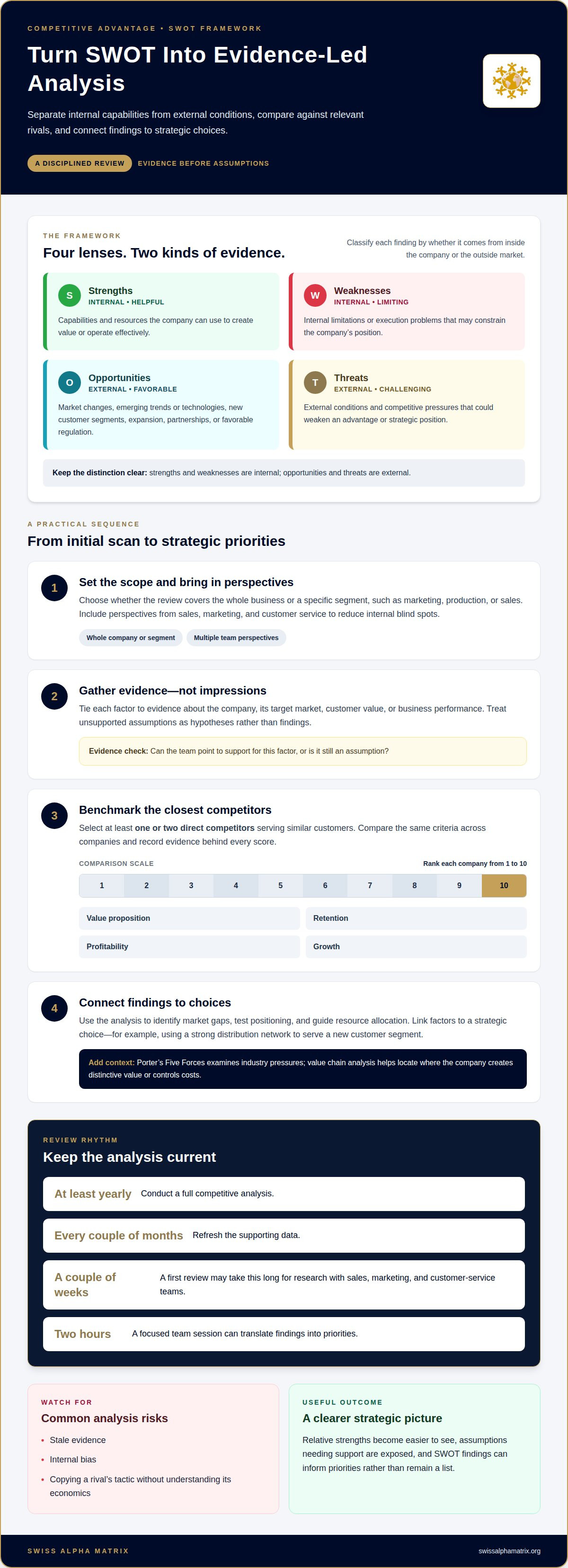
A SWOT framework supports evaluating a company’s competitive advantage by connecting internal capabilities with external conditions. It also helps separate evidence from assumptions before setting strategic priorities.
-
Use SWOT Analysis
Separate internal strengths and weaknesses from external opportunities and threats. Then connect each finding to a strategic choice, such as using a strong distribution network to serve a new customer segment. SWOT is one part of competitive analysis; Porter’s Five Forces and value chain analysis add industry and operational context. Include perspectives from sales, marketing, and customer service to reduce internal blind spots. Treat unsupported assumptions as hypotheses, not findings.
-
Weigh the Benefits and Risks
Conduct a full competitive analysis at least once a year, then refresh its data every couple of months. A first review can take a couple of weeks of research with sales, marketing, and customer-service teams. Use findings to identify market gaps, test positioning, and guide resource allocation. Risks include stale evidence, internal bias, and copying a rival’s tactic without understanding its economics. A focused two-hour team session can translate findings into priorities.
-
Compare Closest Competitors
For evaluating a company’s competitive advantage, select at least one or two direct competitors serving similar customers. Compare criteria such as value proposition, retention, profitability, and growth. Rank each company using a scale from 1 to 10, and record evidence behind every score. This reveals relative strengths while exposing assumptions that need stronger support. For consequential decisions, a structured risk management framework can help organize material uncertainties.
A company can use SWOT analysis to shape its overall business strategy or a strategy for a specific segment, such as marketing, production, or sales. Bringing together different groups and perspectives from across the organization can make the analysis more useful. Businesses can turn external opportunities into competitive advantage. These may include market changes, emerging trends or technologies, new customer segments, geographic expansion, partnerships, and favorable regulatory changes.
Assessing positioning, reputation, people, and partnerships
Translate strategic positioning into observable evidence, then test whether customers, employees, and partners reinforce it. A balanced review links market perception to operating results.
- Define the value proposition by identifying its target market, the specific value offered, and how the company meets customer needs. Compare that position with competitors serving similar customers. Assess reputation through customer surveys, interviews, reviews, and social media, looking for recurring themes in satisfaction, loyalty, and preferences. Separate consistent customer evidence from isolated praise or criticism.
-
Measure Pricing Power and Customer Loyalty
Compare pricing and retention patterns with competitors, accounting for differences in customer segments and offerings. Pricing power is supported when customers continue choosing a company despite alternatives, but price alone does not establish loyalty. Examine retention, repeat preference, and customer feedback together. Surveys and interviews can reveal whether customers stay for distinctive value, convenience, or a limited choice of alternatives.
-
Review Financial and Nonfinancial Metrics
Track market share, customer satisfaction, retention, loyalty, profitability, and growth as complementary indicators. Financial measures show commercial outcomes; customer and market measures help explain them. Rank the company and competitors on relevant criteria using a scale from 1 to 10, recording evidence for each assessment. Avoid relying on one strong result, such as growth, without examining customer experience or profitability.
- Assess people and partnerships as sources of execution capacity. Examine whether employees have the expertise needed to deliver the stated value proposition and whether key partners extend access, capabilities, or customer reach. Compare those contributions with the company’s strategic priorities. A partnership adds competitive value when its role is specific and material, not merely mentioned in corporate communications.
Metrics such as market share, customer satisfaction, retention, loyalty, profitability, and growth can help companies assess their competitive position. No single measure should stand in for the full picture.
Comparative advantage versus differential advantage
Distinguish operational efficiency from customer-perceived distinction before judging an advantage. This clarifies how a company competes and what evidence supports its position.
- Identify comparative advantage by examining whether the company produces a product or service more efficiently than a rival. Compare relevant inputs, operating processes, and output quality on a like-for-like basis. For example, a provider using fewer resources to deliver an equivalent service may sustain stronger margins. Efficiency matters strategically when it supports customer value or profitability, rather than resulting from a temporary reduction in investment.
- Assess differential advantage by determining whether customers perceive the company’s offering as distinctive or higher quality. Look for evidence in customer preferences, retention, and willingness to choose that offering over alternatives. A distinctive service experience, for instance, may support preference even when production costs are not lower. Test management’s claims of uniqueness against customer feedback and competitor offerings.
- Map each advantage to its source and beneficiary. Comparative advantage concerns relative efficiency; differential advantage concerns perceived distinction. A company may have both, such as a streamlined service model that also delivers a more consistent customer experience. It may also have one without the other. This distinction prevents strong cost performance from being mistaken for brand preference, or a celebrated brand from being mistaken for operating efficiency.
- Test durability by examining whether competitors can reproduce the source and how customers respond as alternatives change. An easily copied process may lose its efficiency edge; a differentiated feature may lose value if customers no longer consider it distinctive. Track the evidence over time and separate enduring capabilities from short-lived conditions. For a transaction-specific assessment of operational and execution risks, discuss independent due diligence.
Swiss Alpha Matrix
Swiss Alpha Matrix helps stakeholders assess competitive positioning alongside the operational and investment risks that may affect strategic decisions. Its Operational Due Diligence and Risk Management Frameworks provide a structured perspective when an advantage depends on complex operations, counterparties, or execution across markets. Audit-Grade Instrument Validation and On-Ground Verification Services support careful validation of evidence, while Complex Project Management helps coordinate programmes.
Consider this support when a SWOT assessment identifies material uncertainties that internal analysis alone cannot resolve, or when an investment decision depends on the reliability of an asserted advantage. The aim is not to replace strategic judgment, but to strengthen the evidence informing it. Contact Swiss Alpha Matrix to discuss your requirements.
Make Competitive Insight Part of Strategic Decisions
The value of evaluating a company’s competitive advantage lies in how carefully the findings inform future choices. Treat the assessment as a decision-making discipline: connect strategic priorities to evidence, identify the assumptions behind them, and revisit those assumptions when market conditions or execution change. This helps leadership distinguish durable sources of value from advantages that need renewed investment or a different response. It also gives leaders a clearer basis for directing attention and capital toward capabilities that matter to long-term positioning.
Where a strategic decision depends on complex transactions, operational evidence, or coordinated execution, independent scrutiny can add useful perspective. Swiss Alpha Matrix provides Audit-Grade Instrument Validation, On-Ground Verification Services, and Complex Project Management for relevant programmes. Contact Swiss Alpha Matrix to discuss strategy and consider the evidence your next decision requires. A measured process can help turn competitive insight into deliberate action.
Frequently Asked Questions
What is a competitive analysis?
A competitive analysis is a structured assessment of rival businesses, their market choices, and their relative capabilities. It helps decision-makers understand the alternatives available to customers and where the company’s position differs. For example, compare a rival’s stated expansion plans with its actual capacity to serve new customers. This can inform strategic decisions more reliably than reviewing competitor messaging alone.
What is a competitive advantage in business?
A competitive advantage is a capability or position that enables a business to deliver better customer or commercial outcomes than alternatives. It matters when customers receive a meaningful benefit or the company serves them more efficiently, and that difference supports sustained performance. For example, a specialist provider may be preferred for its expertise, while another competes through a more efficient operating model.
How do you assess a company’s market share and industry position?
Define the market segment and period first, then calculate the company’s sales as a proportion of total sales in that same market and period. Use consistent boundaries when comparing competitors, since broad industry figures can obscure a strong niche position. Then assess market share alongside growth, profitability, customer retention, and customer preference. Together, these measures show whether the company’s position is expanding and commercially valuable.
What risks or warning signs can erode a company’s competitive advantage?
Watch for repeated customer losses, persistent discounting, declining service quality, or growing dependence on a single customer, supplier, or partner. These patterns can weaken pricing power, reduce resilience, or undermine the company’s value proposition. Competitors may also imitate a visible capability or introduce alternatives that change customer expectations. Investigate whether each warning sign persists and identify the business dependency or capability behind it.