

What if the central risk in a regulatory engagement is not a missed rule, but an obligation that never becomes an operational control? Firms assessing Hong Kong financial regulation consultants need more than a polished interpretation. They need a mandate that identifies who owns each action, what evidence will demonstrate progress, and when issues must be escalated.
That concern is well founded. Financial activity in Hong Kong can involve distinct regulatory responsibilities, operational dependencies, and cross-border considerations. Advisory scope and accountability may be less clear than the rules themselves. Regulatory analysis is most useful when it complements governance and legal work, then connects to verifiable controls and disciplined execution.
This guide explains how to assess your advisory needs, compare consulting approaches, and define an engagement around clear deliverables, ownership, and escalation paths. It also covers how to evaluate expertise, independence, and evidence standards against the risks at hand, and how to coordinate regulatory compliance advisory with operational due diligence, on-ground verification, and cross-border project oversight. The aim is a considered selection process that supports sound decisions from initial analysis through implementation.
Key Takeaways
- Start with the regulatory issue, its business consequence, and the decision at stake. This helps determine whether the mandate calls for interpretation, operational assessment, or cross-border coordination.
- Map the regulatory scope to the entity, activities, products, counterparties, and transaction structure. Consider the roles of the SFC and HKMA where applicable.
- Compare hong kong financial regulation consultants on relevant senior experience, independence, evidence standards, reporting, and clarity of scope.
- Structure the engagement around a defined decision, agreed evidence, governance, milestones, reporting cadence, escalation routes, and accountable decision owners.
- Coordinate regulatory analysis with operational due diligence and project oversight so recommendations can inform practical controls and cross-border execution.
When Hong Kong financial regulation consultants add value to a mandate
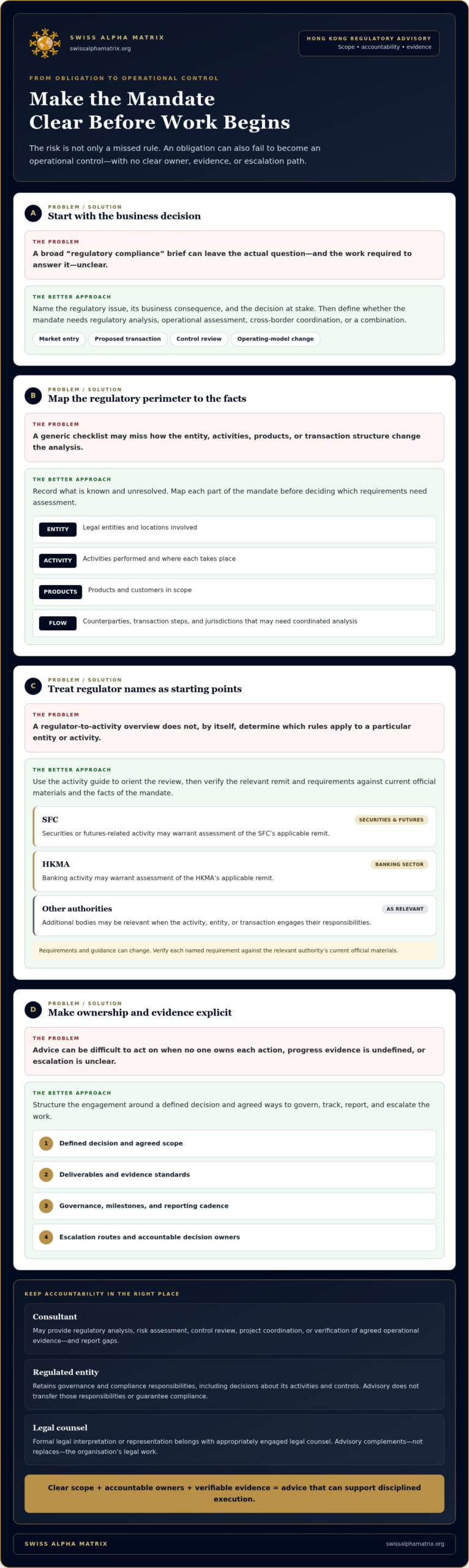
Begin with the decision, not the adviser. What regulatory issue must be resolved, what could it mean for the business, and which decision depends on the answer? A market-entry plan, proposed transaction, control review, or material change to an operating model may raise different questions. Defining the decision first helps establish whether the mandate calls for regulatory analysis, operational assessment, cross-border coordination, or a combination.
In brief: Hong Kong financial regulation consultants translate applicable requirements into scoped analysis and execution support. They can help an organisation assess implications, examine relevant controls, and coordinate defined work. Their advice informs decisions; it does not guarantee compliance or transfer the regulated entity’s responsibilities.
Which situations call for specialist regulatory advisory?
Specialist input can help when a business is entering a market, assessing a transaction, reviewing controls, or changing how a financial activity is delivered. The mandate should identify the specific activity, operating model, and decision under review rather than treating “regulatory compliance” as an unlimited brief. A project question can usually be bounded by agreed scope and deliverables. An ongoing oversight requirement, by contrast, calls for a continuing internal governance and compliance structure.
Cross-border activity adds another layer. An organisation may need to coordinate analysis across jurisdictions because entities, counterparties, products, or transaction steps can engage different obligations. Hong Kong’s position within a connected financial economy is part of that context. The Economy of Hong Kong overview provides general background, while a specific mandate requires analysis tailored to its facts and applicable requirements.
What a consultant can, and cannot, be accountable for
A well-defined advisory mandate may include regulatory analysis, risk assessment, control review, project coordination, or verification of agreed operational evidence. For example, an adviser can assess whether documented procedures align with the project’s stated requirements and report gaps for decision-makers to address. The value lies in clear work products, evidence standards, and escalation routes, not in an assurance that every obligation has been satisfied.
The regulated entity retains its governance and compliance responsibilities, including decisions about its activities and controls. Advisory should complement that accountability and the organisation’s legal work. Where a question requires formal legal interpretation or representation, it belongs with appropriately engaged legal counsel. Keeping these roles distinct makes responsibilities clear and the consultant’s contribution measurable.
How Hong Kong’s regulatory landscape shapes a consultant’s scope
A sound regulatory assessment starts with the facts of the mandate, not a generic checklist. Relevant requirements may depend on the entity carrying out an activity, where it operates, the products involved, its customers and counterparties, and how a transaction is structured. Two businesses offering similar services may therefore need different analysis if their operating models or transaction flows differ.
Which regulators may be relevant to a financial-services mandate?
At a high level, the Securities and Futures Commission (SFC) regulates securities and futures markets, while the Hong Kong Monetary Authority (HKMA) oversees the banking sector. These roles are orientation points, not a conclusion about which rules apply to a particular entity or activity. The relevant regulator, requirements, and remit must be assessed against current official sources and the facts of the mandate.
Regulator-to-activity guide, subject to current-scope verification
SFC: Securities or futures-related activity may warrant assessment of the SFC’s applicable remit.
HKMA: Banking activity may warrant assessment of the HKMA’s applicable remit.
Other authorities: Additional bodies may be relevant where the activity, entity, or transaction engages their responsibilities.
This is a starting point, not a universal map. Hong Kong rules and regulatory guidance can change, so verify each named requirement against the relevant authority’s current official materials before using it to inform a business decision.
How to define the regulatory perimeter before work begins
For hong kong financial regulation consultants, a disciplined scope review records what is known and what remains unresolved. Map the legal entities and locations involved, the products and customers in scope, the activities performed, and the counterparties and transaction steps. For cross-border operations, identify where each activity takes place and which jurisdictions may need coordinated analysis.
Then organise the review into distinct categories:
- Verified obligations: requirements checked against current, relevant official sources.
- Questions for assessment: potential permissions, controls, reporting, or cross-border issues requiring further analysis.
- Open assumptions: facts that could change the scope or conclusions if they prove inaccurate.
- Legal questions: matters requiring appropriately engaged legal counsel rather than operational advisory alone.
This separation makes the analysis easier to review, assign, and update as facts or guidance change. Where the mandate also requires operational due diligence or project coordination, cross-border regulatory advisory can connect regulatory analysis with evidence and execution planning while preserving the distinction between advisory work, legal counsel, and the entity’s own governance responsibilities.
How to compare Hong Kong financial regulation consultants
Compare the proposed team and method against the risks of your mandate, rather than relying on firm size or broad claims of expertise. Relevant transaction, regulatory, and risk-management experience matters most when it relates to the activity under review. Establish who will lead the work, how senior expertise will remain involved, and how the adviser will document assumptions, evidence, findings, and unresolved issues.
Ask for a mandate-specific methodology and descriptions of expected deliverables, such as a risk assessment, evidence log, or executive-level report. These can be discussed without seeking confidential client information. The central test is whether the proposed work makes responsibilities and decision points clearer. Advisory can strengthen analysis and execution discipline, but it cannot guarantee compliance or remove the organisation’s own obligations.
What evidence demonstrates relevant institutional experience?
Look for direct experience that matches the mandate’s transaction, regulatory, or operational features. Establish whether the people presenting that experience will lead or review the work. At Swiss Alpha Matrix, leadership includes former senior executives from Tier-1 global banks, and engagements can produce audit-grade reports and risk assessment documentation. Consider how that experience will shape the scope, evidence standards, and reporting for your specific mandate.
How independence, legal advice, and compliance ownership differ
An independent adviser can assess available evidence, test assumptions, and report concerns without taking over management’s decisions. Legal counsel provides legal advice and representation within its engagement. Internal compliance supports the organisation’s continuing compliance function, while project oversight coordinates agreed work, dependencies, and delivery. These roles can complement one another, but they are not interchangeable. Management and boards retain their applicable decision-making and compliance responsibilities.
Compare the function, not the label
| Function | Typical contribution | Key boundary |
|---|---|---|
| Regulatory advisory | Scoped analysis, risk assessment, and review of agreed evidence | Does not assume the entity’s governance duties or guarantee compliance |
| Legal counsel | Legal advice and, where engaged, legal representation | Distinct from operational verification and project delivery |
| Internal compliance | Ongoing internal monitoring and compliance processes | Remains part of the organisation’s own control environment |
| Project oversight | Coordination of milestones, dependencies, reporting, and escalation | Does not itself determine legal obligations |
For hong kong financial regulation consultants, a strong proposal should make these boundaries explicit, name the outputs, and explain how findings and open issues will reach decision-makers. That clarity helps the organisation assess fit before work begins and preserve accountability throughout the engagement.
How to structure a regulatory consulting engagement
A well-structured mandate turns a broad regulatory concern into work that can be directed, evidenced, and reviewed. For hong kong financial regulation consultants, the engagement should connect the decision required with a defined scope, proportionate evidence, clear governance, and outputs that support accountable action. Use a practical sequence to keep the work focused:
- Define the decision. State what management or the board needs to decide, and by when.
- Map the scope. Identify relevant entities, activities, products, jurisdictions, dependencies, assumptions, and exclusions.
- Agree the evidence. Specify which documents, interviews, records, or on-ground verification are relevant to the questions being assessed.
- Set governance. Name the engagement lead, internal owners, decision-makers, reporting cadence, milestones, and escalation routes.
- Review the outputs. Agree how findings will be validated, who will receive them, and how open issues will reach the appropriate decision forum.
From regulatory question to agreed scope
Translate the decision need into precise questions about the entities, activities, and jurisdictions under review. Record assumptions, exclusions, dependencies, and matters requiring legal or other specialist input. This keeps advisory work distinct from legal advice and the organisation’s own compliance responsibilities. The mandate should also set out deliverables, evidence requirements, confidentiality expectations, escalation thresholds, and the people responsible for supplying information and responding to findings.
Choose methods to match the scope. Document review may be sufficient for some questions. Interviews can clarify how controls operate in practice, while on-ground verification is appropriate when direct operational evidence is material to the mandate. This keeps evidence gathering proportionate and makes gaps visible instead of obscuring them with an unnecessarily broad review.
What executive-ready reporting should make clear
Reporting should distinguish verified facts from analytical judgements, unresolved issues, and recommended next actions. Each finding is more useful when linked to an accountable owner, a proposed timeline, a relevant governance forum, and any decision gate it may affect. If new evidence changes an assumption, the report should make that change traceable.
Audit-grade documentation can support disciplined review when it records the basis for conclusions and the evidence considered, with detail proportionate to the engagement. It cannot promise a particular regulatory outcome. The organisation retains responsibility for its decisions, controls, and any actions taken in response.
For a mandate that connects regulatory analysis with operational evidence and project delivery, discuss mandate-specific advisory with Swiss Alpha Matrix.
Selecting an adviser for Hong Kong and cross-border oversight
A suitable adviser should bring relevant experience, independence, a clearly bounded scope, disciplined evidence standards, and accountable delivery. These criteria matter especially when Hong Kong regulatory analysis is one part of a wider transaction or programme. Findings need to inform operational decisions without obscuring who owns them or which matters require separate legal advice.
Swiss Alpha Matrix brings together regulatory and risk-management experience from former senior executives of Tier-1 global banks, alongside cross-border due diligence and project oversight. Its work can include audit-grade reporting, risk assessment documentation, and on-ground verification where direct evidence is material. Define the appropriate scope around the mandate’s objectives, workstreams, and decision requirements.
When regulatory advisory should connect to wider due diligence
Regulatory findings can intersect with counterparty, operational, instrument, and execution risks. For example, an identified control dependency may affect how a transaction workstream is sequenced, while a gap in operational evidence may change what decision-makers can reasonably conclude. Coordinating these strands helps keep regulatory analysis connected to the facts that shape implementation.
Where stakeholders span jurisdictions, consistent records of assumptions, evidence, open questions, and decisions help maintain a coherent review trail. This is particularly useful when multiple teams contribute to diligence or execution. For a broader framework, see the guide to cross-border investment due diligence.
A mandate-specific approach to oversight
Senior-led project management can coordinate advisers, internal owners, milestones, dependencies, and executive reporting while preserving the distinction between regulatory analysis, legal advice, and management’s own responsibilities. On-ground verification is valuable when documentary review alone cannot resolve a material factual question, such as whether an operational process works as described. Let the issue determine the method, rather than expanding the mandate by default.
Cross-border work also calls for careful attention to differences in applicable requirements and their current status. The guide to international financial regulations offers wider context. Each Hong Kong or overseas obligation still needs assessment against the relevant entity, activity, and transaction facts.
When selecting hong kong financial regulation consultants, look for an adviser who can connect relevant expertise to a precise mandate, support conclusions with traceable evidence, and report clearly to accountable decision-makers. Swiss Alpha Matrix welcomes a discussion of your mandate’s objectives and oversight requirements, including how regulatory advisory, due diligence, and project governance may fit together.
Set a Clear Course for Regulatory Oversight
A well-chosen advisory engagement begins with a precise decision, a scope grounded in the relevant entity and activities, and clear ownership of the work that follows. When comparing hong kong financial regulation consultants, assess whether their experience, independence, evidence standards, and reporting approach fit the mandate’s risks. For cross-border activity, regulatory analysis is most useful when coordinated with operational due diligence and project oversight, while remaining distinct from legal advice and the organisation’s own responsibilities.
Swiss Alpha Matrix brings together senior leadership experience from Tier-1 global banks with cross-border due diligence, on-ground verification, and audit-grade reports and risk assessment documentation. These capabilities can help decision-makers examine evidence and coordinate complex work with greater discipline, without promising a particular regulatory outcome.
Define the oversight your mandate requires, then make accountability and deliverables explicit. Discuss a mandate-specific regulatory advisory engagement with Swiss Alpha Matrix to consider your objectives, evidence needs, and oversight requirements. A clearly framed mandate is a sound foundation for measured, informed decision-making.
Frequently Asked Questions
What do Hong Kong financial regulation consultants do?
Hong kong financial regulation consultants assess regulatory questions within a defined business mandate and help translate relevant requirements into practical analysis and execution support. Depending on the scope, work may include reviewing controls and evidence, identifying risks and open questions, coordinating cross-border due diligence, or overseeing project workstreams. Deliverables can include documented findings and risk assessments. The organisation retains responsibility for its governance, decisions, and compliance obligations.
When should a financial institution engage a Hong Kong regulatory consultant?
Engage a consultant when a defined business decision depends on understanding regulatory implications or testing how relevant controls operate. Common triggers include market entry, transaction diligence, a control review, or a material operating-model change. Specialist support can also help coordinate work across jurisdictions. If the need is continuing oversight rather than a bounded project, define how the adviser’s work will fit with internal compliance and governance arrangements.
Are regulatory consultants the same as financial services lawyers?
No. Regulatory consultants provide scoped analysis, risk assessment, operational review, verification, or project coordination. Appropriately engaged legal counsel provides legal advice and representation within its engagement. The roles can complement one another, but advisory work should not substitute for legal advice where a question requires it. Management and boards also retain their applicable decision-making, governance, and compliance responsibilities.
How do I assess a Hong Kong financial regulation consultant?
Assess whether the proposed team has experience relevant to your activities, transaction, and risk profile, and clarify who will lead and review the work. Examine the proposed scope, independence, evidence standards, reporting approach, and escalation process. Ask for a mandate-specific methodology and descriptions of sample deliverables without requesting confidential client material. Strong documentation should distinguish verified facts, analysis, assumptions, and unresolved issues.
Can a consultant guarantee that my business is compliant in Hong Kong?
No consultant can guarantee that a business is compliant or eliminate regulatory risk. Requirements depend on the entity, its activities, products, counterparties, and transaction structure, and conclusions rely on the information and evidence available. A consultant can support disciplined analysis, assess agreed controls, document potential gaps, and help coordinate actions. The organisation remains accountable for its decisions, governance, and ongoing compliance arrangements.
Which Hong Kong regulators may be relevant to a financial business?
The Securities and Futures Commission (SFC) and Hong Kong Monetary Authority (HKMA) may be relevant, depending on the activities under review. At a high level, the SFC is associated with securities and futures markets, while the HKMA oversees the banking sector. These are not universal assignments: the applicable regulator and requirements depend on the entity and activity. Verify current remits and obligations against official sources.
What should a regulatory consulting engagement deliver?
A well-defined engagement should specify its questions, entities and activities in scope, evidence requirements, deliverables, owners, milestones, reporting cadence, and escalation routes. Depending on the mandate, outputs may include documented analysis, risk assessment, control findings, verification results, and prioritised next actions. Executive-ready reporting should separate established facts from judgements and open issues, making clear who must consider each finding and what decision it informs.