

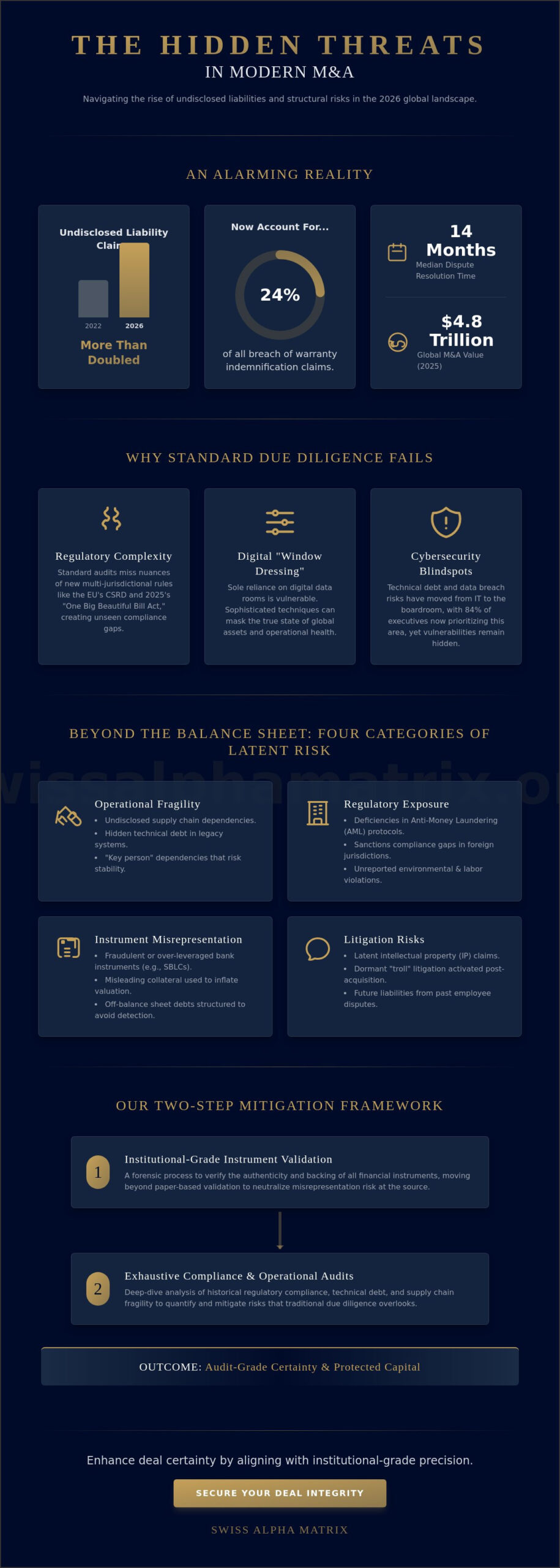
Did you know that undisclosed liability claims in M&A have more than doubled since 2022, currently accounting for 24% of all breach of representations and warranties indemnification claims? As global M&A value reached $4.8 trillion in 2025, the difficulty of uncovering hidden liabilities in m&a has reached a critical threshold; the median resolution time for these disputes is now 14 months. You’ve likely observed that standard due diligence often fails to capture the nuances of the 2026 regulatory environment, where the EU’s CSRD and the July 2025 One Big Beautiful Bill Act have fundamentally altered the fiscal landscape for cross-border entities.
We understand that protecting capital requires a level of scrutiny mirroring the traditional precision of Swiss private banking. This article provides an institutional framework for identifying and neutralizing latent operational risks that threaten deal integrity. We’ll guide you through a strategic methodology that moves beyond paper-based validation to ensure your final valuation is supported by audit-grade certainty and a bespoke understanding of modern compliance, including California’s $16.90 minimum wage and new emissions reporting mandates.
Key Takeaways
- Evaluate how the evolution toward multi-jurisdictional deal structures in 2026 demands a sophisticated lens to discern obligations that remain obscured by traditional reporting.
- Master a comprehensive categorization of hidden liabilities in m&a, focusing on the subtle operational risks and regulatory deficiencies that threaten cross-border deal integrity.
- Recognize the inherent vulnerabilities of relying solely on digital data rooms and the sophisticated “window dressing” techniques used to mask the true state of global assets.
- Adopt a robust, two-step framework for risk mitigation that prioritizes institutional-grade instrument validation and exhaustive audits of historical regulatory compliance.
- Enhance deal certainty by aligning strategic mandates with a partner that exemplifies the discretion and technical precision characteristic of the Swiss financial tradition.
The Evolution of Hidden Liabilities in Modern M&A
The conceptualization of hidden liabilities in m&a has shifted from mere accounting discrepancies to a sophisticated array of structural risks that evade standard balance sheet scrutiny. As we navigate the 2026 fiscal landscape, these obligations are frequently woven into the multi-jurisdictional fabric of modern Mergers and acquisitions. Since global deal values surged to $4.8 trillion in 2025, the limitations of traditional audits have become glaringly apparent. These standard procedures often fail to detect the nuances of financial engineering or the long-term implications of the “One Big Beautiful Bill Act” passed in July 2025. Ensuring the integrity of high-stakes capital requires an institutional-grade advisory approach that moves beyond the surface to achieve absolute technical precision.
The “Unknown Unknowns” in Tier-1 Transactions
Strategic architects must differentiate between disclosed contingencies and the truly hidden liabilities that reside in the “quiet” sectors of a target entity. While disclosed items are quantifiable, hidden liabilities often manifest as systemic failures or off-balance sheet debts that don’t appear until well after the integration is finalized. It’s common for these “unknown unknowns” to surface 14 months post-deal, which happens to be the median resolution time for such claims as of late 2025. Applying a rigorous standard of financial discipline ensures that we don’t just identify what’s visible, but interrogate the very foundations of the target’s valuation.
Why 2026 Requires a New Due Diligence Standard
The current year demands a paradigm shift in how we approach risk, driven by the proliferation of digitised financial instruments and increasingly compressed deal timelines. With 84% of executives now prioritizing cybersecurity due diligence, the risk of technical debt or data breaches has moved from the IT department to the boardroom. A sophisticated framework for cross-border investment due diligence is now mandatory to account for the fragmented regulatory shifts of 2026, such as California’s new climate disclosure laws. This standard ensures that the pursuit of alpha is never compromised by the structural fragility of an unverified asset, maintaining the excellence and precision that institutional investors demand.
Categorising Latent Risks: Beyond the Balance Sheet
Identifying hidden liabilities in m&a necessitates a departure from elementary fiscal reviews, favoring instead a forensic interrogation of risks that do not reside within traditional ledger entries. Although a standard balance sheet analysis in M&A offers a necessary baseline of solvency, it’s inherently limited in its ability to detect the structural decay or the sophisticated regulatory exposures that characterize the 2026 global market. To preserve capital and ensure long-term wealth preservation, the strategic architect must look toward four critical categories of latent risk:
- Operational Fragility: Undisclosed supply chain dependencies and technical debt that can erode post-closing margins.
- Regulatory Exposure: Deficiencies in Anti-Money Laundering (AML) protocols and sanctions compliance in foreign jurisdictions.
- Instrument Misrepresentation: Fraudulent or over-leveraged bank instruments, such as SBLCs, used as misleading collateral.
- Litigation Risks: Latent intellectual property claims and “troll” litigation that may not manifest until the integration phase.
Operational and Technical Debt
The true cost of technical debt is rarely disclosed in a preliminary prospectus. If an entity operates on legacy systems that lack interoperability with modern standards, the subsequent capital infusion required for modernization can significantly diminish risk-adjusted returns. We also observe “key person” dependencies, where the departure of a single executive could destabilize the entire operational framework. Executing a bespoke operational due diligence process allows for the identification of these vulnerabilities before they compromise the valuation. This level of scrutiny is essential to maintain the business continuity that institutional investors expect.
The Peril of Fraudulent Financial Instruments
Standby Letters of Credit (SBLCs) and other bank instruments are frequently utilized as high-value collateral, yet their legitimacy is too often assumed rather than verified. In an era where 84% of executives anticipate heightened scrutiny of digital and financial assets, relying on unverified documentation is a strategic failure. Employing bank instrument validation services ensures that all collateral meets audit-grade standards, protecting the integrity of the final deal structure. Integrating these forensic layers ensures that your capital remains protected within a framework of Swiss excellence. For those seeking to secure their next high-stakes acquisition, consulting with a dedicated strategic partner provides the necessary layer of institutional security.
The Fallacy of Paper-Based Verification in Global Deals
The assumption that a Virtual Data Room constitutes a comprehensive source of truth represents a profound strategic vulnerability in high-stakes acquisitions. Digital documentation, while efficient for initial screening, is inherently susceptible to “window dressing”—a practice where financial reports are meticulously curated to present an idealized version of fiscal health that may not exist in reality. Unmasking hidden liabilities in m&a requires looking past the pixelated veneer of the data room to the tangible assets beneath. Relying solely on local counsel in foreign jurisdictions often introduces a fragmented perspective, as these entities may lack the institutional oversight necessary to align local legalities with the overarching global financial standards required for capital protection. Our philosophy at Swiss Alpha Matrix is rooted in the traditional discretion and precision of Swiss private banking: we trust the documentation, but we verify the reality on-ground through exhaustive, independent scrutiny.
The Necessity of On-Ground Verification
In global financial hubs such as London, Geneva, and Hong Kong, the physical existence and operational condition of assets cannot be confirmed through a PDF. There are documented instances where pledged collateral existed only on paper, or where the “pristine” condition of a manufacturing facility was masked by outdated photography in the digital repository. Verification must extend beyond the polished narratives of the C-suite; it’s often the mid-level operational managers who, during on-site interviews, inadvertently reveal the cultural friction or supply chain dependencies that represent a latent risk. This on-ground presence ensures that the strategic architect possesses a verified, three-dimensional view of the target, rather than a flat, potentially manipulated representation that serves the seller’s interests.
Bridging the Gap Between Legal and Financial Reality
Legal “Representations and Warranties” are a standard component of any transaction, yet their utility is fundamentally tethered to the seller’s post-closing solvency and the strength of the indemnification structure. If a seller lacks the liquid capital to back a claim, the legal protection becomes an empty gesture, leaving the buyer exposed to significant loss. To mitigate this, we employ independent financial project management to oversee every stream of the verification process with clinical detachment. This institutional oversight ensures that the financial reality of the deal matches the legal narrative, providing the executive-level intelligence required to confirm transactional integrity. By merging financial discipline with forensic on-ground audits, we ensure that hidden liabilities in m&a are neutralized before they can threaten the long-term preservation of your capital.
A Strategic Framework for Unearthing Hidden Liabilities
Neutralizing the risks associated with hidden liabilities in m&a requires a transition from passive checklists to a multi-dimensional strategic framework. In the 2026 deal environment, where regulatory fragmentation and sophisticated financial engineering are the norm, a linear approach is insufficient. Our methodology prioritizes a structured, five-pillar process designed to provide the clinical detachment and technical precision necessary for high-stakes capital protection. This framework ensures that every facet of the target entity is interrogated through an institutional lens before any final commitment of capital is made.
- Step 1: Institutional-grade instrument validation. We conduct a forensic review of all pledged collateral, confirming the authenticity of bank instruments with the issuing institutions.
- Step 2: Deep-dive operational audit. This involves a granular assessment of internal controls, legacy systems, and the historical integrity of financial reporting.
- Step 3: Multi-jurisdictional compliance mapping. We evaluate the target’s standing regarding Anti-Money Laundering (AML), Know Your Customer (KYC), and global sanctions.
- Step 4: Physical on-ground verification. Following the principles established in previous sections, we confirm the existence and condition of key assets through direct inspection.
- Step 5: Synthesis of findings. All data streams are consolidated into a bespoke executive-level risk assessment report, providing a clear path for valuation adjustments or deal restructuring.
Executing Audit-Grade Validation
Precision is paramount. When validating financial instruments such as SBLCs or sovereign guarantees, we utilize the expertise of former Tier-1 bank executives who possess the specialized knowledge to identify subtle red flags that automated systems often overlook. It’s not enough to verify a document’s existence; one must confirm the specific terms and the issuing bank’s capacity to honor the obligation. By applying our financial advisory methodologies, we ensure that every asset used to anchor a transaction meets the highest standards of audit-grade legitimacy, effectively eliminating the risk of misrepresented collateral.
Mapping Regulatory Exposure
Modern transactions are increasingly vulnerable to shifts in international financial regulations, particularly those concerning ESG transparency and cross-border data privacy. A target’s historical adherence to these evolving standards is a primary indicator of future liability. We conduct rigorous background investigations into every counterparty to mitigate the risk of successor liability, ensuring that past deficiencies do not become your future burdens. This level of scrutiny is the hallmark of a strategic architect dedicated to long-term wealth preservation. To secure your next acquisition with the same level of technical precision, we invite you to consult with our senior advisory team today.
Securing Deal Integrity through Institutional Advisory
The final phase of any transaction involves the transition from forensic discovery to the decisive execution of risk-mitigation strategies. While the identification of hidden liabilities in m&a provides the necessary intelligence, the preservation of capital ultimately rests upon the quality of the advisory partner overseeing the final structure. Swiss Alpha Matrix operates at the intersection of institutional financial discipline and the traditional, quiet discretion of Swiss private banking. We provide a layer of independent oversight that ensures capital deployment decisions are made with surgical precision, shielding our clients from the volatility inherent in unverified global markets. This approach guarantees that every strategic move is backed by the unwavering pace of expert logic and a commitment to long-term wealth preservation.
The Swiss Alpha Matrix Advantage
Our firm leverages decades of Tier-1 global banking experience to serve as the strategic architect for your most complex mandates. Unlike larger, volume-driven consultancies, we remain a boutique institution that prioritizes exclusivity and the absolute privacy of our clients. This focus allows us to produce bespoke, audit-grade reports that satisfy the most rigorous requirements of institutional stakeholders and board members. We don’t merely present data; we deliver a synthesis of intelligence that distinguishes high-performance alpha generation from passive market participants. Our commitment to neutralizing hidden liabilities in m&a ensures that your portfolio remains a bastion of stability amidst the fragmented regulatory shifts of 2026.
Next Steps for the Strategic Investor
Integrating Swiss Alpha Matrix into an existing M&A deal team is a seamless process designed to enhance, rather than disrupt, the transactional flow. To begin, we recommend the following sequence:
- Initiate a confidential inquiry to define the scope of the bespoke mandate and identify specific areas of jurisdictional concern.
- Deploy our specialized on-ground verification teams to confirm the physical and operational integrity of key assets.
- Review the final institutional-grade risk assessment with your board of directors to finalize the valuation and deal structure.
Most clients initiate a mandate during the late stages of preliminary negotiations, allowing our experts to conduct independent validation before the final signing. This proactive engagement ensures that no undisclosed debts or regulatory deficiencies remain to threaten the integrity of the closing. To begin this process, we invite you to initiate a confidential inquiry with our senior partners to discuss your specific cross-border risk profile.
“Precision in due diligence is the only true protection for capital.”
Architecting Transactional Security for 2026
The pursuit of risk-adjusted returns in the 2026 market demands a departure from traditional, cursory due diligence in favor of a forensic, multi-disciplinary framework. We’ve explored how identifying hidden liabilities in m&a requires a synthesis of audit-grade instrument validation and physical on-ground verification across global financial hubs. Relying solely on digital repositories leaves capital vulnerable to sophisticated window dressing and structural risks that only seasoned, institutional expertise can unmask with clinical detachment. This level of scrutiny is vital when the median resolution time for undisclosed liability claims now extends to 14 months.
Swiss Alpha Matrix, led by former Tier-1 global bank executives, provides the technical depth and discretion necessary to navigate these intricate global structures. Precision is non-negotiable. With an established presence in Geneva, London, and Hong Kong, our team delivers the bespoke oversight required to protect your most significant mandates. You’re invited to secure your next cross-border mandate with Swiss Alpha Matrix and experience a standard of service where excellence and integrity are the primary anchors of every transaction. We look forward to ensuring your capital remains in the hands of experts dedicated to strategic growth and permanence.
Frequently Asked Questions
What are the most common hidden liabilities in cross-border M&A?
The most frequent hidden liabilities in m&a include undisclosed off-balance sheet debts, environmental remediation obligations, and technical debt stemming from legacy IT systems. In the 2026 fiscal environment, we also observe a rise in latent tax liabilities triggered by the July 2025 “One Big Beautiful Bill Act” and undisclosed labor costs related to California’s $16.90 minimum wage mandate. These obligations often remain obscured by sophisticated accounting practices until a forensic, institutional-grade review is performed.
How does audit-grade instrument validation differ from a standard financial audit?
Audit-grade instrument validation is a forensic process that confirms the authenticity and liquidity of specific collateral, whereas a standard audit merely reviews historical financial statements for reporting compliance. While standard audits rely on the documentation provided by the target, validation involves direct communication with issuing Tier-1 banks to verify the terms of SBLCs or sovereign guarantees. This clinical approach ensures that the assets anchoring the transaction possess the “audit-grade” status required for capital protection.
Why is physical on-ground verification necessary in the digital age?
Physical verification is essential because digital data rooms are susceptible to manipulation, often presenting “window-dressed” assets that don’t reflect operational reality. Confirming the condition of facilities in London, Geneva, or Hong Kong requires a physical presence to identify issues like deferred maintenance or environmental hazards that a PDF cannot convey. On-site interviews with mid-level managers frequently uncover cultural or supply chain dependencies that are omitted from high-level executive summaries.
Can insurance fully protect a buyer from hidden liabilities?
Insurance, specifically Representations and Warranties (R&W) insurance, provides a significant buffer but rarely offers absolute protection due to specific exclusions and coverage limits. In 2025, WTW North America clients recovered over $150 million from RWI claims, yet many policies exclude known risks or specific regulatory breaches like those found in the EU’s CSRD. A robust framework for hidden liabilities in m&a must combine insurance with forensic due diligence to address the gaps that standard policies don’t cover.
What is the role of independent project management in M&A due diligence?
Independent project management provides the clinical detachment necessary to oversee multiple verification streams without the bias often found in internal deal teams. By utilizing a bespoke mandate, the project manager ensures that legal, financial, and operational audits are synthesized into a coherent risk profile. This institutional oversight prevents fragmented reporting and ensures that the strategic architect has a unified, technical view of the target’s integrity before capital is committed.
How do hidden liabilities affect the final valuation of an M&A deal?
Hidden liabilities typically lead to direct reductions in the purchase price, increased escrow holdbacks, or the implementation of specific indemnification clauses. Since undisclosed liability claims now account for 24% of all R&W indemnification claims, uncovering these risks early allows for a more precise calculation of risk-adjusted returns. In extreme cases where the liability threatens the core solvency of the target, the identification of these risks provides the necessary grounds to terminate the transaction entirely.
What regulatory risks are most frequently overlooked in international transactions?
Overlooked risks often center on fragmented environmental and labor regulations, such as California’s SB 253 climate disclosure laws or Virginia’s salary history ban effective July 2026. Non-EU companies frequently underestimate their exposure to the EU’s CSRD reporting requirements, which take effect for many in 2026. These deficiencies in regulatory mapping can result in substantial post-closing fines and reputational damage that diminish the long-term alpha of the acquisition.
How long does a comprehensive hidden liability investigation typically take?
A comprehensive investigation generally requires 4 to 8 weeks, depending on the complexity of the multi-jurisdictional structure and the accessibility of on-ground assets. While compressed deal timelines are common in the $4.8 trillion global market, rushing this process increases the probability of oversight. A measured, steady pace allows for the technical precision required to validate all financial instruments and conduct deep-dive audits of internal controls across every relevant jurisdiction.