

A polished instrument file is not the same as a verified exposure. For executives searching “risk management consultants geneva,” the central question is whether an adviser can connect document review with independent operational evidence and disciplined oversight, especially when counterparties, jurisdictions and regulatory obligations intersect.
Cross-border mandates can reveal gaps between what documentation represents and what operations support. Decision-makers need findings they can assess before committing capital. This guide explains how to evaluate an adviser’s expertise, evidence methods and engagement model, so you can distinguish documented verification work from broad assurances.
It covers independent advice and senior transaction experience, audit-grade instrument validation, on-ground verification, operational due diligence, compliance advisory and risk frameworks. It also explains how tailored project oversight and executive-level reporting can support a coherent assessment from initial review through execution, without treating analysis as a guarantee of outcomes.
Key Takeaways
- Start with the decision at stake, then identify the financial, counterparty, operational, execution or cross-border exposures relevant to the mandate.
- Assess risk management consultants geneva by their independence, senior experience, evidence methods, reporting and ability to coordinate cross-border workstreams.
- Separate what document review can establish from what on-ground verification may clarify. Each provides a different form of evidence.
- Structure the engagement around a defined decision, mapped exposures, agreed evidence sources, assessed findings and clear reporting responsibilities.
- Consider how Swiss Alpha Matrix’s former Tier-1 global bank leadership and tailored project oversight can support continuity from assessment through execution.
Risk Management Consultants in Geneva: Define the Mandate Before Comparing Advisers
The right adviser depends on the exposure under review and the decision that must follow. A Geneva-linked transaction may involve decision-makers, financial intermediaries and other stakeholders across jurisdictions, but that connection alone does not define the work. Before comparing risk management consultants geneva, establish whether the mandate concerns an instrument, a counterparty, an operational dependency, an execution milestone or a combination of these.
Each exposure calls for different evidence. Financial risk may involve an instrument’s value, structure or performance assumptions. Counterparty risk concerns the capacity and reliability of the parties involved. Operational risk can arise from processes, information flows or dependencies needed to complete a transaction. Execution risk concerns whether agreed steps can be carried out as intended. Cross-border structures add complexity when records, responsibilities and workstreams sit across different entities or locations. Not every mandate requires all five lenses, so match the scope to the decision at hand.
Financial risk management provides a foundation for understanding categories such as market, credit and operational risk. A specific mandate must translate those broad categories into questions about the relevant instrument, parties and transaction sequence. This guide addresses advisory capability and evidence, not investment performance or legal representation.
Which financial risks should a Geneva-linked mandate address?
Map the exposure to the instrument or transaction, the counterparties, the operational dependencies and the milestones that must be met. For example, an instrument review may examine supporting documentation and the parties connected to the transaction. A separate operational assessment may trace how information or approvals move between entities. For a cross-border structure, identify who holds each record, performs each task and owns each decision. This helps reveal where evidence or responsibility may be missing.
Financial due diligence can assess evidence relevant to risk, while legal interpretation is a distinct matter for qualified legal counsel. Keeping the remits separate helps executives understand what an advisory finding establishes and what it does not.
What should the consultant’s remit make explicit?
State the decision the work must inform, the entities involved and the intended reporting audience. Then define whether the engagement includes document validation, on-ground verification, continuing oversight or selected elements. Clear boundaries make findings easier to interpret and responsibilities easier to assign.
For a broader view of cross-border review, see Mastering Cross-Border Investment Due Diligence. A defined remit gives the adviser a disciplined basis for assessment and gives executives a practical framework for weighing the evidence before acting.
How Geneva Risk Consultants Connect Instrument Review with Real-World Evidence
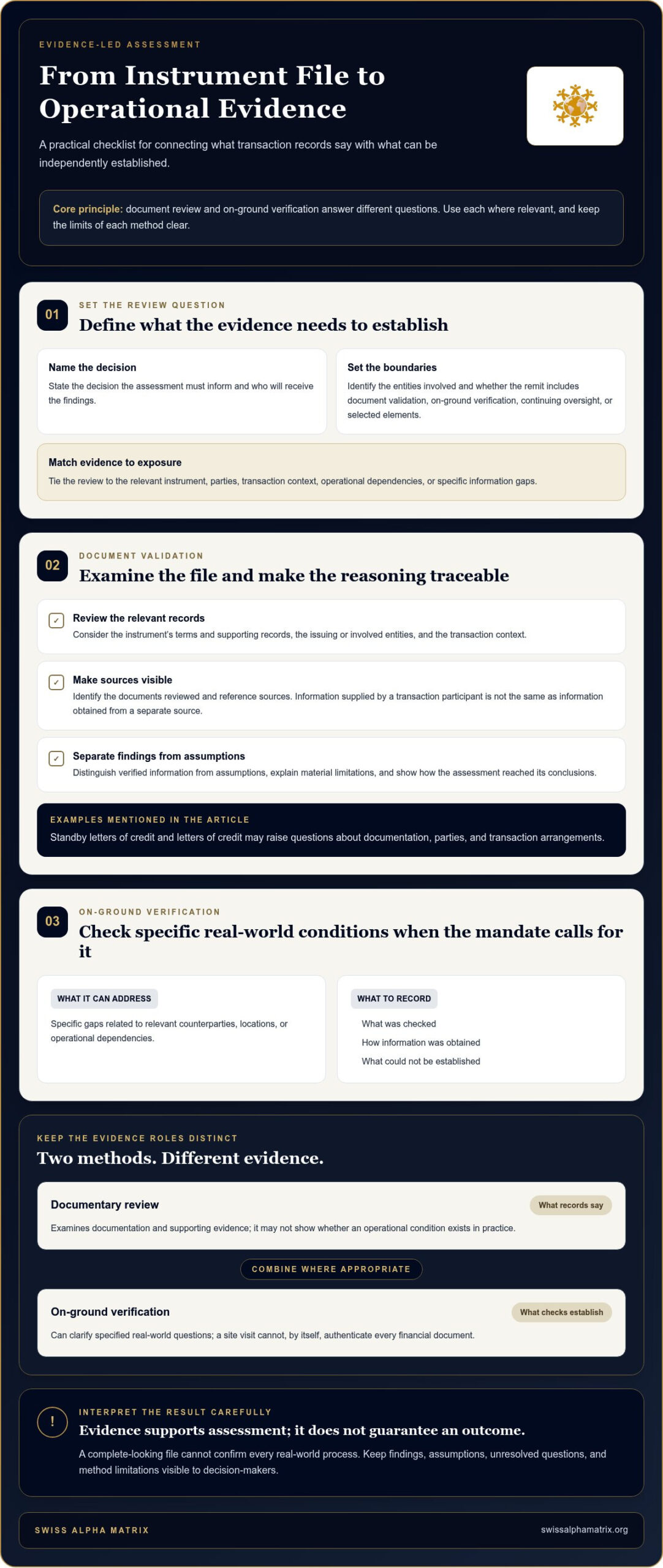
Instrument validation is a structured examination of relevant documentation, the entities involved and available supporting evidence. It clarifies what records establish, where information originates and which questions remain open. For executives assessing risk management consultants geneva, the distinction between document review and independent verification is central. Each can test a different part of the transaction, and neither guarantees an outcome.
What does audit-grade instrument validation examine?
The scope depends on the instrument and the decision it must inform. A review may consider the instrument’s terms and supporting records, the issuing or involved entities, and the transaction context. Standby letters of credit and letters of credit, for example, may raise questions about documentation, parties and transaction arrangements. These are examples of instruments that can be assessed, not a promise about any particular finding.
A defensible assessment makes its reasoning traceable. Findings can identify the documents reviewed, reference sources, distinguish verified information from assumptions and explain material limitations. This gives executives a clearer basis for evaluating the evidence instead of relying on an assurance they cannot trace. Source independence matters too: information supplied by a transaction participant and information obtained from a separate source do not carry the same evidentiary weight.
When does on-ground verification add value?
Documentary review establishes what records say, but may not show whether an operational condition exists in practice. When the mandate calls for it, on-ground verification can address specific gaps through checks connected to relevant counterparties, locations or operational dependencies. Keep the scope tied to the question, and record what was checked, how information was obtained and what could not be established.
Neither method replaces the other. A site visit cannot, by itself, authenticate every financial document, just as a complete-looking file cannot confirm every real-world process. Combining the methods where appropriate connects the paper record to operational evidence while keeping the limits of each method clear. For a deeper discussion, see The Critical Role of On-Ground Verification.
Swiss Alpha Matrix provides audit-grade instrument validation and on-ground verification for complex mandates, documenting findings and limitations to support executive review. Any statement about Swiss or Geneva-specific regulatory requirements should be checked against current primary sources before it informs a conclusion; this section does not offer legal interpretation.
Compare Geneva Risk Management Consultants with an Evidence-Led Evaluation Framework
Compare how an adviser’s proposed work fits the mandate, rather than relying on reputation or polished credentials alone. Use the framework below to assess the scope and approach of risk management consultants geneva. It is a practical evaluation guide, not a scorecard that can establish quality without reviewing the underlying evidence.
| Evaluation area | What to assess | Evidence of a clear approach |
|---|---|---|
| Independence | Is the adviser’s role, reporting line and any relevant potential conflicts clearly articulated? | A defined remit and transparent explanation of whom the adviser reports to. |
| Senior expertise | Does relevant transaction experience align with the instrument, complexity and jurisdictions involved? | Specific experience connected to the mandate, rather than broad claims of expertise. |
| Evidence methods | How will documents, counterparties and operational facts be assessed? | Identified sources, verification methods and a traceable evidence trail. |
| Deliverables | Will executives receive findings they can interpret and review? | Scoped reporting with source references, material limitations and decision-relevant risk assessment. |
| Cross-border coordination | How will the adviser manage information and responsibilities across entities or jurisdictions? | Clear ownership, communication routes and escalation paths for the workstreams in scope. |
How can decision-makers assess independence and expertise?
Credentials can indicate experience, but they do not establish that an adviser’s work is independent, suitable for the mandate or supported by sufficient evidence. Clarify the adviser’s role and reporting line, and consider whether potential conflicts have been disclosed. Then compare senior transaction experience with the instruments, counterparties and jurisdictions involved. Specific methods and evidence trails are more useful than broad assurances or claims that risk can be eliminated.
Interpret the assessment carefully. A documented finding is a conclusion tied to identified evidence. An assumption is a premise used in the analysis but not independently established. An unresolved question marks a gap requiring further information or assessment. A legal conclusion is a separate determination and should not be mistaken for an advisory risk finding.
Which deliverables make findings usable at executive level?
Look for reports that define scope, link findings to source material, disclose material limitations and distinguish evidence from interpretation. Audit-grade reporting can support internal review and executive decision-making, but it does not replace legal advice or an investment decision, and it cannot guarantee an outcome. For a related discussion of documented validation, see How Audit-Grade Validation Protects Your Capital.
Compare proposed deliverables and methods with the decision to be informed. This keeps the evaluation grounded in mandate fit and evidentiary sufficiency, rather than ranking firms in a way the available evidence cannot support.
Plan a Geneva-Linked Risk Advisory Engagement Around Scope, Evidence, and Governance
A well-structured engagement connects the question under review to the evidence assessed and the findings reported. For Geneva-linked work involving stakeholders or operations across borders, agreed responsibilities and escalation paths clarify who supplies information, resolves gaps and receives material findings. Tailor the engagement around defined milestones, review points and executive outputs that match the mandate.
How should scope, evidence, and reporting be agreed?
Before work begins, document the objective, entities and jurisdictions in scope, available source material and reporting audience. A practical sequence is:
- Define the decision. Specify what the assessment must inform, such as whether to proceed to a transaction milestone or seek further evidence.
- Map the exposures. Identify relevant instruments, counterparties, operational dependencies and transaction stages.
- Agree evidence sources. Record which documents, records, interviews or on-ground checks may inform the review, along with known limitations.
- Assess findings. Distinguish evidence-supported conclusions from assumptions and unresolved questions.
- Report and review. Set out the intended executive outputs, review points and how material findings will be escalated.
Record responsibilities, assumptions, evidence limitations and milestones at the outset. This gives everyone a shared reference if the scope changes or a workstream encounters an information gap. For further execution context, see The Strategic Architecture of Independent Financial Project Management.
How does cross-border governance affect execution?
Map dependencies among counterparties, local operations, decision-makers and transaction milestones. A delayed record from one entity, for example, may affect the timing of a review elsewhere. Clear ownership and escalation routes help direct the issue to the person responsible for resolving it. Regulatory obligations are jurisdiction- and mandate-specific, so check statements about applicable requirements against current primary sources rather than treating them as general rules. International Financial Regulations: A Comprehensive Guide for 2026 offers broader context.
For those evaluating risk management consultants geneva, the engagement model is part of the assessment. Scope, evidence, governance and reporting should align with the decision and its execution path. To discuss a complex financial mandate, speak with Swiss Alpha Matrix.
How Swiss Alpha Matrix Supports Geneva-Linked Financial Risk Decisions
Once the mandate, evidence requirements and reporting criteria are clear, assess the adviser’s capabilities against the work required. Swiss Alpha Matrix is an independent advisory firm serving complex financial and investment programmes globally. Its senior team includes former executives from Tier-1 global banks, bringing experience relevant to transactional, regulatory and risk management considerations across international mandates.
What distinguishes the Swiss Alpha Matrix approach?
Swiss Alpha Matrix tailors its work to the mandate’s scope and complexity. Depending on the engagement, this may combine audit-grade instrument validation, operational due diligence, on-ground verification, regulatory compliance advisory and complex project management. The approach connects relevant documentary and operational evidence with clear reporting, rather than treating a complex exposure as an isolated review.
Deliverables can include audit-grade reports and risk assessment documentation for executive consideration. These support decision-making but do not assure a particular investment result, eliminate risk or replace legal advice. Swiss discretion informs the firm’s approach to international mandates. Its remit is advisory and oversight-focused: Swiss Alpha Matrix does not provide direct asset management or legal representation.
For organisations comparing risk management consultants geneva, the key question is whether the proposed expertise, evidence methods and oversight fit the decision at hand. Senior experience is most useful when applied to a clearly defined mandate and translated into documented findings executives can assess.
What is a practical next step for a prospective client?
Prepare a concise outline of the transaction or programme, the decision required, the entities and counterparties involved, and the evidence already available. Note known information gaps and who needs to receive the findings. This gives an initial discussion a precise foundation and helps shape the review around the mandate rather than assuming every project needs the same process.
The engagement can then be tailored to the project’s scope, complexity and reporting needs, with workstreams and oversight aligned to its objectives. This establishes a proportionate path from assessment to executive reporting, with findings grounded in the evidence reviewed. To discuss the requirements of a specific mandate, Discuss your risk advisory mandate.
Make Your Next Financial Decision with a Clearer Evidence Base
Complex mandates call for more than a polished review. Define the decision first, then align the adviser’s remit with the exposures, evidence and governance it requires. Documentary validation and on-ground verification answer different questions, while clear reporting helps executives distinguish supported findings from assumptions and unresolved issues.
For those assessing risk management consultants geneva, relevant experience and a traceable approach matter more than broad assurances. Swiss Alpha Matrix’s senior team includes former executives from Tier-1 global banks. Depending on the mandate, its independent advisory work can combine instrument validation, on-ground verification and project oversight, with executive-level risk assessment documentation to support structured decision-making, not guarantee outcomes.
A concise outline of your transaction, the decision ahead, involved counterparties and known evidence gaps is a useful starting point. Swiss Alpha Matrix tailors scope and reporting to project requirements, with Swiss discretion and continuity across assessment and execution. Discuss your risk advisory mandate.
Frequently Asked Questions
What does a risk management consultant in Geneva do?
A financial risk management consultant helps stakeholders identify, assess and document exposures affecting a transaction or investment programme. Depending on the mandate, work may include instrument validation, counterparty and operational due diligence, on-ground verification or project oversight. The remit should define the decision being supported and the evidence to be reviewed. Findings should distinguish verified information from assumptions, limitations and questions requiring legal advice.
How do I choose a risk management consultant for a Geneva-linked transaction?
Start with the decision the engagement must inform, then compare relevant senior experience, independence, evidence methods, cross-border coordination and reporting quality. Check whether the proposed scope addresses the actual counterparties and operational dependencies involved. A search for “risk management consultants geneva” is only a starting point. Mandate fit depends on documented methods and relevant expertise, not credentials alone or claims that risk can be eliminated.
Can a consultant verify a financial instrument independently?
Yes. Independent instrument validation can involve examining available documentation, relevant entities, supporting evidence and transaction context. The precise review depends on the instrument and mandate. A useful report identifies what was examined, explains the basis for its findings and discloses limitations or unresolved issues. Validation can inform a decision, but it does not guarantee authenticity, payment, investment performance or legal enforceability.
What is the difference between document review and on-ground verification?
Document review assesses records and other information gathered for the mandate, while on-ground verification checks relevant real-world facts directly where appropriate. The methods can complement each other: documents may not establish whether an operational process or condition exists, and physical checks do not replace documentary or legal analysis. A well-scoped engagement identifies the sources used and explains what each method can and cannot establish.
When should a Geneva-based or Geneva-linked business use external risk advisers?
External advice may be valuable when a transaction involves complex instruments, multiple jurisdictions, material counterparty exposure or operational facts that internal teams cannot independently establish. Outside support is not necessary for every transaction; the appropriate scope depends on its complexity and governance needs. Before engaging an adviser, define the decision to be informed, the specific evidence gap and who needs to receive the findings.
What should an executive risk assessment report include?
An executive risk assessment report should state its mandate and scope, present material findings, reference supporting evidence, and disclose assumptions and limitations. It should distinguish verified facts from unresolved questions and explain how findings relate to the decision under review. The detail and format should suit the transaction, stakeholders and agreed reporting needs. Advisory analysis can support internal decisions, but should not be presented as a guaranteed outcome or legal conclusion.
Do risk management consultants provide legal or investment advice?
Advisory responsibilities vary, so the engagement scope should specify what the consultant assesses and where other expertise is needed. Swiss Alpha Matrix provides financial and project advisory services, including due diligence and instrument validation, but not legal representation or direct asset management. Its risk assessments can inform executive decision-making; they do not replace qualified legal counsel, the investment decision itself or an organisation’s own governance responsibilities.