

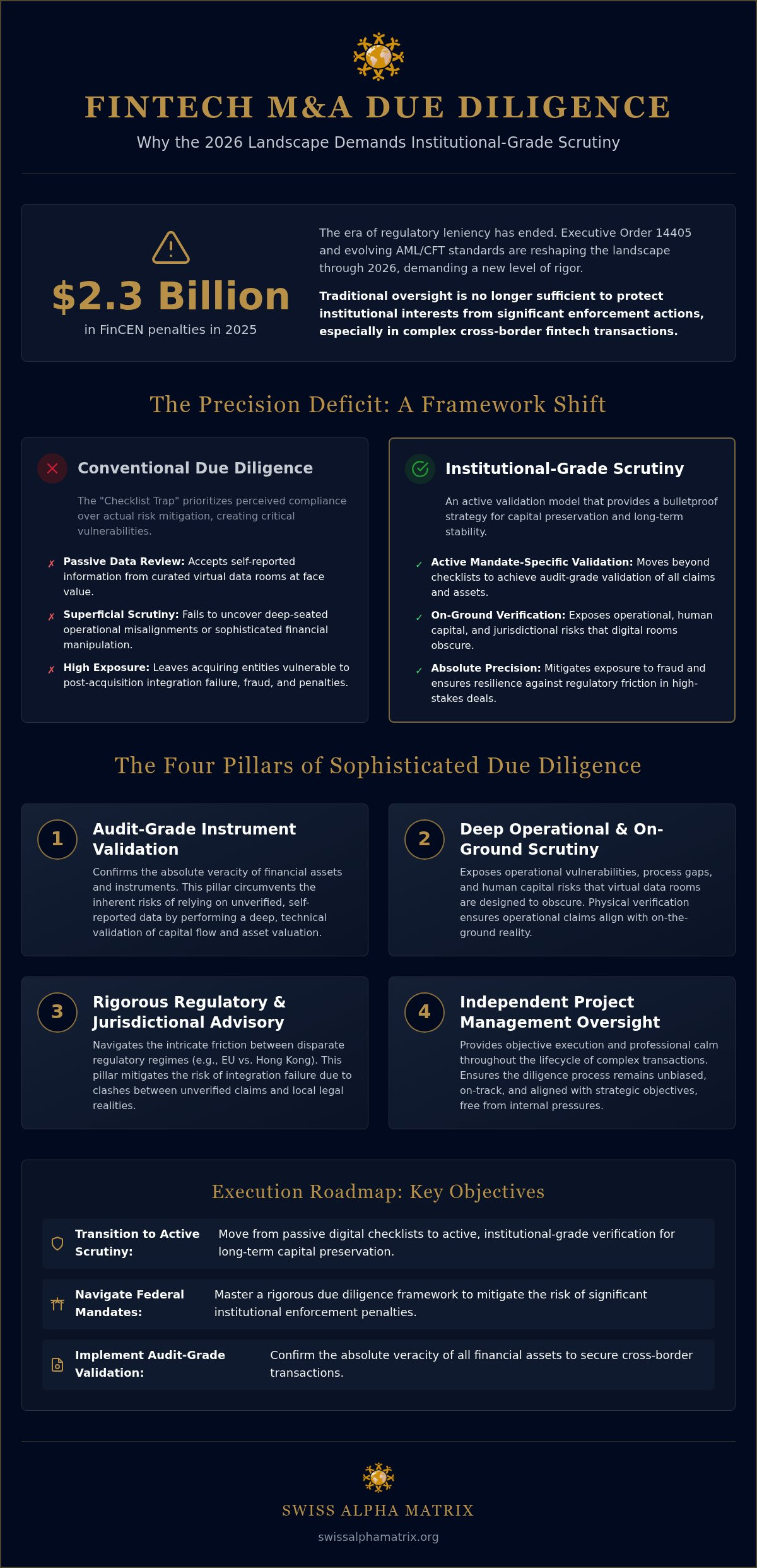
In 2025, FinCEN levied $2.3 billion in penalties against financial services companies, with a disproportionate share of those enforcement actions specifically targeting fintech entities. This figure underscores a stark reality for senior executives: the era of regulatory leniency has concluded, replaced by a climate where traditional oversight is no longer sufficient to protect institutional interests. As Executive Order 14405 continues to reshape the landscape through late 2026, the necessity for rigorous fintech regulatory due diligence has evolved from a procedural requirement into a critical pillar of capital preservation. You likely recognize that standard digital checklists often fail to uncover the deep-seated operational misalignments or sophisticated financial discrepancies that lead to post-acquisition integration failure.
This article provides a comprehensive, institutional-grade framework designed to secure cross-border transactions through meticulous on-ground verification and instrument validation. We’ll explore how to move beyond superficial data rooms to achieve an audit-grade validation of all financial assets, ensuring your strategy remains resilient against jurisdictional friction. By following this structured methodology, you’ll gain a clear execution roadmap that mitigates exposure to fraud and provides the absolute precision required for complex, high-stakes fintech M&A projects.
Key Takeaways
- Identify the structural shifts in the 2026 financial landscape that necessitate a transition from passive digital checklists to active, institutional-grade scrutiny for long-term capital preservation.
- Master a rigorous fintech regulatory due diligence framework designed to navigate evolving federal mandates while mitigating the risk of significant institutional enforcement penalties.
- Utilize audit-grade instrument validation to confirm the absolute veracity of financial assets, effectively circumventing the inherent risks of relying on unverified, self-reported data.
- Recognize the indispensability of on-ground verification services in exposing operational vulnerabilities and human capital risks that traditional virtual data rooms often obscure.
- Integrate independent project management oversight to ensure objective execution and professional calm throughout the lifecycle of complex, cross-border fintech transactions.
The Shifting Landscape of Fintech M&A: Why 2026 Demands Institutional Rigour
The global fintech sector has transitioned into a period of extreme technical opacity and multi-jurisdictional complexity. Deals that once seemed straightforward are now fraught with invisible risks, as digital-first entities operate across borders with varying levels of transparency. This environment has exposed a profound “Precision Deficit” within traditional fintech regulatory due diligence models. Many firms still rely on passive data reviews that accept self-reported information at face value, a strategy that is increasingly dangerous as global regulatory scrutiny intensifies. In 2026, the requirements for a successful transaction have moved beyond mere compliance. The implementation of Executive Order 14405, alongside evolving AML/CFT standards, demands an active, mandate-specific validation of all claims. Swiss Alpha Matrix serves as a protective authority for institutional entities, offering the disciplined oversight required to ensure that strategic growth doesn’t come at the expense of long-term stability. Our approach prioritizes technical accuracy over short-term speculation, catering to executives who value nuance and thoroughness.
The Complexity of Cross-Border Fintech Transactions
Executing a cross-border deal involves navigating the intricate friction between disparate regulatory regimes. We frequently observe significant challenges when reconciling EU standards with the specific financial requirements of jurisdictions like Hong Kong. These disparities often lead to integration failures when unverified operational claims clash with local legal realities. The valuation of digital assets remains a high-risk area where capital movement can be obscured by complex technological layers. Achieving precision in these deals requires executive-level intelligence. It’s about moving beyond the surface to understand how capital actually flows and how regulatory misalignments might impact the due diligence process over the long term. This level of scrutiny is no longer optional; it’s the prerequisite for any high-stakes acquisition.
The Failure of Conventional Due Diligence
Traditional audits are often ill-equipped to detect sophisticated financial instrument manipulation. Digital data rooms provide a curated view of a target firm, which can lead to the “Checklist Trap.” In this scenario, compliance is prioritized over actual risk mitigation, leaving the acquiring entity exposed to unverified operational claims. To counter this, it’s essential to adopt the mindset detailed in Mastering Cross-Border Investment Due Diligence: An Institutional Framework for 2026. By shifting from a passive review to an active validation model, stakeholders ensure that their fintech regulatory due diligence provides a bulletproof strategy for asset protection. This institutional rigour is the only way to validate the veracity of a target’s financial health in an increasingly volatile market where bad actors leverage technical complexity to hide systemic weaknesses.
The Four Pillars of Sophisticated Fintech Due Diligence
Strategic acquisitions in the financial technology sector require a departure from standard, checklist-oriented reviews toward a multidimensional validation model. This model rests upon four distinct pillars: audit-grade instrument validation, deep operational scrutiny, rigorous regulatory advisory, and a cohesive risk management framework. Each pillar serves to construct a defensive perimeter around the transaction, ensuring that stakeholder interests remain protected against the technical and jurisdictional volatility inherent in 2026 deals. By moving beyond superficial data rooms, executives can achieve a level of certainty that mirrors the traditional discretion of high-end private wealth management, where long-term preservation is the primary objective.
Audit-Grade Instrument Validation
The veracity of high-value financial instruments, such as Standby Letters of Credit (SBLCs) and Letters of Credit (LCs), cannot be confirmed through surface-level paper reviews. Standard due diligence often stops at the document’s edges, failing to account for the sophisticated manipulation frequently employed by bad actors in the digital age. Audit-grade validation requires Tier-1 institutional expertise to verify these instruments directly at the source bank, confirming that the underlying assets are unencumbered and legally binding under the specific terms of the mandate. For a deeper analysis of these essential protocols, senior stakeholders should consult Bank Instrument Validation Services: An Executive Guide to Protecting Capital in 2026.
Operational and Regulatory Scrutiny
Effective fintech regulatory due diligence necessitates an unblinking evaluation of a firm’s underlying technology stack against its stated capabilities in the pitch deck. It’s common for target entities to exaggerate the scalability or security of proprietary algorithms, which can lead to catastrophic integration failures post-acquisition. Our methodology involves real-time testing of these systems to identify operational red flags that signal future friction or hidden liabilities. This scrutiny extends to the integrity of human capital and the resilience of internal workflows, ensuring that the target firm possesses the institutional character required for sustainable growth.
Navigating the evolving landscape of AML and KYC requirements requires more than just a review of archived reports. Compliance protocols must be verified in live environments, adhering to the latest federal guidance on fintech due diligence to ensure alignment with global standards and local mandates. By identifying misalignments in transaction monitoring or identity verification early in the process, executives avoid the punitive enforcement actions that have become prevalent among non-bank financial entities. Organizations seeking to fortify their acquisition strategy often find that specialised risk management frameworks provide the professional calm and technical accuracy needed to execute complex, cross-border projects with absolute confidence.
The Criticality of Physical Verification in an Increasingly Digital Market
Digital data rooms, while efficient for the logistics of information exchange, often present a curated and sanitized perspective of a target firm’s actual health. This curated environment creates a significant risk for institutional stakeholders who might mistake organized documentation for operational veracity. In the context of fintech regulatory due diligence, relying solely on virtual environments is a vulnerability that sophisticated bad actors frequently exploit. Physical presence remains the only definitive method to validate the existence of assets, the legitimacy of entities, and the integrity of key personnel. This on-ground verification serves as the ultimate trust-builder for board members, offering an unvarnished view of the target firm that no automated tool or digital scan can replicate.
The Limitations of Digital-Only Audits
Digital-only audits are inherently susceptible to the concealment of “ghost assets” and fraudulent financial instruments that appear perfectly legitimate within a digital ledger but lack any physical backing. We’ve observed a recurring psychological bias among private equity partners where the perceived accuracy of digital data creates systemic blind spots. This bias often leads to a failure in questioning the source of reported metrics. True rigour requires moving beyond the screen to conduct face-to-face verification with counterparty bank officers. Without this direct interaction, it’s impossible to ensure that high-value instruments are authentic, unencumbered, and legally binding under the stated terms of the transaction. Physical audits catch the subtle inconsistencies in human behaviour and physical documentation that digital scans inevitably miss.
Executing On-Ground Verification Globally
The logistics of verifying fintech operations in primary hubs like London, Geneva, and Hong Kong require a combination of technical expertise and regional precision. Our approach is governed by a principle of Swiss Discretion, which allows for sensitive on-site investigations to proceed with the necessary depth without alerting the market or destabilizing the target’s daily operations. This level of privacy is essential for maintaining the integrity of the deal flow while ensuring that every operational claim is verified at the source. During these engagements, our senior experts apply the principles detailed in International Financial Regulations: A Comprehensive Guide for 2026 to provide real-time, on-site intelligence. By deploying seasoned professionals to the physical location of the target entity, we bridge the gap between reported data and actual operational health, providing the absolute certainty required for high-stakes institutional mandates.
Orchestrating Complexity: The Role of Independent Project Management (PMO)
In the high-pressure environment of cross-border fintech acquisitions, the presence of a Project Management Office (PMO) serves as the indispensable command centre for both execution and risk mitigation. Unlike standard administrative support, an institutional PMO acts as the master planner, ensuring that the intricate threads of legal, financial, and technical streams remain aligned with the overarching mandate. This level of orchestration is vital when navigating the complexities of fintech regulatory due diligence, where a single misstep in jurisdictional compliance can compromise the entire transaction’s stability. By centralizing oversight, the PMO provides a structured argument for every strategic pillar, creating a sense of inevitable logic that encourages confidence among senior stakeholders during periods of high volatility.
The RACI Matrix in High-Stakes M&A
The closing phase of a multi-jurisdictional deal is often where accountability begins to fracture under the weight of technical complexity. We utilize the RACI Matrix to restore order, clearly identifying those Responsible for specific tasks, the individual Accountable for the final result, the specialists to be Consulted for their technical depth, and the executive team who must remain Informed. This framework prevents the decision paralysis that often plagues cross-functional teams when they’re faced with unverified operational claims or shifting regulatory landscapes. By defining these roles with absolute precision, we ensure that every stakeholder understands their specific contribution to the deal’s integrity. The RACI model stands as the definitive blueprint for institutional accountability in complex transactions.
Independent Project Oversight
True objectivity is only achievable through an advisor who is distinct from the legal counsel or the primary lender. While these partners are essential to the deal flow, their inherent proximity to the transaction’s completion can sometimes create a bias toward closure over caution. An independent PMO prioritizes the long-term preservation of capital, focusing on the absolute veracity of every deliverable rather than just the timely reaching of milestones. This distinction is critical; a milestone reached on the basis of unverified data is a liability, not a success. The independent oversight ensures that the fintech regulatory due diligence process isn’t merely a box-ticking exercise but a robust validation of institutional health.
By following The Strategic Architecture of Independent Financial Project Management, executives build a defensive perimeter around their interests, ensuring that strategic growth never compromises moral character or high-level standards. This methodology moves from broad principles to specific strategic pillars with a calm, unwavering pace that mirrors the traditional discretion of private wealth management. To ensure your next cross-border transaction is managed with this level of technical accuracy and professional calm, we invite you to explore our complex project management services.
Precision Execution: Integrating Swiss Alpha Matrix Methodologies into the Deal Flow
The integration of audit-grade instrument validation, on-ground verification, and independent PMO oversight creates a unified mandate that transcends the limited capabilities of traditional advisory firms. This holistic approach ensures that every facet of a transaction is scrutinized through a lens of institutional discipline, moving beyond the superficiality of digital data rooms. In the 2026 fintech landscape, Swiss Alpha Matrix stands as the definitive partner for senior executives who require absolute precision rather than mere administrative compliance. Our engagement process is characterized by a measured, logical progression. It begins with a rigorous mandate definition, moves through a hyper-personalized scope of work, and concludes with the delivery of audit-grade reports that provide the technical accuracy necessary for final board-level approval.
The Institutional-Grade Advisory Framework
Our strategic methodologies are rooted in the principles outlined in Institutional-Grade Financial Advisory Methodologies: A Framework for Complex Capital Protection. These frameworks aren’t static checklists; they’re tailored to the specific nuances of each unique deal mandate. By deploying former senior executives from Tier-1 global banks, we provide a level of peer-level scrutiny that effectively challenges the unverified operational claims of target entities. This intellectual depth allows us to produce executive-level intelligence reports that meet the most stringent audit standards. Our fintech regulatory due diligence doesn’t just identify risks, it provides a structured methodology for long-term capital preservation and strategic growth. We ensure that your interests are in the hands of seasoned, unemotional experts who prioritize stability over short-term speculation.
Securing Your Next Cross-Border Fintech Deal
The ability to mobilize senior experts to any global jurisdiction, from London to Hong Kong, ensures that our clients maintain a strategic advantage in increasingly volatile markets. We refuse to oversimplify the complex dynamics of cross-border capital movement, opting instead for a meticulous attention to detail that mirrors the historical reliability of Swiss precision. This commitment to technical accuracy serves to protect institutional interests against the systemic weaknesses often hidden in technically opaque fintech firms. Every project we undertake is governed by a focus on moral character and high-level standards, reinforcing the exclusive nature of our service. To ensure the absolute integrity of your next acquisition, we invite you to consult with Swiss Alpha Matrix for a mandate-specific engagement that secures your future growth.
Securing Institutional Longevity in the 2026 Fintech Market
The evolution of the global financial landscape through 2026 necessitates a departure from the superficiality of digital checklists, favoring instead a model of active, audit-grade validation that secures institutional interests against the inherent opacity of cross-border deals. By integrating physical on-ground verification with independent project management oversight, senior executives can effectively mitigate the precision deficit that often leads to catastrophic post-acquisition integration failures. It’s essential that your fintech regulatory due diligence serves as a bulletproof strategy for navigating complex jurisdictional friction, ensuring that every operational claim is verified with technical accuracy and professional calm.
As a Swiss-based independent advisory led by former Tier-1 global bank executives, we provide the elite scrutiny required to perform audit-grade instrument validation at the source. We invite you to consult with our Tier-1 experts on your next fintech M&A mandate to achieve the absolute certainty that your strategic growth demands. Your interests remain protected through our commitment to meticulous detail, regional excellence, and the intellectual depth required for successful capital preservation.
Frequently Asked Questions
How does fintech M&A due diligence differ from traditional financial services deals?
Fintech acquisitions are distinguished by technical opacity and the rapid evolution of digital regulatory standards. Unlike traditional deals centered on physical collateral, these transactions demand a deeper fintech regulatory due diligence process that scrutinizes proprietary algorithms and cross-border digital asset movement. The interplay between disparate jurisdictional requirements, such as the friction between EU and Hong Kong frameworks, introduces unique risks that traditional financial services audits often overlook during the integration phase.
What are the primary red flags to look for in fintech financial instruments?
Primary red flags include unverified Standby Letters of Credit (SBLCs) that lack direct confirmation from Tier-1 source banks or documentation showing inconsistencies with SWIFT protocols. Instruments that appear unencumbered in digital data rooms but lack physical validation often signal sophisticated financial manipulation. Additionally, any instrument originating from jurisdictions with opaque reporting standards requires immediate audit-grade scrutiny to ensure the asset is legally binding and hasn’t been leveraged across multiple mandates.
Why is physical on-ground verification necessary for digital fintech companies?
Physical on-ground verification is essential because digital data rooms often present a sanitized, curated version of a target firm’s health. While the company’s services are digital, its operations depend on physical infrastructure, human capital, and legitimate banking relationships. On-site audits expose ghost assets and fraudulent instruments that digital scans miss. This process provides the absolute certainty required by institutional stakeholders, ensuring that the target’s physical presence and personnel align with their reported operational claims.
How does a RACI matrix improve the efficiency of a fintech M&A transaction?
A RACI matrix improves efficiency by defining absolute accountability across cross-functional deal teams, particularly during the high-pressure closing phase. By clearly identifying who is Responsible, Accountable, Consulted, and Informed, the framework prevents decision paralysis and eliminates accountability gaps. In complex fintech transactions, this structure ensures that technical experts and executive stakeholders remain aligned; this allows the deal to move forward with a measured, logical pace that reduces the risk of post-acquisition friction.
What role does independent project management play in capital risk mitigation?
Independent project management acts as a command center that prioritizes long-term capital preservation over the mere completion of a deal. By maintaining a distance from legal counsel and primary lenders, an independent advisor provides the objective oversight necessary to mitigate conflicts of interest. This role focuses on the absolute veracity of every deliverable, ensuring that the fintech regulatory due diligence process remains robust and that strategic growth never compromises the acquiring entity’s high-level standards.
Can Swiss Alpha Matrix validate standby letters of credit (SBLCs) across jurisdictions?
Swiss Alpha Matrix specializes in validating Standby Letters of Credit across all major global jurisdictions by utilizing former Tier-1 bank executives to conduct investigations at the source. Our methodology moves beyond surface-level paper reviews to achieve audit-grade validation, confirming that instruments are authentic and unencumbered. This global reach, combined with Swiss discretion, allows us to verify high-value financial instruments in key hubs like Geneva and London without destabilizing the target’s daily operations or alerting the broader market.
What are the regulatory compliance requirements for fintech deals in 2026?
In 2026, fintech deals must adhere to Executive Order 14405, which modernizes the regulatory framework for non-bank financial innovation. Key requirements include a documented, risk-focused assessment of AML/CFT programs as per the June 2026 FinCEN rules. Regulators now demand a life-cycle approach to third-party risk management. By mid-November 2026, agencies are directed to finalize steps that encourage innovation while maintaining stringent oversight, requiring firms to demonstrate clear divisions of compliance responsibilities and robust oversight.
How does audit-grade validation protect against cross-border transaction fraud?
Audit-grade validation protects against cross-border fraud by moving beyond digital ledgers to verify assets directly with counterparty bank officers. This institutional-level scrutiny identifies sophisticated manipulation that automated tools inevitably miss, such as the use of fraudulent financial instruments to inflate a target’s valuation. By providing an unvarnished view of a firm’s actual financial health, this methodology ensures that all assets are unencumbered and that the transaction remains resilient against jurisdictional friction and sophisticated bad actors.