

The assumption that sophisticated digital screening constitutes a complete financial project risk assessment is a precarious fallacy that leaves institutional capital exposed to unprecedented jurisdictional vulnerabilities. Within the 2026 regulatory environment, where the Financial Crimes Enforcement Network has shifted toward effectiveness-based standards, the mere presence of a documented trail no longer suffices to satisfy the rigorous demands of global compliance. You likely recognize that the most profound threats to a cross-border mandate aren’t found in the spreadsheets, but in the opaque spaces between international regulatory frameworks and the legitimacy of the instruments themselves.
We agree that the traditional reliance on “desktop-only” due diligence has become an unacceptable liability for those charged with the stewardship of significant assets. This article provides an executive-level framework for moving toward audit-grade verification, ensuring that every counterparty and instrument is validated through on-ground, forensic precision. We’ll examine the methodologies required to navigate the 2026 Basel III capital requirements and the specific protocols necessary to transform institutional uncertainty into a disciplined strategy for long-term capital preservation.
Key Takeaways
- Transition from reactive to predictive risk models to better anticipate jurisdictional regulatory traps within the 2026 landscape.
- Distinguish between superficial digital reports and the forensic validation required to confirm the authenticity of international financial instruments.
- Implement a robust financial project risk assessment framework that utilizes audit-grade stress testing to safeguard institutional capital.
- Leverage on-ground verification services to identify non-obvious counterparty risks that standard databases frequently overlook.
- Eliminate internal confirmation bias by integrating independent advisory from seasoned experts into your cross-border project management.
Defining Financial Project Risk Assessment within Complex Mandates
The discipline of financial project risk assessment transcends the rudimentary identification of operational hurdles, positioning itself instead as a forensic examination of institutional integrity and instrument validity. While common risk management principles often suffice for localized commercial ventures, the execution of high-value, cross-border mandates requires a more profound layer of scrutiny. This distinction is vital; where general project risk might focus on delivery timelines or supply chain disruptions, institutional financial risk focuses on the legitimacy of the capital itself and the legal enforceability of the instruments involved. In 2026, as the Financial Crimes Enforcement Network (FinCEN) moves toward an effectiveness-based standard for AML programs, the burden of proof has shifted from showing that a process exists to proving that the process actually works in practice.
A sophisticated financial project risk assessment serves as the foundation for capital preservation by identifying non-obvious jurisdictional traps before they compromise the mandate. This proactive stance isn’t merely a preference but a fiduciary obligation for those managing complex financing structures that often mix contracted offtake with merchant exposure. By moving from reactive models to predictive forensics, seasoned experts can validate the moral character of counterparties and the authenticity of bank instruments with absolute technical accuracy. This ensures that interests remain in the hands of unemotional professionals who prioritize strategic growth and historical reliability over short-term speculation.
The Evolution of Financial Risk in a Multipolar Economy
The current year has seen capital flows become increasingly intricate, particularly following the March 2026 Basel III implementation standards. Traditional “desktop” reviews, which rely on static database entries and public filings, aren’t enough to satisfy modern institutional safety requirements. As digital transformation accelerates, the transparency of financial instruments has become paradoxically more complex, requiring on-ground verification to pierce through digital facades and confirm the physical reality of assets and entities.
Audit-Grade Standards vs. Standard Due Diligence
For executive stakeholders, the difference between standard due diligence and an audit-grade assessment is the difference between a general overview and a definitive validation. An audit-grade report provides the technical precision necessary for board-level decision-making, moving beyond the vague qualifiers found in lower-tier reports. It’s a refusal to oversimplify the intricate nature of the industry, ensuring that regulatory compliance and operational reality are perfectly aligned for long-term stability.
The Taxonomy of Risk: Categorising Threats in Cross-Border Projects
While generic project finance models often segment risk into construction, operation, and volume metrics, these industrial categories fail to address the specific vulnerabilities inherent in high-stakes financial mandates. An institutional financial project risk assessment must prioritize the forensic validation of financial instruments and the moral character of the principals involved. In the current multipolar economy, threats aren’t merely logistical; they’re rooted in the legitimacy of the capital itself and the disparate legal frameworks that govern international transactions. Identifying these risks requires a shift from superficial checks to a sophisticated taxonomy that categorises threats based on their potential to compromise capital preservation.
Instrument and Sovereign Risk Analysis
The execution of high-level mandates often relies on bank instrument validation services to ensure that sovereign guarantees or standby letters of credit are not merely decorative but legally enforceable. In 2026, the implementation of Basel III standards has simplified capital calculation approaches, yet it has also heightened the need for precision in evaluating instrument liquidity. Tier-1 banking standards serve as the benchmark here, as any deviation from these norms can signal underlying sovereign risk or a lack of cross-border transferability. It’s essential to verify that instruments are issued by institutions with the requisite asset thresholds, particularly as the FDIC has recently updated the “large institution” definition to $30 billion in total assets.
Counterparty Due Diligence and KYC/AML Integration
Standard KYC protocols often stop at the surface, yet true institutional safety requires investigating ultimate beneficial ownership (UBO) to reveal potential jurisdictional traps. Assessing a counterparty’s “stated capability” against their actual “track record” is a critical component of a robust financial project risk assessment. This forensic scrutiny is particularly vital in emerging markets where the risk of institutional fraud is elevated. Engaging an independent master planner ensures that these complexities are managed with the discretion and precision required for capital preservation. By uncovering the moral character of partners, stakeholders can avoid the regulatory scrutiny that follows ineffective AML programs, especially as FinCEN now evaluates programs based on their actual effectiveness in detecting financial crime.
Jurisdictional risk remains a constant variable, as legal frameworks in global deals often conflict. Navigating these disparate systems requires more than just legal advice; it demands an operational understanding of how local regulations impact project execution. Finally, operational continuity must be evaluated to ensure the project management structure is robust enough to withstand market volatility, such as the fluctuations in the Secured Overnight Financing Rate (SOFR), which stood at 3.55% in July 2026. A framework that ignores these granular financial realities is not an assessment; it’s a liability.
Qualitative Forensics: Why On-Ground Verification Surpasses Desktop Due Diligence
The digital era has fostered a dangerous reliance on algorithmic screening and remote data aggregation, yet a truly robust financial project risk assessment requires a return to the foundational principles of physical verification. Digital databases, while efficient for preliminary filtering, are inherently limited by the quality of the information provided to them; they’re often unable to detect the sophisticated, multi-layered fraud that characterizes modern institutional collapse. When significant capital is at stake, the distinction between a verified asset and a mere spreadsheet entry becomes the pivot point for long-term preservation. Relying solely on public filings or digital certificates ignores the reality that high-level fraud is designed to look perfect on paper, specifically to bypass the standard due diligence protocols used by most firms.
The Swiss Alpha Matrix approach rejects this “desktop-only” methodology, opting instead for a framework that merges Swiss financial discipline with on-ground intelligence led by former Tier-1 global bank executives. This methodology ensures that every claim made in a prospectus is validated against physical reality, providing an audit-grade level of certainty that digital tools cannot replicate. History is replete with instances where paper-based diligence failed to detect institutional collapse, often because the underlying collateral didn’t exist or was pledged to multiple parties simultaneously. By prioritizing qualitative forensics, we provide a standard of service that is both broad in reach and meticulous in its attention to detail, ensuring that interests are protected by seasoned experts who understand the nuances of global mandates.
The Methodology of Physical Asset Verification
True operational due diligence demands on-site audits of facilities and collateral to confirm existence and control. This process includes interviewing key stakeholders to assess management competence, a factor that spreadsheets frequently fail to quantify. We verify the actual control of pledged financial instruments, ensuring that the legal chain of custody is intact and that the instruments are not encumbered by undisclosed liabilities. This on-ground presence allows for the detection of subtle operational inconsistencies that would be invisible to an analyst working from a remote office.
Detecting Red Flags in Sophisticated Financial Schemes
Identifying inconsistencies between formal bank communications and the specific terms of a financial instrument is a hallmark of an elite risk assessment. We facilitate independent, third-party confirmation from issuing banks to bypass potentially compromised intermediaries. It’s through this level of scrutiny that cross-border investment due diligence uncovers hidden liabilities and jurisdictional traps. This forensic approach is the only way to ensure that the moral character of a counterparty matches their stated financial standing, providing the confidence necessary for long-term capital preservation in an increasingly complex global economy.
Implementing an Audit-Grade Risk Assessment Framework
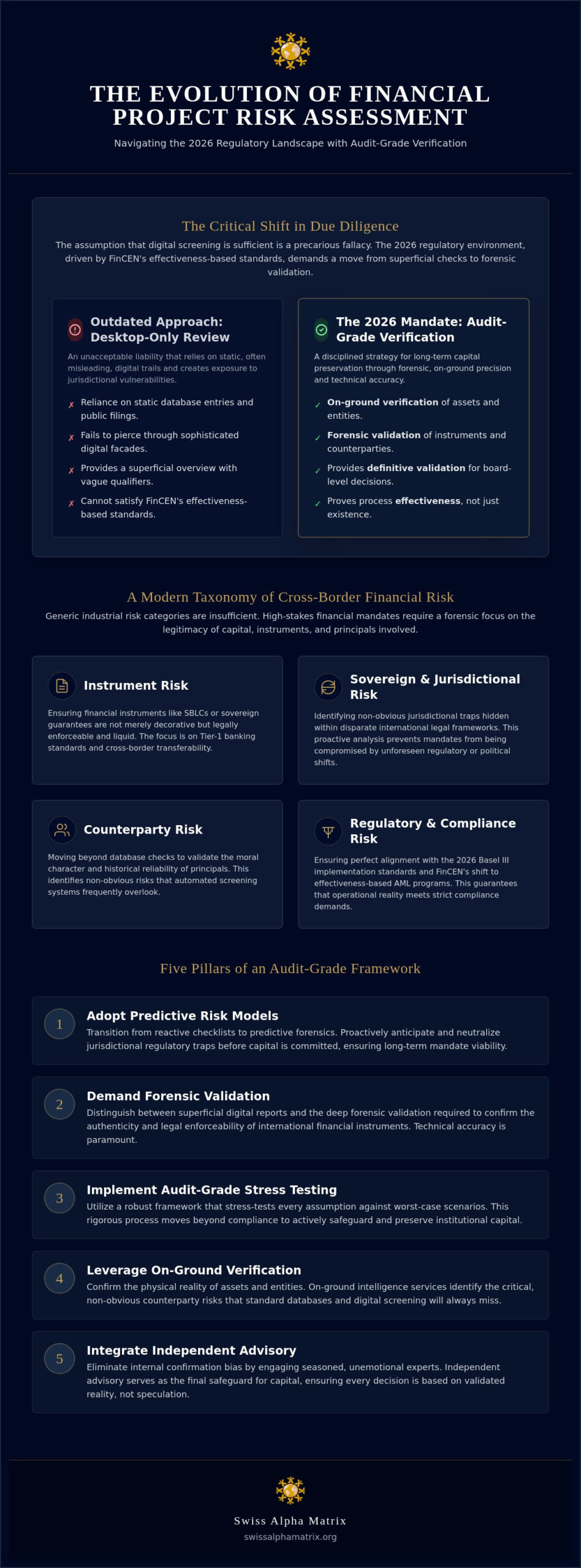
The transition from theoretical risk identification to the rigorous implementation of an audit-grade framework requires a structured, multi-phased approach that prioritizes precision over speed. This process isn’t merely a checklist but a cyclical discipline of validation and stress testing, designed to ensure that fiduciary boundaries remain uncompromised throughout the lifecycle of a mandate. A truly robust financial project risk assessment necessitates a meticulous adherence to five strategic pillars, each serving as a safeguard against the institutional vulnerabilities identified in previous forensic deep-dives.
- Step 1: Defining the Scope and Fiduciary Boundaries: Establishing the precise legal and operational parameters of the mandate to prevent scope creep and ensure all parties understand their risk exposure.
- Step 2: Quantitative Stress Testing and Financial Modelling: Utilizing real-time market data to simulate adverse conditions and measure the resilience of the project’s capital structure.
- Step 3: Qualitative Forensic Deep-Dives: Executing the on-ground verification protocols discussed earlier to validate counterparty integrity and instrument authenticity.
- Step 4: Synthesis of Findings into an Executive Risk Matrix: Categorising identified threats by their probability and potential impact to facilitate informed, board-level decision-making.
- Step 5: Developing Mitigation Strategies and Contingency Protocols: Establishing clear, actionable pathways for risk containment should any identified threats materialize during execution.
Quantitative Analysis and Scenario Planning
In the current environment, measuring the impact of currency volatility and interest rate shifts is paramount for long-term stability. As of July 10, 2026, the Secured Overnight Financing Rate (SOFR) stood at 3.55%, with a 30-day average of 3.62539%; these figures must be integrated into sensitivity analyses for project cash flows and debt service coverage. By applying Monte Carlo simulations within our established financial advisory methodologies, we can project a spectrum of outcomes that account for the 2.4% decrease in CET1 capital requirements expected under the 2026 Basel III reforms. This level of quantitative depth ensures that stakeholders aren’t blindsided by predictable market fluctuations.
The Executive Review and RACI Application
Assigning clear accountability for risk mitigation is the final safeguard in any complex project management structure. We utilize a RACI (Responsible, Accountable, Consulted, Informed) matrix to ensure that every mitigation strategy has a designated owner, effectively eliminating the ambiguity that often leads to institutional failure. The role of the Independent Project Manager is critical here, acting as a master planner who maintains an unemotional, third-party perspective on the risk lifecycle. To ensure your mandate is protected by these rigorous standards, you may engage our specialized Audit-Grade Instrument Validation services to secure your capital’s future.
Independent Advisory as the Final Safeguard for Capital Preservation
In the execution of high-stakes mandates, the most insidious threat to capital is often the internal momentum of the project itself. Even the most competent internal teams aren’t immune to confirmation bias; the desire to see a complex deal reach fruition can inadvertently lead to the marginalization of subtle red flags. A truly robust financial project risk assessment requires a detached, unemotional perspective that only an independent advisor can provide. By engaging former Tier-1 bank executives, institutional stakeholders ensure that their interests are protected by professionals who prioritize technical accuracy and long-term stability over the short-term satisfaction of a closed transaction.
This objective oversight is the cornerstone of independent financial project management. It transforms risk mitigation from a procedural hurdle into a strategic advantage. In the 2026 landscape, where the regulatory burden for AML compliance has shifted toward proving effectiveness, the value of an “independent master planner” cannot be overstated. Precision in capital deployment isn’t just a goal; it’s a fiduciary imperative. Without a forensic, third-party validation of every instrument and counterparty, even the most promising mandates remain vulnerable to jurisdictional traps and institutional fraud.
The Swiss Alpha Matrix Advantage
Our approach combines the traditional discretion of high-end private wealth management with the technical rigor of global institutional banking. We produce intelligence that withstands the highest levels of scrutiny, ensuring that every financial project risk assessment we deliver is audit-grade and actionable. Engaging our specialist advisory means your mandate benefits from a standard of service that is both broad in reach and meticulous in its attention to detail. We don’t just identify risks; we provide the strategic architecture required to navigate them with confidence.
Securing the Future of Global Investments
The long-term benefits of a robust risk management framework extend far beyond a single deal. It establishes a culture of institutional safety and historical reliability. Before project commencement, every executive should confirm a final checklist of safeguards:
- Has the authenticity of all bank instruments been validated through on-ground forensics?
- Is there absolute clarity regarding the ultimate beneficial ownership of all counterparties?
- Have project cash flows been stress-tested against 2026 SOFR averages and Basel III capital requirements?
- Does the risk documentation satisfy the FinCEN effectiveness-based standard for AML programs?
The complexity of the current global economy leaves no room for oversimplification. By prioritizing forensic verification over desktop due diligence, you secure the permanence of your institutional legacy. It’s time to move beyond passive participation and embrace a performance-oriented mindset. Protect your capital with Swiss Alpha Matrix and ensure your cross-border mandates are managed by the industry’s most seasoned experts.
Navigating the Future of Institutional Capital Preservation
The financial landscape of 2026 demands a departure from passive risk management toward a disciplined, forensic methodology. We’ve explored how a rigorous financial project risk assessment serves as the definitive safeguard against jurisdictional traps and instrument fraud. By prioritizing qualitative forensics over digital assumptions, you ensure that every mandate is grounded in physical reality rather than spreadsheet projections. This transition to audit-grade standards isn’t just a best practice; it’s a fiduciary imperative for those charged with the stewardship of significant assets in a multipolar economy.
Our firm is led by former Tier-1 bank executives who bring a legacy of Swiss-grade discretion and precision to every engagement. Through our global on-ground verification capabilities, we provide the objective oversight necessary to navigate the most complex cross-border mandates with absolute technical accuracy. We invite you to secure your capital deployment with a professional risk assessment from Swiss Alpha Matrix. Establishing this level of forensic certainty is the first step toward a future defined by stability, trust, and the successful execution of your most ambitious financial objectives.
Frequently Asked Questions
What is the difference between a standard risk assessment and an audit-grade financial project risk assessment?
An audit-grade financial project risk assessment provides forensic validation that exceeds the superficial scope of standard due diligence. While standard reports often rely on static database entries, our audit-grade framework incorporates on-ground verification led by former Tier-1 bank executives. This ensures every instrument and counterparty is validated to a standard that withstands institutional scrutiny, providing the technical precision required for board-level decision-making in high-stakes mandates.
How do you verify the validity of a standby letter of credit (SBLC) in a cross-border transaction?
Verifying a standby letter of credit requires independent, third-party confirmation directly from the issuing bank to bypass potentially compromised intermediaries. We meticulously evaluate the instrument’s terms against Tier-1 banking standards and confirm the issuing institution’s asset threshold. In the current regulatory environment, this includes verifying that the bank meets the updated $30 billion asset definition for large institutions, as established by the FDIC in June 2026, to ensure liquidity and cross-border enforceability.
Why is on-ground verification necessary if we have a legal opinion from a reputable law firm?
On-ground verification is essential because legal opinions typically focus on the validity of document forms rather than the physical reality of the underlying assets. While a law firm confirms that a contract is legally binding, our forensic teams confirm that the collateral actually exists and is under the counterparty’s control. This physical scrutiny is the only reliable method to detect sophisticated fraud that appears legally perfect on paper but lacks institutional substance.
What are the primary red flags to look for when assessing an international financial project?
Primary red flags include discrepancies between official bank communications and the specific terms of financial instruments, along with opaque beneficial ownership structures. We also monitor for deviations from the latest Basel III capital requirements, as a counterparty’s inability to meet these standards often signals underlying liquidity issues. A lack of transparency regarding the track record of project principals is another critical indicator that warrants immediate forensic investigation to protect capital preservation.
How does jurisdictional risk impact the enforcement of financial instruments in 2026?
Jurisdictional risk in 2026 is defined by the shift toward effectiveness-based standards in AML and CFT programs following the FinCEN rulemaking earlier this year. Regulators now evaluate whether a risk assessment actually detects financial crime in practice rather than just on paper. This means that a failure to account for local regulatory nuances can lead to severe jurisdictional traps, potentially compromising the entire capital structure of a cross-border mandate and inviting adverse supervisory action.
Can a financial project risk assessment be conducted remotely using digital tools?
Remote digital tools are useful for preliminary screening, but they cannot replace the forensic depth of a physical financial project risk assessment. Sophisticated institutional fraud is specifically designed to bypass digital filters and algorithmic checks. True capital preservation requires an on-ground presence to verify the moral character of principals and the operational reality of facilities, providing a level of certainty that digital templates simply can’t offer in high-value transactions.
What role does a RACI matrix play in managing financial project risks?
A RACI matrix serves as the structural backbone for accountability, ensuring that every identified risk has a designated owner within the project hierarchy. By clearly defining who is Responsible, Accountable, Consulted, and Informed, we eliminate the operational ambiguity that often leads to institutional failure. This disciplined approach ensures that mitigation strategies are executed with the precision required to protect the interests of all stakeholders involved in a complex financial mandate.
How does Swiss Alpha Matrix integrate regulatory compliance into the risk assessment process?
Swiss Alpha Matrix integrates regulatory compliance by tethering every assessment to the latest institutional standards, including the 2026 Basel III reforms and FinCEN effectiveness requirements. Our team of former Tier-1 bank executives ensures that your risk framework isn’t just documented but is operationally effective. This meticulous attention to detail provides our clients with the confidence that their mandates are managed by seasoned experts who prioritize long-term stability and strategic growth.