

What if the strongest protection for project profitability isn’t tighter control, but earlier visibility into where value is being lost? Financial project oversight can provide that visibility without adding unnecessary layers when it is independent, proportionate and aligned with the project’s existing governance.
Returns can become harder to assess as assumptions shift, delivery risks emerge, and costs, milestones and responsibilities span multiple parties. For executives deciding whether to commit further capital, fragmented reporting can make it difficult to distinguish a temporary variance from a deeper threat to project economics.
This article explains how independent oversight can identify value leakage and emerging risks, strengthen the evidence behind capital-allocation decisions, and support disciplined action while delivery continues. It shows how financial review, operational verification and executive-ready reporting can bring greater clarity to project performance, and how a mandate-specific approach can complement sponsor and delivery teams rather than duplicate their work.
Key Takeaways
- Assess profitability through costs, timing, delivery risks and realised value, not revenue alone.
- Compare the approved business case with current forecasts, commitments and delivery evidence to investigate emerging variances before they compound.
- Choose financial project oversight that is proportionate to the mandate, weighing independence and evidence depth against review cadence and resource demands.
- Establish a clear baseline for economics, assumptions, milestones, responsibilities and evidence sources before setting a review and escalation process.
- Understand how due diligence, project management and verification can support executive decisions while complementing existing sponsor and delivery teams.
Financial project oversight: what it is and how it affects profitability
Financial project oversight is the structured, independent review of a project’s economics, delivery evidence, risks and decisions. It helps leaders assess performance and determine whether capital remains aligned with approved objectives. It gives decision-makers a clearer basis for action, but cannot guarantee a project’s financial outcome.
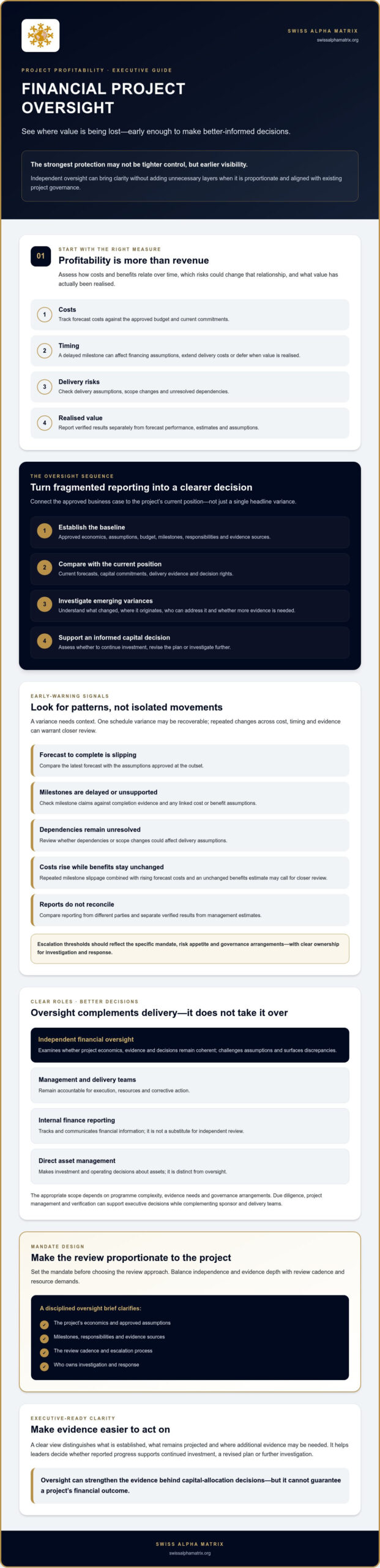
Profitability is not revenue alone. A programme may generate expected income yet deliver weaker returns if costs rise, milestones slip, financing assumptions change or anticipated benefits take longer to materialise. A sound assessment considers how costs and benefits relate over time, which risks could change that relationship, and what value has actually been realised. Report forecast performance separately from realised results.
Oversight also depends on clear decision rights and reliable evidence. A project governance framework can help establish how accountability, decisions and controls are structured. With that foundation, decision-makers can test whether reported progress supports continued investment, a revised plan or further investigation.
Which financial and operational signals shape project profitability?
Start with a consistent baseline: the approved budget, capital committed to date, forecast costs and expected benefits. Compare each with delivery evidence and current assumptions instead of relying on a single headline variance. For example, consider a milestone reported as complete alongside evidence of completion and any cost or benefit assumptions tied to it.
Timing matters. A delayed milestone can affect financing assumptions, extend delivery costs or defer when value is realised. Executive reporting should distinguish verified results from management estimates and underlying assumptions. This helps decision-makers see what is established, what remains projected and where more evidence may be needed.
Where does oversight sit within financial project management?
Oversight is not delivery ownership. Management remains accountable for execution, resources and corrective action. Nor is oversight a substitute for internal finance reporting, which tracks and communicates financial information, or direct asset management, which makes investment and operating decisions about assets. The oversight mandate is to examine whether the economics, evidence and decisions remain coherent.
An independent reviewer can challenge assumptions and surface discrepancies without taking control of delivery. This is the distinction behind independent financial project management: review and challenge can complement sponsor and delivery teams while management retains responsibility for execution. The right scope depends on the programme’s complexity, evidence needs and governance arrangements.
How financial oversight reveals value leakage before it compounds
Value leakage is the measurable erosion of expected project value through costs, delays, unmet delivery assumptions or other factors that weaken the approved economics. It may emerge gradually: a forecast slips, a dependency remains unresolved or reported progress cannot yet be substantiated. Each variance needs context, not an automatic conclusion of failure.
Effective financial project oversight connects the approved business case with the project’s current position. Review the original assumptions alongside current forecasts, capital commitments, delivery evidence and decision rights. This shows not only that performance has changed, but where the change originates, who can address it and which decision may need reconsideration.
Patterns matter more than isolated movements. A single schedule variance may be recoverable. Repeated milestone slippage combined with rising forecast costs and an unchanged benefits estimate may warrant closer review. Documented escalation thresholds help teams distinguish routine deviations from issues requiring executive attention. Set thresholds to reflect the specific mandate, risk appetite and governance arrangements, and assign clear ownership for investigation and response.
Which warning signals should executives examine?
Compare the forecast to complete, schedule variance, scope changes and unresolved dependencies with the assumptions approved at the outset. Check whether progress claims are supported by appropriate evidence and whether reports from different parties reconcile. A milestone marked complete without supporting delivery evidence is a question to investigate, not proof of misconduct or failure.
Escalation is most useful when criteria are set in advance. Define what requires explanation, who reviews the variance and which decisions may follow, such as revising a forecast, validating a dependency or reassessing a commitment. A threshold should prompt proportionate inquiry, not mechanical intervention.
How can validation strengthen project reporting?
Depending on the mandate, validation may test source documents, counterparties, transaction assumptions and evidence linked to milestones. Document review can establish whether records are internally consistent and support reported claims. It is distinct from independent verification of real-world activity, which may require on-ground evidence. Do not imply that either type of review has been performed unless it has.
For programmes where instrument documentation forms part of the evidence base, audit-grade instrument validation may be relevant to the review mandate. The purpose is not to duplicate management reporting, but to clarify what is supported, what remains an estimate and what needs further examination. That distinction gives executives a more disciplined basis for deciding whether to proceed, adjust or escalate.
Internal controls, milestone reviews or independent oversight: which approach fits?
No single oversight model suits every programme. The right arrangement depends on the reliability of existing controls, the quality of delivery evidence, the level of uncertainty and the consequences of an unresolved issue. A proportionate approach can sharpen decisions without creating a parallel management structure: oversight clarifies evidence and escalation, while management retains responsibility for delivery.
| Approach | Independence and evidence | Cadence and escalation | Resource demands |
|---|---|---|---|
| Internal finance controls | Embedded in the organisation; draw on routine financial records and controls. | Often integrated with regular reporting; escalation follows internal governance. | Use existing processes, but depend on their consistency and reach. |
| Periodic milestone reviews | Assess progress and supporting evidence at defined project points. | Focused reviews provide checkpoints; issues between reviews may need separate escalation routes. | Concentrated around review periods, with effort shaped by milestone scope. |
| Independent oversight | Provides a separate perspective and can examine evidence across parties, subject to mandate. | Cadence and escalation are agreed for the programme’s risk profile and decision needs. | Requires a defined scope, access to relevant information and coordination with existing teams. |
When are internal controls and milestone reviews sufficient?
Existing controls and periodic reviews may be appropriate when scope is stable, reporting is reliable, accountability is clear and dependencies across parties are limited. They can remain the governance foundation without being duplicated. Consider a more frequent or independent review when assumptions change, evidence is incomplete, milestones repeatedly move or decision-makers cannot reconcile reports. The case for escalation should reflect the programme’s risk appetite, not an arbitrary universal threshold.
When does independent financial project oversight add value?
Independent review may be useful when transactions are complex, stakeholders span jurisdictions, material uncertainty persists or key evidence is difficult to reconcile. A reviewer working to a defined mandate can test assumptions, identify unresolved questions and present findings for executive consideration without directing delivery. For a broader discussion of the role, see the article on independent project oversight.
In practice, models can be combined. Internal controls may support routine monitoring, milestone reviews may test progress at decision points, and independent scrutiny may be commissioned where confidence in evidence or assumptions needs strengthening. For financial project oversight, specify what will be reviewed, how findings will reach decision-makers and how the arrangement will complement, rather than replace, management accountability.
How to improve project profitability through a disciplined oversight process
A disciplined process makes review a repeatable decision system rather than a parallel reporting exercise. Connect the mandate, the evidence examined and the actions taken, while leaving delivery accountability with the project’s management team. Financial project oversight can inform choices about continuing, adjusting or escalating a programme, but cannot assure a particular financial result.
What should an oversight mandate define at the outset?
Before review begins, document its objective and scope, relevant jurisdictions and stakeholders, decision rights, and the format and cadence of reporting. Agree what evidence can be accessed, how confidentiality will be handled, and which issues must be escalated, to whom and by when. Define the boundary between advisory oversight and operational execution. Where legal advice is required, obtain it separately from appropriately qualified counsel.
Establish a baseline that links project economics to delivery: approved budget and capital commitments, forecast costs and expected benefits, key assumptions, milestones, accountable owners and evidence sources. Record the basis for material assumptions so later changes can be assessed against a traceable reference point.
How should findings translate into executive action?
Use a consistent review sequence, calibrated to the mandate:
- 1. Confirm the mandate. Set the objectives, boundaries, access, reporting cadence and escalation route.
- 2. Establish the baseline. Record economics, assumptions, milestones, responsibilities and source evidence.
- 3. Review performance. Compare current forecasts and delivery evidence with the baseline, noting variances and confidence in the supporting information.
- 4. Classify and escalate findings. Assess each issue by potential financial exposure, urgency, evidence confidence and accountable owner. Escalate according to agreed thresholds, not on variance alone.
- 5. Document decisions and follow up. Record the decision, unresolved assumptions, assigned actions and points for subsequent verification. Update forecasts when new evidence supports a change, and preserve the rationale.
This record gives executives a clear line from observation to decision and follow-through. It also makes unresolved uncertainty visible instead of allowing an estimate to become indistinguishable from a verified result. The appropriate response may be further investigation, a revised forecast or a management action. Let the evidence and agreed governance process guide the conclusion.
For organisations considering a tailored mandate, discuss a mandate-specific oversight approach with Swiss Alpha Matrix. Its work includes operational due diligence, complex project management, audit-grade validation and on-ground verification.
How Swiss Alpha Matrix supports complex financial project oversight
Complex programmes may require more than a review of financial reports. Depending on the mandate, Swiss Alpha Matrix can bring together operational due diligence, complex project management and verification to help sponsors examine whether financial assumptions, reported progress and delivery evidence align. The work is designed to complement existing management and governance arrangements, not take ownership of execution or investment decisions.
The firm’s senior team includes former executives from Tier-1 global financial institutions. Its capabilities include audit-grade instrument validation and on-ground verification, alongside operational due diligence, regulatory compliance advisory and risk management frameworks. For a programme involving several counterparties or delivery locations, a mandate may combine financial document review with verification of relevant activity and structured reporting for executive consideration. Scope depends on the evidence required and the questions decision-makers need answered.
What can a mandate-specific engagement include?
An engagement can be configured around the programme’s evidence gaps and governance needs. Relevant services may include:
- Audit-grade instrument validation to examine instruments and their supporting documentation within the agreed scope.
- On-ground verification services where independent evidence of real-world activity is relevant to the mandate.
- Operational due diligence and complex project management to assess operational factors and support coordination across a complex programme.
- Regulatory compliance advisory and risk management frameworks that may inform programme governance, subject to the engagement scope.
Not every engagement needs to include all these elements. A focused assignment may address a specific uncertainty, while a broader mandate may combine several capabilities and provide reporting at agreed decision points. Engagement structures may be fixed-fee, milestone-based or retainer-based. The appropriate arrangement depends on the defined scope and requirements.
What should executives prepare before an initial discussion?
A concise briefing helps establish whether the proposed review fits the programme. Set out its objective, relevant jurisdictions, principal stakeholders and current stage. Then identify the main uncertainties, available documentation, existing reporting cadence and upcoming decisions where independent input may be useful.
It can also help to clarify what information may be shared, who owns delivery and which questions fall within the oversight mandate. Findings can inform client decisions, but no review can guarantee profitability, returns or capital protection. The value lies in disciplined examination and clear communication of what the evidence supports, what remains uncertain and where further scrutiny may be appropriate.
To discuss scope, evidence needs and oversight requirements, Discuss financial project oversight with Swiss Alpha Matrix.
Make the Next Project Decision with Greater Clarity
Stronger project profitability begins with a dependable view of the economics, delivery evidence and risks behind each decision. Financial project oversight helps leaders identify where expected value may be eroding, distinguish verified results from assumptions and determine when a variance calls for investigation rather than immediate intervention.
The right level of review should fit the programme. Internal controls and milestone reviews may be sufficient in some circumstances. Complex or uncertain mandates may call for an independent perspective that complements management without taking over execution. Clear scope, evidence standards and escalation routes help turn findings into documented decisions and accountable follow-up.
Swiss Alpha Matrix’s senior team includes former executives from Tier-1 global financial institutions, and its services include audit-grade instrument validation and on-ground verification. These capabilities can inform a mandate-specific review without promising a particular financial outcome.
For a considered discussion of your programme’s scope, evidence needs and oversight requirements, discuss a mandate-specific financial project oversight approach. With a clear mandate and disciplined evidence, executives can move forward with greater confidence in the decisions before them.
Frequently Asked Questions
How does financial project oversight improve profitability?
Financial project oversight can support profitability by testing assumptions, tracking costs and milestones, and bringing emerging risks to decision-makers’ attention. For example, a forecast cost increase alongside a delayed milestone may prompt sponsors to reassess exposure or investigate a dependency. Oversight does not generate profit or guarantee a return. Its contribution is a stronger evidence base for timely decisions about deviations and whether corrective action is warranted.
What is the difference between project oversight and project management?
Project management coordinates delivery, resources, schedules and execution. Project oversight reviews progress, evidence, risks and decisions, often from a governance or independent perspective. The functions can work together: project managers remain accountable for delivery, while oversight examines whether reported performance and supporting evidence align with approved objectives. Clear responsibilities help prevent duplicated work and ensure review strengthens decision-making without transferring execution accountability away from management.
When should a company use independent financial project oversight?
Independent review may be appropriate when a programme involves complex transactions, cross-border stakeholders, material uncertainty, fragmented evidence or decisions that would benefit from an external perspective. The need depends on the mandate, risk profile and effectiveness of existing controls, not a universal threshold. An initial scope discussion can help determine whether independent review would add useful scrutiny or whether internal reporting and milestone reviews are proportionate.
Which metrics should executives monitor to assess project profitability?
Executives commonly monitor the approved budget, committed and forecast costs, expected benefits, milestone performance and changes to key assumptions. The relevant measures depend on the project’s business case and the quality of its reporting. Establish a consistent baseline, then separate actual results from management estimates and assumptions. Consider measures together: a cost variance may call for a different response depending on schedule, scope, evidence and anticipated benefits.
Can independent oversight slow down a financial project?
It can create friction if the mandate is poorly defined, reporting is excessive or decision rights are unclear. A proportionate review focuses on material questions, uses agreed evidence sources and sets clear escalation routes. Integrated with existing governance, oversight can inform timely decisions without taking delivery ownership from project managers or other accountable stakeholders. Agreeing scope and cadence in advance helps limit duplication and direct attention to the issues that matter.
What documents are needed to begin a financial project oversight review?
An initial review may draw on the business case, approved budget, current forecasts, milestone records, relevant transaction documents, risk registers and existing governance reports. Precise requirements depend on the mandate and jurisdiction. Before sharing sensitive materials, agree the review scope, information access, confidentiality arrangements and reporting expectations with the relevant advisers. An inventory of available records can also help identify evidence gaps early, before review conclusions are formed.
Does financial project oversight guarantee capital protection or higher returns?
No. Oversight can identify information gaps, emerging risks and deviations from approved assumptions, but it cannot eliminate risk or guarantee capital protection, profitability or investment returns. Its purpose is to support better-informed decisions through structured review and clear reporting. Results remain subject to underlying conditions, evidence quality and choices made by accountable stakeholders. Treat findings as decision support, not a promise of a particular financial outcome.