

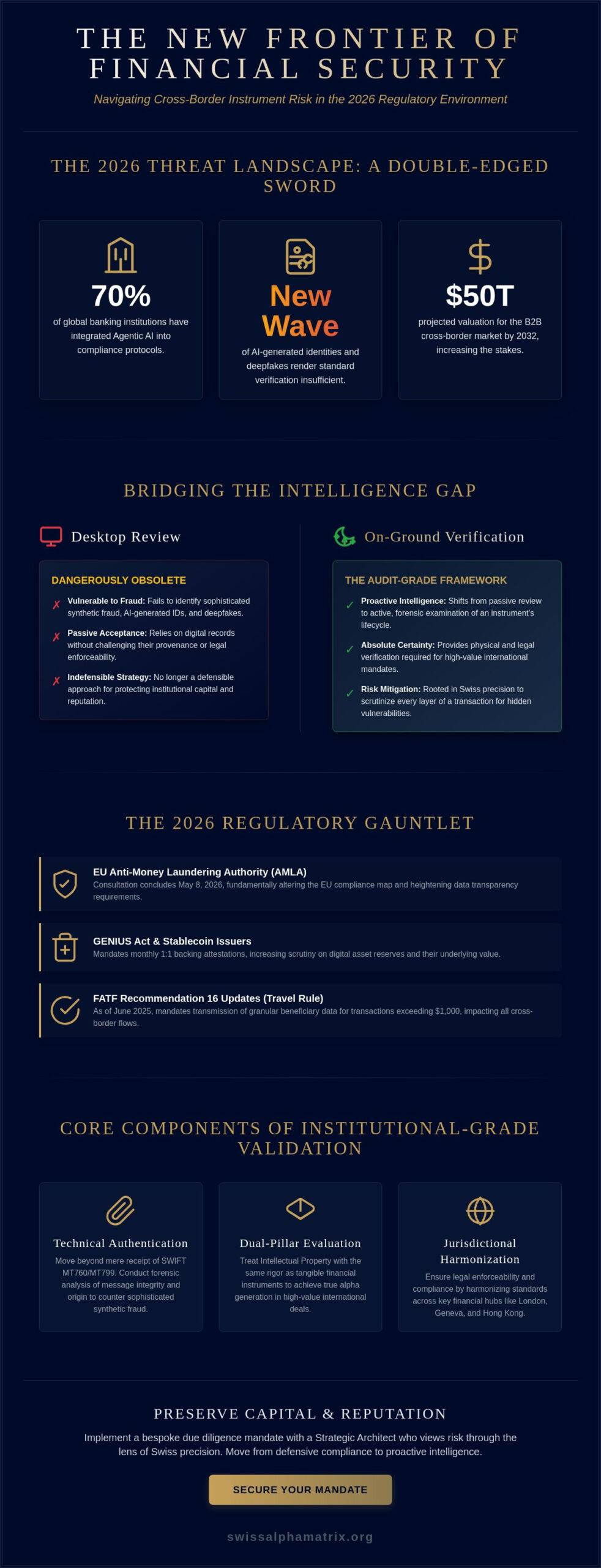
While 70% of global banking institutions have integrated Agentic AI into their compliance protocols as of 2026, the simultaneous proliferation of AI-generated identity documents and sophisticated deepfakes has rendered standard digital verification insufficient for high-value asset transfers. The necessity for rigorous financial instrument due diligence in cross-border transactions has never been more acute, especially as the global B2B cross-border market scales toward its projected $50 trillion valuation by 2032. You likely recognize that in this climate, where the EU’s Anti-Money Laundering Authority consultation concludes on May 8, 2026, and the GENIUS Act mandates monthly 1:1 backing attestations for stablecoin issuers, a mere desktop review is no longer a defensible strategy for protecting institutional capital. This article provides the methodology required to master the intricacies of validating high-value instruments and intellectual property within complex international corridors through an audit-grade framework designed for the 2026 regulatory environment. We’ll explore the shift from defensive compliance to proactive intelligence gathering, focusing on on-ground verification and the harmonization of standards across London, Geneva, and Hong Kong to ensure your bespoke mandates remain secure.
Key Takeaways
- Identify the critical limitations of traditional KYC protocols and understand why institutional-grade validation must now account for the increased sophistication of global financial crime.
- Master the technical authentication of SWIFT MT760 and MT799 messages to maintain the integrity of financial instrument due diligence in cross-border transactions within an increasingly volatile market.
- Implement a dual-pillar evaluation framework that treats intellectual property with the same rigor as tangible financial instruments; it’s the only way to achieve the alpha generation associated with high-value international deals.
- Move beyond the vulnerabilities of desktop-based reviews by adopting on-ground verification protocols that provide the absolute certainty required for high-value international mandates.
- Leverage a bespoke project management methodology rooted in Swiss financial traditions to mitigate risk; that’s the strategic architect’s path to preserving institutional reputation across diverse regulatory environments.
The Landscape of Cross-Border Financial Instrument Risk in 2026
The global cross-border payments market, having achieved a valuation of $238 billion in early 2026, operates within a climate where the velocity of capital is matched only by the sophistication of those seeking to illicitly divert it. For the institutional investor or the high-net-worth individual, the execution of financial instrument due diligence in cross-border transactions is no longer a peripheral compliance task but a core requirement for capital preservation. Traditional KYC and AML frameworks, while providing a baseline of regulatory adherence, frequently fail to identify the “synthetic” fraud structures that have become prevalent in international markets. These sophisticated schemes utilize AI-generated identity documents and deepfake verification bypasses to simulate institutional credibility, making standard “desktop” due diligence dangerously obsolete. In this environment, an institutional-grade framework is the only reliable defense against the erosion of both capital and reputation.
A rigorous due diligence process must move beyond the passive acceptance of digital records to actively challenge the provenance of every asset. When 91% of B2B decision-makers acknowledge that secure payments are the primary driver of growth, the cost of a single oversight can be catastrophic. The rise of autonomous “Agentic AI” in 70% of banking compliance departments has created a false sense of security, as malicious actors concurrently use similar technologies to create high-fidelity fraudulent instruments. Protecting your interests requires a Strategic Architect who views risk through the lens of Swiss precision, ensuring that every layer of a transaction is scrutinized for hidden vulnerabilities.
Defining Cross-Border Instrument Validation
Audit-grade validation requires a departure from superficial document review toward a forensic examination of an instrument’s lifecycle and legal enforceability. This process is particularly critical when dealing with high-value instruments such as Standby Letters of Credit (SBLC), Bank Guarantees (BG), and traditional Letters of Credit (LC), which serve as the bedrock of international trade finance. Cross-border due diligence is a multi-layered verification of authenticity, enforceability, and counterparty integrity that confirms a financial instrument remains a legally binding claim across multiple, often conflicting, jurisdictions.
The 2026 Regulatory Environment
The regulatory landscape in 2026 is defined by a heightened emphasis on data transparency and the harmonization of global standards across key hubs like London, Geneva, and Hong Kong. Following the FATF Recommendation 16 updates in June 2025, financial institutions are now mandated to transmit granular beneficiary data for any transaction exceeding $1,000. Additionally, the conclusion of the EU’s AMLA consultation on May 8, 2026, and FinCEN’s February 13, 2026, order regarding beneficial ownership have fundamentally altered the compliance map. A deep understanding of international financial regulations is vital for structuring deals that are both resilient and high-performing in this new era of digital asset integration.
Core Components of Institutional-Grade Instrument Validation
The technical validation of high-value assets requires a shift from passive acknowledgement to an active interrogation of the instrument’s origin. While the G20 roadmap targets near-real-time settlement by the end of 2027, this accelerated pace creates a dangerous window for fraudulent activity that exploits the pressure for speed. Consequently, financial instrument due diligence in cross-border transactions must evolve beyond the mere receipt of a SWIFT MT760 or MT799 message. In 2026, these messages, while essential for inter-bank communication, are no longer foolproof; the rise of sophisticated synthetic fraud and Agentic AI spoofing means that a message’s presence doesn’t inherently guarantee the underlying asset’s existence or the issuer’s liquidity.
Assessing the issuing institution involves more than a cursory glance at a credit rating. Operational stability, particularly in jurisdictions with differing regulatory oversight such as Hong Kong, London, or Geneva, must be scrutinized through a lens of historical reliability. We favor a Strategic Architect approach, where the focus lies on the bank’s actual capacity to honor the instrument under duress. If an instrument cannot be liquidated immediately upon default due to jurisdictional friction or localized capital controls, its value to the institutional investor is effectively zero. This level of scrutiny protects the institutional reputation and ensures that capital is never committed to a “paper-only” asset.
The Multi-Step Validation Protocol
A robust protocol begins with the direct verification of the issuing officer’s authority and a forensic cross-match with the bank’s internal ledger. It’s imperative to analyze the “chain of custody” for the instrument, ensuring no prior encumbrances or collateral double-counting have occurred. Utilizing bank instrument validation services provides an additional layer of certainty, acting as an essential truth-filter against the 26% of B2B transactions that fail due to procedural delays or fraudulent documentation. This multi-layered approach ensures that the instrument is not just authentic, but fully enforceable.
Counterparty Integrity and Reputation
Modern due diligence transcends simple “blacklist” screenings, opting instead for a sophisticated behavioral and network analysis of all transacting parties. This is where the tradition of Swiss discretion becomes a tangible asset, allowing for sensitive investigations that reveal the true nature of a counterparty’s history without alerting the market. Red flags often hide in plain sight; they manifest as inconsistencies in communication or subtle deviations in standard banking documentation that automated systems might overlook. To ensure your capital remains secure, it’s often wise to consult with an expert architect who understands these institutional nuances.
The Master Checklist: Intellectual Property and Financial Due Diligence
The valuation of intangible assets in the 2026 global economy has necessitated a fundamental shift in how we approach financial instrument due diligence in cross-border transactions. While traditional audits focus on liquid capital and bank-issued guarantees, the Strategic Architect recognizes that the underlying value of a bespoke mandate often rests upon intellectual property (IP) assets that act as primary or supplementary collateral. If these assets are not validated with the same Swiss precision applied to a bank ledger, the entire deal structure remains vulnerable to hidden encumbrances or jurisdictional disputes. Audit-grade certainty requires a dual-track investigation that synchronizes financial statement analysis with a forensic review of the target entity’s intangible portfolio.
The interplay between IP value and financial instrument collateralization is particularly significant in 2026, as the EU’s Markets in Crypto-Assets (MiCA) regulation takes full effect by mid-year, adding layers of complexity to digital asset IP. To maintain institutional-grade security, every checklist item must be verified through primary sources rather than third-party summaries. This proactive intelligence gathering distinguishes our methodology from the superficial reviews offered by generalist firms, ensuring that your capital is anchored by assets with verified provenance and clear legal enforceability across London, Geneva, and Hong Kong corridors.
Intellectual Property Due Diligence Checklist
A comprehensive assessment must begin with the multi-jurisdictional verification of ownership for patents, trademarks, and copyrights. It’s critical to determine if these assets have been pledged as collateral in prior transactions; double-pledging remains a frequent red flag in high-value cross-border deals. We scrutinize the validity of licensing agreements to ensure they generate the projected cash flows required to service the instrument. Finally, a review of any pending or threatened IP litigation is mandatory, as legal challenges can instantaneously impair the asset’s value and the enforceability of the associated financial instrument.
Financial and Operational Integrity
The second pillar of our framework involves a forensic review of audited financial statements, specifically reconciling the differences between local standards and international benchmarks like IFRS or GAAP. Beyond the numbers, we conduct operational due diligence to assess the “engine room” of the target entity, ensuring their internal controls are robust enough to withstand 2026 market volatility. For those seeking a deeper understanding of these complex deal structures, our guide on mastering cross-border investment due diligence provides the broader context necessary for institutional success. This level of technical accuracy is the only way to achieve consistent alpha generation while mitigating multi-jurisdictional risk.
Desktop vs. On-Ground Verification: Bridging the Intelligence Gap
The reliance on digital interfaces for financial instrument due diligence in cross-border transactions has reached a critical juncture in 2026. While 70% of banking institutions have adopted Agentic AI to streamline their compliance workflows, this technological shift has inadvertently provided a veil for sophisticated criminal networks. Desktop due diligence, which consists of reviewing electronic filings, digital certificates, and remote database entries, remains vulnerable to high-fidelity forgeries that automated systems often fail to detect. Relying solely on a screen to validate a multi-million dollar Bank Guarantee is no longer a strategic choice; it’s a risk that ignores the reality of modern financial crime. The Wise Guardian understands that digital data is merely a representation of value, not the value itself.
We believe that physical presence serves as the ultimate truth-filter in an era of digital abstraction. The Strategic Architect approach necessitates that we look beyond the PDF and the portal to witness the operational reality of a counterparty. In early 2026, our on-ground verification protocols identified a “Potemkin Village” scenario in a Southeast Asian financial hub where a purportedly Tier-1 issuing office was, in fact, a shared co-working space with no institutional staff or ledger access. This discovery prevented a $45 million capital loss for a client who had initially received “verified” digital documentation. Balancing the necessary speed of desktop review with the uncompromising security of on-ground mandates ensures that your capital is anchored in reality, not just code.
The Limitations of Digital Evidence
Digital verification is a prerequisite, not a conclusion. Sophisticated SWIFT spoofs and AI-generated identity documents can now bypass even the most advanced perpetual KYC (pKYC) systems, which were designed to monitor risk in real-time. The risk of a “Potemkin Village” is higher than ever; an office address or a legitimate-looking website does not guarantee an operating business with the liquidity to honor a Standby Letter of Credit. To bridge this intelligence gap, you should secure an on-ground verification mandate to confirm the physical existence and operational integrity of your counterparties before committing significant capital.
Executing On-Ground Mandates in Global Hubs
True institutional-grade validation requires local intelligence in primary financial centers like Hong Kong, London, and Geneva. Our teams conduct physical inspections of corporate headquarters and, where applicable, the underlying tangible assets or inventory that collateralize an instrument. By engaging in direct, face-to-face verification with local regulators and bank branch managers, we bypass the intermediary “gatekeepers” who often facilitate fraudulent schemes. This meticulous level of scrutiny provides the audit-grade certainty that digital-only firms simply cannot replicate, ensuring that your bespoke mandates are protected by more than just an algorithm.
Implementing a Bespoke Due Diligence Mandate with Swiss Alpha Matrix
The transition from identifying risks to actively managing them requires a partner who operates with the traditional discretion of a Swiss private bank while maintaining a modern, global transactional reach. At Swiss Alpha Matrix, we don’t view financial instrument due diligence in cross-border transactions as a mere regulatory hurdle to be cleared; rather, it’s a strategic pillar that provides our clients with a distinct advantage during deal negotiations. When an institutional investor enters a transaction backed by our audit-grade validation, they do so with a level of certainty that commands respect and ensures the preservation of long-term wealth. Our role as the Strategic Architect is to oversee the intricate mechanics of your mandate, ensuring that every financial instrument and intellectual property asset is verified with an uncompromising commitment to precision.
By shifting the perspective of due diligence from a defensive necessity to a proactive intelligence exercise, we help executives secure superior risk-adjusted returns. In a market where 26% of B2B decision-makers have ceased working with partners due to payment delays or procedural friction as of 2026, having an institutional-grade framework in place is essential for maintaining deal momentum. This approach doesn’t just protect capital. It fosters a sense of professional calm, allowing our clients to focus on strategic growth while we manage the complexities of multi-jurisdictional risk mitigation and counterparty integrity.
The Swiss Alpha Matrix Methodology
Our firm utilizes financial advisory methodologies developed by former Tier-1 bank executives who understand the nuances of global capital markets. Central to our success is the integration of independent financial project management, which ensures that deal integrity is maintained without the conflicts of interest often found in larger, multi-service institutions. These bespoke mandates provide “alpha” not through market speculation, but through the superior mitigation of the structural risks inherent in the volatile international landscape of 2026.
Engagement and Execution
The process of executing a mandate is characterized by a measured and highly logical progression. We begin with a comprehensive initial risk assessment, moving steadily toward on-ground verification and concluding with a detailed, audit-grade report that serves as the definitive truth-filter for your transaction. Throughout the project lifecycle, we prioritize executive-level discretion and absolute confidentiality, mirroring the historical reliability of Swiss financial traditions. If you’re facing a high-stakes transaction and require the certainty that only an expert architect can provide, we invite you to contact Swiss Alpha Matrix to secure your next cross-border mandate.
Securing Institutional Resilience in a Borderless Economy
The 2026 financial landscape demands a transition from passive compliance to a proactive, intelligence-led strategy. We’ve explored how the intersection of digital asset regulation and sophisticated synthetic fraud has rendered traditional KYC frameworks insufficient for high-value mandates. By prioritizing physical on-ground verification and integrating intellectual property into the core evaluation pillar, institutions can bridge the intelligence gap that often leads to catastrophic capital loss. This comprehensive approach ensures that every asset is validated against the highest standards of Swiss excellence.
Swiss Alpha Matrix, led by former Tier-1 global bank senior executives, provides the strategic architecture necessary to navigate these complexities with Swiss precision. Our bespoke mandates across London, Geneva, and Hong Kong deliver the audit-grade reports executive stakeholders require for absolute certainty. Mastery of financial instrument due diligence in cross-border transactions isn’t just about risk mitigation; it’s about establishing a foundation of trust that enables strategic growth in a volatile global market.
It’s time to elevate your approach to capital protection. Secure your capital with institutional-grade due diligence and ensure your international deals are anchored in verified reality. Your commitment to excellence deserves a partner who shares your standard of integrity and technical accuracy.
Frequently Asked Questions
What are the most common red flags in financial instrument due diligence?
Red flags typically manifest as an urgent insistence on bypassing standard verification protocols or discrepancies between a SWIFT MT760 header and the bank’s internal ledger. In early 2026, 26% of B2B transactions failed due to such procedural inconsistencies or fraudulent documentation. We also monitor for “gatekeepers” who obstruct direct communication with the issuing officer, as this often signals a lack of underlying asset liquidity or authority.
How does intellectual property due diligence differ in cross-border transactions compared to domestic deals?
Cross-border IP due diligence requires navigating conflicting legal frameworks across jurisdictions like Hong Kong and London, whereas domestic deals operate under a single sovereign law. The complexity increases when verifying that an asset isn’t pledged as collateral in another region. With the EU’s MiCA regulation taking full effect by mid-2026, validating digital asset IP requires a forensic understanding of international data transparency standards that domestic reviews often overlook.
Is SWIFT verification sufficient for validating a Standby Letter of Credit (SBLC)?
SWIFT verification via MT760 or MT799 is a foundational requirement but remains insufficient as a standalone validation method in 2026. Malicious actors now utilize sophisticated spoofs and AI-generated bypasses to mimic institutional messaging. Comprehensive financial instrument due diligence in cross-border transactions must supplement SWIFT messages with on-ground verification and direct confirmation of the issuing officer’s authority to honor the specific instrument.
How long does a comprehensive on-ground verification mandate typically take?
A comprehensive on-ground verification mandate typically requires between 10 and 21 business days to complete, depending on the complexity of the asset and the location of the issuing institution. This timeframe allows for the physical inspection of assets, meetings with local regulators, and forensic reconciliation of internal bank ledgers. We prioritize technical accuracy over speed to ensure every bespoke mandate meets our audit-grade standards for capital protection.
What are the consequences of failing to conduct audit-grade due diligence in M&A?
Failing to conduct audit-grade due diligence can lead to catastrophic capital erosion and the total loss of institutional reputation. In 2026, 91% of B2B decision-makers link secure payment structures directly to business growth; a single fraudulent instrument can halt an entire merger. Without rigorous validation, you risk inheriting hidden encumbrances or unenforceable guarantees that fundamentally impair the target entity’s valuation and long-term viability.
Can Swiss Alpha Matrix provide due diligence in jurisdictions with strict privacy laws like Switzerland?
Swiss Alpha Matrix excels in conducting due diligence within jurisdictions characterized by strict privacy laws, such as Switzerland and Singapore. We leverage our deep roots in Swiss financial traditions to navigate these environments with the necessary discretion and professional authority. Our former Tier-1 bank executives utilize established protocols to verify instrument validity while strictly adhering to local data protection and banking secrecy regulations.
How do you integrate IP valuation into a broader financial instrument analysis?
Integrating IP valuation involves treating intangible assets as core collateral rather than secondary considerations. We analyze licensing agreements and historical cash flows to determine how IP supports the underlying financial instrument. This dual-track methodology ensures that financial instrument due diligence in cross-border transactions accounts for the total asset value, particularly as digital asset IP becomes more prominent following the mid-2026 regulatory shifts.
What is the difference between legal due diligence and the operational due diligence provided by Swiss Alpha Matrix?
Legal due diligence focuses on contract enforceability and corporate standing, while the operational due diligence provided by Swiss Alpha Matrix examines the “engine room” of the transaction. We verify the actual existence of assets and the operational capacity of the issuing bank to honor its commitments. It’s important to clarify that we don’t provide legal representation; instead, we offer the technical validation and project management required to ensure the deal’s operational integrity.