

In the architecture of high-stakes institutional finance, a signature is rarely just a mark of approval. It represents the final barrier against catastrophic capital erosion and the ultimate validation of fiduciary duty. You recognize that in complex, cross-border transactions, any ambiguity regarding deliverable ownership isn’t merely a technical oversight. It’s a profound systemic vulnerability that invites audit failure and unmitigated risk. Implementing a sophisticated financial deliverable sign-off framework ensures that every milestone meets the rigorous standards expected by Tier-1 entities, transforming procedural checkpoints into audit-grade fortifications.
We understand the weight of responsibility that accompanies the verification of unverified instruments and the fear of capital loss from opaque reporting. This article provides a comprehensive blueprint for mastering the intricate protocols of sign-offs to protect your institution’s interests. You’ll discover how to establish clear executive accountability and reduce counterparty risk through a repeatable, logical methodology. We’ll examine the strategic pillars of on-ground verification and operational due diligence, providing you with the tools to lead your organization with the quiet authority and precision that defines global financial excellence.
Key Takeaways
- Establish an institutional-grade financial deliverable sign-off framework to bridge the precision gap that often compromises generic project management protocols in Tier-1 environments.
- Validate the technical logic and authenticity of financial instruments by integrating rigorous regulatory compliance with on-ground operational due diligence.
- Understand why internal PMO reviews often fail to identify systemic risks and why independent validation is essential for protecting high-value mandates.
- Deploy a structured review matrix and milestone-based validation to ensure that cross-border transactions meet the highest standards of audit-grade reporting.
- Transition your oversight strategy from passive monitoring to an active, risk-aware model that prioritizes the long-term preservation of institutional capital.
Beyond the Procedural: The Strategic Necessity of a Financial Deliverable Sign-off Framework
In high-stakes institutional finance, the traditional notion of project completion is often dangerously insufficient. A simple signature on a status report doesn’t account for the complex technical logic or the regulatory weight of cross-border instruments. This creates a “Precision Gap” where generic project management methodologies fail to address the specific vulnerabilities of Tier-1 environments. To bridge this gap, a robust financial deliverable sign-off framework must be viewed as an institutional-grade protocol designed for the meticulous validation of capital-intensive outputs. It’s a fundamental shift from checking a box to fulfilling a fiduciary duty. Stakeholders must realize that a deliverable isn’t simply a task completed; it’s a potential liability that requires technical verification before it’s integrated into the broader portfolio.
Effective governance relies on sophisticated internal control frameworks that prioritize deliverable integrity over mere task completion. When dealing with high-value mandates, the sign-off acts as a strategic risk-mitigation checkpoint. It ensures that every instrument is not just finished, but technically accurate and regulatorily sound.
The Institutional Definition of ‘Done’
Audit-ready criteria must transcend surface-level completion by verifying the underlying financial architecture of every deliverable. We define the financial deliverable sign-off framework as a multi-layered verification gate that serves as the primary mechanism for capital protection throughout the project lifecycle. Achieving “Swiss precision” in deliverable acceptance requires a level of technical depth that standard internal teams may overlook. It demands a rigorous, unemotional assessment of every data point to ensure that the final product can withstand the scrutiny of global regulatory bodies and institutional auditors.
Mitigating the Costs of Procedural Failure
The consequences of an unverified deliverable extend far beyond a delayed timeline. They manifest as severe regulatory non-compliance and unhedged capital exposure that can destabilize even the most robust balance sheets. By treating the sign-off as a formal risk-transfer mechanism, executive stakeholders ensure that accountability is clearly defined, documented, and defensible. Integrating independent financial project management into this process provides a critical buffer against the internal biases and “optimism bias” that often cloud internal project reporting. This independent oversight acts as a necessary safeguard, ensuring that transactional integrity is maintained across diverse global jurisdictions. It provides the seasoning and unemotional expertise required to prioritize long-term preservation over short-term project velocity.
Anatomy of an Audit-Grade Sign-off Framework: Technical, Regulatory, and Operational Pillars
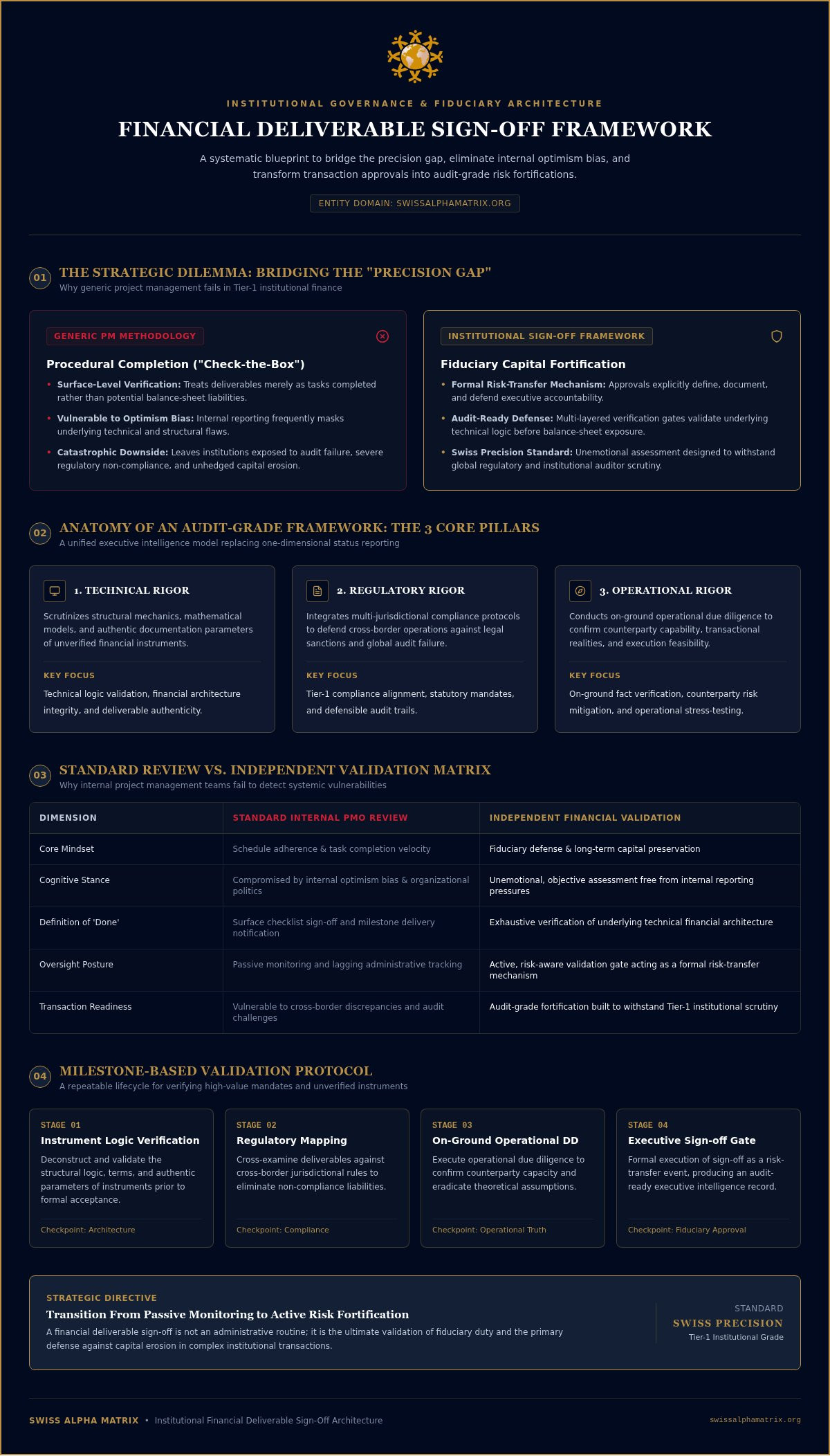
A sophisticated financial deliverable sign-off framework isn’t a linear checklist; it’s a three-dimensional architecture of validation that ensures transactional integrity. Unlike generic project management tools that prioritize workflow status, an institutional-grade protocol demands the synthesis of technical, regulatory, and operational pillars into a unified executive intelligence report. This synthesis ensures that a signature isn’t merely an administrative formality but a definitive statement of verified precision. It requires a level of technical depth that standard internal teams often lack, particularly when managing capital-intensive mandates across diverse jurisdictions.
Instrument Validation and Technical Rigor
The technical pillar necessitates the integration of bank instrument validation services directly into the sign-off workflow to ensure that the underlying financial logic remains unassailable. It requires audit-grade documentation for every technical deliverable, moving the organization beyond the ambiguity of “reasonable assurance.” By adopting standards similar to the PCAOB AS 2201 auditing standard, institutions can enforce a level of testing rigor that validates the authenticity of every instrument before capital is deployed. This technical depth is essential when navigating high-value mandates where even a minor calculation error can lead to significant downstream friction. It’s about ensuring that the data presented in a report perfectly mirrors the technical reality of the instrument.
Regulatory Alignment and Fiduciary Compliance
The regulatory pillar ensures that every sign-off aligns with international financial regulations, including Basel IV, Form PF, and regional AML requirements. Senior executive expertise is vital here to navigate the nuances of regulatory arbitrage and cross-border mandates. Every deliverable must be mapped against these requirements to ensure it withstands the scrutiny of global regulatory bodies. This alignment isn’t just about compliance; it’s about fulfilling a fiduciary duty to preserve capital and maintain institutional reputation. When you manage a financial deliverable sign-off framework, you aren’t just approving a document. You’re verifying that the transaction exists within a safe, compliant legal envelope.
Finally, the operational pillar bridges the gap between paper-based claims and on-ground reality. It involves verifying that the physical or legal status of an asset matches its digital representation. For institutions seeking to formalize these protections, engaging with expert risk management frameworks provides the necessary independent oversight to synthesize these pillars into a defensible, audit-grade record of transactional integrity. This holistic approach ensures that no detail, however small, is left to chance.
Standard Review vs. Independent Validation: Navigating the Sophistication Gap
Internal project management offices, while efficient for operational throughput, frequently suffer from a structural conflict of interest that compromises the integrity of a financial deliverable sign-off framework. Because internal teams are often measured by completion speed and budget adherence, they’re subtly incentivized to overlook nuanced red flags that could delay a mandate. This bias creates a sophistication gap where high-value deals are signed off based on surface-level checklists rather than deep-dive technical scrutiny. Transitioning to an independent validation standard isn’t merely an extra step. It’s a non-negotiable prerequisite for protecting institutional capital in cross-border environments where the complexity of instruments often exceeds the capacity of standard PMO resources.
The necessity for this “effective challenge” is mirrored in the Federal Reserve’s supervisory guidance on model risk management, which emphasizes that validation must be performed by parties independent of the development process to ensure objective oversight. By separating the execution of a project from its final validation, institutions create a defensible record of due diligence that satisfies both internal auditors and external regulators. This approach moves beyond basic checklist-based reviews, opting instead for audit-grade instrument validation that confirms the technical reality of every claim before capital is deployed.
The Conflict of Interest in Internal Sign-offs
Internal teams often find themselves under immense pressure to meet quarterly targets, which can lead to a dangerous prioritization of task completion over capital risk mitigation. Unemotional expertise is required to evaluate project milestones without the cloud of internal politics or performance-related incentives. Independent validation acts as a necessary safeguard, ensuring that red flags are identified and addressed rather than suppressed. It’s the only way to ensure that the sign-off reflects the true state of the deliverable, providing the quiet authority needed for institutional-grade decision-making.
Leveraging External Senior Executive Intelligence
There’s a profound difference between a standard project manager and a former Tier-1 bank executive when navigating the sign-off process. While a project manager focuses on timelines, a seasoned executive applies a lifetime of institutional knowledge to identify technical inconsistencies and regulatory gaps. Sophisticated financial advisory methodologies incorporate these external verification layers to bridge the gap between transactional speed and institutional safety. This independent project manager serves as the final arbiter of deal integrity, ensuring that every signature is backed by technical precision and a deep understanding of global financial mandates. This level of oversight provides the regional precision and technical depth required to manage complex capital protection mandates effectively.
Implementing the Framework: A Step-by-Step Protocol for Executive Stakeholders
Implementing a financial deliverable sign-off framework requires a departure from generic administrative approvals toward a technical, risk-based architecture. It’s a disciplined transition. This protocol ensures that executive stakeholders don’t just sign off on a timeline, but on the technical and legal integrity of the capital involved. The process begins with a structured review matrix and culminates in an executive intelligence report that provides the unassailable data required for fiduciary confidence. By following a structured, multi-layered protocol, institutions can ensure that every signature represents a definitive statement of verified precision rather than a procedural formality.
Phase 1: Pre-Validation and Matrix Design
Customizing the review matrix for cross-border investment due diligence is the critical first step in establishing institutional-grade oversight. This matrix must identify mandate-specific risk profiles and establish “Hard Stop” criteria that prevent any sign-off from proceeding until technical discrepancies are resolved. Defining the specific evidence required for audit-grade verification ensures that the financial deliverable sign-off framework remains objective and resistant to internal pressure. It’s about setting the standard for deliverable acceptance before the first milestone is even reached, ensuring that the technical logic of every instrument is scrutinized against established regulatory benchmarks.
Phase 2: Execution of the Independent Audit
The second phase involves the mechanics of on-ground verification for physical assets or entities, ensuring that paper-based claims perfectly mirror reality. When technical discrepancies are discovered during this validation phase, they must be documented and addressed through a sophisticated RACI model that aligns stakeholder accountabilities. This prevents the diffusion of responsibility that often occurs in complex, multi-jurisdictional projects. The final executive briefing then translates this complex data into an actionable intelligence report, which serves as the final arbiter for the sign-off decision. This report provides the intellectual depth and technical accuracy expected in Tier-1 environments, allowing for a standard of service that is both broad in reach and meticulous in its attention to detail. To secure your institution’s interests through these rigorous protocols, consider adopting our sophisticated risk management frameworks to ensure every milestone meets the Swiss standard of precision.
Strategic Oversight: Integrating Independent Advisory into Your Sign-off Ecosystem
The transition from a passive project management office to an active, risk-aware oversight model represents the final stage of institutional maturity. In high-stakes environments, a financial deliverable sign-off framework serves as the primary mechanism for fiduciary fortification, ensuring that capital is never deployed based on unverified data. This transition requires more than just better software; it demands a cultural pivot toward ‘Precision over Speed.’ By prioritizing technical accuracy over transactional velocity, institutions protect themselves from the systemic vulnerabilities that often accompany cross-border mandates. Swiss Alpha Matrix brings this level of regional excellence to every engagement, applying the same meticulous standards used by Tier-1 global banks to ensure that your interests remain secure.
The Boutique Advantage in Complex Project Management
Specialized advisory firms offer a level of technical rigor and discretion that large-scale, generalist consultancies simply aren’t structured to provide. While larger entities may focus on throughput, a boutique partner prioritizes the intricate validation of complex instruments through the lens of seasoned, unemotional experts. This exclusivity is vital when managing sensitive financial programs where privacy and technical accuracy are non-negotiable. Leveraging former Tier-1 executive intelligence allows for a standard of service that is both broad in reach and meticulous in its attention to detail. It’s about having a dedicated partner who understands the nuances of regulatory arbitrage and the technical logic of every deliverable, ensuring that the ‘Swiss standard’ of discipline is applied to every milestone.
Securing the Future of Capital Deployment
The long-term benefits of an institutionalized sign-off framework extend far beyond the current project lifecycle. It establishes a repeatable, audit-grade protocol that reduces counterparty risk and ensures that every future capital deployment is backed by verified data. This logic creates a sense of professional calm, knowing that every milestone has been scrutinized by independent eyes before final acceptance. To integrate this level of precision into your own ecosystem, you can secure your capital with Swiss Alpha Matrix’s independent advisory services. Our methodology ensures that your interests are in the hands of experts who prioritize strategic growth and long-term preservation over short-term speculation. Finalizing the sign-off with this level of rigor ensures that your institution remains resilient and fully compliant in an increasingly complex global landscape.
Securing Institutional Integrity Through Meticulous Validation
Establishing a robust financial deliverable sign-off framework is the definitive step toward bridging the precision gap in high-stakes finance. We’ve explored how technical rigor, regulatory alignment, and independent validation form the three pillars of an audit-grade protocol. This methodology ensures that every signature is backed by technical reality, protecting capital from the inherent biases of internal project offices and the complexities of cross-border mandates. Precision is paramount.
Swiss Alpha Matrix provides the elite oversight required to navigate these intricate dynamics. Led by former Tier-1 Global Bank Executives and serving as Audit-Grade Instrument Validation Specialists, we bring global reach with Swiss precision to your most sensitive mandates. By prioritizing intellectual depth and technical accuracy, you ensure that your institution’s interests remain in the hands of seasoned, unemotional experts. We invite you to Request a Consultation for Independent Project Oversight to formalize your capital protection strategies. Your commitment to these standards today builds a foundation of stability for every future deployment.
Frequently Asked Questions
What is the primary difference between a milestone and a deliverable in a financial framework?
A milestone represents a strategic point in time or a critical event within a project’s lifecycle, whereas a deliverable is the tangible, technical output that requires validation. In an institutional context, a milestone might be the completion of a due diligence phase, but the deliverable is the audit-grade report itself. The financial deliverable sign-off framework focuses specifically on the technical integrity of these outputs to ensure they meet fiduciary standards.
How does an audit-grade sign-off framework mitigate cross-border regulatory risk?
The framework mitigates risk by mapping every technical output against a matrix of international regulations, such as Basel IV and regional AML mandates. This ensures that deliverables are regulatorily sound across multiple jurisdictions, preventing the friction of regulatory arbitrage. By institutionalizing these checks, firms create a defensible record of compliance that withstands the scrutiny of global auditors, thereby protecting capital from the legal vulnerabilities inherent in complex international transactions.
Why is independent on-ground verification necessary for financial deliverable sign-off?
On-ground verification is essential because paper-based claims often fail to reflect the physical or legal reality of an asset. In cross-border deals, relying solely on digital documentation invites significant counterparty risk. Independent specialists conduct physical inspections and entity verifications to ensure that what’s reported in the deliverable perfectly mirrors reality. This “on-ground” layer is a critical component of a robust financial deliverable sign-off framework designed for absolute capital protection.
Can a standard PMO implement a Tier-1 financial sign-off framework internally?
While a standard PMO can manage timelines, they often lack the unemotional expertise and technical depth required for Tier-1 financial validation. Internal teams face structural conflicts of interest, as they’re incentivized to meet completion targets rather than identify technical red flags. Achieving an audit-grade standard typically requires an independent advisory partner to provide an objective effective challenge, ensuring that the sign-off process isn’t compromised by internal performance pressures or organizational bias.
What role does a RACI matrix play in high-stakes financial project management?
A RACI matrix establishes clear stakeholder accountabilities, ensuring that the technical logic of every instrument is verified by the correct authority. In high-stakes finance, the diffusion of responsibility is a major risk factor. By defining who is Responsible, Accountable, Consulted, and Informed, the framework prevents oversight gaps. It ensures that senior executives are only presented with deliverables that have been rigorously vetted by technical specialists and regulatory advisors before any capital is deployed.
How often should the financial deliverable review matrix be updated during a transaction?
The review matrix should be evaluated at every major phase gate or when significant shifts occur in the regulatory landscape. High-value mandates are dynamic, and a static matrix may fail to account for emerging risks or new cross-border requirements. Regular updates ensure the framework remains aligned with the specific technical logic of the transaction. This iterative approach maintains the precision required for long-term capital preservation and strategic institutional growth throughout the project lifecycle.
What are the common red flags during the validation phase of a financial instrument?
Common red flags include inconsistent terminology within financial instruments, calculation errors in underlying logic, and a lack of clear audit trails for data sources. Validation often reveals opaque counterparty structures or discrepancies between reported asset values and physical reality. Identifying these technical inconsistencies early is vital. The sign-off protocol serves as the final barrier, preventing flawed instruments from being integrated into an institution’s broader portfolio or capital deployment strategy.
How does Swiss Alpha Matrix ensure the discretion and privacy of the sign-off process?
Swiss Alpha Matrix operates as a boutique entity, prioritizing the traditional discretion and exclusivity expected in high-end private wealth management. Led by former Tier-1 global bank executives, the firm treats every mandate with technical precision and moral character. We don’t utilize broad, outsourced teams; instead, we provide high-level access to seasoned experts. This controlled environment ensures that sensitive financial data and strategic project details remain confidential throughout the entire validation and oversight process.